







Learn about how TweakTown tests and reviews hardware. As an Amazon Associate, we earn from qualifying purchases. TweakTown may also earn commissions from other affiliate partners at no extra cost to you.
Stay Updated
Follow TweakTown for breaking tech news, reviews, and daily updates.


AMD releases optimized drivers for The Last of Us on PC to address performance
Based on the current state and feedback surrounding the PC port of the iconic PlayStation title The Last of Us Part I on PC, the game will need more than an "optimized" driver release to get it into shape.

Still, AMD Software Adrenalin Edition 22.40.43.05 has been released, offering game optimizations for The Last of Us for Radeon GPU owners. The driver release looks to have been pushed out early, with AMD noting in the release notes that a subsequent AMD Software: Adrenalin Edition 23.4.1 driver will be made available in the future.
And with that, optimizations for this one game look to be the extent of the latest Radeon driver update - but that makes sense. Currently, AMD is offering a free copy of The Last of Us Part I for new Radeon buyers, so it's unfortunate that the game's poor state on PC is outside of its control.
3DMark AMD FSR 2 Feature Tests added, letting you compare image quality
AMD FidelityFX Super Resolution (FSR) upscaling technology is now officially a part of the 3DMark benchmarking suite, with a new AMD FSR feature test available in the 3DMark Advanced and Professional Editions.

The test is a tool to gauge the potential performance improvements gained from enabling AMD FSR 2 technology. It also lets users compare the image quality between FSR and traditional rendering like TAA (Temporal Anti-Aliasing).
Image comparison is available via the 3DMark frame inspector tool that lets users compare image quality with an interactive side-by-side presentation that includes FSR and native rendering. The tool allows users to pan and zoom up to 32 times for a super close inspection which is excellent.
NVIDIA RTX 4070 GPU leaked price is $599 - and we can't believe it, frankly
NVIDIA's RTX 4070 graphics card, which is expected to debut in April (likely in a couple of weeks), will be priced at $599 in the US, or so the latest rumor holds.

While that's not exactly affordable - far from it, really, you can still buy a whole (budget) PC for that - it's a lot less than previous speculation contended.
The GPU grapevine has been rife with mutterings about the RTX 4070 being priced as high as $750, or maybe $699, with those hoping for a $599 price tag being on the most optimistic end of the spectrum.
Google throws all its weight behind Bard, gunning for ChatGPT in a big way
Google is shifting things about to cater more for its Bard AI rather than Google Assistant, according to a new report.

CNBC tells us that an internal Google reshuffle is detailed in a memo entitled 'Changes to Assistant and Bard teams' that details changes to 'heavily' prioritize the development of Bard at the expense of Assistant.
Direct personnel changes include the departure of Jianchang Mao, who was vice president of engineering at Google Assistant. Mao will be replaced by Peeyush Ranjan, who was vice president in Google's commerce organization, the CNBC report claims.
Next-gen ChatGPT sounds scary - it could be 'indistinguishable' from a human
ChatGPT has only just been upgraded to version 4, and we're already hearing leaks about the next-gen incarnation of the chatbot which we're told will be 'indistinguishable' from the experience of chatting to a human.

The next incarnation of ChatGPT, GPT-5, is being worked on by OpenAI and should be ready to roll towards the end of 2023.
According to a new report aired by BGR - citing Siqi Chen, a developer and entrepreneur on Twitter (see above) - GPT-5 might be set to reach a big milestone, namely achieving AGI or artificial general intelligence.
Scientists discover the largest black hole yet with a mass of 30 billion Suns
Images snapped by NASA and the European Space Agency's (ESA) Hubble Space Telescope have led to the discovery of what could be the biggest black hole known to date.

The team of astronomers analyzed images snapped of the Abell 1201 galaxy cluster by the Hubble Space Telescope and, from those images, used gravitational lensing to magnify the background objects. Notably, gravitational lensing is a phenomenon that occurs when the gravity of an object bends the light that is passing through it, causing a magnification effect. Astronomers commonly use this natural phenomenon to see much further into the cosmos than they could if they were exclusively using human-made telescopes such as Hubble.
Using gravitational lensing, astronomers were able to spot the giant black hole in the background of one of Hubble's images. According to statements from the astronomers, this black hole has an estimated mass of approximately 30 billion suns and is one of, if not the largest black hole ever discovered. Astronomers made these conclusions after simulating how much light was bending around the foreground galaxy and analyzing the gravitational lensing magnification. Before arriving at their conclusion, researchers tested the size of thousands of black holes and eventually found a solution to what they were observing.
Companies are paying insane salaries to people that can use ChatGPT well
The AI race has spawned the apparent need for companies to acquire individuals that have skills with artificial intelligence systems, with some companies paying hundreds of thousands of dollars per year to people that can confidently teach other individuals how to effectively use the software.

It's no surprise that the rush to develop the most advanced artificial intelligence system has created the need for individuals capable of teaching company employees how to leverage these systems to their advantage properly. A new report from Bloomberg outlines new positions under a "prompt engineer", which are people that are very good at getting chatbots such as ChatGPT or Bing Chat to respond with the desired answer to a problem. Essentially, these people are good at asking the AI the right questions to generate the best answers.
Individuals capable of this are becoming extremely valuable as companies around the world watch closely at the emergence of AI and ponder how it will impact their industry and how they can best position themselves to adapt to it. Individuals capable of teaching other people how to use these systems effectively are very valuable to these companies.
NASA's Hubble spots mysterious object in deep space that's unclassifiable
Hubble has snapped a new image that has recently been released of a mysterious object located approximately 390 million light years away from Earth. This object is called Z 229-15.

Z 229-15 resides in the constellation Lyra, and according to a blog post by the European Space Agency (ESA), the more researchers look into Z 229-15, the more difficult it becomes to classify it. According to the blog post, Z 229-15 falls into a special category of celestial object that fits multiple definitions at once. As the ESA writes, researchers have classified Z 229-15 as a galaxy but also an AGN, an active galactic nucleus. A galaxy is given this classification when it harbors an active supermassive black hole at the galaxy's center.
The powerful gravitational pull of the supermassive black hole pulls large amounts of matter toward it, forming a disk around the black hole that emits a bright light across the electromagnetic spectrum when it's heated up. The definitions or classifications don't stop there, as Z 229-15's AGN is also a quasar, which astronomers label as a specific subtype of AGN, that is only given to a galaxy when it displays an extreme level of brightness over a very long distance. Since Z 229-15 is located 390 million light-years away from Earth and Hubble's image showcases an extremely bright center, Z 229-15 fits this classification also.
Elon Musk signs open letter warning AI threatens society and humanity
The artificial intelligence race has already begun, and now leading technologists, along with AI experts, are calling for it to grind to a halt.

The recent launch of OpenAI's new language model, GPT-4, has made waves across the internet, with countless reports demonstrating its impressive capabilities. Perhaps what is most impressive is just how much better GPT-4 is compared to its predecessors and just how fast OpenAI's developers were able to achieve this. Notably, OpenAI released its GPT-3 in 2020, which was superseded by GPT-3.5, which was released in November 2022 alongside ChatGPT. GPT-4 was released on March 14, 2023, and is the newest OpenAI model.
The improvements between each of these iterations are simply staggering. GPT-4 was trained on a much larger and more diverse data set than GPT-3.5 or GPT-4 and features 100 trillion parameters, compared to GPT -3's 175 billion parameters. This leap in parameters and an increased dataset size enables GPT-4 to provide much more accurate responses, overall be more reliable, creative, and handle more nuanced instructions. Furthermore, OpenAI threw in a new feature with GPT-4, text-to-image capabilities.
Continue reading: Elon Musk signs open letter warning AI threatens society and humanity (full post)
1-in-10,000 year explosion, the most powerful in the universe hits Earth
NASA has taken to its blog to announce that a study has been conducted on what is being described as the "brightest of all time" explosion that recently hit the solar system.

The space agency writes that on October 9, 2022, a pulse of intense radiation known as a gamma-ray burst (GRB) passed through the solar system and that this wave, which is known as the most powerful type of explosion in the universe, blinded NASA's eyes in space. NASA writes that the event named GRB 221009A was so bright that it effectively blinded most gamma-ray instruments in space, which means that NASA was unable to detect the true intensity of the explosion.
However, the space agency says that researchers were able to reconstruct the data from NASA's Fermi Gamma-ray Space Telescope and compared their results against data being worked on by teams of researchers in China and Russia. NASA writes that research suggests an event such as this occurs once in every 10,000 years and that it was 70 times brighter than any other GRB humans have detected yet. So, where did it come from?
Micron loses billions as demand for 3D NAND and DRAM drops significantly
Micron, one of the biggest names in storage technology, has posted its latest financial report for the second quarter of 2023. And it's pretty bleak, with Micron reporting a net loss of USD 2.31 billion.

This figure is based on revenue of USD 3.69 billion for the quarter, which represents a significant drop from the USD 7.79 billion from the same quarter last year. Micron also notes that it had to write down inventory worth over a billion and is cutting expenses to preserve its "technology and product portfolio competitiveness."
It cites a challenging market environment for the losses it's experiencing in the 3D NAND and DRAM markets. And with year-over-year revenues dropping by over 50%, Micron will be letting a number of employees go - cutting its overall headcount by 15% this year. That said, Micron expects demand for memory and storage to improve in the coming years.
GALAX HOF Extreme 50 PCIe Gen 5 SSD announced, coming in 1TB and 2TB variants
GALAX's HOF (Hall of Fame) range is well-known in the GPU space as being blinged-out models built for extreme overclocking, and now the company is looking to add a bit of that HOF style and performance with new HOF Extreme 50 PCIe 5.0 SSDs.

With sequential read speeds of up to 10 GB/s, the new HOF Extreme 50 SSDs will be available in 1TB and 2TB variants, and yes, they will feature chunky cooling. A large copper heatsink sporting the HOF aesthetic with the addition of a cooling fan will reportedly keep the drive's operating temperatures within the 40 to 45-degree range.
The cooling fan will require a standard 4-pin PWM fan connector, making it another PCIe 5.0 SSD with extreme cooling due to the increased speed and heat with the latest generation of PC storage. At least for now, active cooling will be the norm for high-speed PCIe 5.0 SSDs.
NVIDIA GeForce RTX 4050 is reportedly coming in June with only 6GB of VRAM
It looks like NVIDIA is prepping to release a range of new GeForce RTX 40 Series GPUs soon, covering everything from mid-range to entry-level. With the non-Ti GeForce RTX 4070 set to arrive next month, the RTX 4060 Ti will release before the end of May, with the RTX 4060 and even the GeForce RTX 4050 set to follow.

The latter is news today, with MEGAsizeGPU stating that the desktop RTX 4050 is on track for a June release. Even though previous reports have noted that the RTX 4060 Ti and RTX 4060 would launch in May, this new info puts the date for the RTX 4060 as "undecided."
The GeForce RTX 4050, like the RTX 3050 before it, will represent the entry-level model for the current Ada Lovelace generation. But, regarding the VRAM question, MEGAsizeGPU responded to a query by stating that the RTX 3050 will ship with 6GB. A step down from most Ampere-based RTX 3050 models available with 8GB, so this will undoubtedly be a point of contention if true.
Steve Wozniak and Elon Musk, and more, sign open letter to pause AI development
Apple co-founder Steve Wozniak, SpaceX CEO Elon Musk, and Stability AI CEO Emad Mostaque are among the signees on a new open letter list. One calling for "AI labs to immediately pause for at least 6 months the training of AI systems more powerful than GPT-4."

The open letter titled "Pause Giant AI Experiments," published by Future of Life Institute has more than 1,300 people from the tech industry and academia on board.
The last few months have seen an explosion in AI models, driven by the success of large-scale projects like ChatGPT. And the recent debut of GPT-4 has seen the previously text-only AI advance into audio, video, and images.
Naughty Dog responds to PC port of The Last of Us Part I getting slammed
The Last of Us Part I was released for the PC yesterday, and early feedback on Steam regarding the quality of the port of the PlayStation classic has been scathing in many cases.

Naughty Dog has swiftly stepped in to acknowledge the feedback on Steam, with reviews on Valve's gaming platform showing as 'mostly negative' after over 7,000 opinions have now been aired on the PC remake of the zombie shooter.
The developer says it is actively investigating multiple issues that PC gamers have reported.
Wanted: Fix for Windows 11 bug that's killed Red Dead Redemption 2
Windows 11 is pushed by Microsoft as a superior OS to Windows 10 for gamers, but not fans of Red Dead Redemption 2 - seeing as a bug in the latest patch has prevented the game from working for some users.

Specifically, this problem affects those running Windows 11 21H2, so in other words, folks who still need to upgrade to the most recent incarnation of Windows 11 (22H2, released late last year).
The latest patch KB5023774 is an optional update for March, which means it's still in testing, so could be bugged - and indeed clearly does have a gremlin in the works, as gamers trying to start Red Dead Redemption 2 are finding that it fails to get going at all.
Continue reading: Wanted: Fix for Windows 11 bug that's killed Red Dead Redemption 2 (full post)
Bored of endless Zoom meetings? Supercharged AI bot can summarize any you miss
Zoom IQ, the AI helper on the Zoom videoconferencing platform, has been given a boost and a whole heap of additional features.

Zoom announced the new capabilities while noting that the AI's powers are being bolstered by incorporating tech from OpenAI - the outfit that develops the widely used ChatGPT bot - alongside proprietary and other AI models.
As a result of this melting pot of AI tech, Zoom IQ will get a lot smarter, we're told, and help out users a good deal more when it comes to that central aspect of the platform - having meetings (and lots of them, invariably).
Scientists cook up meatballs made from the flesh of a woolly mammoth
In June, a gold miner made a shocking discovery in Yukon, Canada, as the digger found the remains of a woolly baby mammoth incased in permafrost.

This woolly baby mammoth is one of many mammoths that have been found encased in permafrost, which has preserved their skin, fur, and tissue for thousands of years. From these carcasses, researchers are able to extract the DNA sequence of the mammoth, which can then be combined with other animal DNA sequences. Australian cultured meat startup, Vow, did this very thing, with the company announcing the creation of woolly mammoth meatballs, made using the DNA sequence of one of the biggest animals to walk the Earth.
A new report from CNN has revealed the team made the meatballs as a publicity stunt to draw attention to the potential of lab-grown or cultured meat, and it is a cruelty-free alternative to typically sourced meat. The idea behind the implementation of the mammoth meatballs is more symbolic, if anything, as its creators want it to be viewed as an important part of the wildlife that has been lost and for humans to reconsider how they are sourcing their food.
Continue reading: Scientists cook up meatballs made from the flesh of a woolly mammoth (full post)
Hackers discover they can remotely make Tesla's honk uncontrollably
A team of security researchers found a slew of vulnerabilities within Tesla's that give them control over a few different parts of the vehicle.

The security researchers work for Synacktiv, a security research firm that supported the team presenting their findings at the Pwn2Own conference in Vancouver last week. The researchers explained that a string of three vulnerabilities within the software allowed them to take control system to turn off the car lights, honk the horn, open the trunk, activate the windshield wipers, and play with the infotainment system.
Notably, the researchers explained the first security vulnerability was discovered in the vehicle's Bluetooth settings, and the second vulnerability gave the hackers enough vulnerability to become root, or in layman's terms, obtain the highest level of administrative access to the system. Once the security researchers gained root access, they were able to execute code in the infotainment system that gave them control of the security gateway, a component that sends specific commands to the vehicle.
Continue reading: Hackers discover they can remotely make Tesla's honk uncontrollably (full post)
Multiple reports of fireballs streaking across the US night sky
Residents across Florida were shocked to witness a group of fireballs streaking across the night sky on Thursday, March 23, 2023.

The event stunned onlookers as they witnessed what began with a single fireball breaking up into multiple fireballs that burned through the night sky until they went out. Immediately a slew of videos and images made their rounds on social media, joined by rampant speculation about what the fireballs could be. The American Meteor Society (AMS) confirmed the existence of the fireballs and corrected the definition, writing the object "was not a fireball", which is a space rock falling to Earth, but a rocket that was re-entering Earth's atmosphere.
The AMS stated on its website that the object was most likely the KZ-1A rocket 4th stage that launched from China on March 22, 2023. This rocket was designed to launch and deploy satellites in Earth's orbit, but only a day before the fiery sightings it made a post-deployment burn that led it to an uncontrolled reentry over Florida just 24 hours later, according to Jonathan McDowell, an astrophysicist at Harvard-Smithsonian Center for Astrophysics.
Continue reading: Multiple reports of fireballs streaking across the US night sky (full post)
 VPS vs. Shared vs. Dedicated Hosting: Which One Actually Fits a UK Power User in 2026?
 Qualcomm is raising chip prices from September 1, and Android phones could get more expensive
 Google's AI patched more Chrome bugs in two releases than it had in two years, including a 13-year-old flaw
 A missing underscore in a Skyrim-inspired username sent an innocent man to prison for 18 months
 Microsoft improves Windows 11 optimization for PCs with 8GB RAM
 Steam Deck LCD battery returns to iFixit, but costs $50 more now
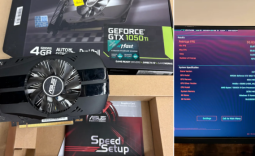 Redditor scores a working GTX 1050 Ti for just $2 at Goodwill
 Sony has secured enough memory to meet PS5 sales targets through March 2027 and says no further price hikes are planned
 Reddit is building a video and audio listening experience for the viral post format it accidentally created for TikTok
 Seagate says Mozaic 5 50TB hard drives are on track for 2027, with 100TB already on the roadmap
 Montech TG3 Mid-Tower Chassis Review
 ASUS ROG Strix X870E-A Gaming WiFI7 Neo Review - A New Enticing Option
 Noctua NL-LC1-36 Liquid CPU Cooler Review
 Logitech G316 X 98 Wired Gaming Keyboard Review - Retro-Inspired Board that Falls a Little Short
 Biwin M560 2TB SSD Review - Best Overall Retail-Ready DRAMless SSD
 Logitech G512 X 98 Analog Mechanical Gaming Keyboard Review - An Innovative Two-in-One
 Thrustmaster T.Flight HOTAS 5 MSFS Edition Review
 SteelSeries Arctis Nova Pro Omni Wireless Headset Review - One Headset to Rule Them All
 SteelSeries Arctis Nova 7 Wireless Gen 2 Headset Review - New and Improved, But Is It Enough?
 AMD Ryzen 7 7700X3D Review - Days of Future Past
 How to tell if someone has been using your Windows PC without your permission
 6 Task Manager tips for troubleshooting Windows performance problems
 ASUS ROG's 20th Anniversary Line-up of Premium PC Gaming Gear has Arrived - Here's Everything You Need to Know
 Six File Explorer tips every Windows user should know
 I switched my PC to encrypted DNS in Windows 11, and browsing felt more private
 Printer Not Working in Windows? How to fix detection, print queues and drivers
 The Ultimate Guide to Personalizing Your Windows 11 Taskbar
 How to Turn Your Windows Laptop Into a Second Monitor with Miracast and Wireless Display in Minutes
 6 Mistakes to Avoid When Buying a Windows Laptop
 I capped Windows Update's bandwidth with Delivery Optimization, and my downloads stopped choking