
Our Verdict
Pros
- Competitive gaming performance
- Excellent power efficiency
- Easy cooling requirements
- AM5 platform longevity
Cons
- Poor multithreading performance
- Low clock speed
- Limited appeal outside of gaming
Should you buy it?
Introduction, Specifications and Pricing
The PC landscape is in a tumultuous state. Ongoing RAM and storage shortages are forcing customers to reevaluate their purchase decisions, and gamers in particular have been badly hit. There is still demand though, and the release of the 'new' AMD Ryzen 7 7700X3D stands out as an entry-level gaming processor for the AM5 platform. Its purpose is to give gamers the benefits of a stacked X3D cache at a more attractive price point than 9000-series X3D chips.

The Ryzen 7 7700X3D is essentially a downclocked 7800X3D. It's built with the Zen 4 architecture with TSMC's 5nm process. It's a single CCD (Core Complex Die) 8-core/16-thread model with 64MB of stacked V-cache, which combined with the 32MB of cache within the CCD itself, gives a total of 96MB. Cache is historically very gamer-friendly. Many (but not all) games respond well to high-speed cache, which reduces the need to access system memory, providing latency benefits, particularly in CPU-bottlenecked games such as competitive shooters.
As the 7700X3D is a Zen 4 model, it's equipped with first-generation V-cache, as is the 5800X3D. The stacked cache is located atop the CCD as opposed to Zen 5 X3D chips, which place it underneath the CCD. This means AMD has to compromise on core clocks and TDP due to heat concerns. As we'll see, the 7800X3D thankfully has no such worries.
| CPU | Architecture | Socket | Cores | Threads | Base Clock | Boost Clock | L2 cache | L3 cache | TDP | Unlocked OC |
|---|---|---|---|---|---|---|---|---|---|---|
| Ryzen 9 9950X3D | Zen 5 | AM5 | 16 | 32 | 4.3 GHz | 5.7 GHz | 16 MB | 128 MB | 170W | yes |
| Ryzen 9 9900X3D | Zen 5 | AM5 | 12 | 24 | 4.4 GHz | 5.5 GHz | 12 MB | 128 MB | 120W | yes |
| Ryzen 7 9850X3D | Zen 5 | AM5 | 8 | 16 | 4.7 GHz | 5.6 GHz | 8 MB | 96 MB | 120W | yes |
| Ryzen 7 9800X3D | Zen 5 | AM5 | 8 | 16 | 4.7 GHz | 5.2 GHz | 8 MB | 96 MB | 120W | yes |
| Ryzen 9 7950X3D | Zen 4 | AM5 | 16 | 32 | 4.2 GHz | 5.7 GHz | 16 MB | 128 MB | 120W | no |
| Ryzen 7 7800X3D | Zen 4 | AM5 | 8 | 16 | 4.2 GHz | 5.0 GHz | 8 MB | 96 MB | 120W | no |
| Ryzen 7 7700X3D | Zen 4 | AM5 | 8 | 16 | 4.0 GHz | 4.5 GHz | 8 MB | 96 MB | 120W | no |
| Ryzen 7 5800X3D | Zen 3 | AM4 | 8 | 16 | 3.4 GHz | 4.5 GHz | 4 MB | 96 MB | 105 W | no |
| Ryzen 9 9950X | Zen 5 | AM5 | 16 | 32 | 4.3 GHz | 5.7 GHz | 16 MB | 64 MB | 170W | yes |
| Ryzen 9 9900X | Zen 5 | AM5 | 12 | 24 | 4.4 GHz | 5.6 GHz | 12 MB | 64 MB | 120W | yes |
| Ryzen 7 9700X | Zen 5 | AM5 | 8 | 16 | 3.8 GHz | 5.5 GHz | 8 MB | 32 MB | 65W | yes |
The 7700X3D comes with a base clock frequency of 4.0 GHz and a boost clock of 4.5 GHz. That compares to the 4.2 GHz base clock and 5.0 GHz boost clock of the 7800X3D. Both the 7700X3D and 7800X3D are otherwise identical, with a 120W TDP, 8MB of L1 cache, and support for PCIe 5.0 and dual-channel DDR5 memory.

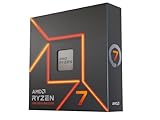
Best Deals: AMD Ryzen 7 7700X 8-Core
Price Trend:
Prices last scanned 4 hours and 57 minutes ago

7 days ago: $232 USD30 days ago: $230 USD

7 days ago: $329 USD
7 days ago: $334.99 CAD30 days ago: $339.98 CAD
7 days ago: $439.99 CAD
7 days ago: £188.9830 days ago: £199.99

7 days ago: $499
7 days ago: $399 AUD30 days ago: $399 AUD
If that boost clock seems low, you can play around with PBO and Curve Optimizer; however, traditional overclocking via the multiplier is not allowed. That's a shame as there is plenty of headroom. Zen 4 is easily capable of reaching well over 5 GHz, so you'll need to be prepared to lose a lot of performance in non-gaming workloads.
The 7700X3D is compatible with all AM5 motherboards after a BIOS update. The 7700X3D's low power requirements make it a good choice for pairing with an affordable B850 board. Even B650 and A620 boards will run it. You also get the advantage of guaranteed AM5 support from AMD for at least another two years, whereas Intel's Core Ultra 200S series is a one-and-done platform until the release of the Noval Lake family. That gives 7700X3D buyers an attractive upgrade path.
The AMD Ryzen 7 7700X3D's MSRP is $329, much lower than the 7800X3D's official $449 price. However, regular discounts often see that price drop well below $400. In time, I'm sure the 7700X3D will drop under $300.
Our Latest AMD CPUs Review Coverage
- AMD Ryzen 7 9850X3D Review - The best gaming chip just got better
- AMD Ryzen 9 9950X3D Review - The all-round X3D chip we've been waiting for
- AMD Ryzen 7 9800X3D Processor Review - All of the gaming goodness without compromise
- AMD Ryzen 9 9900X CPU Review
- AMD Ryzen 9 9950X CPU Review - Top Dog Zen 5 Tested
The Ryzen 7 7700X3D and Test System
Ryzen 7 7700X3D

The 7700X3D's package is on the large side, even though Ryzen CPUs no longer ship with a cooler.

Frequently Asked Questions
Open a question for an answer from TweakTown's coverage of this review, or ask your own below.
Which motherboards are compatible with the 7700X3D and is a BIOS update required?
How does the 7700X3D perform in multi-threaded productivity tasks like Cinebench, Blender, and Handbrake?
What are the 7700X3D's power consumption and temperature characteristics under load, and what cooling is recommended?
Given its MSRP and typical discounts mentioned, at what price point does the article consider the 7700X3D a particularly good value?
Have a question about this content not listed here? Ask below and TweakBot will answer it.


The chip comes with a small instruction booklet, a card with a QR code for more information, and a case sticker.

It's a bit of an odd thing to say about a CPU, but it looks good. Not that you'll ever see it once you place it under a cooler.

The backside offers 1718 socket pads, the same as all AM5 CPUs.
Test System
The key components of our test system were an ASRock X870E Taichi White, G.Skill Trident Z5 Neo RGB 2x16GB DDR5-6000, and an MSI RTX 4070 Ti Super graphics card.
- Motherboard: ASRock X870E Taichi White - Buy from Amazon
- GPU: MSI GeForce RTX 4070 Ti Super Ventus 3X - Buy from Amazon
- RAM: G.Skill Trident Z Neo RGB 2x16GB DDR5-6000 CL30 - Buy from Amazon
- Cooler: Cooler Master MasterLiquid PL360 Flux - Buy from Amazon
- OS Storage: Teamgroup T-Force Z540 2TB - Buy from Amazon
- Power Supply: Super Flower Leadex Titanium 850W - Buy from Amazon
- OS: Microsoft Windows 11 Pro - Buy from Amazon
Benchmarks - Rendering and Encoding
Cinebench 2024
Cinebench is a well-established rendering benchmark. It has two tests: a single-core workload that uses one thread (1T) and a multi-threaded test that uses all threads (nT) of a tested CPU.

The graphs showing multi-threading performance are going to be pretty bleak for the 7700X3D. It has a relatively low core count compared to the Intel chips, and of course, the newer Zen 5 chips pull away. It goes without saying that if you are coming from an AM4 chip, you'll see gains. Just not against this lot of chips.
Blender
A rendering application like Blender is just one of many reasons a user will consider a high-core-count CPU. We use the Whitelands demo file and record how long it takes to render the image.

If you're into content creation, the 7700X3D is not for you.
Handbrake
Handbrake is a simple-to-use video encoding and transcoding application. Here, we convert a 4K movie trailer to 1080p. The results below show the average FPS, where a higher result means the task will take less time to complete.

Ditto with Handbrake. Core count is king in these kinds of tasks.
Benchmarks - File Compression and Memory Latency
7Zip
7Zip is a commonly used free file compression and decompression app. It's susceptible to memory speed and latency changes and scales with the number of CPU threads.

Well, it's not at the bottom!
AIDA64 Memory Latency
Chiplet architectures inevitably add some latency compared to older monolithic designs. A nanosecond or two here or there is not noticeable, but larger margins, particularly when the memory is frequently accessed, will result in more undesirable, cumulative idle cycles. Arrow Lake chips perform poorly here.

Curiously, all of the X3D results are a touch behind those of the non-X3D chips. High memory latency can significantly impact gaming performance, but it matters less due to the 7700X3D's voluminous L3 cache. Fewer memory accesses are what V-Cache was designed for.
Benchmarks - 3DMark
3DMark Time Spy Extreme
Time Spy Extreme has lost favor as a graphics benchmark to Speed Way and Steel Nomad, but its CPU test remains a good measure of multi-core performance.

The Time Spy Extreme CPU test score is behind that of the 7800X3D, as expected.
Benchmarks - Gaming
Enough of that productivity and creative stuff. The 7700X3D is a gaming chip. Let's get to it.
Cyberpunk 2077
Cyberpunk 2077 is brutal on graphics cards, but when features like ray tracing are disabled, it becomes more sensitive to differences in CPU and memory performance.

Here, our RTX 4070 Ti Super is still GPU bottlenecked. It serves as an example of how virtually all modern CPUs are sufficient for gaming in graphically limited scenarios. Still, a little bit of CPU grunt helps. The X3D chips rule the roost.
Far Cry 6
Far Cry 6 is an example of a game that exhibits CPU bottlenecking with powerful graphics cards.

The important takeaway here is how much faster the 7700X3D is over the cache-less 7700X. Also, the high clock speeds of the Intel chips help in Far Cry 6.
Horizon Zero Dawn
Horizon Zero Dawn can achieve high frame rates with powerful graphics cards when using the Favor Performance preset.

Horizon Zero Dawn loves cache. If you're a gamer first and foremost, It's a good example of how X3D chips can really benefit certain games.
Metro Exodus Enhanced Edition
Metro Exodus received an update that improved DLSS support, enhanced ray tracing features, and variable rate shading, among other things. Still, with a powerful graphics card, CPU, and memory performance affects 1080p performance, though less so with a card like the RTX 4070 Ti Super.

It's a mid-pack result for the 7700X3D. It's clearly affected by clock speed here. At 5.0 GHz+, it'd definitely rise a few spots.
F1 22
F1 22 is not a particularly demanding title, and it doesn't need a high-end graphics card to enjoy smooth frame rates. We tested at 1080p with high settings.

It's not a bad result for the 7700X3D, though it's one of those games that shows Intel's Arrow Lake CPUs are not always duds when it comes to gaming.
Benchmarks - Power Consumption and Temperatures
Power
The 7700X3D has a 120W TDP and 162W maximum socket power (PPT) limit. A Cinebench looping test showed the 7700X3D not even getting close to that 162W limit. It makes me wonder why AMD gave the chip a 120W TDP. With a boost clock of 4.5GHz, it just doesn't require that much power.

Though the peak result doesn't provide the full context of a CPU's efficiency across a variety of workloads, a full-load reading of 77W is exceptional. It's the 7700X3D's greatest strength.
Temperatures
It goes without saying that temperature results heavily depend on your cooler's capabilities, case airflow, and ambient temperature. We aim to maintain a constant ambient temperature of 22 degrees Celsius for temperature testing.

A peak temperature reading of 73 degrees is quite a jump over the 9700X, but it is still a very good result given the stacked V-cache's heat-retaining characteristics. Any decent cooler will handle a fully loaded 7700X3D.
Final Thoughts
When the 7800X3D launched in April of 2023, it was the ultimate gaming chip, and the 7700X3D is simply a downclocked 7800X3D. 3 years is a long time in the tech world though, and apart from the release of new architectures, the big story is the rise of AI, consumer memory and storage shortages, and the gobbling up of manufacturing capacity. The leading nodes are all booked for AI and enterprise products.
The 7700X3D is built with TSMC's 5nm process, meaning it's not competing for bleeding-edge capacity. So, why not reach into the goodie bag and give gamers something more affordable? If nothing else, it lets buyers divert some money away from the more expensive 9000X3D chips and allocate it to memory and storage. AMD deserves some credit. The 7700X3D is a viable option for long-suffering gamers.

Alongside strong gaming performance, the 7700X3D's highlight is its stunning power efficiency. It's the kind of chip you can pair with a B650 board without any issue. It won't stress the VRM of budget boards, and it doesn't require a high-end AIO to cool it. That's the real takeaway from this chip. It's an excellent option for gamers looking to minimize overall platform cost.
But that power efficiency comes at a performance cost. The 7700X3D is not an all-round wonder chip. Its clockspeed constraints and relatively low core count make it a poor option for creative-type tasks. It'll be perfectly fine for day-to-day multitasking, but the Core Ultra 200S series - and particularly the Plus refresh models - are far superior at those kinds of tasks.
Then again, the 7700X3D is an AM5 chip. And the platform has years of life ahead of it. You could buy a 7700X3D right now with some basic RAM, and upgrade to a Zen 6 X3D model and faster RAM in the future (which will hopefully be cheaper). It's a major consideration when comparing it to a Core Ultra Plus chip.
The 7700X3D's MSRP of $329 is reasonable, but perhaps a little high. If that drops under $300, then the 7700X3D obviously becomes more attractive. At $269 or so, it becomes a very attractive option. That might happen as we come towards the Thanksgiving and pre-Christmas sales.
How do we sum up the Ryzen 7 7700X3D? It all comes down to what you use your PC for. The 7700X3D is a gaming chip, but really a gaming chip only. It's also important to remember that an X3D chip only shows its strength with a high-end graphics card or in games that require hundreds of FPS on a high-refresh-rate monitor. The Core Ultra 270K Plus is far better for creative workloads.
But factor in the 7700X3D's power efficiency, the AM5 socket's upgrade path, and its low system requirements, and the 7700X3D is recommended. A price drop would make it even better. Just be aware of its limitations in non-gaming workloads.