







Learn about how TweakTown tests and reviews hardware. As an Amazon Associate, we earn from qualifying purchases. TweakTown may also earn commissions from other affiliate partners at no extra cost to you.
Stay Updated
Follow TweakTown for breaking tech news, reviews, and daily updates.


Apple reportedly rushing a software update out to fix Wi-Fi and other issues
Apple is reportedly getting a new software update ready that the company hopes will deal with a couple of niggling issues that it has so far been unable to deal with.

The new software update, set to be called iOS 16.4.1, is said to be in the works. That's according to a Twitter leaker who has a reasonable track record when sharing details about unannounced software updates. They have a protected Twitter account, but MacRumors reports that they believe that iOS 16.4.1 is incoming, although no hard release date has been shared.
With that being said, given the relatively small software number change and the nature of the update we expect Apple to release iOS 16.4.1 sooner rather than later. The update will likely arrive later this week or next week, but Apple and iPhone users will no doubt want it to be the former.
AMD Ryzen 7 7800X3D leak shows a CPU that could seriously worry Intel
AMD's Ryzen 7 7800X3D is on the cusp of being launched - it hits shelves on April 6 - and a fresh leak (following a more pedestrian piece of recent spillage) shows it outguns Intel's Core i9-13900K, the heavyweight Raptor Lake processor.

This leak comes from AMD itself and takes the form of a presentation slide that VideoCardz got hold of (which looks authentic enough, but as ever, remain cautious about anything from the rumor mill).
The slide shows that the 7800X3D is up to 30% faster for frame rates in one game AMD benchmarked, although the average is much lower than this at (up to) 7% - this is at 1080p resolution (with high graphics details).
Continue reading: AMD Ryzen 7 7800X3D leak shows a CPU that could seriously worry Intel (full post)
Google's take on AirDrop is now out for Windows 11 and Android users
Google's Nearby Share feature is getting a new lease of life with the release of a beta app for Windows that allows for whizzing files across from Android phones (and tablets) to your desktop PC.

Nearby Share has actually been kicking around in Google's ecosystem for a few years now, facilitating file transfers between Android devices and Chromebooks, so it's good to see it debut with Windows 11 and 10 (if only in beta).
It's easy enough to use the Nearby Share app. Fire it up - the client can then be left running in the background - and you can send files (or links) from your Android device to the app on the Windows desktop simply by selecting the 'Nearby Share' option and then tapping on the destination PC.
Continue reading: Google's take on AirDrop is now out for Windows 11 and Android users (full post)
Windows 11 won't help desktop PC users make savings with utility bills after all
Windows 11 was supposedly testing a new ability designed to help desktop PCs make a bit of savings with power usage, but it turns out that this functionality was not introduced at all.

The Content Adaptive Brightness Control (CABC) feature was expanded to include not just laptops on battery power, but also notebooks that were plugged in, and desktop PCs too. Or that's what Microsoft told us when preview build 23424 of Windows 11 was rolled out (in the Dev channel).
The feature cleverly adjusts areas of the display to dim them appropriately, saving a little power with no noticeable difference to the overall quality of the image on the screen.
Weird pancake-like cosmic explosion called 'the cow' is unexplainable
New research has been published about a very strange explosion that was detected in 2018. This explosion stunned astronomers when it was discovered, as it was pancake-shaped rather than spherical.

This particular explosion was the very first detected fast blue optical transient (FBOT) explosion, which is currently a grey area for astronomers, as only four others have been detected since the 2018 event officially known as AT2018cow, or the Cow. What is known is that this explosion occurred 180 million light years away from Earth and was approximately the size of the entire solar system.
Additionally, an FBOT explosion behaves very differently when compared to the most typical type of space explosion, a supernova, which happens when a star runs out of its fuel and begins to collapse under its own gravity. A supernova explosion is typically spherical or round, while research suggests that the Cow, or these explosions in general, are more flattened and disk-shaped.
Continue reading: Weird pancake-like cosmic explosion called 'the cow' is unexplainable (full post)
Student uses ChatGPT to write 'perfect letter' to get parking ticket overturned
A student received a $74 parking ticket from local police, and they turned to OpenAI's ChatGPT for help to get it overturned.

The 22-year-old student is Millie Houlton, who is attending York St John University in England when she noticed a parking ticket on her vehicle written by the police for not displaying a permit to park in the location her vehicle was in. Houlton turned to OpenAI's ChatGPT for assistance, and according to reports, she asked the AI, "Please help me write a letter to the council, they gave me a parking ticket."
For those that don't know, chatbots such as OpenAI's ChatGPT or Microsoft's Bing Chat are designed to provide human-like responses to almost any question by scraping a large dataset of information developers have fed them. Users can ask these chatbots almost any question, including legal advice, but the responses can vary in quality depending on the provided information, and according to OpenAI, ChatGPT can even produce "plausible-sounding but incorrect or nonsensical answers".
NASA collided a spacecraft into an asteroid and here's what it achieved
NASA's Double Asteroid Redirection Test (DART) was a success, and according to the space agency, the entire mission was a "great success".

DART was the world's first planetary defense mission, as the objective was to see if it was possible to change the orbit of a binary asteroid system. The target of the mission was the smaller of the two asteroids, Dimorphos, which is orbiting its larger companion asteroid, Didymos. NASA selected this system as it's very well documented by astronomers, with orbits, velocities, and other variables already verified. The goal was to see if a vending machine-sized spacecraft traveling at extremely high speeds was capable of altering the orbit of Dimorphos.
The mission was a smashing success as DART collided with the surface of the 530-foot-wide asteroid Dimorphos on September 26, 2022, and was watched by many space and ground-based telescopes on Earth. In the weeks following the collision, DART researchers began analyzing the data and only recently presented the agreed-upon results at the 8th Planetary Defense Conference in Vienna, Austria, on Monday, April 3.
New Google Flights feature pays ticket buyers if prices change
Google testing whether it's come up with a solution to not knowing when is the best time to buy plane tickets, as the price can sometimes fluctuate drastically.

Most people have been in the situation where they aren't sure whether now is a good time to pay for the tickets for an upcoming trip or if it would be better to wait a few more days to potentially save some money. Google believes its come up with a solution that is an extension of its already implemented price tracking feature on Google Flights. Introducing Google's 'Price Guarantee', a new feature that has just gone into a new pilot program across the US.
Google's new feature adds a new Price Guarantee badge that will appear next to an available flight. The badge represents Google's guarantee that the price you are looking at when you see the badge won't go lower than the current figure. Google believes this new feature will enable users to confidently purchase tickets without worrying that within the days leading up to their departure, their flights will suddenly become cheaper.
Continue reading: New Google Flights feature pays ticket buyers if prices change (full post)
NASA names the next astronauts headed to the Moon in more than 50 years
NASA has revealed the next astronauts that will be returning to the Moon as part of the space agency's Artemis II mission.

The space agency took to all of its social media channels to announce the NASA and Canadian Space Agency (CSA) astronauts that have been chosen for the very first of NASA's crewed missions on the long road to establishing a long-term and sustainable presence on the surface of the Moon. NASA's Artemis I mission was a success, with the space agency's Orion spacecraft even conducting additional observations after completing all of its primary mission objectives.
Much like NASA's Artemis I mission, Artemis II is a reconnaissance mission and won't feature any landing on the surface of the Moon (as Artemis I was uncrewed). Instead of skipping ahead to landing on the Moon, NASA has opted for gathering as much data as possible about the spacecraft's systems, which include its sensors, instruments, temperatures, communications, cameras, and more. All of this data is used to make lunar trips safer and more efficient for astronauts. Artemis II will be NASA's first crewed mission back to the Moon in more than 50 years.
Someone tricked ChatGPT into becoming a keygen, creating usable Windows 95 keys
There's no real mystery surrounding the Windows 95 activation key; it uses a format known and cracked for decades. Generating usable Windows 95 keys isn't exactly something you'd do in 2023 unless you're formatting an old beige desktop PC from 1995 just for fun.

And in that spirit, someone managed to trick ChatGPT into generating Windows 95 keys after being told that as an AI language model, it cannot generate a Windows 95 key or any other type of activation key for proprietary software. As Windows 95 is now abandonware, ChatGPT suggests upgrading to a newer version.
The trickery comes from the fact that the Windows 95 key follows a simple-to-follow pattern of day and year info and sums of random numbers divisible by seven. And with that, YouTuber Enderman proceeds to get ChatGPT to generate a string according to these specific rules.
Intel has reportedly put in big orders with TSMC for next-gen Arc GPUs
The Intel Arc range of discrete GPUs released by Intel may have had a rocky launch. Still, recent driver updates have now positioned the Intel Arc A750 as an affordable entry-level option for high-performance 1080p gaming. And with only two players in the GPU space until now (NVIDIA and AMD), a third means more competition, especially when it's a company as large as Intel.

And speaking of large, a new report at the Taiwan-based publication Commerical Times (via Tom's Hardware) notes that Intel is placing large orders for silicon for next-generation Intel Arc graphics cards at TSMC. The follow-up to the current Alchemist range is dubbed Battlemage, and these GPUs will use the TSMC 4nm process, with the next-next-gen Celestial architecture GPUs set to use the cutting-edge TSMC 3nm process.
Though, the planned launch for these GPUs will arrive later than expected, with Battlemage set to arrive in the second half of 2024 and Celestial in the second half of 2026.
Continue reading: Intel has reportedly put in big orders with TSMC for next-gen Arc GPUs (full post)
be quiet! Light Wings White ARGB fans introduced, and yes, these have blades
That little note about fans in the headline is in reference to be quiet!'s fun little April Fools announcement from the other day, all about a new range of PC fans powered by AI without fan blades.

The acclaimed German manufacturer of PC components has brought things back to reality and listened to community feedback with the announcement that the impressive be quiet! Light Wings ARGB fans are now available in white.
White PC components are becoming increasingly popular, making the Light Wings White range a great option for white PC Cases. These are basically the same Light Wings that we know, but now in white - so they feature the same high-performance, low-noise operation with funky ARGB lighting thanks to the stylish LED ring on the fan's inlet.
ASUS ROG Ally is a Steam Deck competitor that will offer double the performance
Anything announced on April 1 is met with skepticism, but it turns out that the ASUS ROG Ally handheld is real and is being positioned as a direct competitor to Valve's Steam Deck.

Although full details are unavailable, ASUS has confirmed that the ROG Ally is Windows 11-powered handheld PC that will ship with the fastest AMD APU built on a custom 4nm process with Zen 4 and RDNA 3 architecture.
The handheld will sport a Full HD (1080p) display with a 120 Hz refresh rate and a peak brightness of 500 Nits. The handheld is smaller and lighter than Valve's Steam Deck, with dimensions of 280mm x 133mm x 39mm and a weight of 608 grams. For comparison, the Steam Deck weighs 669 grams and features dimensions of 298mm x 117mm x 50.5mm. Plus, its display is limited to 800p (16:10) with a refresh rate of 60 Hz.
Western Digital storage expansion for Xbox Series consoles has appeared online
The new WD_BLACK C50 Expansion Card for Xbox Series X|S was briefly listed on US-based retail outlet BestBuy before being taken down, marking the potential end of Seagate exclusivity on storage expansion for Microsoft's current-gen consoles.

Unlike the PlayStation 5, which supports a wide range of PCIe Gen4 SSDs for storage expansion, the Xbox Series X|S launched in 2020 with Seagate expansion cards that offered plug-and-play storage expansion with SSD speeds similar to the internal storage.
At the time, this was seen as a positive because capable Gen4 drives for the PS5 were prohibitively expensive, and Sony had not yet made expansion possible in the console's firmware and OS. Cut to 2023, and the story is very different. Expanded storage options for PS5 are plentiful, affordable, and open to all manufacturers that meet the required spec and cooling.
Spotify is shutting down its Clubhouse wannabe Spotify Live
In a move that will surprise almost nobody, music streamer Spotify is shutting down its live audio app Spotify Live. The move comes two years after the company bought the app in its original form, dubbed Locker Room.

Spotify confirmed that it is killing the app off in an email to users that was first reported by Music Ally.
Spotify Live was part of an industry-wide focus on live audio that was kicked into gear by the COVID-19 pandemic in 2020. That's when Clubhouse shot to prominence as a way for people to interact in voice-based rooms even when they weren't able to do so in person. Ongoing COVID-19 lockdowns around the world left people looking for ways to connect, and Clubhouse offered that.
Continue reading: Spotify is shutting down its Clubhouse wannabe Spotify Live (full post)
Apple reportedly still on track to launch Reality Pro headset at WWDC in June
Apple is still expected to announce the Reality Pro mixed reality headset during the WWDC23 event on June 5, according to a new report by Bloomberg's Mark Gurman.

Writing in the weekly Power On newsletter, Gurman said that Apple is still on track to announce the new headset despite previous reports suggesting that the launch could be pushed back.
It was thought that Apple employees were concerned that the headset could suffer a false start thanks to a high price - around $3,000 - and technical specification challenges including just two hours of battery life and heavy construction. But Gurman says that Apple is still good to go.
Spotify swears it hasn't forgotten about AirPlay 2
Spotify says that it's still planning on adding AirPlay 2 support to its streaming app, but hasn't actually said when that will happen yet. The skeptics out there would suggest that they've heard this all before and that Spotify has little intention of actually following through.

The news came in an interview with Bloomberg's Mark Gurman as part of his weekly Power On newsletter. Gurman was discussing the fact that Spotify still doesn't fully support the HomePod or HomePod mini despite making plenty of noise about perceived problems with Apple's ecosystem.
After Apple opened the HomePod up to allow third-party streaming services to function properly with Siri back in 2020, many of those services took advantage of that move. But Spotify is the notable exception. Interestingly, Spotify claimed that the company didn't receive many requests for HomePod support. That despite a complaint about the lack of HomePod support on the company's own forums having more than 5,800 likes.
Continue reading: Spotify swears it hasn't forgotten about AirPlay 2 (full post)
AMD Zen 5 leaks can't agree on how fast Ryzen 8000 CPUs might be
AMD's Zen 5 processors have just been the subject of a couple of fresh leaks, although this latest spillage - from two well-known YouTube leakers - can't agree on how fast these next-gen CPUs could be.

The YouTubers in question are Moore's Law is Dead (MLID, see the video above) and RedGamingTech (RGT, see the video below), both of whom have provided pretty big info dumps on Zen 5 (likely to be Ryzen 8000 CPUs, though we don't know that for sure).
We're told via these leaks that Zen 5 could be made on both 4nm and 3nm processes at TSMC, with desktop chips set to use 4nm apparently, and 3nm will be for some APUs (others will be 4nm) and also next-gen server chips.
Continue reading: AMD Zen 5 leaks can't agree on how fast Ryzen 8000 CPUs might be (full post)
Opinion: Xbox Game Pass is indeed disruptive, and that's not a bad thing
Microsoft's indie game program director Chris Charla believes Xbox Game Pass is additive, and not disruptive. We think otherwise, and here's why.

The games industry typically moves at a slower pace than the breakneck speed of the tech sector. Making games is a slow process, and by the time developers try to capture the latest trend, gamers could have moved on to something else. These trends have led to significant disruption points that evolved the industry from boxed retail games in the old days to a thriving billion-dollar digital landscape where players are always online, always engaged, and always buying.
One of the most noteworthy disruption points of the modern video games era is the rise of multi-game subscriptions. The concept of leasing access to players for a reduced fee is attractive to platform-holders, who make long-term revenues, and players, who pay less to play games. A new way to monetize consumers was born and the industry hasn't looked back.
Windows 11 is now on 1 in 5 PCs - but adoption remains painfully slow
Windows 11 has just sneaked over the 20% milestone for desktop OS market share, according to new stats from an analytics firm.

Statcounter has provided the figures on Windows adoption for March 2023 in which Windows 11 increased its share by 1.81%, ending up on 20.94%. Microsoft's newest OS is therefore on just over 1 in every 5 PCs out there.
Windows 10 also crept up a small amount, putting on 0.17%, so it's now on 73.48% of all PCs out there, going by Statcounter's estimations. (And remember - this is just one set of figures).
Continue reading: Windows 11 is now on 1 in 5 PCs - but adoption remains painfully slow (full post)
 VPS vs. Shared vs. Dedicated Hosting: Which One Actually Fits a UK Power User in 2026?
 Qualcomm is raising chip prices from September 1, and Android phones could get more expensive
 Google's AI patched more Chrome bugs in two releases than it had in two years, including a 13-year-old flaw
 A missing underscore in a Skyrim-inspired username sent an innocent man to prison for 18 months
 Microsoft improves Windows 11 optimization for PCs with 8GB RAM
 Steam Deck LCD battery returns to iFixit, but costs $50 more now
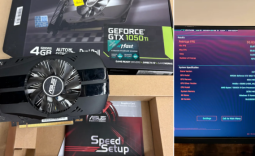 Redditor scores a working GTX 1050 Ti for just $2 at Goodwill
 Sony has secured enough memory to meet PS5 sales targets through March 2027 and says no further price hikes are planned
 Reddit is building a video and audio listening experience for the viral post format it accidentally created for TikTok
 Seagate says Mozaic 5 50TB hard drives are on track for 2027, with 100TB already on the roadmap
 Montech TG3 Mid-Tower Chassis Review
 ASUS ROG Strix X870E-A Gaming WiFI7 Neo Review - A New Enticing Option
 Noctua NL-LC1-36 Liquid CPU Cooler Review
 Logitech G316 X 98 Wired Gaming Keyboard Review - Retro-Inspired Board that Falls a Little Short
 Biwin M560 2TB SSD Review - Best Overall Retail-Ready DRAMless SSD
 Logitech G512 X 98 Analog Mechanical Gaming Keyboard Review - An Innovative Two-in-One
 Thrustmaster T.Flight HOTAS 5 MSFS Edition Review
 SteelSeries Arctis Nova Pro Omni Wireless Headset Review - One Headset to Rule Them All
 SteelSeries Arctis Nova 7 Wireless Gen 2 Headset Review - New and Improved, But Is It Enough?
 AMD Ryzen 7 7700X3D Review - Days of Future Past
 How to tell if someone has been using your Windows PC without your permission
 6 Task Manager tips for troubleshooting Windows performance problems
 ASUS ROG's 20th Anniversary Line-up of Premium PC Gaming Gear has Arrived - Here's Everything You Need to Know
 Six File Explorer tips every Windows user should know
 I switched my PC to encrypted DNS in Windows 11, and browsing felt more private
 Printer Not Working in Windows? How to fix detection, print queues and drivers
 The Ultimate Guide to Personalizing Your Windows 11 Taskbar
 How to Turn Your Windows Laptop Into a Second Monitor with Miracast and Wireless Display in Minutes
 6 Mistakes to Avoid When Buying a Windows Laptop
 I capped Windows Update's bandwidth with Delivery Optimization, and my downloads stopped choking