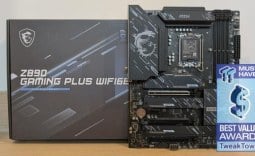

Our Verdict
Pros
- Lots of fast USB ports
- Very good cooling
- Fast memory support
- Dual PCIe 5.0 M.2 and external clock generator
- Refined and visually appealing BIOS
Cons
- 160MHz WiFi 7 only
- No front USB PD support
- It's pricey
Should you buy it?
Introduction, Specifications, and Pricing
With many months to go until we come to the launch of AMD's Zen 6 CPUs and accompanying 900-series chipsets, ASUS has stepped up and released several refreshed Neo boards, indicating there's plenty of life in the X870 chipset yet. Generational features such as DDR6, PCIe 6.0, and USB5 are years away and won't be present on 900 series motherboards, so buying a high-spec X870E board now is certain to remain relevant for years to come.
We have the ASUS ROG Strix X870E-A Gaming WiFi7 Neo up for review (motherboard companies should omit WiFi from product names - they all have it). It's a feature-rich board with a white/silver design theme. It's got a great set of connectivity options, including 5G LAN, WiFi 7, lots of USB, including dual USB4, dual PCIe 5.0 M.2 slots, and a 64MB BIOS ROM with an integrated WiFi driver. It's an overclocking-friendly board with an external clock generator that isolates the CPU base clock from memory, PCIe, and the Infinity Fabric, allowing for finely tuned overclocks.
Popular Now: Linus Tech Tips leaks Steam Frame first impressions, and Valve may be working on native Half-Life: Alyx support| Item | Details |
|---|---|
| Model | ASUS ROG Strix X870E-A Gaming WiFi7 Neo |
| CPU Socket | AM5 |
| Chipset | AMD X870E |
| CPU Support | AMD 7000, 8000 & 9000 series |
| Memory | 4x DDR5 DIMM slots, up to 256GB, up to 9600 MT/s (OC) |
| Expansion slots | 1x PCIe 5.0 x16, 1x PCIe 4.0 x16 |
| Storage | 4x M.2, 4x SATA |
| Ethernet | Realtek RTL8126 5Gb |
| Wireless & Bluetooth | MediaTek MT7925 WiFi 7, Bluetooth 5.4 |
| USB | Up to 2x USB4, 1x USB 20Gbps, 6x USB 10Gbps, 9x USB 5Gbps, 6x USB 2.0 |
| Audio | Realtek ALC4080 |
| Form Factor | ATX |
| MSRP | $469 |
The Strix X870E-A Neo supports AMD AM5 Ryzen 7000, 8000, and 9000 series CPUs. It supports up to 256GB of memory at 9600 MT/s+. It comes with a range of ease-of-use features, including a toolless primary M.2 heatsink, a PCIe quick-release mechanism, and a Wi-Fi EZ-plug. It's also got ASUS's Q-Connector, which is used for connecting select ASUS AIO coolers.
The board is available for $469. That puts it in the middle of some strong competition, though it's well below the price of the cheapest ROG Crosshair boards. But it's a good option for buyers looking for a light-coloured ASUS board with all but the highest-end trimmings.
Packaging, Accessories, and Overview
Packaging and Accessories

The busy-looking X870E-A Neo's box has a sticker with a link to ASUS's cloud storage platform.

Best Deals: ASUS ROG Strix X870E-A Gaming WiFI7 Neo
Price Trend:
Prices last scanned 4 hours and 10 minutes ago

7 days ago: $461.99 USD30 days ago: $469.99 USD

7 days ago: $448 USD30 days ago: $479.99 USD
7 days ago: $649.99 CAD30 days ago: $649.99 CAD
7 days ago: $673.45 CAD30 days ago: $672.23 CAD
7 days ago: £797.06

7 days ago: $85930 days ago: $859

The rear of the box is jammed with all of the board's key specifications, features, and compliance logos.

The board comes with a comprehensive set of accessories. The 60mm memory cooling fan is a handy inclusion. Zen 6 is expected to add full CUDIMM support, and some extra memory cooling won't go astray.
Our Latest Socket AM5 Review Coverage
- GIGABYTE B850M AORUS Stealth Ice Review - One for the cleanest of builds
- GIGABYTE B850 AORUS Elite X3D Review - B850 maxed out
- ASRock X870E Taichi White Review: a premium AM5 motherboard with 10G LAN and WiFi 7
- GIGABYTE X870E Aero X3D Dark Wood Review - A woody goody
- ASUS TUF Gaming X870-Pro WiFi7 W NEO Review - Tuffed up
There are the expected SATA cables, M.2 bits and pieces, and a keychain. The board doesn't include a thumb drive with utilities and drivers, so you'll have to visit the ASUS site to get these, or rely on the Armory Crate app.

Frequently Asked Questions
Open a question for an answer from TweakTown's coverage of this review, or ask your own below.
Which CPUs are supported by the ASUS ROG Strix X870E-A Gaming WiFi7 Neo?
How many M.2 and SATA drives can I install on the X870E-A Neo, and which M.2 slots support PCIe 5.0?
What USB ports and USB Power Delivery capabilities are available on the rear I/O and headers?
What cooling features and temps did the review report for the VRM and M.2 areas under load?
Have a question that isn't listed here? Ask below, and TweakBot will answer it.


Next up is a quick-start guide, some stickers, and more information on ASUS's WebStorage platform. The WiFi antenna is adjustable and well-built. It connects to the rear I/O via a simple insertion mechanism.
Motherboard Overview

The X870E-A Neo, like many ROG boards, has a busy design with extensive silk screening and branding across the board. Looks are subjective, but I have to say I'm not really a fan of the pixellated look of the RGB section atop the I/O shroud. I prefer a simpler design, though of course, others may love its retro appeal. There's no denying that white-themed boards look fantastic when showcased in a well-lit ARGB case, and the board includes three ARGB headers.
The USB header complement is very good, offering a range of options to suit your case. There are headers supporting up to six USB 2.0 ports, five USB 5Gbps ports including a single Type-C, and a single Type-C 20Gbps port. The USB-C ports lack official PD support, though they can deliver up to 15W by default. USB 2.0 headers can be used for things like AIO powering and monitoring, and it's better to have too many than not enough.
The X870E-A Neo, like several other Neo boards, includes a bank of metal pads between the CPU socket and memory slots. ASUS calls it the AIO Q-Connector. It's compatible with ROG Strix LC IV series AIO CPU liquid coolers. It omits the need for power, LCD control, and ARGB cabling. It also powers radiator fans, making it a great way to remove cables for the cleanest build. It's a clever solution. If only such a feature could become standardized across the industry.
The board includes 8 fan headers, a thermistor header, a PCIe mode switch, a CPU overvoltage jumper, and a power button. Curiously for a board at this price, a debug LED readout is omitted.
The X870E-A Neo includes a 64MB BIOS ROM, which is now common among refreshed 800 series boards. AMD has confirmed that AM5 will remain supported for many years to come, much as AM4 still is 10 years after its launch. There's enough space to include a WiFi driver, negating the need to download a driver from another device and then transfer it to the new PC.
Builder-friendly features are all the rage. The X870E-A Neo includes many of them. In addition to the aforementioned AIO Q-Connector, the board includes M.2 heatsink quick-release mechanisms, a tool-free M.2 slide for easy switching between 2280 and 2242 M.2 drives, M.2 Q-Latches, PCIe quick release, and one-click WiFi antenna installation.

Four DIMM slots support up to DDR5-9600+ speeds with an 8000 series APU. ASUS claims its NitroPath memory technology delivers up to 400 MT/s faster speeds with these optimizations. With Zen 6 near certain to include a new I/O die and CUDIMM support, there's every chance the X870E-A Neo will be able to hit DDR5-10000 or more with a capable memory kit, though only time will tell.
It's always worth mentioning that for Zen 5, AMD recommends memory in the 6000-6400 MT/s range in 1:1 mode for the best balance of speed, latency, and compatibility.

The board offers two PCIe x16 expansion slots. The primary slot supports PCIe 5.0 x16, while the other supports PCIe 4.0 at up to x4 electrically.
The X870E-A Neo supports up to four M.2 SSDs, with two supporting PCIe 5.0 and two supporting PCIe 4.0. The primary slot supports PCIe 5.0 x4 drives and is cooled by a dedicated heatsink. A single large plate cools the other three slots. It's independent of the heatsink used to cool the dual X870E chipset.
Due to lane restrictions, there is an inevitable lane-sharing compromise when a board includes dual PCIe 5.0 slots, as the X870E-A Neo does. The second PCIe 5.0 M.2 slot (M.2_2) and the USB4 ports share bandwidth. If the M.2_2 slot is occupied, it runs in x2 mode. You can switch it to x4 mode in the BIOS, but this will disable the USB4 ports.
Four SATA ports join the four M.2 slots.

The primary M.2 heatsink has a large surface area, and it attaches with a well-designed toolless mechanism. It performs very well in practice.
A single large plate cools the other M.2 slots. It features a toolless mechanism for easy access. However, it goes without saying that you'll need good case airflow if you populate all three of these slots, particularly if you have a high-TDP triple-slot graphics card.

The X870E-A Neo features a solid 16+2+1-phase VRM with 90A stages. Ryzen 9 chips are not extreme power guzzlers, and it is more than sufficient, even for overclocking. Unless future Zen chips come with a shocking increase in power consumption (bearing in mind such chips need to run on A- and B-series boards too), it's safe to say the X870E-A Neo won't have any problem powering high core count next-generation chips.
I was very impressed with the VRM cooling performance of the X870E-A Neo. The VRM heatsinks provide a lot of surface area, with deep channels. I thought the RGB area atop the rear I/O might impact cooling by a few degrees, but with a full load result of just 54 degrees, any concerns were dispelled.

The rear I/O of the X870E-A Neo stands out thanks to its high-speed USB port complement. It starts with dual USB4 Type-C ports, both of which support DP 1.4a. They are joined by six 10Gbps ports and four 5Gbps ports, giving you 12 in total. One of the six 10Gbps ports is Type-C, which supports up to 30W USB PD. That's a welcome inclusion given the front USB-C ports don't support PD.
A Realtek RTL8126 controller provides a single 5G LAN port. The MediaTek MT7925 WiFi 7 controller supports 160 MHz connections only.
Next are the audio ports, which consist of 3.5mm line-in and line-out ports and S/PDIF. A Realtek ALC4080 codec drives these. ASUS added additional circuitry, including a Savitech SV3H712 amp and dedicated audio capacitors.
Finally, there's a single HDMI port, CMOS clear, and BIOS flashback buttons. Overall, the board offers a strong set of connectivity options.
UEFI and Test System
UEFI


ASUS has overhauled the UEFI design on its Neo motherboards. The EZ Mode page includes almost all the settings a set-and-forget type user will need. It's easy to read and provides instant access to important monitoring and fan control settings without having to navigate to the advanced pages.
The new Essential Mode page bridges the gap between EZ mode and the more difficult-to-navigate Advanced section. Here, users can access features such as PBO settings, CPU core ratio, and memory frequency.
ASUS ROG BIOSes are typically jam-packed with features, and the X870E-A Neo is packed with esoteric settings to tweak.
Sadly, the Q-Dashboard page is missing, which listed the important headers and ports and whether they've been populated. It was useful for troubleshooting.
I am always thankful to ASUS for its wonderfully designed Q-Fan control page, which offers several automatic options or can be fully customized, even allowing you to set fan curves based on a thermistor sensor.
Test System
- CPU: AMD Ryzen 9 9950X - Buy from Amazon
- GPU: MSI GeForce RTX 4070 Ti Super Ventus 3X - Buy from Amazon
- RAM: G.Skill Trident Z Neo RGB 2x16GB DDR5-6000 CL30 - Buy from Amazon
- Cooler: Cooler Master MasterLiquid PL360 Flux - Buy from Amazon
- OS Storage: Teamgroup T-Force Z540 2TB - Buy from Amazon
- Power Supply: Super Flower Leadex Titanium 850W - Buy from Amazon
- OS: Microsoft Windows 11 Pro - Buy from Amazon
Benchmarks - Rendering and Encoding
Cinebench 2024
Cinebench 2024 is a reliable, widely used benchmark that measures both single- and multi-threaded performance. Note that all our benchmark testing used the latest available Windows updates.

A result of 2,295 in the nT test and 139 in the 1T test is right in the window of what a 9950X should score.
Blender
A rendering application like Blender is just one of many reasons a user might consider a high-core-count CPU, such as the Ryzen 9 9950X. We use the Whitelands demo file and record how long it takes to render the image.

Though the entire field is covered by only 9 seconds over the course of a test that takes over 7 minutes, it's better to be near the top rather than the bottom.
Handbrake
Handbrake is a simple-to-use video encoding and transcoding application. Here, we convert a 4K movie trailer to 1080p. The results below show the average FPS, where a higher value indicates the task will take less time to complete.

It's another strong result for the X870E-A Neo.
Benchmarks - File Compression and Memory Latency
7Zip
7Zip is a commonly used free file compression and decompression app. It's very sensitive to changes in memory speed and latency, and scales with the number of CPU threads.

It's another strong result for the X870E-A Neo.
AIDA64 Memory Latency
Memory latency has been an area where Intel has traditionally held an advantage. Chiplet architectures inevitably add some latency compared to monolithic chips. The real-world benefits aren't that important, though.

Default EXPO memory performance is not a problem for the X870E-A Neo, nor should it be given the maturity of the platform.
Benchmarks - 3DMark
3DMark Storage
UL's newest 3DMark SSD Gaming Test is the most comprehensive SSD gaming test ever devised. It is superior to testing against games themselves because, as a trace, it is much more consistent than variations that will occur between runs of the actual game.

It's another solid result for the X870E-A Neo.
3DMark Time Spy Extreme
Time Spy Extreme has lost favor as a graphics benchmark to Speed Way and Steel Nomad, but its CPU test is still a good measure of multi-core performance.

The differences in Time Spy Extreme are minor, with only a few hundred points separating them when measured by CPU score.
Benchmarks - Gaming
Cyberpunk 2077
Cyberpunk 2077 is brutal on graphics cards, but when things like ray tracing are removed, it becomes more sensitive to CPU and memory performance differences.

It's no surprise that the motherboard makes little difference in graphically limited scenarios, though a strong minimum FPS result is notable.
Horizon Zero Dawn
When using the 'favor performance' preset, Horizon Zero Dawn can achieve high frame rates with powerful graphics cards.

A solitary frame puts the X870E-A Neo in the top spot, though the differences here are negligible in percentage terms.
Metro Exodus Enhanced Edition
Metro Exodus received an update that added improved DLSS support, enhanced ray tracing, and variable rate shading, among other features. Still, with a powerful graphics card, it is affected by CPU and memory performance at 1080p, though less so with a card like the RTX 4070 Ti Super.

Just four frames per second cover the entire field in this test. Overall, the X870E-A Neo consistently scores highly in the gaming tests.
VRM and SSD Temperatures
These tests are performed to show off the differences between each motherboard's cooling assemblies. Each board is subjected to a 20-minute Cinebench loop, while the SSD test records the peak temperature during the lengthy 3DMark Storage test.

A peak temperature of 54 degrees is an excellent result for the X870E-A Neo. It outperforms some boards that cost a lot more, with only the finned X870E Godlike and ASRock X870E OCF beating it by the narrowest of margins.

ASUS has stepped up its game when it comes to its M.2 cooling. The X870E-A Neo is very close to the GIGABYTE boards.
Final Thoughts
The ASUS ROG Strix X870E-A Gaming WiFi7 Neo doesn't have a direct predecessor, though the X870-A comes close. While it is ostensibly a refresh motherboard, it can be considered a new model.
The Strix X870E-A Neo, like the other Neo boards, includes a set of features that won't be notably improved upon when next-generation motherboards arrive. Game-changing features such as USB5, PCIe 6.0, and DDR6 memory are several years away, making a feature-rich board like the X870E-A Neo a solid investment that will remain relevant for years to come - particularly if you're casting an eye towards Zen 6, or maybe even Zen 7.
The board features an impressive-looking white and silver theme, even though I think it's a bit busy looking compared to a board like the GIGABYTE X870E Aero Wood. But that's just me. Beauty is in the eye of the beholder. Looks aren't everything, and the X870E-A Neo has a lot to offer. Aesthetically and practically, I am very pleased with what ASUS has done with its refreshed UEFI. The inclusion of a WiFi driver is welcome, and the addition of the Essential Mode is a great bridge between the novice-friendly EZ page and the Advanced section, which can be overwhelming for some users.
The board performed well in our benchmarks, particularly the gaming tests. That's great if you plan to pair it with a high-performing graphics card. It's no slouch in other areas either. The board's cooling is excellent too, easily keeping our 9950X and PCIe 5.0 SSD cool at all times.

The Strix X870E-A Neo has a great set of connectivity and networking features. It's not perfect, as some competitors offer 320MHz WiFi 7 or front USB PD. There's a USB PD-supporting Type-C port at the back, so that's ok. With plenty of high-speed USB ports, the X870E-A is well-placed to serve as the hub for a gaming system with plenty of peripherals.
The four M.2 slots - two of which support PCIe 5.0 - mean it's a great option for users frequently shifting around large files. I think four M.2 slots is fine. Boards with extra slots end up having significant lane-sharing compromises, which the X870E-A mostly escapes.
At $469, the Strix X870E-A isn't a budget board, but it is competitive, and ASUS fans will be more than happy with it. If brand loyalty doesn't matter, then the GIGABYTE X870E AORUS Pro Ice and ASRock X870E Taichi White are strong alternatives. It all depends on what discounts are available on the day, too. With the X870E-A Neo, you know you'll get a reliable board that will happily house any components you care to name, including Zen 6 CPUs.
With its PCIe 5.0 SSD support, strong USB complement, 5G LAN, and support for fast memory, it ticks the key boxes. It takes a lot more money to get more. For example, the Crosshair X870E Dark Hero is well over $200 more. When viewed like that, the Strix X870E-A is good value.
In addition to a strong feature set, the ASUS ROG Strix X870E-A Gaming WiFi7 Neo delivers excellent performance and cooling, and with that said, it earns a TweakTown Best Performance Award.