







Learn about how TweakTown tests and reviews hardware. As an Amazon Associate, we earn from qualifying purchases. TweakTown may also earn commissions from other affiliate partners at no extra cost to you.
Stay Updated
Follow TweakTown for breaking tech news, reviews, and daily updates.


Doom creator John Romero making new FPS with online multiplayer
John Romero, the co-creator of gaming's most legendary first-person shooters like Doom, Quake, Wolfenstein, and Hexen, is returning to the world of FPS mayhem.

Today John Romero announced he is making a new first-person shooter built in Unreal Engine 5. Talk about a major return of the king moment. Sadly the new FPS won't be set in any established universe or series, so don't expect Romero to lead the charge on the next Doom, the brutal Wolfenstein 3 sequel, or the rumored Quake reboot.
The new FPS is being developed by Romero Games and will be set in a new all-original IP (kind of like Hexen, or even Daikatana). It will have online multiplayer elements across PC and consoles, according to Online Architect and Senior Multiplayer Programmer job listings.
Continue reading: Doom creator John Romero making new FPS with online multiplayer (full post)
PS5 game licensing issues cause headaches for paying PS Plus users
UPDATE: FF7 Remake Intergrade can now be claimed and downloaded by PS Extra and Premium subscribers.

Today Sony added Final Fantasy VII Remake Intergrade as a downloadable game for all PlayStation Plus Premium and Extra subscribers, but multi-SKU licensing issues have prevented some users from downloading the game.
Sony's PlayStation 5 game classifications have caused issues since the console's release. Unlike Microsoft's Smart Delivery which automatically upgrades (or downgrades) a game based on the console used, Sony separates PS4 and PS5 games into two separate versions. This has caused save issues and other collision problems between the two SKUs.
Continue reading: PS5 game licensing issues cause headaches for paying PS Plus users (full post)
343i loses artistic visionary that has shaped modern Halo games
Today marks the end of an era for Halo and 343 Industries. Sparth, the renowned concept artist that has helped guide and shape the look and feel of modern Halo games, has left the studio.

After 14 years of working on Halo games, Nicolas "Sparth" Bouvier is moving on. Sparth has been incredibly influential on 343i's Reclaimer Trilogy, shaping the exotic, high-futuristic visuals of Halo's in-game environments. Bouvier was to Halo what Ralph McQuarrie was to Star Wars. It's not uncommon to see Sparth's artwork directly recreated in 343i's Halo games.
"All good things come to an end. After close to 14 years on HALO, I have decided to pursue other opportunities outside Microsoft and 343 Industries. It's been a hell of a ride, loved every minute of it. Wishing the absolute best to 343, you guys are and always will be amazing," Sparth said on Twitter.
Continue reading: 343i loses artistic visionary that has shaped modern Halo games (full post)
Buzz Aldrin's Apollo 11 space gear on auction, could reach $2 million
Sotheby's is auctioning a collection of artifacts and memorabilia preserved by Buzz Aldrin, the Lunar Module Pilot for Apollo 11, which landed the first humans on the Moon on July 26th, 2022.

The collection includes Aldrin's jacket worn in space during the Apollo 11 mission when not wearing his space suit. Also being auctioned is the part of the broken circuit breaker that almost stranded Aldrin and Neil Armstrong on the Moon and the felt-tipped pen Aldrin used to save them. The broken switch part and the Duro-brand marker are expected to fetch between one and two million dollars.
Continue reading: Buzz Aldrin's Apollo 11 space gear on auction, could reach $2 million (full post)
Japanese scientists infused human muscle with a serum from black bears
A study on the bear serum titled "Supplementing cultured human myotubes with hibernating bear serum results in increased protein content by modulating Akt/FOXO3a signaling" has been published in the journal PLOS ONE.

Researchers from Hiroshima University and Hokkaido University have cultured human skeletal muscle cells, supplementing them with a serum taken from hibernating black bears. The infusion confirms that unique molecules in their blood allow them to stave off muscular atrophy, or the death of muscle cells, despite being inactive for months at a time. Only three weeks of inactivity will lead to muscle mass loss in humans and contribute to diseases like obesity and obesity.
Muscle mass is typically maintained by a balance of mechanisms controlling muscle proteins being synthesized and degraded. The serum the team extracted from hibernating Japanese black bears suppressed the "destruction mechanism" for muscle proteins and was able to boost protein synthesis in the human muscle cell culture significantly. This effect was not present when the culture was supplemented with serum collected from bears during summer when they do not hibernate.
Continue reading: Japanese scientists infused human muscle with a serum from black bears (full post)
NASA to fund billions of stem cells being grown on the space station
Researchers are investigating whether stem cells may grow better in zero gravity conditions than here on Earth.

Researcher Dhruv Sareen's stem cells have made their way to the International Space Station (ISS) on a supply ship sent by the Cedars-Sinai Medical Center in Los Angeles, which is trying to find new ways to mass produce stem cells. The stem cells are induced pluripotent stem cells, meaning they can differentiate themselves into almost any other kind of cell found in the body, and have the potential to treat various diseases.
So far, the Food and Drug Administration (FDA) has only approved blood-forming stem cell treatments for patients with blood disorders like lymphoma, with the stem cells being sourced from umbilical cord blood. The stem cells being sent to space could be used for futuristic therapies to treat conditions like Type 1 diabetes, macular degeneration, Parkinson's disease, or damage from heart attacks.
Continue reading: NASA to fund billions of stem cells being grown on the space station (full post)
New York City issues PSA for preparing for a nuclear attack
The New York City (NYC) Emergency Management Department has released a new public service announcement (PSA) regarding "nuclear preparedness."

The Department notes the likelihood of a nuclear weapon being used to attack NYC or a nearby incident involving such a weapon is low. However, its citizens should be prepared in the event of one. Eric Adams, the mayor of NYC, commended the Office of Emergency Management for the PSA and called himself "a big believer in better safe than sorry." He also referred to NYC as "one of the top terrorist threats," and thus that New Yorkers should always be prepared.
The new PSA advises citizens to enter a building quickly and avoid windows, and they should shut all doors and windows and head for the middle of the building. Removing clothing and showering with soap or shampoo is also advised to clean off radioactive material as quickly as possible. Citizens are then advised to stay tuned to news sources, sign up for Notify NYC, and be alert for Wireless Emergency Alerts (WEAs).
Continue reading: New York City issues PSA for preparing for a nuclear attack (full post)
NASA rover discovers weird string-like object on Mars that goes viral
The internet is currently clawing for answers from NASA as recent images released from the space agency revealed a strange spaghetti-like object.

The image seen above was snapped by NASA's Perseverance rover, which is currently exploring the Jezero Crater on Mars. The photograph was taken on July 12, 2022, with Perseverance's Front Left Hazard Avoidance Camera A and can be found on the NASA website, where the space agency lacks a description for the strange string-like object seen in the middle of the image.
So, what is the object? At the moment, there is no official explanation from NASA on what the object could be, but CNET has reported that the most likely answer is it is Perseverance's own landing gear. This wouldn't be very surprising, considering it was only last month that NASA's Mars rover spotted its own thermal blanket that was used to protect it on its entry to the Red Planet.
Continue reading: NASA rover discovers weird string-like object on Mars that goes viral (full post)
Leading space weather expert predicts 'direct' hit on Earth very soon
The Sun is entering its most active phase and now officials are putting out warnings for a potential solar storm impacting Earth.

Spaceweather.com has reported that a minor G1-class geomagnetic storm is possible within the coming days as a slow-moving coronal mass ejection (CME) is expected to approach and hit Earth's magnetic field sometime between July 20 and July 21. Space Weather Physicist, Dr. Tamitha Skov, also known as the "Space Weather Woman," took to Twitter to post a warning about the coming solar storm.
Notably, Skov also posted a video of a NASA prediction model that showcases Earth is within the "strike zone" of the impact. The solar storm and CME can be traced back to a filament moving across and seemingly snapping on the surface of the Sun - Skov describes this filament as "snake-like". According to Skov the expected geomagnetic storm could bring G2, possibly G3 levels.
Continue reading: Leading space weather expert predicts 'direct' hit on Earth very soon (full post)
Quantum 'time reversal' used by physicists to measure atomic vibration
A study on the quantum processes titled "Time-reversal-based quantum metrology with many-body entangled states" has been published in the journal Nature Physics.

Researchers from the Massachusetts Institute of Technology (MIT) have found a way to measure the vibrations of atoms significantly more accurately, using quantum entanglement and time reversal. Manipulating the quantum entangled atoms caused them to behave "as if they were evolving backward in time." This amplified any changes observed in the atomic vibrations, making them more easily detectable. Gravitational waves, dark matter, and other unexpected phenomena can all affect atomic vibrations.
The vibrations, or oscillations, are the basis of atomic clocks, and the new technique for measuring them could improve the accuracy of the current best atomic clocks by 15 times. In effect, such clocks would be so precise that they would be no more than 20 milliseconds off over the entire age of the universe, which is approximately 13.8 billion years old.
Continue reading: Quantum 'time reversal' used by physicists to measure atomic vibration (full post)
Y chromosomes can disappear as men age, causing deadly conditions
A study on Y chromosome loss titled "Hematopoietic loss of Y chromosome leads to cardiac fibrosis and heart failure mortality" has been published in the journal Science.

Researchers from the Osaka Metropolitan University have investigated how a condition called mLOY (mosaic Loss Of Y chromosome) contributes to the risk of cardiovascular disease and strokes with age. The condition arises when errors occur during DNA replication as new cells are made in the body, and letters in the DNA code change, sometimes resulting in the loss of entire chromosomes as cells divide and replicate.
mLOY occurs when white blood cells lack their Y chromosome and appears in at least 20% of 60+ year olds and 40% of 70+ year olds. The condition is associated with shorter lifespans and a greater risk of age-related diseases, including Alzheimer's and cancer. The team found that mLOY leads to tissue damage in mice, ultimately leading to heart failure or cardiovascular disease.
Continue reading: Y chromosomes can disappear as men age, causing deadly conditions (full post)
NASA thought the Webb telescope died and became $10 billion space junk
NASA researchers recently revealed that there was a brief moment of panic at NASA headquarters when engineers couldn't communicate with Webb.

NASA Mission Operations Manager Carl Starr appeared on Science Channel where he explained that Webb's tennis court-sized sunshield, that is used to protect the observatory's extremely sensitive instruments from the Sun's rays was failing to respond to communications from Mission Control. Starr explained that NASA engineers never saw the Sun shields "switches activate", which means that the shield wasn't fully deployed.
Starr continued and said that the next thing engineers did was fire the deployment again, "and it didn't work". The Mission Control Operations Manager admitted that when this problem presented itself the room became "very quiet, and people became very solemn". Mission Control never got a response from Webb, but engineers and researchers alike sighed in relief when a report came in on Webb's temperature readings, which indicated that the sunshield had deployed.
Continue reading: NASA thought the Webb telescope died and became $10 billion space junk (full post)
NASA's James Webb Space Telescope has an SSD that's hilariously small
NASA's James Webb Space Telescope has already sent back some stunning images of the cosmos with its highly-advanced scientific instruments.

Webb's development cost more than $10 billion, and now that its reached its destination, calibrated its instruments, it's ready to begin scientific operations with the first set of images already been released. While Webb is extremely expensive, and its instruments are next-generation, you would expect its hard drive that stores its images to be extremely large - however, this isn't the case.
Webb's doesn't have a hard drive, it has a solid state drive (SSD), and it's much smaller than you would anticipate at just 68 gigabytes, according to IEEE Spectrum. For context, 68 gigabytes is just half of the standard iPhone storage capacity. How does Webb take such incredible photos and store them on such a small SSD? Firstly, the SSD is actually a "solid state recorder" and is a highly modified piece of hardware that has been given the capabilities of withstanding the harsh conditions of space (radiation).
Continue reading: NASA's James Webb Space Telescope has an SSD that's hilariously small (full post)
Elon Musk fires back at Twitter with new court filing urging rejection
Tesla and SpaceX CEO Elon Musk has backed out of his deal to purchase Twitter, and now the second largest social media company is taking Musk to court.

Musk offered to purchase Twitter for $54.20 a share, or $44 billion in April 2022. This offer was accepted by Twitter less than two weeks after it was announced, which was quickly followed by Musk pointing to Twitter's claim that less than 5% of its total users are bot accounts. As a result of this, the Tesla CEO said the deal was "temporarily on hold" until Twitter provided his team with the correct data to verify the claims.
Twitter responded by providing Musk with the full "fire hose" of Twitter, which was followed by Musk accusing Twitter of a "material breach" by withholding vital information. Fast forwarding to July 8, Musk's legal team informed the Securities and Exchange Commission (SEC) that he was backing out of the deal and wished to terminate the merger agreement.
Continue reading: Elon Musk fires back at Twitter with new court filing urging rejection (full post)
NASA's James Webb Space Telescope is damaged, and this image proves it
At the beginning of June, NASA confirmed that the James Webb Space Telescope, the space agency's newest space telescope, had been struck by a micrometeorite.

NASA confirmed that a micrometeorite struck the new observatory sometime between May 23 and May 25, and after analysis, engineers were able to discover that the tiny space rock impacted Webb's primary mirror. Unfortunately, micrometeorites are an "unavoidable aspect of operating any spacecraft", according to NASA. Notably, engineers accounted for micrometeorite impacts throughout Webb's construction and anticipated that impacts would be somewhat common.
As for the impact that occurred between May 23 and May 24, NASA stated that Webb is still performing at a level beyond its mission requirements and that over the course of its estimated 10-year lifespan, impacts such as these will "gracefully degrade telescope performance". The segment that was impacted was segment C3, and according to reports, the overall impact on the telescope's performance is small "because only a small portion of the telescope was affected".
Continue reading: NASA's James Webb Space Telescope is damaged, and this image proves it (full post)
Kingston reveals FURY Renegade DDR5 RAM: up to DDR5-6400 CL32 kits
Kingston has just announced its latest FURY Renegade DDR5 family of RAM, with both the FURY Renegade DDR5 and FURY Renegade DDR5 RGB memory.

The new Kingston FURY Renegade DDR5 RAM is offered at up to DDR5-6400 speeds, with quick CL32 timings. The company is using premium components, "hard-tuned by engineers" and rigorously tested for compatibility across a wide range of motherboards.
Kingston is using a black and silver aluminum heat spreader, something that the company says is "newly designed" while you can get RGB lighting with the dynamic LED light bar with the FURY Renegade DDR5 RGB memory. If you opt-in for RGB lighting, simply tap into the Kingston FURY CTRL 3 software, which lets you tweak 16 smooth, customizable RGB lighting effects.
Continue reading: Kingston reveals FURY Renegade DDR5 RAM: up to DDR5-6400 CL32 kits (full post)
ADATA shows off XPG PCIe Gen5 SSD: up to an insane 14GB/sec reads
ADATA revealed its next-gen PCIe 5.0 SSD at CES 2022 earlier this year as "Project Blackbird", but now the company is giving the skinny on its ultra-fast next-gen SSDs.

The new ADATA XPG PCIe Gen5 SSD will be pushing a huge 12GB/sec writes, and a bonkers 14GB/sec writes that will also require some radical cooling: ADATA is using an in-house, exclusively developed cooling solution for its new Project Nighthawk PCIe 5.0 SSDs. Not only is it fast, but it looks awesome, too.
ADATA is reportedly using the SM2508 controller, offering up to 1800K IOPS random reads, and 1600K IOPS writes operations per second. ADATA's new Project Nighthawk PCIe 5.0 SSDs will be offered in a large 8TB capacity, which is the capacity you can get now from the likes of Sabrent and their kick-ass Rocket 4 Plus 8TB SSD... but you ain't getting 14GB/sec reads, that's for sure.
Continue reading: ADATA shows off XPG PCIe Gen5 SSD: up to an insane 14GB/sec reads (full post)
NVIDIA GeForce RTX 4090 benched: 66% faster than RTX 3090 Ti in 3DMark
NVIDIA's new GeForce RTX 4090 graphics card is getting closer and closer, with the very latest on the next-gen GPU and some 3DMark TimeSpy Extreme benchmark scores.

The new AD102-powered GeForce RTX 4090 reportedly scores over 19,000 points in 3DMark TimeSpy Extreme, making it 62% faster than the GeForce RTX 3090 Ti, and 82% faster than the GeForce RTX 3090. Bloody impressive, eh? For comparison, personally, I overclocked MSI's custom GeForce RTX 3090 Ti SUPRIM X and hit just under 12,000 points in TimeSpy Extreme.
Leaker "kopite7kimi" tweeted rather simply "RTX 4090, TSE > 19000". Remember, this is a synthetic benchmark and not a game so we should expect similar, if not better (and sometimes worse) performance in games from NVIDIA's next-gen GeForce RTX 4090. The last we heard on the GeForce RTX 4090 is that it'll be powered by the AD102 GPU with 450W, while NVIDIA is reportedly saving up another AD102 with 600W TDP that will be released after AMD unleashes its next-gen RDNA 3-based Navi 31 GPU.
Continue reading: NVIDIA GeForce RTX 4090 benched: 66% faster than RTX 3090 Ti in 3DMark (full post)
You don't even have DDR5 RAM yet, but Samsung has DDR6 in the works
Samsung is already talking about being in the early development of totally next-gen DDR6 memory, where during a recent seminar in Suwon, South Korea.

During the seminar, Younggwan Ko, Samsung's Vice President for Test and System Package (TSP) said that packaging technology needs to evolve, as the performance (speed) of memory continues to skyrocket. I mean, DDR5 starts at JEDEC specs of 4800Mbps... but DDR6 flies up to 17,000Mbps.
Korean media outlet The Elec reports: "The previous tenting method only coated areas of the circular copper plate where the circuit patterns will be formed while the other areas were etched out". Ko continued: "But in MSAP, the areas besides the circuits are coated and the empty spaces plated, allowing for finer circuits. As the capacity and data processing speed of memory chips increase, packages must be designed to fit that, the VP said. As the number of layers increases and processes become more sophisticated, the memory package market is also expected to grow exponentially".
Continue reading: You don't even have DDR5 RAM yet, but Samsung has DDR6 in the works (full post)
Intel Arc A750 desktop GPU benched: beats NVIDIA GeForce RTX 3060
Intel has officially unveiled its upcoming Arc A750 desktop GPU, with the Intel Arc A750 Limited Edition graphics card being shown off for real this time... kinda.

Ryan Shrout, ex-PC Perspective, now Intel GPU marketing boss, has benchmarked and shown off the Intel Arc A750 graphics card. Inside, there's the Intel ACM-G10 CPU, which Shrout benchmarked in Cyberpunk 2077 at 2560 x 1440 on "High" settings with 60FPS average -- 17% faster than NVIDIA's GeForce RTX 3060.
Ryan Shrout explained: "Performance results shown here are from a small subset of the games, that work very well with Intel® Arc™ and the Alchemist architecture. I'm not asserting that ALL GAMES will show these results, but it's a view of what Intel Arc A-series cards are capable of with the right software and engineering enablement".
Continue reading: Intel Arc A750 desktop GPU benched: beats NVIDIA GeForce RTX 3060 (full post)
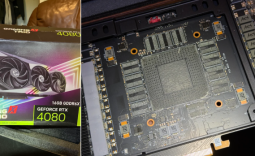 Redditor buys an RTX 4080, opens it up to find no GPU die or VRAM inside
 NVIDIA GPU rumors swirl claiming major price hikes of 20 to 30% - or more - are coming, as VRAM costs climb
 AMD's RX 9050 GPU comes up short in first review, but there's a good reason why it lags behind NVIDIA's RTX 5050 here
 Sony confirms it won't reverse disc phase out: 'We're going to cautiously move forward'
 GeForce RTX 50 Series GPU prices are rumored to increase by 30% in the coming weeks, months
 TSMC's 1.4nm process timeline accelerates, with mass production happening sooner than expected
 Diablo 4's next season is bringing back iconic items from Diablo 2 and 3
 Razer Huntsman V3 HE Magnetic 8K keyboards include a Mini 65% model
 Four C's of Xbox's future outlined in new CEO memo
 Linux kernel patch boosts Steam Deck 1% lows by 31.8% by fixing AMD CPU clock handling
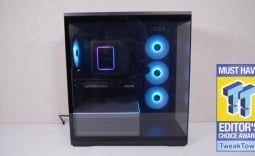 Montech TG3 Mid-Tower Chassis Review
 ASUS ROG Strix X870E-A Gaming WiFI7 Neo Review - A New Enticing Option
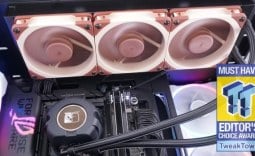 Noctua NL-LC1-36 Liquid CPU Cooler Review
 Logitech G316 X 98 Wired Gaming Keyboard Review - Retro-Inspired Board that Falls a Little Short
 Biwin M560 2TB SSD Review - Best Overall Retail-Ready DRAMless SSD
 Logitech G512 X 98 Analog Mechanical Gaming Keyboard Review - An Innovative Two-in-One
 Thrustmaster T.Flight HOTAS 5 MSFS Edition Review
 SteelSeries Arctis Nova Pro Omni Wireless Headset Review - One Headset to Rule Them All
 SteelSeries Arctis Nova 7 Wireless Gen 2 Headset Review - New and Improved, But Is It Enough?
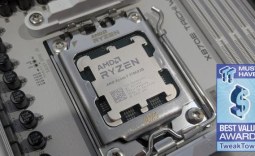 AMD Ryzen 7 7700X3D Review - Days of Future Past
 I switched my PC to encrypted DNS in Windows 11, and browsing felt more private
 Printer Not Working in Windows? How to fix detection, print queues and drivers
 The Ultimate Guide to Personalizing Your Windows 11 Taskbar
 How to Turn Your Windows Laptop Into a Second Monitor with Miracast and Wireless Display in Minutes
 6 Mistakes to Avoid When Buying a Windows Laptop
 I capped Windows Update's bandwidth with Delivery Optimization, and my downloads stopped choking
 I use this decade-old free tool that finds files faster than Windows Search does
 I install and update most of my apps with this Windows command now, and I stopped downloading sketchy installers
 Hisense U6SF 65-inch MiniLED TV: High Performance Meets Leisurely Convenience
 I stopped digging through Windows menus after I set up this one folder