







Learn about how TweakTown tests and reviews hardware. As an Amazon Associate, we earn from qualifying purchases. TweakTown may also earn commissions from other affiliate partners at no extra cost to you.
Stay Updated
Follow TweakTown for breaking tech news, reviews, and daily updates.


Pitch black sky turned blue color as object enters atmosphere over US
Residents in Indiana and other states noticed the sky turn a strange blue color on July 23, and now we know why.

A video uploaded to the American Meteor Society (AMS) shows a somewhat large meteoroid entering Earth's atmosphere at high speeds and bursting into flames as it soared across the night sky. The event was recorded by the AMS, and according to its website, the fireball was spotted by 155 people across multiple states such as Kentucky, Missouri, Iowa, Wisconsin, Michigan, and more.
So, why did the meteoroid cause the sky to turn into a blue color? When a meteoroid enters Earth's atmosphere, it experiences a high level of friction with Earth's dense atmosphere. This friction is increased as the meteor gets closer to Earth's surface, and as a result, the meteor catches fire - turning into a fireball. The brightness of the meteor is determined by the speed and size of the space debris.
Continue reading: Pitch black sky turned blue color as object enters atmosphere over US (full post)
Man sues third largest US city over AI wrongfully imprisoning him
On Thursday, a federal lawsuit was filed that alleges gunshot detection technology that uses artificial intelligence wrongfully imprisoned the plaintiff Michael Williams.

The gunshot detection technology that has been thrown into question is developed by the company ShotSpotter, which deployed numerous microphones around the city, which are paired with an AI system that is capable of determining when a gunshot has been fired. Once that system detects the appropriate sound, it notifies local police. In Williams' case, Chicago police used audio recordings by ShotSpotter as critical evidence against Williams, who was charged with murder in 2020 for allegedly shooting a man inside his vehicle.
Now, Williams, along with the human rights advocacy group The MacArthur Project, is looking to recover damages from the city of Chicago, as well as reparations for loss of income, legal bills, and the mental anguish caused by being imprisoned. The lawsuit alleges that police put "blind faith" into the gunshot detection system, with Engadget reporting that police didn't even confirm a motive for Williams and that he was imprisoned with only two pieces of evidence - a video of a car that lacked any audio and a ShotSpotter alert.
Continue reading: Man sues third largest US city over AI wrongfully imprisoning him (full post)
AI asked to show an image of the last selfie ever taken on Earth
An artificial intelligence (AI) has been asked to produce an image that displays the last selfie a human ever took on Earth.

The artificial intelligence system is called DALL-E and is designed to produce completely original images from text descriptions that anyone can enter. The AI system is a 12-billion parameter version of GPT-3, which is an autoregressive language model that uses deep learning to produce human-like conversations. Engineers took that GPT-3 model, developed by OpenAI, to create DALL-E, and instead of the AI producing human-like conversations, it produces a batch of images based on the text entered.
The AI system was asked to produce what it "thinks" would be the last selfie a human ever took on Earth, and using the data provided to it by Google's servers, the AI produced a batch of completely original images that showcase a grim depiction of the world ending. Now, these images hold no validity when it comes to predicting Earth's future. However, it's certainly an interesting result that was produced. Notably, the same AI was asked to produce an image from inside a black hole. The results of that search can be found below.
Continue reading: AI asked to show an image of the last selfie ever taken on Earth (full post)
Corsair Vengeance RGB DDR5 RAM: up to 6600MHz and 64GB kit with RGB
Corsair has just launched its new Vengeance RGB series DDR5 memory, with initial kits offering DDR5-6400 speeds but Corsair has faster DDR5-6600 speeds coming soon.

The new Corsair Vengeance RGB DDR5 memory comes in both black and white color options, with beautiful RGB lighting that will make any gaming PC look awesome. Corsair is launching its new Vengeance RGB DDR5 memory in DDR5-6400 speeds with a 32GB kit (2 x 16GB sticks) but faster DDR5-6600 speeds are coming.
Corsair notes that just like with all Corsair DDR5 memory, the new Vengeance RGB DDR5 memory modules are "built with only hand-sorted, tightly-screened memory chips to ensure consistently high frequencies, atop performance PCBs for excellent signal quality and stability. Cooling these chips is a stylish solid aluminum heat spreader that efficiently conducts heat away from your memory while complementing your system's modern aesthetic".
Continue reading: Corsair Vengeance RGB DDR5 RAM: up to 6600MHz and 64GB kit with RGB (full post)
Apple patents VR gloves for finger gestures for Apple AR/MR headset
Apple has just filed a patent for what looks like some interesting VR gloves that would let you use your hands and fingers to do things like move a cursor, scroll, open a document, select things, and so much more.

The upcoming Apple AR glasses would let you use the VR-style gloves with skin-to-skin contact, meaning full-on finger and hand gestures. Apple should be using a camera or radio frequency-based system on the headset, so that it can track the finger movement of the user, using these new gloves.
Apple's new patent would see two Apple Watch-like products that would be capable of detecting skin-to-skin contact, where the one of the wearables can sense, while the other handles gestures. Apple's patent also details a ring that would be in place of the watch, and would work with the VR gloves for particular actions.
Continue reading: Apple patents VR gloves for finger gestures for Apple AR/MR headset (full post)
Innosilicon to unveil next-gen Fantasy 2 graphics cards on August 3
Innosilicon is going to unveil its next-gen Fantasy 2 graphics card family on August 3, with the Chinese GPU maker teasing its announcement ahead of the reveal.

The new Innosilicon Fantasy 2 graphics cards will act as the successor to the Fantasy No.1 series, where the previous Type-A graphics card offering 5 TFLOPs of compute performance, while the Type-B card was a dual-GPU affair offering 10 TFLOPs of compute performance.
We should see the new Innosilicon Fantasy 2 GPUs based on Imagination's IMG BXT architecture, where the Chinese GPU company is making GPU solutions for high-performance tasks in cloud computing. Innosilicon had goals of reaching similar performance to NVIDIA's mid-range GeForce RTX 3060 graphics card... but didn't compute with the gaming performance of the RTX 3060.
Continue reading: Innosilicon to unveil next-gen Fantasy 2 graphics cards on August 3 (full post)
v-color Manta XSky DDR5-6600 CL32 RAM launched, 32GB DDR5 costs $399
We have some new high-end DDR5 memory unveiled by v-color, with the new v-color Manta XSky RGB DDR5 memory that comes in a 32GB DDR5-6600 CL32 kit for $399.

v-color's new Manta XSky RGB DDR5 memory comes in a 32GB kit (2 x 16GB) with CL32-39-39-102 timings at 1.4v that use 100% Hynix ICs for excellent overclocking performance. The company has also unveiled its new Advanced OC Smart Sorting System, which is a patented automated sorting system for DDR4 and DDR5 memory ICs.
The patented automated Smart Sorting System accelerates the testing process of memory ICs, with v-color being the only company to automate the testing and sorting of ICs for 30-50% more efficiency and reliability over manual sorting. v-color's impressive Smart Sorting System is configurable to test DDR4 + DDR5 memory ICs, at any speed right up to 6800MHz.
Continue reading: v-color Manta XSky DDR5-6600 CL32 RAM launched, 32GB DDR5 costs $399 (full post)
TEAMGROUP: first with industrial-grade Vapor Chamber M.2 SSD cooling
TEAMGROUP has just unveiled the world's first VC (Vapor Chamber) liquid-cooled M.2 SSD cooler, which will come more and more into play as we enter the world of PCIe 5.0 SSDs.

Vapor Chamber liquid cooling technology is commonly used in high-end mobile devices, but now TEAMGROUP's new N74V-M80 is an industrial grade VC Cooling MM.2 SSD that uses proprietary liquid cooling technology. TEAMGROUP is using specially designed VC liquid cooling tubes which pumps cooling fluid to the headzone of the PCIe M.2 SSD controller.
From there, heat is transferred to the aluminum fin heat sink, with TEAMGROUP using a convective design through gas-liquid phase transition to boost thermal performance. TEAMGROUP's new N74V-M80 combines the functions of heat absorption, conduction, and dissipation to better transfer and regulate thermal energy.
Continue reading: TEAMGROUP: first with industrial-grade Vapor Chamber M.2 SSD cooling (full post)
KIOXIA teams with Aerospike: boosts database performance by up to 36%
KIOXIA has announced that it's collaborating with Aerospike to boost their Aerospike Community Edition database, which resulted in a 36% increase in application performance when compared against the original software without the KIOXIA enhancements.

The companies tested it with the KIOXIA FL6 Series enterprise NVMe Storage Class Memory (SCM) SSDs with a software enhancement developed by KIOXIA. As for the Aerospike database, it was optimized to run on flash and SSD products, and is capable of high throughout, and low patency on flash.
KIOXIA notes that it featured the KIOXIA SCM solution, XL-FLASH, and PCIe 4.0 and NVMe 1.4-compliant KIOXIA FL6 Series SSDs to "bridge the gap" between DRAM and TLC-based drives, "making them well-suited to loatency-sensitive use cases such as caching layer, tiering and write logging".
Continue reading: KIOXIA teams with Aerospike: boosts database performance by up to 36% (full post)
AMD Ryzen 7000 series Zen 4 CPUs to be announced in August, get ready!
AMD will be talking to its partners on August 5 about its next-gen Ryzen 7000 series CPUs and new enthusiast-grade X670E motherboards.

The company teased its upcoming "Exclusive Look at Partner Products: A Showcase of The New AM5 Motherboards" for business partners and customers who are eager to learn more about AMD's next-gen products, taking place on August 5 at 12:00 AM Taiwan time (9 AM PT). We should expect the Zen 4 + X670E launch shortly after.
It seems that there are a lot of... let's just say convenient leaks about AMD's new Zen 4 products (including the next-gen 600-series motherboards) over the last few months. This is another one of those leaks, but it doesn't matter... we know it's coming, and it's coming real soon.
Continue reading: AMD Ryzen 7000 series Zen 4 CPUs to be announced in August, get ready! (full post)
NVIDIA GeForce RTX 4090: rumored to be CHEAPER than the RTX 3090 Ti
NVIDIA will be launching its next-gen GeForce RTX 4090 in the coming months, with a new rumor that the company will be launching a 450W and 600W variant of the GPU.

Not only that, but NVIDIA will reportedly be making its new GeForce RTX 4090 cheaper... yes, cheaper... than NVIDIA's current flagship GeForce RTX 3090 Ti graphics card. The rumor we're discussing right now is coming from the Chiphell forums, stating that the GeForce RTX 4090 will be the only next-gen GPU that we see this year.
The rumor continues that NVIDIA might not have the other GeForce RTX 40 series SKUs out until Q1 2023, which would be a very interesting way of Ada Lovelace being rolled out. But why, and how would that happen? Well, I've been reporting from leaker Tom @ Moore's Law is Dead that AIB partners told NVIDIA to "go pound sand" over their warehouses filled with Ampere and Turing GPU stock. The AIB source said, "we're even willing to risk Lovelace allocation if they threaten us".
Continue reading: NVIDIA GeForce RTX 4090: rumored to be CHEAPER than the RTX 3090 Ti (full post)
Microsoft: Xbox Series X/S is best-selling Xbox generation of all time
The Xbox Series X/S continues its strong momentum and is still the best-selling Xbox console generation of all time.

Today was a big day for Xbox. Microsoft announced a record-breaking $16.2 billion revenue generated from Xbox gaming in Fiscal Year 2022, which is more money than the games business has made in the history of the brand.
It doesn't stop there. According to Microsoft leadership, the Xbox Series X/S console duo is breaking new sales records since the system released in 2020. "We sold more Xbox Series X/S consoles life to date than any previous generation of Xbox, have been market leader in North America in the last three quarters across next-gen consoles," Microsoft CEO Satya Nadella said in the company's Fiscal Year 2022 earnings call.
Continue reading: Microsoft: Xbox Series X/S is best-selling Xbox generation of all time (full post)
Meta lost $10 billion on VR in 2021, now raising Quest 2 price by $100
Meta's VR business is losing billions of dollars every quarter, and now the company is raising the price of its Quest 2 VR headset.

Today Meta announced that all Quest 2 models will see a $100 price increase, representing a 33% premium over existing HMD prices. "Starting in August, Meta Quest 2 will cost $399.99 USD and $499.99 USD for the 128GB and 256GB versions respectively," Oculus announced. Quest 2 headsets will include a free copy of Beat Saber for a limited time (but this game should really be included anyway).
Meta explains that production costs have risen and this $100 price jump will help grow its "investment in groundbreaking research and new product development." Meta also says that gamers have spent over $1 billion in Quest apps so far, but this is a paltry sum to the incredibly $12.468 billion that Meta spent on its Reality Labs division. Reality Labs also lost more than $10 billion in operating income in FY21.
Continue reading: Meta lost $10 billion on VR in 2021, now raising Quest 2 price by $100 (full post)
Xbox smashes records with $16.2 billion earned in FY22
Microsoft made more money from Xbox than it ever has before, shattering all previous game revenue records.

Xbox gaming made a staggering $16.2 billion in Microsoft's FY22 period, which is a new all-time record for the video games giant. The growth was driven by content in services across the Xbox, PC, and mobile ecosystem via first-party and third-party game sales and microtransactions, as well as consistent growth in Xbox Game Pass.
Content and services made up 77% of total Xbox gaming earnings for FY22, or $12.5 billion, with hardware (Xbox One, Xbox Series X/S consoles and peripherals) making up 23%, or $3.7 billion.
Continue reading: Xbox smashes records with $16.2 billion earned in FY22 (full post)
Capcom Q1'22 earnings down 50%, but the company is not in trouble
Capcom's Q1 Fiscal Year 2022 results show significant drops in year-over-year earnings, but that's because Capcom is having a hard time competing against its previous record success.

Companies not only compete with other companies, but they also compete with themselves. Investors, analysts, and companies are always comparing the current periods against past quarters or years for signs of growth.
So when Capcom delivered a record Q1 period in the FY2021 financial year, it set a new milestone that it would have a hard time breaking. This fluctuation between high points and stabilized earnings is typical of any games publisher.
Continue reading: Capcom Q1'22 earnings down 50%, but the company is not in trouble (full post)
Alzheimer's can now be detected 17 years in advance, before symptoms
A study on Alzheimer's detection titled "Amyloid-beta misfolding and GFAP predict risk of clinical Alzheimer's disease diagnosis within 17 years" has been published in the journal Alzheimer's & Dementia.

Researchers from the Ruhr University Bochum in Germany have created a new sensor that can detect early signs of Alzheimer's disease in patients during the 15 to 20-year period before symptoms emerge in cases. An immuno-infrared sensor detects the misfolding of the amyloid-beta protein biomarker, which leads to the accumulation of characteristic "plaques" in the brain.
Continue reading: Alzheimer's can now be detected 17 years in advance, before symptoms (full post)
Video shows test fire of NASA's massive new rocket booster
The Northrop Grumman Corporation has released footage of a test firing of NASA's new rocket booster.

The test was a "full-scale static fire" conducted by Northrop Grumman and NASA, using the Flight Support Booster-2 from NASA's Space Launch System (SLS) rocket, the world's largest solid rocket motor. The SLS will fly on NASA's upcoming Artemis missions to the Moon and uses a five-segment solid rocket booster to provide over 75% of the SLS rocket's initial thrust at launch.
The 154-foot-long (46.9 meters) booster fired for more than two minutes, generating over 3.6 million pounds of thrust. The booster segments to be used on the first three missions in the Artemis program are already complete. However, boosters for the Artemis IV mission through Artemis IX have yet to be finalized. Northrop Grumman was awarded a contract in December 2021 to develop the next generation of boosters for the missions.
Continue reading: Video shows test fire of NASA's massive new rocket booster (full post)
Saudi Arabian prince plans to build wild 75-mile-wide skyscraper
The Crown Prince of Saudi Arabia, Mohammed bin Salman, has demanded an ambitious new construction project to rival the pyramids of Egypt.

The project, first unveiled in 2021, is known as The Line and comprises plans for a 105-mile-long (170 kilometers) linear urban development in the northwestern desert of Saudi Arabia. Part of the project is called the Mirror Line, which is planned to be the world's largest structure. The Mirror Line will see two skyscrapers running parallel for 75 miles (120.7 kilometers), standing 1,600 feet (487.7 meters) tall, interconnected with walkways and its own high-speed train that can carry people from end-to-end in 20 minutes.
The Mirror Line and other projects make up a grander vision by Prince Mohammed to build the Neom city, "the first cognitive city," designed to diversify Saudi Arabia's economy by attracting foreign investment and tourism and decreasing its reliance on oil. Completing construction of the Mirror Line has a 2030 deadline, though a 2021 assessment suggests that construction could take up to 50 years.
Continue reading: Saudi Arabian prince plans to build wild 75-mile-wide skyscraper (full post)
World's largest 'doomsday' submarine delivered to Russian navy
The Russian Navy received the massive new nuclear-powered submarine from Sevmash Shipyard, Russia's largest shipbuilder.

Named the Belgorod, it is the world's longest known submarine and is a modified version of Russia's Oscar II class of submarines. Construction began in December 2012 on what was known as Project 09852, culminating in the 184-meter-long (608 feet) submarine that was received by the Russian Navy on July 8th, 2022. According to the state-run Russian News Agency TASS, Belgorod will carry Russia's new nuclear-capable Poseidon torpedoes.
Continue reading: World's largest 'doomsday' submarine delivered to Russian navy (full post)
'Necrobotic' spiders made by reanimating dead spiders into robots
A study on the spiders titled "Necrobotics: Biotic Materials as Ready‐to‐Use Actuators" has been published in the journal Advanced Science.

Researchers from Rice University have repurposed the carcasses of deceased wolf spiders to serve as mechanical grippers, taking the first step in a novel research field dubbed "necrobotics" by the researchers. The team's lab specializes in soft robotics, a subfield of robotics that utilizes nontraditional materials to achieve more flexibility and unique functions unattainable with traditional plastics, metals, and electronics.
Continue reading: 'Necrobotic' spiders made by reanimating dead spiders into robots (full post)
 Assassin's Creed Odyssey gains 90% more players due to Christopher Nolan's 'The Odyssey'
 AMD Radeon GPU prices set to increase by 10% in August
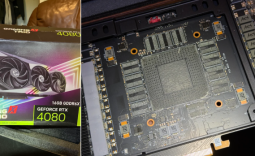 Redditor buys an RTX 4080, opens it up to find no GPU die or VRAM inside
 NVIDIA GPU rumors swirl claiming major price hikes of 20 to 30% - or more - are coming, as VRAM costs climb
 AMD's RX 9050 GPU comes up short in first review, but there's a good reason why it lags behind NVIDIA's RTX 5050 here
 Sony confirms it won't reverse disc phase out: 'We're going to cautiously move forward'
 GeForce RTX 50 Series GPU prices are rumored to increase by 30% in the coming weeks, months
 TSMC's 1.4nm process timeline accelerates, with mass production happening sooner than expected
 Diablo 4's next season is bringing back iconic items from Diablo 2 and 3
 Razer Huntsman V3 HE Magnetic 8K keyboards include a Mini 65% model
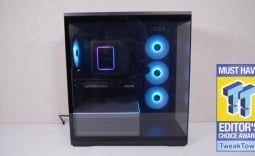 Montech TG3 Mid-Tower Chassis Review
 ASUS ROG Strix X870E-A Gaming WiFI7 Neo Review - A New Enticing Option
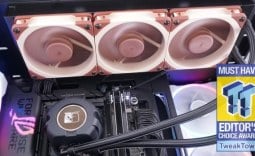 Noctua NL-LC1-36 Liquid CPU Cooler Review
 Logitech G316 X 98 Wired Gaming Keyboard Review - Retro-Inspired Board that Falls a Little Short
 Biwin M560 2TB SSD Review - Best Overall Retail-Ready DRAMless SSD
 Logitech G512 X 98 Analog Mechanical Gaming Keyboard Review - An Innovative Two-in-One
 Thrustmaster T.Flight HOTAS 5 MSFS Edition Review
 SteelSeries Arctis Nova Pro Omni Wireless Headset Review - One Headset to Rule Them All
 SteelSeries Arctis Nova 7 Wireless Gen 2 Headset Review - New and Improved, But Is It Enough?
 AMD Ryzen 7 7700X3D Review - Days of Future Past
 I switched my PC to encrypted DNS in Windows 11, and browsing felt more private
 Printer Not Working in Windows? How to fix detection, print queues and drivers
 The Ultimate Guide to Personalizing Your Windows 11 Taskbar
 How to Turn Your Windows Laptop Into a Second Monitor with Miracast and Wireless Display in Minutes
 6 Mistakes to Avoid When Buying a Windows Laptop
 I capped Windows Update's bandwidth with Delivery Optimization, and my downloads stopped choking
 I use this decade-old free tool that finds files faster than Windows Search does
 I install and update most of my apps with this Windows command now, and I stopped downloading sketchy installers
 Hisense U6SF 65-inch MiniLED TV: High Performance Meets Leisurely Convenience
 I stopped digging through Windows menus after I set up this one folder