







Science, Space, & Robotics - Page 140
Explore the latest Science, Space, Health, and Robotics news from TweakTown. Coverage includes space launches, medical tech, discoveries, and rockets. - Page 140
Stay Updated
Follow TweakTown for breaking tech news, reviews, and daily updates.


As an Amazon Associate, we earn from qualifying purchases. TweakTown may also earn commissions from other affiliate partners at no extra cost to you.
Tesla is upgrading its Supercharger network, adding Starlink support
Tesla has begun to add Starlink functionality to some Supercharger stations across America, with multiple people online spotting satellite dishes appearing in Lake City, Florida, and Lisbon, Connecticut.

Tesla already supports free in-car cellular connectivity for limited features such as email or simple navigation and offers a Premium Connectivity subscription for a $10 monthly fee which supports more data-intensive features. However, when connected to a Wi-Fi network, all Internet features are free to use.
Elon Musk recently replied to other users on Twitter that expressed a desire to see Wi-Fi built into all Supercharger stations, stating that they all eventually would. Now it seems the rollout has begun, potentially enabling a plethora of features. Enabling full Wi-Fi functionality between the car and the Starlink network would allow users full Internet access in the downtime spent charging at stations on a long road trip, without subscribing to the Premium Connectivity plan.
Continue reading: Tesla is upgrading its Supercharger network, adding Starlink support (full post)
The most gravitational waves ever have been detected, here's how
The Laser Interferometer Gravitational-Wave Observatory (LIGO) and the Virgo interferometer, designed to detect cosmic gravitational waves, have recently observed 35 new waves produced from black holes merging and black holes and neutron stars colliding.

Ninety total gravitational waves have been detected from three observing runs between 2015 and 2020. The latest collection of observations came from observing runs conducted using both observatories between November 2019 and March 2020.
Almost all of these detections come from events occurring billions of years ago and billions of light-years away from our solar system. 32 of the 35 events involve mergers between black holes, with the remaining three likely attributed to collisions between neutron stars and black holes.
Continue reading: The most gravitational waves ever have been detected, here's how (full post)
NASA confirms three solar flare combined, trigger auroras upon impact
NASA has confirmed three solar flares erupting on the surface of the Sun and an impact resulting in auroras being seen in the sky across select locations.

NASA writes in a new blog post that the solar flares came from two active regions on the Sun; AR 12891 and AR 12887. On November 1, a C1.3-class flare was detected erupting from AR12887, which was followed by a C4-class flare two hours later. The flare intensity is measured on a scale; A, B, C, M, and X-classes. Each class is ten times stronger than the last, with X being the strongest and A being the weakest.
Two hours after the last flare, another was detected out to AR 12891. This one was an M1.6-class flare. NASA writes that solar flares are often associated with coronal mass ejections (CME), large swaths of plasma ejected into space from the Sun's corona. CME's can sometimes hit Earth and, depending on the intensity of the impact, can cause geomagnetic storms in Earth's upper atmosphere. The impact of the charged particles on Earth's magnetic field can cause issues for satellites, radio communication, electricity grids, and more.
Continue reading: NASA confirms three solar flare combined, trigger auroras upon impact (full post)
This NASA spacecraft holds the record for fastest human-made object
It isn't a car or a plane that holds the record for the fastest human-made object. It's a NASA probe that is about to make its closest approach to the Sun yet.

NASA's Parker Solar Probe recently took a swing around Venus, gaining some speed through sling-shotting itself through its gravitational pull, and is now on its way to the Sun, where it will come within about 5.3 million miles to its while traveling up to speeds of 101 miles per second, or 364,621 miles per hour.
The goal of the fly-by is to capture data on the solar wind that is close to the Sun's surface and hopefully provide valuable data to researchers that will unlock a deeper understanding of our Sun and thus other stars. There is a large dust cloud circling the Sun, and engineers have constructed the Parker probe to be able to survive what it will encounter. However, this region of space is still yet to be discovered, so it certainly presents challenges for researchers and engineers, which NASA acknowledges.
Continue reading: This NASA spacecraft holds the record for fastest human-made object (full post)
SpaceX drops phenomenal picture of Starship SN20 engine test
Elon Musk's SpaceX has dropped a wallpaper-worthy image of its Starship SN20 vehicle performing a "static fire" test.

The Starship vehicle will be what SpaceX offers as a solution of transporting humans to the Moon, Mars, and eventually more distant locations within our solar system. The company is currently in testing mode as Starship gears up for its first orbital test flight. Starship is comprised of two main parts, its 260-foot booster named Super Heavy, and the 165-foot tall spacecraft named Starship. SpaceX's flagship vehicle has performed some flights tests in the past where it reached altitudes of about 6 miles.
However, the orbital flight test is going to be its biggest challenge yet, which SpaceX plans on conducting within the coming weeks or months. A solid time and date hasn't been set by SpaceX as it's waiting for the Federal Aviation Administration (FAA) to complete an environmental assessment of the Starbase orbital launch site, which will arrive in the form of a report that's yet to be released. Starship completed a static fire test that included all six raptor engines - it's Super Heavy in all its glory.
Continue reading: SpaceX drops phenomenal picture of Starship SN20 engine test (full post)
Earth found to have a second 'Moon', but it won't be around forever
Researchers have located a temporary second "moon" floating around Earth in a strange fashion, according to a new study published in Nature Magazine.

The new study details an object that is circling Earth in a corkscrew-like trajectory, and this object is dubbed Kamo'oalewa, which in Hawaiian means "moving celestial object". Kamo'oalewa was first discovered back in 2016 and became the smallest stable quasi-satellite of Earth, measuring in at just 164 feet in diameter. The space rock was believed to be a small asteroid, but according to results from the newly published study, it appears that Kamo'oalewa is a fragment of our Moon.
The researchers compared lunar sample data retrieved from the Apollo 14 mission (1971) to Kamo'oalewa data and found that the results match. The team of researchers proposed that the moon-fragment likely came from a meteor collision that occurred on the surface of resulting in this piece of "lunar material" being broken off towards Earth. Ben Sharkey of the Lunar and Planetary Laboratory at the University of Arizona, and the lead author on the study, said that Kamo'oalewa won't be around forever as estimations indicate that after 300 years, it will break its orbit and journey out into space.
Continue reading: Earth found to have a second 'Moon', but it won't be around forever (full post)
Comet makes its closest approach to Earth, will leave for 200 years
A famous comet recently made its closest approach with Earth and won't make another approach for the next 200 years.

Comet 67P became famous after a European mission called Rosetta started orbiting the comet after journeying towards it for 10 years. The Rosetta spacecraft orbited the comet very closely for 2.5 years, taking measurements and capturing valuable information. Additionally, the Rosetta mission featured a small probe landing on the surface of the comet. The small probe Philae landed on the comet in December 2014, marking the first time a human-made probe has landed on a comet.
As for its close approach to Earth, Comet 67P came within 39 million miles from Earth at 7:50 pm EST, Friday, November 12. The comet was visible for amateur astronomers with telescopes, but unfortunately, due to its orbit, the comet won't be coming back to our planet for the next 200 years. EarthSky reports that the celestial ice ball won't approach Earth again until 2214. If you are interested in reading more about this story, check out this link here.
Continue reading: Comet makes its closest approach to Earth, will leave for 200 years (full post)
Child genius starts college at 12-years-old, aims for at NASA at 16
There are very few children like Alena Wicker, who has been accepted into college at the age of 12 and is aiming to be working at NASA by 16.

12-year-old Alena Wicker has been accepted to Arizona State University (ASU), and according to an interview with Phoenix TV station KPNX, Wicker has always dreamed of becoming an engineer, "I always dreamed of being an engineer because, throughout my life, I liked building." Wicker had a talent for numbers, science, and building at a young age, and according to her mother, Daphne McQuarter, "At 4 years old she said, 'I'm going to work at NASA and I'm going to go up there.' She would point to the stars."
Wicker will soon be attending Arizona State University and be double majoring in planetary science and chemistry. As Wicker makes her way through her courses, she will attempt to begin working at NASA as soon as she can. While she may not get accepted into NASA at the age of 16, as that is quite young, she certainly will be on the agency's radar when she becomes a little bit older. Wicker will definitely be going places.
Continue reading: Child genius starts college at 12-years-old, aims for at NASA at 16 (full post)
NASA reveals images of Pluto's dark side taken by space probe
A NASA spacecraft snapped some images of the dark side of Pluto while it was making an approach with the dwarf planet back in 2015.

NASA's New Horizons spacecraft turned around to take some images of Pluto's dark side while it was passing by the dwarf planet in 2015, and after some post-processing, the images revealed some interesting information about the side of Pluto that wasn't illuminated by the Sun. Tod Lauer, a member of the New Horizons team, said, "When you look back at Pluto's dark side, you turn around and look almost right at the Sun, and it's pretty damn bright".
Lauer continued and said, "It's like driving in a car with a dirty window, looking into the Sun without a sun visor, trying to read a street sign." Pluto's main moon named Charon, is much smaller than our moon and resides much closer to the planet. For these reasons, the moon provides faint illumination to the surface of Pluto that is facing away from the Sun. After cleaning up the image by removing parts of it that were overexposed, the researchers found that the south pole of the dwarf planet was less bright than the north pole - something that wasn't expected at all.
Continue reading: NASA reveals images of Pluto's dark side taken by space probe (full post)
Jeff Bezos predicts the future, humans will be born in space
Billionaire Jeff Bezos has given a prediction for the future of human civilization. He says humans will eventually be born in space.

During the Ignatius Forum in Washington DC, Amazon and Blue Origin founder Jeff Bezos said that humans will eventually be born in space and visit Earth as tourists. According to Bezos, humans will build colonies in space, and these colonies will give birth to humans who have never been on Earth before. "Over centuries, many people will be born in space. It will be their first home," said Bezos.
Additionally, Bezos says that people will live within these space colonies and visit Earth the same way people go and visit countries or locations such as Yellowstone National Park or Disneyland. Here's what Bezos said, "They will be born on these colonies, live on these colonies, then they'll visit Earth the way you would visit, you know, Yellowstone National Park." If you are interested in reading more about this story, check out this link here.
Continue reading: Jeff Bezos predicts the future, humans will be born in space (full post)
SpaceX Endurance crew safely docks with ISS, astronauts board station
The four astronauts aboard the SpaceX Endurance have successfully arrived at the International Space Station.

Crew Dragon Endurance launched from pad 39A at NASA's Kennedy Space Center in Florida on Wednesday, November 10, and after 22 hours after launch, linked up with the Harmony module on the International Space Station at 6:32 p.m. EST. The entire event was live-streamed by NASA and SpaceX, and NASA's Courtney Beasley can be heard confirming Endurance attaching itself to the ISS module for docking.
"Capture confirmed. Contact confirmed at 3:32 p.m. Pacific Time as the International Space Station and Endurance were flying above the Caribbean," said Beasley. NASA astronauts Raja Chari, Tom Marshburn and Kayla Barron, and European Space Agency (ESA) astronaut Matthias Maurer were onboard Endurance and are happy and healthy. If you are interested in reading more about the Crew-3 launch, check out this link here.
Continue reading: SpaceX Endurance crew safely docks with ISS, astronauts board station (full post)
NASA snaps incredible image with Hubble of a snowman out in deep space
A new image has been posted to NASA's blogs, and this time it's of a space snowman spotted by the Hubble Space Telescope.

NASA explains in the blog post that the Hubble Space Telescope was used to observe the emission nebula named "Snowman Nebula" that's located in the constellation Puppis about 6,000 light-years away from Earth. The Snowman Nebula, like other emission nebulae, are large clouds of gas that a neighboring star has charged up.
The radiation from the star begins a process called ionization, which is when the gases' electrons are stripped from the hydrogen atoms, resulting in the cloud emitting a light, causing the "glow" to occur. NASA explains the Hubble Space Telescope has captured "the details of sweeping curves of bright gas and dark knots of dust in a small section of the nebula." If you are interested in reading more about the Snowman Nebula, check out this link here.
Continue reading: NASA snaps incredible image with Hubble of a snowman out in deep space (full post)
Subway tuna claimed to have strange DNA, says lawsuit
Subway's tuna is being attacked for its authenticity by people behind a lawsuit that claims the company's tuna isn't actually just tuna but a mixture of other things labeled as tuna.

A lawsuit was filed against Subway that characterized its tuna as a "mixture of various concoctions that do not constitute tuna, yet have been blended together by defendants to imitate the appearance of tuna." This lawsuit sparked heavy criticism from Subway as the company rejected all the claims. Now a new suit has surfaced that leans on DNA testing of Subway tuna samples acquired from multiple locations. However, the results from the testing yielded lacking evidence, according to the court.
Barber Lab at UCLA's Department of Ecology and Evolutionary Biology tested the samples, and of the 20 samples tested, only one contained tuna DNA and all 20 contained chicken DNA. Additionally, 11 samples contained pork, and seven more had beef. The Washington Post reports that customers with strict dietary requirements for health or religious reasons would have consumed the tuna without knowing its contents. However, the results from the test have been rejected by Subway, with a Subway spokesperson reinforcing its stance on having "high-quality, wild-caught, 100 percent tuna."
Continue reading: Subway tuna claimed to have strange DNA, says lawsuit (full post)
Moon has enough oxygen to supply 8 billion people, but there's a catch
A soil researcher has written in The Conversation that the Moon contains enough oxygen for eight billion people to survive for around 100,000 years.

However, this oxygen isn't located in the atmosphere of the Moon because it doesn't have one. It's actually located in the soil. According to John Grant, a soil researcher for Southern Cross University, the top layer of the soil on the Moon referred to as "regolith" contains the oxygen, and through "a pretty straightforward process" called electrolysis, engineers will be able to separate the oxygen from the other soil components such as silicon, aluminum, and magnesium. This process is regularly used by manufacturers here on Earth to make aluminum, writes Grant.
About 45% of the lunar soil consists of oxygen, which means if humans can devise a way to harvest oxygen from the soil, a sustainable lunar base is monumentally more feasible. Grant notes in the article that Space Applications Services, a Belgian startup, has already announced plans to construct three reactors that will be sent to the Moon to test the process of harvesting oxygen from the soil. If you are interested in reading more about this exciting technology, check out this link here.
Continue reading: Moon has enough oxygen to supply 8 billion people, but there's a catch (full post)
James Webb Space Telescope inches closer to launch, instrument checked
NASA, the European Space Agency (ESA), and the Canadian Space Agency (CSA) are inching closer to getting the extremely delicate James Webb Space Telescope on the launch pad.

In a new blog post on the NASA website, it's announced that one of Webb's core instruments has been checked by engineers and is ready for use. According to Pierre Ferruit, the scientific lead on Webb's Near-Infrared Spectrograph (NIRSpec) instrument, this instrument is an example of an international effort between space agencies as the instrument is built by European industrial companies with components from NASA, much like Webb itself.
So, what will this instrument do? Ferruit explains that NIRSpec will allow researchers to examine and analyze the properties seen in images of distant galaxies. The instrument will do this by splitting the infrared light into different shades that is called a spectra. Ferruit says, "Analysis of these spectra will tell us how distant these galaxies are, what type of stars they contain, what is the relative abundance of life-giving elements such as oxygen and carbon in their interstellar gas, and much more."
Continue reading: James Webb Space Telescope inches closer to launch, instrument checked (full post)
Researchers discover origins of strange object that's orbiting Earth
Researchers may have found the origins for the mysterious quasi-satellite that orbits Earth called Kamo'oalewa.

A new study published in Nature details a team of researchers using the Large Binocular Telescope and the Lowell Discovery Telescope to observe the object Kamo'oalewa. The researchers observed the object in several wavelengths and what they found was that the object's colors didn't match up to what a regular asteroid would display. This surprised the researchers as it was assumed that the object was an asteroid trapped inside Earth's gravitational pull.
Benjamin Sharkey from the University of Arizona, and lead author on the study, said, "It doesn't look like what we would have expected if it was just a 'regular' asteroid. We looked at almost 2000 spectra of other near-Earth asteroids, and none of them matched." After comparing the colors to several different types of asteroids, the researchers then compared the results to samples of moon rock that were brought back from the Apollo missions.
Continue reading: Researchers discover origins of strange object that's orbiting Earth (full post)
400 people spot fireball streaking across the night sky over US states
Hundreds of people have spotted a fireball streaking across the night sky over several US states, and it wasn't the SpaceX Crew Dragon.

The American Meteor Society (AMS) has recorded the event as 2021-7540 and states that it received more than 400 reports from 13 states of the object erupting into flames before disappearing. The event was seen mostly over North Carolina, but it was also spotted in Washington DC, Delaware, Georgia, Maryland, New Jersey, Pennsylvania, South Carolina, Tennessee, Virginia, and West Virginia.
According to the report, the fireball became visible to onlookers at around 48 miles and moved northwest at a ridiculous speed of 33,000 miles per hour. The AMS reports that the fireball only lasted 3.5 seconds in Earth's atmosphere before it disintegrated, disappearing in front of onlookers. Additionally, the AMS writes that at its peak, the fireball was so bright it was equivalent to the moon, which suggests it may have weighed around 45 pounds and was around 10 inches in diameter.
Continue reading: 400 people spot fireball streaking across the night sky over US states (full post)
Diamond from deep within Earth found, holds unprecedented mineral
Researchers have penned a new study that reveals the discovery of a rare mineral that forms under extremely high pressure and high temperature in Earth's mantle.

The mineral that was found is called davemaoite, after the geophysicist Ho-kwang (Dave) Mao, and forms in the solid layer of Earth that is between the crust and the core. Researchers have suspected that there would be quite a lot of davemaoite but have never found any due to the mineral breaking down into other minerals as it moves closer to the surface. However, researchers examined a diamond from Botswana that is estimated to have formed 410 miles below the surface revealed some davemaoite trapped inside.
Oliver Tschauner, a mineralogist at the University of Nevada, Las Vegas, and lead author on the study, said to LiveScience, "The discovery of davemaoite came as a surprise". Tschauner explains that the discovery of davemaoite within the diamond suggests that diamonds can form much deeper in Earth's mantle than previously thought and that looking at this depth for more minerals of the mantle may be a viable option for further research.
Continue reading: Diamond from deep within Earth found, holds unprecedented mineral (full post)
NASA achieves the fastest turnaround in human spaceflight history
A new team of astronauts is heading to the International Space Station, and the launch has marked a milestone in human spaceflight history.

According to a new blog post by NASA, SpaceX Crew-3 has successfully launched and is currently in orbit - about to arrive at the International Space Station at the time of writing this. NASA astronauts Raja Chari, Tom Marshburn, and Kayla Barron, and European Space Agency (ESA) astronaut Matthias Maurer launched on the back of SpaceX's Falcon 9 rocket, which propelled the Crew Dragon Endurance spacecraft towards the floating laboratory. The astronauts will stay aboard the ISS for six months, as per the crew that just left - more on that here.
NASA administrator Bill Nelson commented on the launch, saying, "With Raja, Thomas, Kayla and Mattias on their way to the International Space Station just days after Crew-2's return, we're seeing the power of American ingenuity right before our eyes. NASA's partnership with SpaceX is not only critical for cutting-edge research but also for international collaboration. The space station brings together nations around the world for the benefit of all. Godspeed, Crew-3 - I can't wait to see all that you accomplish."
Continue reading: NASA achieves the fastest turnaround in human spaceflight history (full post)
Astronomers capture a first clear shot of a moon-brewing disk
Astronomers have an extremely valuable opportunity to learn about the relationship between the formation of planets and moons.

Researchers used the Atacama Large Millimeter/submillimeter Array (ALMA) to observe a planetary system that features a Jupiter-like exoplanet. The star at the center is called PDS 70, and a large amount of material surrounding it. This material is called a circumstellar disk. Located inside the ring of material is the Jupiter-like exoplanet, and from the data, the researchers know that the planet also has its own disk that is referred to as a circumplanetary disk.
These disks are the formation of celestial objects such as the moon and planets, and now researchers have an opportunity to watch the formation of a potential moon within this system. The researchers suspect that the amount of material that surrounds the star is enough to form three satellites that would be the size of our Moon. If you are interested in learning more about this planetary system, check out the above video that has been released onto the European Space Agency's YouTube channel.
Continue reading: Astronomers capture a first clear shot of a moon-brewing disk (full post)
 Twitch opts streamers into gen AI training by default, faces harsh backlash
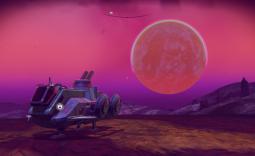 Sean Murray still plays the 2016 launch version of No Man's Sky
 China's YMTC has climbed to third place in global NAND flash shipments
 $100 GTA 6 version makes up 89% of pre-orders, analysts estimate
 HWiNFO's latest update quietly confirms Intel is working on Razor Lake-AX
 Nintendo puts Switch 2 price increase warnings on store demo kiosks ahead of September 1 hike
 GIGABYTE launches two new B450 motherboards as demand for AM4 stays high in 2026
 Microsoft finally makes up its mind and unifies Copilot features into one big app
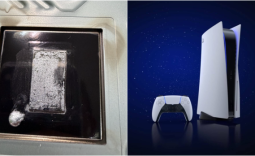 PS5 suffers from severe overheating after liquid metal eats into the heatsink
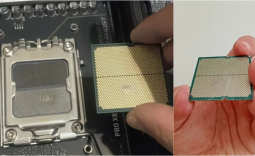 AMD Ryzen 7 7800X3D CPU burns and swells even after using AMD's updated BIOS
 D-Link F518 5G Wi‑Fi 6 AX1800 Mobile Hotspot Review: All-Day Mobile Hotspot
 Bose Lifestyle Ultra Speaker Review - Impressively Detailed Room-Filling Sound
 MSI Z890 Gaming Plus WIFI6E Review - Z890 for under $200
 Mortal Kombat (1995) 4K Ultra HD Blu-ray Review
 CPS PCCOOLER YS1200 ATX 3.1 80 PLUS Gold PSU Review
 ASRock X870E Taichi White Review: a premium AM5 motherboard with 10G LAN and WiFi 7
 Asetek Initium Pedal Modular Upgrades Review
 Thinkware U3000 Pro Review - Smart Dashcam with Wi-Fi quirks
 Montech TG3 Mid-Tower Chassis Review
 ASUS ROG Strix X870E-A Gaming WiFI7 Neo Review - A New Enticing Option
 I ditched the Windows 11 context menu for this open-source tool, and here's why
 Windows 11 may be encrypting your drive already, and I checked where my recovery key went
 GIGABYTE's 40 Days of INFINITY celebrates 40 Years of Innovation with stunning GeForce RTX graphics cards and rewards
 I swapped File Explorer for this free file manager and finally got the layout I wanted
 How to tell if someone has been using your Windows PC without your permission
 6 Task Manager tips for troubleshooting Windows performance problems
 ASUS ROG's 20th Anniversary Line-up of Premium PC Gaming Gear has Arrived - Here's Everything You Need to Know
 Six File Explorer tips every Windows user should know
 I switched my PC to encrypted DNS in Windows 11, and browsing felt more private
 Printer Not Working in Windows? How to fix detection, print queues and drivers