







Learn about how TweakTown tests and reviews hardware. As an Amazon Associate, we earn from qualifying purchases. TweakTown may also earn commissions from other affiliate partners at no extra cost to you.
Stay Updated
Follow TweakTown for breaking tech news, reviews, and daily updates.


Tesla laying off 200 staff from Autopilot team, shuts San Mateo office
Tesla has reportedly laid off hundreds of employees in its Autopilot department, as well as closing down an office in San Mateo, California.

Bloomberg and TechCrunch have both reported the story, with the teams at the San Mateo office "tasked with evaluating customer vehicle data related to the Autopilot driver-assistance features and performing so-called data labeling. Many of the staff were data annotation specialists, all of which are hourly positions, said one of the people, who asked not to be identified discussing private information" reports Bloomberg.
Tesla had around 350 staffers in that office before the slashing of staff took place, where some of them have been transferred to nearby offices. 200 people out of its Autopilot team is a big deal for the autonomous side of Tesla, but not overall considering the company hires around 100,000 people across the planet.
Continue reading: Tesla laying off 200 staff from Autopilot team, shuts San Mateo office (full post)
EVGA's new PowerLink 52U: power connector BFF for RTX 3090 Ti KINGPIN
EVGA unleashed its monster new GeForce RTX 3090 Ti KINGPIN graphics card not too long ago, as well as its PowerLink 41s power adapter... and now... the upgraded EVGA PowerLink 52U has been unveiled.

The new EVGA PowerLink 52U features 5 x 8-pin PCIe power connectors, that plug into the 2 x 16-pin PCIe power connectors on EVGA's flagship GeForce RTX 3090 Ti KINGPIN graphics card. If you purchased the EVGA GeForce RTX 3090 Ti KINGPIN -- which costs $2500 and includes a free 1600W PSU, with 9 x PCIe power connectors -- there's no native 16-pin PCIe power connectors.
That's where the PowerLink 52U steps in, making your system look much nicer to look at, with the whole system looking much cleaner: especially, because there's so many damn PCIe power connectors required with all of the adapters (5 x 8-pin PCIe power connectors is insane for a single GPU).
Continue reading: EVGA's new PowerLink 52U: power connector BFF for RTX 3090 Ti KINGPIN (full post)
Intel Arc A750 Limited Edition graphics card spotted in the flesh
I guess we're seeing the marketing launch of Intel's upcoming Arc desktop GPUs, with Intel preparing a new Arc desktop GPU bus that is hitting LANFest in September, and now Gamers Nexus have the new Intel Arc A750 Limited Edition graphics card.

Gamers Nexus have been sent over the new Intel Arc A750 Limited Edition graphics card, but haven't done much with it at all. VideoCardz incorrectly reported that GN was reviewing the card, but Gamers Nexus explained in a tweet that a "review isn't "already in the works." We said we ran some benchmarks on it (when an engineer visited), but we aren't reviewing it yet".
It seems Intel marketing is running GPUs into the hands of who they think matters... with PC Perspective's previous EIC and owner -- now working at Intel -- Ryan Shrout with the first GUNNIR Arc A380 Photon 6G OC graphics card in the US. Now, we have Gamers Nexus with an unreleased Intel Arc A750 Limited Edition graphics card. This must be the start of the Odyssey.
Continue reading: Intel Arc A750 Limited Edition graphics card spotted in the flesh (full post)
AMD confirms RDNA 3-based Navi 31 has 6 x MCDs + 384-bit memory bus
AMD is still cooking its next-gen RDNA 3 graphics architecture in the oven, but the flagship Navi 31-based GPU is getting some rumor mill goodness today: kinda, accidentally confirmed MCD counts.

The MCD (multi-chip die) is something we've been hearing about for a while, with more details arriving through leaks in April 2022, but now we're hearing that Navi 31 will have up to 6 x MCDs on a 384-bit memory bus. The news is coming from information posted about the RDNA 3 architecture in new Linux code, but was immediately retracted... not surprised.
AMD should use a single GCD (Graphics Complex Die) with six MCDs that should see a 384-bit memory bus, while we should see 192MB of Infinity Cache (or up to 384MB if AMD moves with its revolutionary 3D V-Cache technology on each of the MCDs).
Continue reading: AMD confirms RDNA 3-based Navi 31 has 6 x MCDs + 384-bit memory bus (full post)
Intel Arc gaming bus coming to LANFest, marketing is spinning wheels
Intel is ramping up the marketing for its Arc desktop GPU by... sending an Intel Arc gaming bus to LANFest Colorado in September.

The news was announced by Intel staffers on the Intel Insiders Discord channel, where the Intel Arc gaming bus is completely wrapped in "Arc High Performance Graphics". But what about inside? Inside isn't ready to game on yet, as Intel will be installing as many as 30 gaming stations that will be powered by their own Intel NUC 12 Extreme "Dragon Canyon" systems.
Inside of the Arc GPU gaming bus there's just renderings of what to expect with a suss-looking guy who doesn't like his picture being taken, or is looking at another monitor inside of the render. Intel has partnered up with SteelSeries which will provide peripherals, and AOC to provide gaming monitors. Jokes aside, I think Wccftech's Hassan Mujtaba puts it beautifully: "that truck better have a good driver".
Continue reading: Intel Arc gaming bus coming to LANFest, marketing is spinning wheels (full post)
MSI 600-series BIOS updates arriving: supports Intel Raptor Lake CPUs
MSI is pushing out fresh new BIOS updates to its Z690, H670, and B660-based motherboards that support Intel's upcoming 13th Gen Core "Raptor Lake" CPUs.

The current 600-series motherboards from MSI will need a BIOS update, and not all of them have a new BIOS for you to prepare yourself for Intel's upcoming 13th Gen Core "Raptor Lake" CPUs. There's a larger list below, and their respective BIOS versions that are now available.
We should expect MSI to push out BIOS updates for its full fleet of 600-series motherboards, as we lead into the launch of the new 13th Gen Core "Raptor Lake" CPUs later this year. MSI will of course have its own next-gen 700-series motherboards led by the new flagship Z790 chipset, which will arrive later this year.
Continue reading: MSI 600-series BIOS updates arriving: supports Intel Raptor Lake CPUs (full post)
Netflix's new lower-cost ad subscription will use Microsoft's adtech
Netflix is moving forward with its plan for a lower-cost, ad-supported subscription tier and has teamed up with Microsoft to make it happen.

Today Netflix announced that it has partnered with Microsoft as its global advertising partner for its new advertisement subscription model. Completely new to the world of advertisements, Netflix has chosen to team up with Microsoft due to the company's massive reach and its ever-growing ad platform (Microsoft purchased adtech specialists Xandr from AT&T in 2021).
Microsoft makes billions every year from its lucrative and powerful adtech platform, which Netflix will use to beam ads to its 221 million subscribers across the world. Netflix has not divulged further details of pricing, availability, or launch dates of its new ad subscription tier.
Continue reading: Netflix's new lower-cost ad subscription will use Microsoft's adtech (full post)
PlayStation Plus is now using Xbox Game Pass' best tactic
Sony's new three-tiered PlayStation Plus subscription is mimicking one of the best parts of Xbox Game Pass.

Today Sony announced the new games rotating into PlayStation Plus Extra and Premium, and the lineup includes a day-and-date release of the anticipated feline future-punk game Stray on both PS4 and PS5. It's a big far cry from Microsoft's heavy-hitting day-one first-party promise, but it's definitely a step in the right direction for added value.
The big story here is how newer games are rotating into the service in the capacity of game downloads and ultimately sampling new content. The first-party Xbox Game Pass promise is great, but a lot of subscribers still move over to other games they wouldn't have played if they weren't offered on the service. PlayStation Plus is now sparking up discovery and visibility while offering up incremental, growing value.
Continue reading: PlayStation Plus is now using Xbox Game Pass' best tactic (full post)
SEGA Genesis Mini 2 announced for North America, includes 50 games
SEGA's Genesis Mini console was the best micro-console on the market in terms of value and games offered. Now SEGA wants to step things up a notch with the SEGA Genesis Mini 2, a newer model that features more games including SEGA CD titles.

The SEGA Genesis Mini 2 is the Western version of SEGA's new Mega Drive Mini (only available in Japan). The Genesis Mini 2 comes with 50 games pre-loaded onto the console which spans both Genesis and SEGA CD eras. Confirmed SEGA CD titles include: Ninja Warriors, Sonic CD, Night Striker, Shining Force, Silpheed, and Mansion of Hidden Souls. SEGA has only confirmed 23 out of the 50 games that will be offered.
While the SEGA Genesis Mini 2 does come with a six-button gamepad, a potential drawback is that it only includes one controller. One added bonus is that existing Genesis Mini controllers are compatible with the Mini 2. The console is a bit more expensive as well; the Genesis Mini 2 launches on October 27, 2022 for a hefty $103 and is also exclusively available on Amazon.
Continue reading: SEGA Genesis Mini 2 announced for North America, includes 50 games (full post)
Bayonetta 3 finally gets an official release date on Nintendo Switch
The wait is finally over--Nintendo and PlatinumGames have officially confirmed Bayonetta's release date for 2022 on the Nintendo Switch.

Today Nintendo dropped a new Bayonetta 3 trailer that confirmed the game's release date for October 28, 2022, and also revealed some story elements and over-the-top chaos. The trailer showcased a new playable witch-in-training character called Viola, who has some distinct rebellious DmC Nero vibes and uses a unique blend of witchcraft and samurai swords.
Bayonetta and Viola travel through different areas, tackling hulking demon monstrosities along the way. There's mention of the Alphaverse which could indicate time or dimension-traveling, too.
Continue reading: Bayonetta 3 finally gets an official release date on Nintendo Switch (full post)
Konami to bring back de-listed Metal Gear Solid games
Much to the delight of fans, Konami has confirmed plans to re-list old de-listed Metal Gear Solid games.

Metal Gear Solid turns 35 years old tomorrow, and to celebrate Konami has said it will bring back Metal Gear games onto storefronts. "The Metal Gear series released on July 13, 1987 celebrated its 35th anniversary today. We are preparing to resume sales of titles that have been temporarily suspended," Konami said on Twitter.
There's no word on which Metal Gear games will be returning and we don't know for what platforms they'll arrive on. Fans are clamoring for the HD collection to be re-released, as well as original releases of the classic PS1, PS2, and PS3-era games. We may get Steam re-releases, or possibly even ports on Nintendo Switch. At the time of writing, only a handful of Metal Gear Solid games are available on Steam and PlayStation, but Xbox has the HD collection and Metal Gear Solid V.
Continue reading: Konami to bring back de-listed Metal Gear Solid games (full post)
CDC finds 'toxic weedkiller' chemical in more than 80% of Americans
A National Health and Nutrition Examination Survey (NHANES) related to the weedkiller has been published on the Centers for Disease Prevention and Control (CDC) website.

The CDC analyzed glyphosate, a widespread herbicide. Two thousand three hundred ten urine samples were analyzed from individuals representative of the broader U.S. population, and 1,885 had detectable levels of the toxic chemical in them - about 81%. Of these, 650 samples were from children, where detectable levels of glyphosate were found in 87% of samples.
Continue reading: CDC finds 'toxic weedkiller' chemical in more than 80% of Americans (full post)
Consequences of mining lithium could 'last decades into the future'
A study on lithium mining titled "Relic Groundwater and Prolonged Drought Confound Interpretations of Water Sustainability and Lithium Extraction in Arid Lands" has been published in the journal Earth's Future.

Researchers from the University of Massachusetts Amherst (UMass) and the University of Alaska Anchorage (UAA) have completed a significantly more comprehensive analysis of the environmental impact of lithium mining and extraction from brine water. Lithium is the backbone of many renewable energy technologies, as it is used for lithium-ion batteries that can store energy produced by renewable sources, so it is important to understand the impact of obtaining it.
Lithium is a highly reactive metallic element and does not prefer to exist in solid form. Instead, it often leaches into groundwater and reacts with the water to form a briny mixture. This dense mixture settles beneath a layer of fresh water, which is lighter. Over 40% of lithium deposits are found in Salar de Atacama, Chile's largest salt flat, where these freshwater layers host diverse and fragile ecosystems containing unique wildlife.
Continue reading: Consequences of mining lithium could 'last decades into the future' (full post)
Precursor molecules for life found at the center of the Mily Way
A study on the precursor molecules titled "Molecular Precursors of the RNA-World in Space: New Nitriles in the G+0.693−0.027 Molecular Cloud" has been published in the journal Frontiers in Astronomy and Space Sciences.

Spanish researchers have observed the center of the Milky Way galaxy and found a host of different organic molecules called nitriles. These are used in building prebiotic molecules (precursors to molecules associated with life) that are commonly associated with RNA, a similar molecule to DNA used to carry genetic information.
The team found evidence of nitriles, including cyanic acid, cyanoallene, propargyl cyanide, and cyanopropyne, in the G+0.693-0.027 molecular cloud. The cloud is located inside the Central Molecular Zone (CMZ) at the center of the Milky Way, where many prebiotic molecules have been found.
Continue reading: Precursor molecules for life found at the center of the Mily Way (full post)
Patient gets gene-editing treatment to permanently lower cholesterol
A New Zealand patient has volunteered to be the first person to receive a gene-editing treatment to lower their blood cholesterol.

The patient is part of a clinical trial by Verve Therapeutics, a U.S. biotechnology company. The patient suffers from heart disease and inherited the risk for excessively high cholesterol, which lends itself to an increased risk of heart attacks and heart disease. The patient's treatment involved an injection of a version of the CRISPR gene-editing tool designed to modify the DNA in the patient's liver cells slightly.
Continue reading: Patient gets gene-editing treatment to permanently lower cholesterol (full post)
Earth's population will reach a new milestone this year, says the UN
A new report from the United Nations has revealed what intergovernmental organization estimates the world population will be before 2022 is finished.

According to the report titled "World Population Prospects", the world's population is expected to reach 8 billion by mid-November, according to the UN's estimations. By 2030 the UN predicts that the planet will hold a total of 8.5 billion people, and by 2050 there will be 9.7 billion people. Notably, the UN predicts the world's population will reach a peak of approximately 10.4 billion people around 2080.
Furthermore, the UN writes that these sharp increases in population will come from less than ten countries, and those countries are; Congo, India, Nigeria, Pakistan, Egypt, the Philippines, and Tanzania. Other notable predictions from the report are that there will be as many women in the world as men by 2050, with current metrics indicating that as of 2022, the world's population is about 50.3% male.
Continue reading: Earth's population will reach a new milestone this year, says the UN (full post)
Elon Musk is being sued by Twitter for these reasons
Tesla and SpaceX CEO Elon Musk is being sued by Twitter over his attempt to back out of his acquisition deal to purchase the company for $44 billion.

Here's a quick synopsis of the events between the two parties so far. In April 2022, Musk moved to purchase Twitter for $54.20 a share, or $44 billion - Twitter accepted this offer in less than two weeks after it was announced by Musk. The following month Musk shined a spotlight on Twitter's claim that less than 5% of its total users accounted for bots/spam accounts. The Tesla CEO even went as far as to announce that the deal was "temporarily on hold" until Twitter provided him with adequate information to confirm Twitter's claims.
Musk's team was unable to confirm the claims from Twitter, and as a result, Musk accused Twitter of a "material breach" by withholding vital information. Twitter followed up on Musk's accusations by providing Musk's team with the full "fire hose" of Twitter data, however, that must have been inefficient as Musk's team told the Securities and Exchange Commission (SEC) on July 8 that he was backing out of the deal and that he wished to terminate the merger agreement.
Continue reading: Elon Musk is being sued by Twitter for these reasons (full post)
James Webb telescope photographs 'Cosmic Cliffs' 7 light-years high
NASA's James Webb Space Telescope (JWST) is fired up for scientific operations, and the space agency has released a beautiful image of a star-forming region.

NASA has shared a new image snapped by the James Webb Space Telescope's infrared instrument that focuses on the star-forming region NGC 3324, or the Carina Nebula. According to NASA's recent blog post, the region is called the Cosmic Cliffs, and after looking at the image, you can understand why. The agency explains the space mountains consist of cosmic dust, but Webb's extremely sensitive instruments are capable of peering through that veil at the young stars behind it.
NASA notes that the ultraviolet radiation that is being released from the young stars is influencing the mountain's edge, while the mist that is seen above the mountain top is actually hot ionized gas and dust that is being forced away from the nebula by star radiation. Furthermore, the tallest "mountain" seen in the above image is estimated to be 7 light-years tall.
Continue reading: James Webb telescope photographs 'Cosmic Cliffs' 7 light-years high (full post)
NASA's James Webb telescope snaps insane photograph of dying star's
NASA has released a selection of colored images snapped by the James Webb Space Telescope (JWST). These images are the first colored images taken by the JWST.

NASA has taken to its blog to showcase a planetary nebula called NGC 3132, which is also called the Southern Ring Nebula, located approximately 2,500 light-years from Earth. NASA explains that the above observations of the nebula have been taken almost face-on to the subject and that if you were to look at the nebula from side-on, it would look like two bowls placed together pointing outwards with their bases touching.
Notably, NGC 3132 consists of two stars that orbit each other very closely. This orbit between the two stellar objects stirs the nebula's dust and gas, causing asymmetrical patterns to be produced. Furthermore, Webb's Mid-infrared camera revealed for the first time that the second star is surrounded by dust, with the brighter star next to it being in the earlier stages of star evolution, hence its difference in color.
Continue reading: NASA's James Webb telescope snaps insane photograph of dying star's (full post)
NASA's Webb snaps 150 million pixel image in never-before seen detail
NASA has released a set of incredible images taken by the highly anticipated James Webb Space Telescope (JWST).

NASA has taken to its blog to finally released the first colored images snapped by the $10 billion James Webb Space Telescope, and showcased above is the galaxy group "Stephan's Quintet". According to the space agency, Stephan's Quintet has been photographed in never-before-seen detail. The above image is actually a mosaic piece made up of 1,000 separate images.
Notably, NASA states that the collection of images flattened into one image consists of more than 150 million pixels and reveals previously unknown details such as the sparkling clusters of a million or more stars and how gas and dust are being pulled into different directions by the gravity of certain objects. Furthermore, NASA states in its blog that this is the largest image to date, and is approximately the same size as one-fifth of the Moon's diameter.
Continue reading: NASA's Webb snaps 150 million pixel image in never-before seen detail (full post)
 AMD's RX 9050 GPU comes up short in first review, but there's a good reason why it lags behind NVIDIA's RTX 5050 here
 Sony confirms it won't reverse disc phase out: 'We're going to cautiously move forward'
 GeForce RTX 50 Series GPU prices are rumored to increase by 30% in the coming weeks, months
 TSMC's 1.4nm process timeline accelerates, with mass production happening sooner than expected
 Diablo 4's next season is bringing back iconic items from Diablo 2 and 3
 Razer Huntsman V3 HE Magnetic 8K keyboards include a Mini 65% model
 Four C's of Xbox's future outlined in new CEO memo
 Linux kernel patch boosts Steam Deck 1% lows by 31.8% by fixing AMD CPU clock handling
 Nexus Mods new owner wants to make installing mods as easy as using Spotify
 Dragon Age remasters are technically possible but won't be easy, BioWare co-founder says
 Montech TG3 Mid-Tower Chassis Review
 ASUS ROG Strix X870E-A Gaming WiFI7 Neo Review - A New Enticing Option
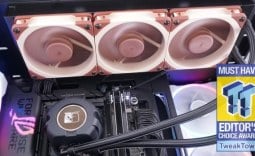 Noctua NL-LC1-36 Liquid CPU Cooler Review
 Logitech G316 X 98 Wired Gaming Keyboard Review - Retro-Inspired Board that Falls a Little Short
 Biwin M560 2TB SSD Review - Best Overall Retail-Ready DRAMless SSD
 Logitech G512 X 98 Analog Mechanical Gaming Keyboard Review - An Innovative Two-in-One
 Thrustmaster T.Flight HOTAS 5 MSFS Edition Review
 SteelSeries Arctis Nova Pro Omni Wireless Headset Review - One Headset to Rule Them All
 SteelSeries Arctis Nova 7 Wireless Gen 2 Headset Review - New and Improved, But Is It Enough?
 AMD Ryzen 7 7700X3D Review - Days of Future Past
 I switched my PC to encrypted DNS in Windows 11, and browsing felt more private
 Printer Not Working in Windows? How to fix detection, print queues and drivers
 The Ultimate Guide to Personalizing Your Windows 11 Taskbar
 How to Turn Your Windows Laptop Into a Second Monitor with Miracast and Wireless Display in Minutes
 6 Mistakes to Avoid When Buying a Windows Laptop
 I capped Windows Update's bandwidth with Delivery Optimization, and my downloads stopped choking
 I use this decade-old free tool that finds files faster than Windows Search does
 I install and update most of my apps with this Windows command now, and I stopped downloading sketchy installers
 Hisense U6SF 65-inch MiniLED TV: High Performance Meets Leisurely Convenience
 I stopped digging through Windows menus after I set up this one folder