







Science, Space, & Robotics - Page 163
Explore the latest Science, Space, Health, and Robotics news from TweakTown. Coverage includes space launches, medical tech, discoveries, and rockets. - Page 163
Stay Updated
Follow TweakTown for breaking tech news, reviews, and daily updates.


As an Amazon Associate, we earn from qualifying purchases. TweakTown may also earn commissions from other affiliate partners at no extra cost to you.
Date found for mile-wide asteroid's highest chance of hitting Earth
Researchers have been watching an asteroid orbit the some for quite some time, but now new research has pinpointed the date for when that asteroid has the highest chance of colliding with Earth.

According to a new study published in the journal Icarus, researchers used data acquired by NASA's OSIRIS-REx spacecraft to measure the trajectory of the mile-wide asteroid named Bennu. Bennu has been orbiting the Sun for hundreds of millions of years, but according to researchers' highly accurate estimations, Bennu has a chance of colliding with Earth in the somewhat relative future.
The researchers calculated Bennu's trajectory and found that there is a 1-in-750 chance that the asteroid will collide with Earth over the next 300 years, which was a much higher probability than researchers previously estimated. The scientists also found that all of the closest encounters with Bennu will happen during the late 2200s and the early 2300s. Additionally, the researchers managed to boil the data down to a single date - September 24, 2182. During the afternoon on that day is the single likeliest time for impact as Bennu has a 1-in-2,700 chance of hitting Earth.
Continue reading: Date found for mile-wide asteroid's highest chance of hitting Earth (full post)
New Mars rover's first sample vanished, but NASA thinks it knows why
NASA researchers and engineers have been left in disbelief after the space agency's new rover Perseverance collected its first martian sample, only to discover the sample of rock vanished.

Last week, NASA's Perseverance rover began its long search for signs of ancient martian life in the Jezero Crater as researchers believe the crater was once a large lake that may have hosted life. Perseverance used its instrument to drill into the ground to collect a rock sample from deep beneath the martian surface, but when the sample tube was raised to the surface, nothing was inside of it.
NASA has said that the problem doesn't lay with Perseverance, but actually with the rock that the rover is trying to sample from. According to Louise Jandura, chief engineer for sampling and caching, "It appears that the rock was not robust enough to produce a core". Essentially, NASA believes that the rock that was drilled into was much too powdery to be collected. "The material from the desired core is likely either in the bottom of the hole, in the cuttings pile, or some combination of both," Jandura said.
Continue reading: New Mars rover's first sample vanished, but NASA thinks it knows why (full post)
Oldest planet in the Milky Way found, makes Earth look like a child
Astrophysicists have located what is believed to be the oldest planet in the Milky Way, and it makes Earth look very young.

According to astrophysicist Harvey Richer, who spoke to The Daily Galaxy, back in 2003, researchers gathered data about a planet that is located in the constellation Scorpius and is orbiting a white dwarf star. The planet is located around 5,600 light-years from Earth, and using NASA's Hubble Space Telescope, the researchers were able to estimate its age, which they found to be twice as old as Earth's.
Richer explains that the planet is around 13 billion years old, twice as old as Earth which is 4.5 billion years old. According to Richer the planet isn't habitable as the ancient M4 cluster where it resides "is poor in metals needed for life. The planet is more like Jupiter than the Earth, with no solid surface, and it might have survived a supernova explosion (the neutron star in the system was likely the end product of this explosion)." If you are interested in reading more about this story, check out this link here.
Continue reading: Oldest planet in the Milky Way found, makes Earth look like a child (full post)
NASA captures stunning image of the largest moon in our solar system
NASA launched its Juno mission ten years ago, and since then, the space agency has been monitoring Jupiter and everything around it via its Juno space probe.

Juno has been relaying valuable data back to researchers for quite some time now, and during its last orbit around Jupiter, the space probe was able to capture a stunning infrared image of Ganymede, the largest moon in our solar system. The last flyby occurred on July 20 when Juno used its Jovian Infrared Auroral Mapper (JIRAM) instrument to measure the levels of infrared light, which was then relayed back to researchers who created a new map of infrared map of Ganymede.
Juno Principal Investigator Scott Bolton, a researcher at the Southwest Research Institute in San Antonio, said on NASA's post, "Ganymede is larger than the planet Mercury, but just about everything we explore on this mission to Jupiter is on a monumental scale. The infrared and other data collected by Juno during the flyby contain fundamental clues for understanding the evolution of Jupiter's 79 moons from the time of their formation to today."
Continue reading: NASA captures stunning image of the largest moon in our solar system (full post)
Elon Musk sends clear message to FAA with a picture worth 1,000 words
In the 1920s humans broke through to the age of the skyscrapers, where skyscrapers were being constructed at an unprecedented rate. Now, a new age is upon us.

One of the most recognizable pictures from this era in time is a team of builders sitting atop a skyscraper in 1932 eating lunch, hence the name "Lunch atop a Skyscraper". The image is quite captivating and reflects the era humans were in back then. On Friday, Elon Musk posted a very similar image, but instead of builders on a skyscraper, it was SpaceX engineers standing beneath Starship, as it was slowly being lowered onto the first-stage rocket for attachment testing.
The image really represents how far humans have come in the last 100 years, highlighting how the era of bleeding-edge construction has changed. ArsTechnica's Eric Berger writes that Musk was sending a clear message to the Federal Aviation Administration with the image, as it represents that regulators must do their part in not holding back the human race from exploring and ultimately progressing as a species. If you are interested in reading more about this interesting image, check out this link here.
Continue reading: Elon Musk sends clear message to FAA with a picture worth 1,000 words (full post)
A country moves to build real-life 'Jurassic Park' despite UN warnings
A real-life 'Jurassic Park' is going to be constructed despite the warnings from a United Nations organizatioin.

A tourism project that has been titled "Jurassic Park" on social media will be continuing on the island of Rinca, despite warnings from the United Nations Educational, Scientific and Cultural Organization (UNESCO). Last month officials from the UN committee said to a World Heritage Committee conference that the project needed to have an environmental assessment completed as there was a potential risk to the Komodo dragon's natural habitat, a UNESCO World Heritage Site.
UNESCO said during the meeting last month that it had requested an environmental impact assessment from the Indonesian government but didn't receive any response. Wiratno, a senior official at Indonesia's environment ministry, said to Reuters, "This project will proceed...it's been proven to have no impact", adding that a new assessment could be sent in September. Details of the tourism project have been kept under wraps, but according to the Indonesian government, who was asked last year, it's building a "premium tourism spot" on the island.
Continue reading: A country moves to build real-life 'Jurassic Park' despite UN warnings (full post)
Planet that 'may support life' found, and it's not far away at all
A new study has identified a planetary system that is relatively close to Earth and may have the right conditions to support life.

The new study published in Astronomy & Astrophysics puts forward evidence of planets orbiting the star L 98-59 located just 35 light-years from Earth, possibly having the right atmospheric conditions for life. The planetary system contains three planets, one is an ocean world, another is half the mass of Venus, and the last is located in what researchers call the star's "habitable zone" - where it's not too hot or cold (like Earth).
Maria Rosa Zapatero Osorio, an astronomer at the Centre for Astrobiology in Madrid and co-author of the study, said in an ESO that the planet located in the habitable zone "may have an atmosphere that could protect and support life." The researchers used European Southern Observatory's Very Large Telescope (ESO's VLT) in Chile to observe the planets.
Continue reading: Planet that 'may support life' found, and it's not far away at all (full post)
Earth's inner core is much stranger than researchers first anticipated
The core of the Earth has remained a mystery to researchers for quite some time, and for one simple reason, we can't drill down to the core to collect a sample.

Some of the most basic questions, such as 'how and when did the core form?' and the answers to those questions are currently being worked on by numerous seismologists and geodynamicists. In the new study, the researchers used seismic observations and geodynamic modeling with estimations of how iron alloys conduct themselves at high pressure and found that the Earth's inner core was growing faster on one side.
It should be noted that this study has its limitations, and the model that was created by the authors only works if it's if Earth's inner core consists "of one specific crystalline phase of iron", per Inverse. The created model allowed researchers to estimate that the Earth's inner core is between 500 million and 1.5 billion years old. Relatively speaking, that would make Earth's inner core quite young, as it would only be between a ninth and a third as old as Earth itself.
Continue reading: Earth's inner core is much stranger than researchers first anticipated (full post)
Mexico dumps human poo into the ocean, forcing a US beach to close
Mexico is no stranger to dumping human waste into the ocean, but now the country has forced the closure of a US beach due to contamination.

A new report from KUSI has revealed that Mexico has dumped human sewage into the ocean, causing the water in Imperial Beach to be seriously contaminated and the beach to be closed. According to KUSi's Dan Planete, who has been reporting on this problem that has been occurring for the last forty years, the increase in visitors to the Playas de Tijuana beach in Mexico has caused the increase in the amount of dumping into the ocean.
The closure of the US beach comes just two days after the Environmental Protection Agency (EPA) announced that they were on their way to help the situation in Mexico. The dumping in the ocean is a result of a lack of sewage system, hence EPA's announcement of coming to the country's assistance. If you are interested in reading more about this story, check out this link here.
Continue reading: Mexico dumps human poo into the ocean, forcing a US beach to close (full post)
New study debunks Moon theory that came from the Apollo lunar landings
A newly published study has caused researchers to rethink their theory of the moon and update it with new information.

The first humans landed on the moon 52 years ago, and when the astronauts were on the surface of the moon, they collected samples to be studied. From the samples, researchers found they had magnetization, leading to the theory that the moon, at some stage, had a protective magnetic field throughout its 4.53 billion-year history. Researchers believed this magnetization could be coming from the mingling of liquid iron deep in the moon's core. However, that isn't the case.
According to John Tarduno, a geophysics professor at the University of Rochester in New York, the previous experiments that have resulted in this long-standing theory about the moon may have provided inaccurate results. Tarduno and colleagues inspected the samples acquired from the Apollo missions with advanced carbon dioxide lasers and highly sensitive magnetometers. What the researchers found was that the moon never had a magnetic field.
Continue reading: New study debunks Moon theory that came from the Apollo lunar landings (full post)
NASA's 2024 moon landing is impossible, but Elon Musk has a solution
NASA has come out and said that due to delays, the space agency won't be able to put humans back on the moon by 2024.

The original plan from NASA was to get the next man and the first woman on the moon by 2024, but now according to a new audit released by NASA, it doesn't seem that is going to happen. According to the audit, the delays in development for the new lunar lander that were caused by the dispute between Jeff Bezos' Blue Origin, Elon Musk's SpaceX, and the Government Accountability Office contributed to the now delayed launch.
The audit reads as follows, "These delays - attributable to funding shortfalls, COVID-19 impacts, and technical challenges - have left no schedule margin for delivery of the two flight-ready xEMUs. Given the integration requirements, the suits would not be ready for flight until April 2025 at the earliest".
Continue reading: NASA's 2024 moon landing is impossible, but Elon Musk has a solution (full post)
Scientists discover enormous structure warping around our galaxy
Researchers have located a very strange structure in the outer regions of our Milky Way galaxy, according to a recent study.

The study has been accepted for publication in The Astrophysical Journal Letters and details what is called Cattail, a filament of gas that "appears to be so far the furthest and largest giant filament in the galaxy," said the team of astronomers at Nanjing University. Astronomers are yet to find out the origin of this large filament of gas, but speculation points towards it being a section of a spiral arm that has gone unnoticed until now.
The astronomers said, "Alternatively, Cattail might be part of a new arm ... though it is puzzling that the structure does not fully follow the warp of the galactic disk." The team of astronomers behind the paper used the Five-hundred-meter Aperture Spherical radio Telescope (FAST) to search for clouds containing neutral atomic hydrogen. By observing the extremely subtle patterns of hydrogen light, the astronomers are able to map the position of the Milky Way's spiral arms.
Continue reading: Scientists discover enormous structure warping around our galaxy (full post)
Researchers find closest species to a real-life 'fearsome dragon'
Australia was once home to what is now known as the largest known flying reptile, according to a new study.

Researchers from the University of Queensland, Australia, have published a new study detailing a newly discovered species of pterosaur that is described as a "fearsome dragon" that once took to the skies in the Australian outback. Tim Richards, a Ph.D. candidate that led the study said that the new pterosaur is named Thapunngaka shawi and is "the closest thing we have to a real life dragon."
The researchers explained that the new pterosaur is the largest known flying reptile and that it would have been a "fearsome beast, with a spear-like mouth and a wingspan around seven meters", says Richards. Additionally, Richards said that the skull of the new species would have had more than 40 teeth in it, which would have been perfect for it swooping down to catch fish located in inland seas. It's believed Thapunngaka shawi populated the Earth as late as 66 million years ago and as early as 228 million years ago.
Continue reading: Researchers find closest species to a real-life 'fearsome dragon' (full post)
Dinosaur-killing asteroid is much more common than scientists thought
A new study published in the November 2021 issue of the journal Icarus has changed the way we think about the asteroid that wiped out the dinosaurs.

The asteroid that wiped out the dinosaurs caused the 90-mile-wide Chicxulub crater located in Mexico's Yucatan Peninsula. The size of the asteroid that caused that crater is estimated to be around 6 miles in diameter, but its origin has been something of debate for quite some time. Now, in the newly published study, researchers used computer models over hundreds of millions of years to find the origin, and according to the researchers, the dinosaur-killing asteroid came from the solar system's outer asteroid belt located between Mars and Jupiter.
The computer models revealed to the researchers that an asteroid from the outer asteroid belt is expected to collide with Earth once every 250 million years and that this calculation lined up with the dinosaur-killing asteroid impacting Earth 66 million years ago. Additionally, the researchers found that a meteor colliding with Earth once every 250 million years is five times more common than researchers previously thought.
Continue reading: Dinosaur-killing asteroid is much more common than scientists thought (full post)
Scientists found the dark origin of asteroid that killed the dinosaurs
Researchers believe that they have found the location of the asteroid that wiped out the dinosaurs 66 million years ago.

The asteroid that resulted in the catastrophic event 66 million years ago is estimated to be 6 miles wide, and now researchers believe that it came from the dark region outside of our solar system. The asteroid caused a 90-mile-wide in Mexico's Yucatan Peninsula called the Chicxulub crater, and now according to a new study, the origin of that asteroid has been traced back using computer model simulations over millions of years.
Researchers simulated an asteroid being flung from the outer region of our solar system's main asteroid belt and found that an asteroid would collide with Earth once every 250 million years. Researchers found that this calculation lined up with the asteroid that caused the Chicxulub crater just 66 million years ago and that the computer model showed that half of the meteors located in the solar system's outer asteroid belt located between Mars and Jupiter are dark carbonaceous chondrites - a primitive type of meteor that researchers believe was the type that killed off the dinosaurs.
Continue reading: Scientists found the dark origin of asteroid that killed the dinosaurs (full post)
NASA is looking for people to simulate a Mars mission for 1 year
NASA is currently accepting applications from people who want to assist the space agency in simulating a Mars mission.

According to a new post on the NASA website, the space agency is currently seeking applications for the first one-year long analog mission that will simulate life on Mars. NASA will be conducting three one-year Mars surface simulations at NASA's Johnson Space Center, and each of the missions will consist of four crew members that will be living and working within a 1,700-square-foot 3D-printed module named the Mars Dune Alpha.
This large 3D printed model by ICON will simulate the environment on Mars, and come with all of the limitations NASA expects astronauts to face when they are actually colonizing the Red Planet. The missions will range objectives, but applicants are expected to undertake "simulated spacewalks, scientific research, use of virtual reality and robotic controls, and exchanging communications", according to NASA.
Continue reading: NASA is looking for people to simulate a Mars mission for 1 year (full post)
NASA's new telescope may show us signs of life that are close to Earth
Next month, NASA is expected to launch the telescope that is poised to replace the famous Hubble Space Telescope.

The new telescope is dubbed the James Webb Space Telescope (JWST), and due to its upgraded hardware, the telescope is expected to usher in a slew of new cosmic discoveries. The New Yorker described the JWST as a "potentially revolutionary instrument" as it will be able to see further into space than any other space telescope currently available, allowing astronomers to peer further back in time than ever before.
While being able to see the infancy of the universe has its own uses, it may not be the most exciting aspect of the telescope. David Helfland, an astronomer at Columbia University, spoke to The New Yorker and said that the JWST will be able to see "very far away" and "very close", and the latter of the two "in some ways may be the most exciting" because "it's about looking at planets that are not too different from Earth."
Continue reading: NASA's new telescope may show us signs of life that are close to Earth (full post)
This is the most irregular star shape, it looks like 'cosmic football'
Kirsten Banks, an Australian astrophysicist that graduated from the University of New South Wales, has shown off what is renowned as the least spherical star studied to date.

In a recent video posted to Banks' TikTok account, the Australian astrophysicist replied to a question from a fan who asked, "Show us the most irregular star shape!". Banks goes on to highlight the star Achernar, the primary star of the binary system designated Alpha Eridani and is the 9th brightest star in the night sky. View video here.
Achernar is the least spherical star researchers have studied to date, and that is because of how fast it spins. Banks explains that the strange shape of the star is a result of its spinning 155 miles every second, causing its equatorial diameter to be 56% greater than its polar diameter. This extreme rotate speed has forced the star into an oblate shape and has caused it to be described as a "cosmic football". For more quick astronomy facts, check out Banks' TikTok account here.
Continue reading: This is the most irregular star shape, it looks like 'cosmic football' (full post)
Here's the world record for the most Big Macs ever eaten in a lifetime
A new video on the Guinness World Records TikTok account has shown off Donald Gorske, the world record holder for most Big Macs eaten in a lifetime.

The Guinness World Record TikTok account has amassed more than 14 million followers since it first started posting back in 2019, and one of the more viral videos on the account is about Donald Gorske, a nearly 50-year-old who has eaten a shocking 32,340 Big Macs in his lifetime. Gorske explains that he currently eats two Big Macs a day and will probably continue to for the rest of his life. Video here.
The Guinness World Record TikTok commented on the video and said that the Don has said that "he still has a great blood sugar level, an exceptionally good cholesterol, and walks about six miles per day to maintain his health". The price of Big Macs has gone up over the years, but considering how many Big Macs Gorske has eaten, the price increases, and added drinks, it's most likely safe to assume that he has spent over his lifetime tens if not one hundred thousand dollars on his favorite meal.
Continue reading: Here's the world record for the most Big Macs ever eaten in a lifetime (full post)
Elon Musk follows woman on Twitter, she thanks him, then he unfollows
Tesla and SpaceX CEO Elon Musk is known for how active he is on his Twitter account, and in-between his posts about Tesla and SpaceX he can be quite the humorous troll.

At the end of last month, space enthusiast Rebecca thanked Musk for him supposedly following her on Twitter, saying that she's "delighted and honored" to receive a follow. Musk replied back to Rebecca with a very short and humorous message, saying, "Sorry, accidental tap", referring to how he must of "accidentally" followed Rebecca.
In some follow-up Tweets, fans of Musk said that it must have been his child named X who followed Rebecca, and Musk replied by saying, "He does like to play with my phone. There are many confusing videos he has taken." In other news about Elon Musk, SpaceX recently broke the world record for the tallest rocket ever constructed, more on that story here.
Continue reading: Elon Musk follows woman on Twitter, she thanks him, then he unfollows (full post)
 Twitch opts streamers into gen AI training by default, faces harsh backlash
 Sean Murray still plays the 2016 launch version of No Man's Sky
 China's YMTC has climbed to third place in global NAND flash shipments
 $100 GTA 6 version makes up 89% of pre-orders, analysts estimate
 HWiNFO's latest update quietly confirms Intel is working on Razor Lake-AX
 Nintendo puts Switch 2 price increase warnings on store demo kiosks ahead of September 1 hike
 GIGABYTE launches two new B450 motherboards as demand for AM4 stays high in 2026
 Microsoft finally makes up its mind and unifies Copilot features into one big app
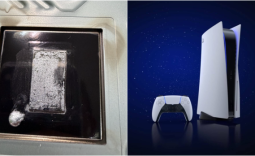 PS5 suffers from severe overheating after liquid metal eats into the heatsink
 AMD Ryzen 7 7800X3D CPU burns and swells even after using AMD's updated BIOS
 D-Link F518 5G Wi‑Fi 6 AX1800 Mobile Hotspot Review: All-Day Mobile Hotspot
 Bose Lifestyle Ultra Speaker Review - Impressively Detailed Room-Filling Sound
 MSI Z890 Gaming Plus WIFI6E Review - Z890 for under $200
 Mortal Kombat (1995) 4K Ultra HD Blu-ray Review
 CPS PCCOOLER YS1200 ATX 3.1 80 PLUS Gold PSU Review
 ASRock X870E Taichi White Review: a premium AM5 motherboard with 10G LAN and WiFi 7
 Asetek Initium Pedal Modular Upgrades Review
 Thinkware U3000 Pro Review - Smart Dashcam with Wi-Fi quirks
 Montech TG3 Mid-Tower Chassis Review
 ASUS ROG Strix X870E-A Gaming WiFI7 Neo Review - A New Enticing Option
 I ditched the Windows 11 context menu for this open-source tool, and here's why
 Windows 11 may be encrypting your drive already, and I checked where my recovery key went
 GIGABYTE's 40 Days of INFINITY celebrates 40 Years of Innovation with stunning GeForce RTX graphics cards and rewards
 I swapped File Explorer for this free file manager and finally got the layout I wanted
 How to tell if someone has been using your Windows PC without your permission
 6 Task Manager tips for troubleshooting Windows performance problems
 ASUS ROG's 20th Anniversary Line-up of Premium PC Gaming Gear has Arrived - Here's Everything You Need to Know
 Six File Explorer tips every Windows user should know
 I switched my PC to encrypted DNS in Windows 11, and browsing felt more private
 Printer Not Working in Windows? How to fix detection, print queues and drivers