







Science, Space, & Robotics - Page 231
Explore the latest Science, Space, Health, and Robotics news from TweakTown. Coverage includes space launches, medical tech, discoveries, and rockets. - Page 231
Stay Updated
Follow TweakTown for breaking tech news, reviews, and daily updates.


As an Amazon Associate, we earn from qualifying purchases. TweakTown may also earn commissions from other affiliate partners at no extra cost to you.
Robots used to help keep the elderly active and engaged in retirement
Senior citizens are finding motivation and entertainment out of a 22-inch humanoid robot leading physical therapy classes. The Zora robot was originally poised to become an assistant in hotels, but designers and programmers found a more appealing market in healthcare.
Previously, Zora has been used to interact with young children, helping teach them basic motor function and keep them stimulated. There are more than 6,000 elderly citizens in Belgium, France and the Netherlands use the robot to stay engaged, listening to news articles, weather forecasts, and following dance and exercise routines.
"A lot of elderly people are actually feeling alone. Solitude is something which is horrible for the moment for a lot of elderly people," said Fabrice Goffin, co-creator of the Zora robot, in a statement to Washington Post. "People don't have all the time to visit their families and they can find some kind of relationship with the robot and that is a nice thing to do."
Continue reading: Robots used to help keep the elderly active and engaged in retirement (full post)
1 in 5 experts feel artificial intelligence could pose a threat
Will artificial intelligence pose a threat to mankind? Around 18 percent of AI experts feel there could be an 'existential threat' to mankind, a new report from Oxford University indicates. Oxford University researchers interviewed 500 AI experts and half of those surveyed appear optimistic, saying AI should be "good" or "extremely good" for humans.
AI will match human ability between 2040 and 2075, with an eventual transition to "super intelligence" within the next century.
... this creation could, in turn, create yet higher intelligence, which could, in turn, create yet higher intelligence, and so on... so we might generate a growth well beyond human ability and perhaps even an accelerating rate of growth: an 'intelligence explosion,'" according to the paper.
Continue reading: 1 in 5 experts feel artificial intelligence could pose a threat (full post)
Telemarketers and refs, lookout... robots coming for your jobs
Whether we want it or not, the transition from human workers to robots is expected to cause mayhem among a number of different industries.
The following industries are expected to face the highest likelihood of being replaced, according to a 2013 study from Oxford University - telemarketers (99 percent), umpires and referees (98.3 percent), cooks (96.3 percent), manicurists and pedicurists (94.5 percent), and roofers (89.7 percent).
It seems careers that require a mix of creativity, negotiation skill and strong communication will be safer than other positions - and there are plenty of concerns about how acceptable humans will be to jobs being carried out by robots.
Continue reading: Telemarketers and refs, lookout... robots coming for your jobs (full post)
NASA discovers a new galaxy which is as bright as 300 trillion suns
NASA has just found a new galaxy that is shining as brightly as, wait for it... 300 trillion suns. That's a lot of zeroes: 300,000,000,000,000 suns. One sun is bright, but 300 trillion? Ugh, I need some new sunglasses.
The discovery has been so large for NASA that they've had to create a new classification for it, and the 19 other galaxies they discovered. These new galaxies are extremely luminous infrared galaxies, or ELIRGs for short. NASA has said that the new ELIRGs are "the most luminous galaxy found to date". NASA scientists spotted the ELIRGs with their Wide-field Infrared Survey Explorer (WISE) space telescope.
The ELIRGs that NASA found are located 12.5 billion light years away, which is why it's so damn bright. NASA JPL scientist Chao-Wei Tsai says that it "may be from the main growth spurt of the galaxy's black hole".
Continue reading: NASA discovers a new galaxy which is as bright as 300 trillion suns (full post)
Is it possible robots will always need humans to help them function?
Even though there is new concern that artificial intelligence may lead to robots taking over, it's plausible to think that robots will always need humans.
"Pilots, physicians and other professionals routinely navigate unexpected dangers with great aplomb but little credit," states a recent editorial published by he New York Times. "Even in our daily routines, we perform feats of perception and skill that lie beyond the capacity of the sharpest computers."
While that is true, some have wondered if that will begin to change when AI is able to learn - and adapt - to daily life. No one is really sure what is lies ahead for mankind and robotics, however, humans can work to ensure there are proper boundaries in place that robots must adhere to.
Continue reading: Is it possible robots will always need humans to help them function? (full post)
Next-gen drug test can detect cocaine in your system from fingerprints
Researchers from the University of Surrey in the UK have developed an interesting new, noninvasive drug test that can detect cocaine in your system through your fingerprints. The system looks for two common cocaine metabolites: benzoylecgonine and methylecgonine.
These two metabolites can be found in blood, sweat, and urine using a "mass spectrometry technique known as Desorption Electrospray Ionisation (DESI)", reports Engadget. Metabolites dissipate from our sweat much quicker than they do in blood and urine, so law enforcement will one day in the near future be able to know if a suspect is high right then and there, or was high a few nights ago.
The study's lead author, Melanie Bailey, told Motherboard: "We can distinguish between cocaine having been touched and cocaine having been ingested". With fingerprints being unique, it's hard to swap out a urine sample or test, which will make this type of technology fast-tracked beyond belief. The team has added that their research is still in its early stages, as they'll need to secure much more data on the effects of dosage and timing before they can move to more reliable testing. They still say that this technology will be made available to law enforcement within 10 years.
Continue reading: Next-gen drug test can detect cocaine in your system from fingerprints (full post)
NASA: the reality we live in is like 'The Matrix', made by aliens
According to British philosopher Nick Bostrom, the reality that surrounds us is thanks to a highly-advanced computer program, similar to the events of The Matrix.
Dr Bostrom proposed his theory in a paper that he wrote, saying that an evolved race of aliens have "imprisoned the human race" in what Bostrom refers to as "digital imprisonment". You might think he is crazy, but NASA scientist Rich Terrile agrees with Bostrom in a way. Terrile is the director of the Centre for Evolutionary Computation and Automated Design at NASA's Jet Propulsion Laboratory.
Terrile spoke with VICE, where he said: "Right now the fastest NASA supercomputers are cranking away at about double the speed of the human brain. If you make a simple calculation using Moore's Law [which roughly claims computers double in power every two years], you'll find that these supercomputers, inside of a decade, will have the ability to compute an entire human lifetime of 80 years - including every thought ever conceived during that lifetime - in the span of a month".
Continue reading: NASA: the reality we live in is like 'The Matrix', made by aliens (full post)
IBM CEO believes 'our lives will be better' because of AI
IBM CEO Ginni Rometty believes artificial intelligence can be used by humans for our own benefit, despite some outcry that AI poses a threat to mankind. During the World of Watson event, aimed at promoting IBM Watson, Rometty promised a "bold prediction."
"In the future, every decision that mankind makes is going to be informed by a cognitive system like Watson... and our lives will be better for it," Rometty said.
IBM Watson is a custom cognitive system that the company promotes as a "new partnership between people and computers that enhances and scales human expertise." The supercomputer has already been used for cancer research - among other breakthrough scientific purposes - but IBM wants to push things even further. Watson was able to beat Jeopardy! king Ken Jennings in 2011, and has been used more recently to help chefs find new recipes.
Continue reading: IBM CEO believes 'our lives will be better' because of AI (full post)
Researchers interested in creating micro-robots, such as RoboBees
Scientists and researchers have great use for robotics development, with a number of different models currently in development. The use of micro-robotics, however, provides an interesting scenario in which researchers study small insects and wildlife for their natural inspiration.
When most people think of robots, they immediately think of large, metallic creations that can be used in factories - but micro-sized robots are proving increasingly popular. If implemented, micro-robots can assist in agriculture, medicine, and other industries, according to supporters.
"If you want to make something a centimeter big that can fly, several hundred thousand solutions already exist in nature," said Robert Wood, electrical engineer at Harvard University's Microrobotics Lab, in a statement to National Geographic. "We don't just copy nature. We try to understand the what, how, and why behind an organism's anatomy, movement, and behavior, and then translate that into engineering terms."
Continue reading: Researchers interested in creating micro-robots, such as RoboBees (full post)
Tesla has reportedly received $800 million in Powerwall orders so far
When Tesla unveiled its new Powerwall home battery, I don't think most people thought it would take off as fast as it has. According to Bloomberg, Tesla has received over $800 million in orders for the Powerwall and Powerpack batteries so far.
The site says that Tesla has received around $179 million worth of Powerwall reservations so far, with $625 million worth of Powerpack reservations to boot. Tesla has already said that it's taken in around 38,000 total reservations for Powerwall, and 2,500 reservations for Powerpack.
Tesla is selling the Powerwall for $3000 and $3500 for the 7kWh and 10kWh models, respectively. Powerpack units make even more money for Tesla, as they're being sold to businesses and utilities for power storage for $250 per kilowatt hour to use.
Continue reading: Tesla has reportedly received $800 million in Powerwall orders so far (full post)
Jeff Bezos' Blue Origin helping push the limits of space tourism
Amazon.com founder Jeff Bezos' Blue Origin, a space venture company, successfully test launched its New Shepard spacecraft last week. The New Shepard reached 307,000 feet, powered by a 110,000-lbf thrust liquid hydrogen, liquid oxygen BE-3 engine. The boundary between Earth and space is 62-miles above the Earth's surface, so the New Shepard maximum altitude of 58 miles was close to the limit.
"Any astronauts on board would have had a very nice journey into space and a smooth return," Bezos said in a blog post. "In fact, if New Shepherd had been a traditional expendable vehicle, this would have been a flawless first test flight."
The space capsule demonstration was successful, but the reusable rocket booster was unfortunately not recovered. Bezos said his company is working on an improved hydraulic system, and hopefully the next launch will not lose pressure during its descent.
Continue reading: Jeff Bezos' Blue Origin helping push the limits of space tourism (full post)
Small businesses adopting robots, and more concern jobs are at risk
Small businesses want to see if robots are able to drive sales and increase productivity, unfortunately at the expense of human workers.
Robots are estimated to carry out 25 percent of all industrial tasks by 2025, according to the Boston Consulting Group - and almost half of US jobs face "high risk" of being automated in the next 10 to 20 years, according to co-directors of the Oxford Martin Programme on Technology and Employment.
"Automation is having a big impact. It's both positive and negative," said Martin Ford, author of the "Rise of the Robots: Technology and the Threat of a Jobless Future" book, which will be published later this month, in a statement to CNBC. "Business will need to hire no people or fewer people. You can literally have one person start a manufacturing business."
Continue reading: Small businesses adopting robots, and more concern jobs are at risk (full post)
Researchers create ape-inspired robot that could explore the moon
National space programs have shown new interest in lunar exploration, and it's possible robots could roam the moon's surface. The German Research Center for Artificial Intelligence (DFKI) has created an iStruct Demonstrator, also known as "Charlie," a robotic ape that can you different locomotion styles.
Using four-legged locomotion adds stability, but bipedal is best for speed and ability to maneuver - so having the robot be able to choose how to move is absolutely huge.
"We chose the ape because it allows us to study several locomotion modes," said Daniel Kuhn, DFKI researcher, in a statement to CNN. "For example, they have quite good quadrupedal walking abilities but they can also perform stand-up motion and walk on two legs - their ability to do this is greater than other animals. This change in posture and walking form interested us."
Continue reading: Researchers create ape-inspired robot that could explore the moon (full post)
Russian military said to be developing mind-controlled exoskeleton
Military technology has become absolutely fascinating in the past few years, with autonomous drones, robots, smart technology, and exoskeletons advancing nicely.
The Russian military is reportedly developing mind-controlled exoskeletons, multiple Russian news outlets claim. If there is any truth to the reports, soldiers could carry up to 600 pounds of additional weight. What makes this announcement curious is the idea that Russia is five years away from being able to include a neuroelectronic interface so the suit's wearer has a unique controlling mechanism.
"The Russian Army is set to receive mind-controlled exoskeletons," the Russian Sputnik media source said. "The wearable robots will be controlled by brain waves and will increase the strength and endurance of the serviceman wearing it by several times."
Continue reading: Russian military said to be developing mind-controlled exoskeleton (full post)
Robots in UCSF hospital utilize 'virtual railroad' to get the job done
The 'Eve' robot is being utilized at the University of California, San Francisco, Medical Center at Mission Bay, a new facility that opened in February. The robots can help humans, make test sample deliveries, and ensure each room has supplies as needed.
UCSF purchased 25 robots from Aethon for $3.5 million, and then invested an additional $2.5 million to prepare the robots and hospital. The hospital expects to break even within two years on its robotic investment, while also freeing up staff to conduct other tasks.
"The hospital is set up almost as a virtual railroad... if they encounter an obstacle along the way, that's when they use their various sensors, laser, sonar and infrared to navigate around those items and continue on their path," said Brian Herriot, director of Mission Bay operations planning for the UCSF Medical Center, in a statement published by NBC News.
Continue reading: Robots in UCSF hospital utilize 'virtual railroad' to get the job done (full post)
Tesla unveils Powerwall, an Internet-connected battery for your house
After quite a while of teasing, Tesla has unveiled its home battery: Powerwall. Tesla's new Powerwall home battery system allows people to disconnect from the power grid for a few hours, which isn't perfect, but it will have significant power savings for countless people around the world.
Tesla CEO Elon Musk said that the new Powerwall is a "whole integrated system that just works and is connected to the Internet". Powerwall is packed with lithium-ion cells and a liquid thermal-control system, with Powerwall being tested with specific customers for the past year. The home battery connects to the Internet so that it can track power usage and share the information with utilities.
How much will Tesla's Powerwall set you back? Right now, the 10kWh system is offered to installers for $3500, while the 7kWh will cost people $3000. These two systems do not include the cost of a DC-to-AC inverter, but if you've already got solar panels, you won't need that additional DC-to-AC inverter. Distributors can lease the Powerwall to consumers, with the Tesla-made device including a 10-year guaranteed life with warranty, and will begin shipping in late summer.
Continue reading: Tesla unveils Powerwall, an Internet-connected battery for your house (full post)
Study: One-third of children use a touchscreen by age one
More than one-third of babies are interacting with touchscreen tablets and smartphones before they are able to crawl, walk and talk. Specifically, 36 percent of children have experience with touching or scrolling before age one, with 15 percent using apps by the same age, according to the Einstein Medical Center's pediatrics department.
Mobile technology becomes more common place, and while there are plenty of educational apps available, researchers are most concerned about children from zero-to-two years old. It's a critical time for brain development, in which human interaction is absolutely vital.
"On the one hand, we have lots of experience with television, and we know that it has some pitfalls and some dangers for children in terms of their educational learning," said Laura Jana, an Omaha-based pediatrician, in a statement to CBS News. "Some benefits as well. Mobile devices, when we're talking about screens and things, are so new that this is a really important survey that has given us some initial information about just how prevalent the use is in very young ages."
Continue reading: Study: One-third of children use a touchscreen by age one (full post)
'Space Spider' 3D scanner could be used on space station
Artec 3D hopes that its "Space Spider" 3D scanner will one day have a presence in space, possibly aboard the International Space Station.
The Space Spider's advanced cooling system has been designed to prevent the handheld scanner from overheating, making it an ideal solution while in microgravity. It's not uncommon to hear that electronics in orbit overheat and malfunction, with NASA and other space agencies asking companies to find solutions to prevent these types of issues.
"Imagine the potential of using 3D scanning technology on the International Space Station paired with a 3D printer," said Artyom Yuhkin, president and CEO of Artec 3D. "The Space Spider boasts an enhanced cooling system that allows the user to capture accurate 3D data more rapidly. This handheld scanner can endure some of the most difficult situations on Earth and has been engineered to perform in nearly zero-gravity environments when called upon."
Continue reading: 'Space Spider' 3D scanner could be used on space station (full post)
Researchers create 3D printed medical implant that changes shape
US medical researchers have created a 3D printed medical device that is able to change shape and help improve breathing as a child grows. Researchers believe the device worked better than they originally imagined, and look forward to a future clinical trial.
The custom biomaterial was used to treat three children suffering from tracheobronchomalacia, a medical issue when airway walls are weak, causing them to collapse after a rough cough or unusual breathing patterns. The 3D-printed splints were tubes - both hollow and porous - that can be attached over impacted airways, giving them increased strength.
"This is the first 3D printed implant specifically designed to change shape over time to allow for a child's growth before finally reabsorbing as the disease is cured," said Dr. Glenn Green, associate professor of pediatric otolaryngology at the University of Michigan, and contributing author for the study, in a statement published by Reuters.
Continue reading: Researchers create 3D printed medical implant that changes shape (full post)
Korean researchers create wearable thermoelectric generator tech
KAIST researchers in South Korea are working on creating a thermoelectric generator that can be used to help power wearable electronics. The team developed a glass fabric TE generator that is able to produce electricity based on heat created by the human body.
"Our technology presents an easy and simple way of fabricating an extremely flexible, light, and high-performance TE generator," said Byung Jin Cho, head of the KAIST research team, in a statement to the media. "We expect that this technology will find further applications in scale-up systems such as automobiles, factories, aircrafts, and vessels where we see abundant thermal energy being wasted."
There have been organic and inorganic material TE generators manufactured in the past, while Cho's team is interested in a new concept that is able to be flexible yet not lose much thermal energy. KAIST's design utilizes a self-sustaining structure that is able to accurately trap inorganic TE materials in between upper and lower substrates.
Continue reading: Korean researchers create wearable thermoelectric generator tech (full post)
 Phantom Blade Zero on PC will launch with DLSS 4.5 and Ray Tracing on day one
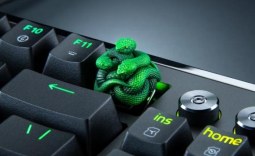 Razer announces its first Artisan Keycap with the Triple-Headed Snake Edition
 ZOTAC's 20th Anniversary Edition GeForce RTX 5080 features a titanium colorway and mirror-like backplate
 GeForce NOW app for Linux leaves beta, while DLSS Frame Generation cloud latency also improves
 Twitch opts streamers into gen AI training by default, faces harsh backlash
 Sean Murray still plays the 2016 launch version of No Man's Sky
 China's YMTC has climbed to third place in global NAND flash shipments
 $100 GTA 6 version makes up 89% of pre-orders, analysts estimate
 HWiNFO's latest update quietly confirms Intel is working on Razor Lake-AX
 Nintendo puts Switch 2 price increase warnings on store demo kiosks ahead of September 1 hike
 Corsair HS35 v3 Wireless Gaming Headset Review - An Affordable Winner
 D-Link F518 5G Wi‑Fi 6 AX1800 Mobile Hotspot Review: All-Day Mobile Hotspot
 Bose Lifestyle Ultra Speaker Review - Impressively Detailed Room-Filling Sound
 MSI Z890 Gaming Plus WIFI6E Review - Z890 for under $200
 Mortal Kombat (1995) 4K Ultra HD Blu-ray Review
 CPS PCCOOLER YS1200 ATX 3.1 80 PLUS Gold PSU Review
 ASRock X870E Taichi White Review: a premium AM5 motherboard with 10G LAN and WiFi 7
 Asetek Initium Pedal Modular Upgrades Review
 Thinkware U3000 Pro Review - Smart Dashcam with Wi-Fi quirks
 Montech TG3 Mid-Tower Chassis Review
 I ditched the Windows 11 context menu for this open-source tool, and here's why
 Windows 11 may be encrypting your drive already, and I checked where my recovery key went
 GIGABYTE's 40 Days of INFINITY celebrates 40 Years of Innovation with stunning GeForce RTX graphics cards and rewards
 I swapped File Explorer for this free file manager and finally got the layout I wanted
 How to tell if someone has been using your Windows PC without your permission
 6 Task Manager tips for troubleshooting Windows performance problems
 ASUS ROG's 20th Anniversary Line-up of Premium PC Gaming Gear has Arrived - Here's Everything You Need to Know
 Six File Explorer tips every Windows user should know
 I switched my PC to encrypted DNS in Windows 11, and browsing felt more private
 Printer Not Working in Windows? How to fix detection, print queues and drivers