







Mobile Devices - Page 118
Mobile device news - smartphones, tablets, iPhone, Android, and foldables. Launches and trends from TweakTown. - Page 118
Stay Updated
Follow TweakTown for breaking tech news, reviews, and daily updates.


As an Amazon Associate, we earn from qualifying purchases. TweakTown may also earn commissions from other affiliate partners at no extra cost to you.
Oppo says it can charge a 2500mAh battery in less than 15 minutes
MWC 2016 - Most high-end smartphones can have their 2500-3000mAh batteries charged in around 1-1.5 hours, but how about 15 minutes? That's what Chinese smartphone manufacturer Oppo is teasing at Mobile World Congress.
The new technology is called Super VOOC, and can charge an empty smartphone battery in only 15 minutes. Oppo's impressive technology is still in the prototyping stage, but the company says that its smartphones coming out later this year and early 2017 will feature the super fast-charging batteries. At MWC 2016, Oppo showed off a reference smartphone with a 2500mAh battery that went from empty to 85% charge in just 7 minutes, which is damn impressive.
Qualcomm's competing technology, Quick Charge 3.0, can get a smartphone from 0-80% in around 35 minutes, so Oppo has something impressive right now - but is only at the prototype stage. While Qualcomm's QC3.0 is slower, it's here right now.
Continue reading: Oppo says it can charge a 2500mAh battery in less than 15 minutes (full post)
NVIDIA Shield finally receives its new Android 6.0 update
After promising it earlier and delays because of issues with the update, Android 6.0 has arrived on the Tegra X1-powered NVIDIA Shield. NVIDIA Shield is the company's 4K-capable Android TV-based device, which you can read all about here in our review.
The new update doesn't just include Google's latest mobile OS, but it also includes the next generation Vulkan API. With support for Vulkan, the NVIDIA Shield becomes the first consumer product based on Android to support the next-gen API. The new Android 6.0 update for Shield doesn't just include Android 6.0 and Vulkan, here's the full update log:
Continue reading: NVIDIA Shield finally receives its new Android 6.0 update (full post)
Samsung Galaxy S7 lets you flag scam, fraud calls
We reported a lot of reasons to get excited about the Galaxy S7 earlier today, and now we have a few more, thanks to a partnership between Whitepages and Samsung.
The collaboration between the two companies means you'll have virtually complete knowledge and control of who's calling you and who can call you with the S7. Caller ID will tell you the who, even if they're not in your contacts, as well as if the number has been reported as fraud or spam. Naturally, you can report numbers as fraud or spam yourself.
All of this functionality is already available via the Whitepages app, which can be used with any phone, but to have it integrated by default is breaking new ground.
Continue reading: Samsung Galaxy S7 lets you flag scam, fraud calls (full post)
Panasonic just announced the toughest pair of mobile phones yet
Panasonic never ceases to amaze with the types of rugged sturdy computing devices they churn out. The newest phones Toughpad phones, the FZ-N1 and F1 with Android 5.1.1 and Windows 10 respectively, up the ante considerably while keeping them competitive with other high-end phones.
They have the extreme end of the hardware spectrum, but they're both powered by a Qualcomm Snapdragon 801 running at 2.3GHz with 2GB of RAM and 16GB of storage. The 4.7" 720P display is incredibly bright and you'll actually be able to read the screen in direct sunlight. And because this is marketed towards those that need a tough phone, gloved fingers won't be a problem with it's sensitive screen. It wouldn't be a toughbook product if it didn't have a slew of accessories mounted on it, like a barcode reader, NFC, dual SIM capability and a microSD slot.
Nor would it be cut from the same cloth as Panasonic's other rugged series of devices without an absolutely massive battery, either. Two options are available for both devices, a normal 3200mAh or a 6200mAh battery. And you can swap out batteries while it's running.
Continue reading: Panasonic just announced the toughest pair of mobile phones yet (full post)
Kyocera shows off a unique prototype solar-powered smartphone
Kyocera has a pretty interesting invention that they're showing off at MWC this year; the solar powered phone. This little device is a rugged proof-of-concept meant to integrate usable solar panels into a smartphone. And it works, sort of.
Last year they showed off a phone that integrated solar cells into the phones display. It was a very interesting concept that could potentially be very useful in certain, more rugged, sectors of the workforce. Or even those wanting to go off the grid completely. The redesigned solar cell technology, called Wysips Glass, from Sunpartner Technologies are much more efficient this time around. Three minutes of sun bathing net you a minute of uninterrupted talk-time. The device has a 5-inch 1080P screen with a newly designed app that can tell you how efficient it's charging. The other specs are absent at the moment.
The concept is just that, a rugged concept trying to show how easily this technology can be used. And like most concepts, it likely won't go to market in this form, but will form the basis for the integration of this into existing or newer technologies. Just the mere fact that transparent solar cells can be integrated into glass is a step towards bringing clean power to everyone through putting this into windows on buildings everywhere. The phone is a nice start, and seems to be a well thought-out design, thus far.
Continue reading: Kyocera shows off a unique prototype solar-powered smartphone (full post)
Even cheap smartphones are getting super powerful GPU's in the future
Mobile GPU's and SoC's are getting quite powerful these days, able to gently sip power and provide a graphical experience that's more than acceptable for smaller, and even some larger, screens. High-end mobile devices have always enjoyed great (relative) performance, but now Imagination Technologies wants to make powerful GPU's accessible even to lower-end hardware.
High resolution is cheap now, with better displays showing up on phones and in TV's for not much money. But GPU's powering our apps and features are not always up to the task. Imagination Technologies is seeking to change that by making more powerful, more efficient and overall less expensive to manufacture GPU's with their PowerVR8XE series.
They're making the entry-level GPU's smaller than the competition, by about 30-45%, while still keeping the same basic pixel fillrate. In otherwords, we're looking at seeing a 60-100% increase in performance at the same size. The PowerVR GE8200 and GE8300, their entry-level solutions, can pump out a surprisingly good two and four pixels per each clock, respectively. That's pretty impressive considering the power-envelope they're shooting for.
Continue reading: Even cheap smartphones are getting super powerful GPU's in the future (full post)
Superman in a phone, the CAT S60 can see everything, go everywhere
The CAT S60 is somewhat of a Superman smartphone, providing users with the ability to see when others cannot thanks to its thermal camera, live underwater for an hour due to its IP68 resistance rating and take a physical beating.
Released with 4G LTE functionality and a 3,800 mAh battery, Tim Shepherd from Bullitt Group is from the designer company of this phone and he told PC World that the sim and expandable storage dock is located under a rear door for good reason: "We put it on the back, not the side, because otherwise it's a structural weakness."
While the structural process was a major focus in the S60, the thermal camera is certainly a big selling feature. With the thermal camera being powered by FLIR and utilising a Lepton image sensor, you can expect a raw recording resolution of 80 x 60 infrared pixels, explained as interpolated up to a 640x480 image thanks to integration with the 13-megapixel camera sitting alongside.
Continue reading: Superman in a phone, the CAT S60 can see everything, go everywhere (full post)
Samsung's new Gear 360 camera, captures 360-degree video for Gear VR
MWC 2016 - Samsung unveiled its new Galaxy S7 and Galaxy S7 edge smartphones yesterday, with Jeff calling them a "surprising refinement" from last year's Galaxy S6 and S6 edge.
Included in the announcement was the new Gear 360 camera, which captures 360-degree videos and photos to playback through the Gear VR - which comes free if you pre-order the Galaxy S7 or S7 edge smartphones. The Gear 360 features two 15-megapixel sensors, which are both find behind a fisheye lens, accompanied by a small 0.5-inch display.
Samsung's Gear 360 camera captures 3840x1920 @ 30FPS - which isn't exactly 4K, but it's damn close. As for images, it captures 30-megapixel images, with a resolution of 7776x3888. With no on-board storage, you'll need a sizable microSD card to keep the Gear 360 happy during those video-taking or photo-taking sessions. You can sync your new Galaxy S7 or Galaxy S7 edge to the Gear 360 with remote control features, and you'll be able to preview the video or images from the Gear 360, in real-time on your Galaxy S7 smartphone. Any videos taken on the Gear 360 can be viewed, stitched together, or saved directly to a Galaxy S7 smartphone.
Continue reading: Samsung's new Gear 360 camera, captures 360-degree video for Gear VR (full post)
HTC unveils its new mid-range Desire 530, 630 and 825 smartphones
MWC 2016 - Samsung has unveiled their new Galaxy S7 and S7 edge smartphones while LG truly surprised with its G5 announcement - but HTC isn't left out in the cold, as it took a different approach with its new mid-range Desire smartphones.
HTC unveiled the Desire 530, 630, and 825 smartphones at Mobile World Congress - something the company is calling a micro splash design. The smartphones definitely look good, with HTC saying that the look was achieved using spray nozzles with different settings of pressure and paint viscosity. All three Desire smartphones are polycarbonate with rear cameras in the upper left corner, zigzagging speaker grills, and holes in the back for a lanyard.
Starting with the Desire 530, we have a Qualcomm Snapdragon 210 processor, while the Desire 630 and 825 feature the snappier Snapdragon 400 processor. The Desire 530 has 1.5GB of RAM while the other two Desire handsets have 2GB of RAM while the Desire 530 features an 8-megapixel rear-facing camera, the other two models bump it up to a 13-megapixel snapper. All three models include a 5-megapixel selfie-shooting camera while all the models include 16GB of internal storage, it's expandable by microSD.
Continue reading: HTC unveils its new mid-range Desire 530, 630 and 825 smartphones (full post)
HP's Elite X3 isn't just a phone, it's a full blown office companion
HP is back in the phone business after their brief encounter with WebOS and the Palm Pre series of sliders. But this time, they're infusing top-end hardware into a Windows 10 phone to make it an all-in-one ecosystem for businesses.
The phone itself is a svelte matte-black brick of a case with a 5.96-inch 1440p display that's been stuffed with the Kyro cored Qualcomm Snapdragon 820 chipset that has four total custom designed 64-bit cores with two operating at a blistering 2.15GHz and two more cores, for the less busy tasks humming along at 1.6GHz. It'll be paired with 4GB of LPDDR4 RAM 64GB of storage, standard. In case that isn't enough storage it can be expanded by 1TB through the microSD card that's on board. Two SIM cards can be populated letting world travelers just keep in their favorite destination's carriers SIM just in case.
But the really interesting bit is the inclusion of a laptop dock, similar to the one that was being marketed with the Motorola Atrix from 2011. This lapdock is a 12.5-inch screen with a full-sized keboard, trackpad and a 48WHr battery attached, letting you use Microsoft's Continuum to display on the larger screen. The phone is being marketed towards businesses, where this one device can theoretically replace both laptop and phone, becoming the only device you might need to be productive. But just how would that work?
Continue reading: HP's Elite X3 isn't just a phone, it's a full blown office companion (full post)
Samsung Galaxy S7 and S7 Edge, surprising refinement from last year
The follow-on to last year's highly sought after Galaxy S6 and S6 Edge have finally been announced today at MWC. They're continuing to refine the forumla they began back with the more premium handsets last year with the Galaxy S7 and S7 Edge.
Image courtesy Anandtech
The two new devices will ship with the most recent version of Android 6.0 Marshmallow and will pack one of two different chipsets under the hood, as is tradition for Samsung. The US will receive a Qualcomm Snapdragon 820 with two Kyro cores operating at 2.15GHz plus an additional two lower power cores working at 1.6GHz. While the rest of the world will have access to Samsung's own Exynos 8 processor. The Exynos 8 is the first fully custom CPU from Samsung on their own 14nm LPP process. Paired to that is 4GB of LPDDR4-1800 RAM and 32GB of NAND with the microSD slot finally making a much-needed return.
Continue reading: Samsung Galaxy S7 and S7 Edge, surprising refinement from last year (full post)
Huawei announces the MateBook, their Surface competitor
Huawei today announced their own take on convertible PC market today, expanding into the Windows realm of devices while bringing their mobile expertise to bear. The MateBook is a 12-inch Windows 10 hybrid tablet designed to one-up Microsoft's own premium Surface line.
Their first foray into laptop territory is an attractive looking device at only 6.9mm thick and a surprising 1.4 pounds. The 12-inch screen is slightly smaller physically and in resolution than the current Surface Pro 4 and Surface Book though it boasts the same resolution of 2160x1440, usable aspect ratio and size as the Surface Pro 3. On such a small(ish) device, the pixel density, at 216 ppi, should be high enough for all but the most hawk-eyed of individuals. The screen they're using will have 85% of the NTSC color gamut.
The device is a true hybrid with a sturdy looking keyboard cover that doubles as a stand when you actually want to use it as a traditional laptop. Being their first computer, this might not initially tick all the boxes, but it seems to have learned from the mistakes of past hybrid makers. Included is a novel active pen and also has a laser pointer in one end to annoy co-workers.
Continue reading: Huawei announces the MateBook, their Surface competitor (full post)
LG unveils its new G5 smartphone, features 5.3-inch QHD display
MWC 2016 - LG has just unveiled its G5 smartphone at Mobile World Congress, with it featuring a 5.3-inch QHD display with its native resolution of 2560x1440 and 554PPI. The 'magic slot' was revealed, something hotly anticipated by myself and many others around the world, where it can be used to remove the battery, and so much more.
The LG G5 features a full-metal body, with the Qualcomm Snapdragon 820 processor inside. We have 4GB of LPDDR4 RAM, 32GB of onboard storage (expandable up to 2TB with microSD), a 16-megapixel rear-facing camera (that does 8-megapixel wide shots) and an 8-megapixel front-facing camera. Software wise, we have the latest Android 6.0 Marshmallow, and the usual Wi-Fi 802.11 ab/g/n/ac and USB Type-C connectivity. LG has included a 2800mAh removable battery, which is awesome.
The rear-facing camera is interesting, thanks to the 8-megapixel wide-angle lens with a 135-degree field of view, which takes beautiful wide-angle shots. LG also made a big mention of the always-on display, with normal users checking their smartphones at an average of 150 times a day, it's a great idea. This isn't the first time LG has used an always-on display, as it was featured on the V10 smartphone. The G5 is a flagship device, so what about the battery drain from the always-on display? Only 1/3 of the screen is turned on, with LG saying it uses only 0.8% of the battery every hour.
Continue reading: LG unveils its new G5 smartphone, features 5.3-inch QHD display (full post)
Samsung Galaxy S7 revealed again before its impending launch
Mobile World Congress 2016 has kicked off, but Samsung's official announcement and reveal of the Galaxy S7 isn't for a little while yet. But before the announcement, we've seen yet another leak, showing us the Galaxy S7 in the best detail yet.
The new leak is courtesy of Android Headlines, with our best look at the Galaxy S7 to date. We can see that the Galaxy S7 definitely features a slightly better design than the S6 and S6 edge, with a fingerprint sensor as the Home button. We know that the Galaxy S7 is now 5.5 inches long, with volume buttons on the left and power button on the right. The rear-facing camera doesn't such a protruding lens, which is great for when the Galaxy S7 is laying face down.
Samsung will unveil the Galaxy S7 at MWC 2016 shortly.
Continue reading: Samsung Galaxy S7 revealed again before its impending launch (full post)
Why the Freedom 251 smartphone is so cheap
Yesterday we reported India was getting a new $4 smartphone dubbed the Freedom 251. With a price that low, naturally, concerns have arisen over its quality and sourcing.
Turns out Ringing Bells -- the company behind the phone -- is expecting to get lot of breaks, allowing it to cut costs now in anticipation of future savings. Bells is expecting state governments to waive duty fees, with more waived through the Make in India initiative (amusingly, the phones will be 70 percent made in Taiwan) and startup schemes. Finally, they say the remaining cost reductions will be made through 'economies of scale.'
Without these breaks, they claim the phone would cost anywhere from $36 to $43. So why not do that anyway? Marketing. The idea is to sell the 251 on the cheap in order to make its new brand famous (and it's sure working so far), then use that fame to sell future higher-priced models. Keep in mind it plans to sell only about 200,000 phones at the $4 price. The scheme worked for Datawind, who manufactured the aforementioned tablet -- no doubt Ringing Bells is following their lead.
Continue reading: Why the Freedom 251 smartphone is so cheap (full post)
Indian company launches world's cheapest smartphone, just $4
While the West is selling $10 and less basic, programmable computers like the Raspberry Pi Zero, India is taking the budget trend much farther. Today it releases the formidable Freedom 251 smartphone at the low, low price of Rs 251 (a little under $4).
The Freedom 251 features a 4-inch display, 1.3GHz quad-core processor, 1GB RAM, 1,450 mAh battery, 8GB internal storage (expandable to 32GB), and .2-megapixel rear camera and a 0.3-megapixel front camera. It runs on Android Lollipop 5.1, and comes pre-installed with the pop stuff like Facebook, YouTube, and WhatsApp, it has apps like Swachh Bharat (part of a "Clean India" initiative), Farmer (useful for -- you guessed it -- farmers), and Women Safety. It comes with a one-year warranty; customers can take the phone to any of the 650 centers across the country for repairs and the like.
The phone is developed by Ringing Bells, who have developed four phones to date, one $44. The Freedom 251 is tied into the government's Make in India campaign, which supports local manufacturing. It's still not clear as of yet how the phone costs so little, but one might think it's due to government assistance, particularly given the government in 2011 funded $36 Android tablets ($16 for schools, with the aim of promoting electronic education). Unfortunately, those turned out to be nigh unusable.
Continue reading: Indian company launches world's cheapest smartphone, just $4 (full post)
LG's unannounced G5 was on sale in Dubai for $680, teases dual cameras
LG have been teasing their next-gen G5 smartphone, and we still don't know the full details on it - but a pre-release model has surfaced in Dubai. The pre-release G5 smartphone sports the G5 logo on its backplate and was selling for 2500 dirhams, or around $680.
The G5 was on a site called Dubizzle, but it's no longer listed - of course. Photos of the G5 teased that it will ditch the plastic body that the G4 has, for an all-metal one, with a dual-camera setup on the back. We should see an impressive accessory slot, which should be used for user-replaceable batteries - but I'm expecting much more from that. I think we'll see some AR/VR technology being used in that slot, as well as the removable battery.
An always-on display will be featured, with notorious leaker @evleaks taking to Twitter saying "Finally saw the G5; secondary screen confirmed". Exciting times ahead for LG fans.
Continue reading: LG's unannounced G5 was on sale in Dubai for $680, teases dual cameras (full post)
Galaxy Note 6 rumored to be first 6GB smartphone
Weibo user HQ Vision has leaked some details on the Samsung Galaxy Note 6 smartphone. Apparently, that '6' is there for more reasons than one, as the device will house 6GB LPDDR4 RAM, making it the first smartphone to do so. This would put it ahead of even the Galaxy S7, so if you're keen on RAM, you may want to instead go for the S6.
Vision also claims the phone will feature a 5.8'' 2560x1440 screen (just slightly bigger than the 5.7'' display on the Note 5), a 12MP rear-facing camera with optical image stabilisation, either 64GB or 128GB of default storage, and likely, the option of either a Snapdragon or Exynos CPU. Finally, it's said to support the S Pen stylus.
The Note 6 is expected to launch later this year.
Continue reading: Galaxy Note 6 rumored to be first 6GB smartphone (full post)
Apple Pay said to be launching in China, France and Canada soon
Already released to those in the US and UK, rumors have mounted that Apple plans to release its payment platform to China extremely soon, with France and Canada to follow before the end of 2016.
While not confirmed by the tech giant directly, China bank announced the release on its official WeChat recently, stating the formal local launch of this service to be February 18th at 5:00.
Some Apple fanatics are looking for and discussing a possible Apple Pay French announcement during WWDC 2016, however unlikely. As for further releases, iPhone In Canada has recently found some Canadian banking related code, helping its mission to string together various Apple Pay related clues regarding a local release in its nation.
Continue reading: Apple Pay said to be launching in China, France and Canada soon (full post)
Here's why setting your iPhone date to 1970 bricks it
Yesterday we wrote about the fact that setting your precious iPhone's date to January 1, 1970 will destroy its usability - something that's currently unfixable, even by Apple.

Tech guru and YouTuber Tom Scott has posted a handy and easy to understand explanation as to why this event occurs. The quick and complicated explanation is that it is an "integer underflow caused by the Unix epoch," with Scott later on expanding this information for people like me who have no idea what 90% of those words mean.
Scott explained that setting your iPhone date to January 1, 1970 means that the value integer for this becomes 0. While this integer itself being 0 doesn't matter, when your phone tries to receive a text message and display it as being sent in the past, your phone will try and set this calendar integer into the negatives in order to explain the past-tense text message, crashing your phone.
Continue reading: Here's why setting your iPhone date to 1970 bricks it (full post)
 Iconic N64 shooter GoldenEye 007 is getting a native PC port
 Diablo 4 is coming to the Switch 2 with both expansions in a special Age of Hatred Collection
 CXMT DDR5 memory hits 9,000 MT/s speed milestone on AMD AM5 motherboard
 Sony says PlayStation 6 release date and pricing are still up in the air
 Lexar's DRAM-less Thor Ultra series PCIe Gen 5 SSDs are built for desktop and laptop PC gaming
 Gaming monitors are next in line for a price hike as manufacturers can no longer absorb costs
 Linux 7.2 makes TSC support mandatory for x86 CPUs, but it's not like Windows 11's TPM 2.0 check
 ChatGPT can now build a timeline of everything you do on your Mac
 Redditor finds a working RTX 2080 Super in the dump, gets a huge free upgrade
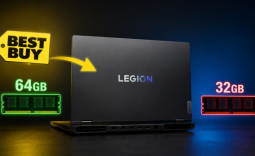 Redditor sends a gaming laptop with 64GB RAM for repair, comes back with 32GB RAM
 Cooler Master HAF II 500 Mid-Tower Chassis Review
 Corsair HS35 v3 Wireless Gaming Headset Review - An Affordable Winner
 D-Link F518 5G Wi‑Fi 6 AX1800 Mobile Hotspot Review: All-Day Mobile Hotspot
 Bose Lifestyle Ultra Speaker Review - Impressively Detailed Room-Filling Sound
 MSI Z890 Gaming Plus WIFI6E Review - Z890 for under $200
 Mortal Kombat (1995) 4K Ultra HD Blu-ray Review
 CPS PCCOOLER YS1200 ATX 3.1 80 PLUS Gold PSU Review
 ASRock X870E Taichi White Review: a premium AM5 motherboard with 10G LAN and WiFi 7
 Asetek Initium Pedal Modular Upgrades Review
 Thinkware U3000 Pro Review - Smart Dashcam with Wi-Fi quirks
 Using Multiple Monitors? Change these Windows settings for a Better Experience
 Windows Sandbox is The Windows Security Feature Most People Never Use
 I ditched the Windows 11 context menu for this open-source tool, and here's why
 Windows 11 may be encrypting your drive already, and I checked where my recovery key went
 GIGABYTE's 40 Days of INFINITY celebrates 40 Years of Innovation with stunning GeForce RTX graphics cards and rewards
 I swapped File Explorer for this free file manager and finally got the layout I wanted
 How to tell if someone has been using your Windows PC without your permission
 6 Task Manager tips for troubleshooting Windows performance problems
 ASUS ROG's 20th Anniversary Line-up of Premium PC Gaming Gear has Arrived - Here's Everything You Need to Know
 Six File Explorer tips every Windows user should know