







Learn about how TweakTown tests and reviews hardware. As an Amazon Associate, we earn from qualifying purchases. TweakTown may also earn commissions from other affiliate partners at no extra cost to you.
Stay Updated
Follow TweakTown for breaking tech news, reviews, and daily updates.


AMD unveils their dual-GPU beast, the Radeon HD 7990
NVIDIA have already entered the dual-GPU arena with their GeForce GTX 690, and have taken the crown once again with their Titan GPU, so AMD have been sitting out of the GPU spotlight for a while now.
This might all end with the unveiling of their Radeon HD 7990, their dual-GPU behemoth. GM of AMD's Graphics Business Unit, Matt Skynner, held up the card for the world to see, saying: "This is the first public showing. We're not saying much about it other than it's two series-7900 GPUs on a single card, and it's whisper quiet."
AMD's Radeon HD 7990 will be a full-sized, dual-slot card, which was expected. The heatsink and fan design runs down the entire card, with no less than three fans keeping the two GPUs cool. We should hear more on this card in the coming weeks, and I'm sure a proper unveiling before, or at Computex in Taipei in June.
Continue reading: AMD unveils their dual-GPU beast, the Radeon HD 7990 (full post)
Tibetan Activist targeted by Hackers using a trojan on their Android devices
Activist in Tibet might want to reconsider spreading the word about their next rally through their Android based smartphones. Researchers at Kaspersky Labs have just discovered a new Trojan virus that is designed to target Tibetan and Uyghur Activist.
The malware is specifically designed for Android Phones and is injected into the device when the unsuspecting user opens an email that references the recent World Uyghur Conference. Kaspersky says that this is the first documented attack that targets Android smartphones but it will most certainly not be the last.
In an interview with Mashable, Kurt Baumgartner, a senior security researcher at Kaspersky, said:
Yahoo buys news-summarizing app Summly for $30 million
Yahoo are on a continued mission to revamp their digital news and media business, with their latest acquisition of Summly, a startup that specializes in summarizing web content into a format made easier to consume media on a mobile device.
AllThingsD reports that the transaction saw Yahoo shifting $30 million to acquire the startup, 90% of it in cash with the remaining 10% in stock. The news gets better; with the iPhone app first designed by London-based Nick D'Aloisio, who was just fifteen years old when he created Summly.
What exactly does Summly do? Well, it allows you to choose your news sources from a bunch of pre-packages categories, or from your favorite websites. From there, it will let you enter keywords for topics that might be of interest too. Summly will also show you the latest stories that it has summarized in up to 400 characters, presented with a beautifully clean interface.
Continue reading: Yahoo buys news-summarizing app Summly for $30 million (full post)
Samsung unveil their Series 9 Premium Ultrabook, give it a 1080p display
Samsung have just injected some more pixels into their latest Ultrabook, the Series 9 Premium Ultrabook. The 13.3-inch Series 9 notebook included a 1600x900-pixel display, but the new and improved NP900X3E-A03US sports a 1920x1080 display.
It doesn't come close to the Google Chromebook Pixel or Apple MacBook Pro Retina displays, but it does provide a generous 40% more pixels than their previous generation Ultrabook. The improved Series 9 Premium Ultrabook includes the usual LED-backlit display which uses Samsung's SuperBright technology, which the South Korean company touts a 50% brighter display than a standard laptop monitor.
Cranking along inside the NP900X3E-A03US, we have Intel's Core i7-3517U processor, 4GB of RAM (why not 8GB?), a 256GB SSD, and Windows 8 Pro. Weighing in at 2.56 pounds and is just 0.51 inches at its thinnest point. What will all of this set you back? $1899.99. Not too bad, but the price is definitely getting up there.
Petr Mitrichev first repeat winner of Facebook Hacker Cup
Facebook's Hacker Cup is a contest in which programmers from around the world are given tasks that they must program solutions to. The third annual Hacker Cup championship took place over the weekend at Facebook's Menlo Park headquarters. This year's winner is the same as 2011's: Petr Mitrichev.
Mitrichev represents the first repeat winner of Facebook's Hacker Cup, though it's only been held for three years. Petr Mitrichev hails from Russia, though other countries were also represented at the finals. Contenders came from Australia, Belarus, China, France, Germany, Poland, Japan, Russia, Switzerland, and Ukraine.
Mitrichev was awarded first place and $10,000. Second and third place were given to Jakub Pachocki and Marcin Smulewicz, who both hail from Poland. Now the question remains: why wasn't the United States represented in this competition?
Continue reading: Petr Mitrichev first repeat winner of Facebook Hacker Cup (full post)
Google adds support for Gifs as Google+ profile pictures
Google is taking a page out of Facebook's book and is pushing images as a main part of Google+. As part of this initiative, Google has added support for Gifs to be used as Google+ profile pictures. Interestingly enough, Twitter dropped support for Gifs last September. It'll be interesting to see if they reverse their decision.
Animated Gifs will be supported on both the desktop and mobile versions of Google+. As Matt Steiner, the person who first posted that Gifs are now supported, said, "[it is] like newspapers in Harry Potter." We imagine some creative people will make use of this to do some funny and interesting things, much like people did with Facebook cover photos when they were first introduced.
Continue reading: Google adds support for Gifs as Google+ profile pictures (full post)
China to get its own official Linux distro called 'Kylin'
China is notorious for trying to control every aspect of its citizen's computing lives. It regularly blocks websites, restricts software and cuts internet connection from its people. Surprisingly even with all of that control, the Chinese government seemingly loves Linux.
Most of you will be surprised to hear that China has had open source "Software Promotion Union" since 2004 and the union is teaming up with Canonical to create a better Linux distro just for China. Dubbed Kylin, this version of Linux is designed to replace "Red Flag", the current "Chinese only" Linux based OS.
Kylin will support Chinese characters and will link up with Chinese web services for banking, music streaming and local mapping. Reports have us seeing an official release of the distro as early as April. With Ubuntu Founder Mark Shuttleworth heading up the Software Promotion Union, we expect that estimate to be fairly accurate.
Continue reading: China to get its own official Linux distro called 'Kylin' (full post)
FCC Commissioner calls net neutrality the agency's biggest failure
Last week FCC Commissioner Robert McDowell announced that he would be stepping down from his seat at the FCC. McDowell was one of the biggest opponents to the Net Neutrality rules that were adopted by the FCC in 2010.
In 2010 the FCC approved net neutrality rules that prevented Internet service providers from blocking lawful traffic and banning discrimination against competitive services running over the ISP's networks. This was seen as a major win for internet lovers across the nation.
The controversy came when Wireless carriers were deemed to not be subject to those rules. McDowell opposed the net neutrality rules stating "I just think it was needlessly disruptive and a diversion of FCC resources." When asked to elaborate, McDowell had the following to say:
Continue reading: FCC Commissioner calls net neutrality the agency's biggest failure (full post)
Windows Blue build 9364 leaks out, multiple Live Tile sizes, same-width side-by-side apps on offer
The latest leaked build of Windows Blue has floated out and onto the Internet, with build 9364 of the upcoming updated OS is available in both 32- and 64-bit, and will set you back around 2.63GB as an ISO file.
This is of course a leaked build, nothing official, so it's only available from the usual file-sharing websites. The latest build shows off some updated larger and smaller Live Tiles, some more Start screen customization as well as updated side-by-side app view which helps multi-tasking quite a bit as you can now display two applications with matching width.
There are some other things included with build 9364, such as a Play option under the Devices panel, a screenshot button on the Share sidebar, as well as Internet Explore 11 which comes included with Windows Blue.
Lawmakers don't want you to be a glasshole and wear Google Glass on the road
Google Glass isn't even here yet and we're already seeing lawmakers make their movies. West Virginia lawmakers are trying to push in a new bill that would make it illegal to drive while "using a wearable computer with head mounted display."
The news comes from CNET, from a piece by Chris Matyszczyk, where he received an e-mail from Gary G. Howell, a Republican in the West Virginia Legislature. The e-mail read "your article on Google Glass prompted this bill." Matyszczyk asked Howell how this had all of the sudden transpired, but Howell isn't totally against Glass, telling Matyszczyk:
Google shut Reader down due to the high cost of privacy compliance
There are thousands of people, myself included, saddened by the news that Google are shutting down Reader in a couple of months. Why did they do it? News is now coming out that the Mountain View-based company closed Reader due to the hidden costs of keeping users' data private.
This is coming from an unnamed source of AllThingD, who said that the closure of Reader is at least partly due to Google's reluctance to build out the staff and infrastructure needed to deal with the legal and privacy issues related to Reader. The source added that Google are trying to position themselves so that they stop getting into expensive lawsuits, by adding dedicated staff to deal with legal issues to each of their teams.
When Google announced the closure of Reader, they didn't even have a project manager of full-time engineer dedicated to it. Google reportedly didn't want to spend the money building the service into a full-blown app, and on the flip side, didn't want to sell it to a third-party because of its deep integration with other Google Apps.
Continue reading: Google shut Reader down due to the high cost of privacy compliance (full post)
Blizzard announce Hearthstone: Heroes of Warcraft, a free-to-play strategy card game
Blizzard have yet another game that gamers will pour hours into, where during the Penny Arcade Expo, Blizzard announced a free-to-play, collectible card game based on the Warcraft franchise. Hearthstone: Heroes of Warcraft will see players select one of nine characters as they take turns summoning characters, casting spells and using weapons in a one-versus-one online game.
The company have said that they love collectible card games and have been playing them since their Silicon & Synapse days, adding that creating a digital card game like Hearthstone felt natural, so they constructed a small team of 15 developers to smash out the title. They were reportedly given more creative freedom to experiment, but it looks like it could pay off.
Hearthstone: Heroes of Warcraft will be made available for PC and Mac users, with an iPad version arriving at a later date. You can try to apply for beta access through your Battle.net account.
Apple have now achieved 100% renewable energy usage at their data centers
Apple have reached 100% renewable energy usage at all of their data centers, with their corporate facilities not far behind with 75% renewable energy. Considering the company was at just 35% renewable energy for their corporate facilities two years ago, this is a swift, and great change:
Apple made a commitment in May of last year after criticism hit then from Greenpeace over their energy usage, and while Greenpeace's ratings are based on erroneous calculations and assumptions, Apple still took the initiative to push forward and make more public statements about their energy usage and plans.
Apple's iOS 7 could see more of a 'flat design', Apple wants to simplify iOS even more
With Tim Cook steering the Apple ship, we are seeing the company go in a new direction, something I'm guessing will help them gain more users, but not alienate others who like iOS. The latest news is that the Apple CEO has set Jony Ive with leadership of Apple's Human Interface teams, as well as his role as the head of Industrial Design.
This news has suggested that Apple's hardware and software user interfaces could be intertwined even more, with one executive in charge of everything you see and touch on an iOS device. The Wall Street Journal has chimed in, confirming that this is true, with mobile software teams being briefed about new hardware prototypes earlier in the design cycle. Ive is now sitting in on the human interface team's review sessions, where he can have more one-on-one time with the new designs.
Bill Gates throws $100,000 on the table, wants you to build a better... condom
The Bill & Melinda Gates Foundation have put up a $100,000 of initial funding for someone who designs the "next generation of condoms." The money won't stop there, as the funding will expand up to $1 million for whoever is capable of delivering the next-gen contraception.
Considering that the basic form of contraception hasn't received many changes over the years, it is used by an estimated 750 million people across the world for both reducing unwanted pregnancies and the spread of sexually-transmitted infections. The Foundation's description of the challenge explains it as: "The primary drawback from the male perspective is that condoms decrease pleasure as compared to no condom."
A next-gen condom might give men more sensation, pushing them to use them more often, for the good of global health. When it comes to female condoms, "suffer from some of the same liabilities as male condoms, require proper insertion training and are substantially more expensive than their male counterparts."
Apple disables iForgot password recovery page after exploit discovered
After a security hole was discovered in Apple's iForgot password recovery page that allowed passwords to be recovered with just an e-mail and date of birth, Apple has disabled the page for obvious reasons. Navigating to the page now returns a "Currently Unavailable" status message that suggests you "check back later."
Make sure to enable two-step authentication on your account to help protect from future vulnerabilities such as this.
At the time of writing, Apple's page continually timed out for both my coworkers and myself.
Continue reading: Apple disables iForgot password recovery page after exploit discovered (full post)
ScienceTT: Source of great dinosaur extinction was not an asteroid, but actually a comet
For the last 50 years or so, it has been widely accepted that an impact from an asteroid was the direct cause of the extinction of the dinosaurs, but it appears that that theory has now been turned upside down. A recent report that was given at the 44th Lunar and Planetary Science Conference suggests that it was not an asteroid that caused the demise of the dinosaurs, but was actually a comet.
This theory is based on the fact that 180km wide Chicxulub crater in Mexico is simply too large to have been caused by a meteor, which is supported by the lack of an abundance of iridium. An element which would have been kicked up in vast quantities if such a large asteroid were the source of the crater.
Dr. Jason Moore, of Dartmouth College said: "You'd need an asteroid of about 5km diameter to contribute that much iridium and osmium. But an asteroid that size would not make a 200km-diameter crater," He theorized that the crater was created by something moving much faster than an asteroid, something with less rock and more ice.
Fujifilm releases two new camera models just in time for summer vacations, FinePix XP200 and S8400W
Fujifilm has just shown off two new cameras that will be added to its FinePix lineup in later this spring. One is aimed at the adventurer who finds themselves in or around water, while the other is more geared towards the higher end point and shoot market.
The funky looking FinePix XP200 is encased in a protective housing that makes it waterproof up to a depth of 50 feet, and has the added bonus of making it impact resistant. A 16MP CMOS sensor with a 28-140mm lens gives the camera an effective zoom length of 5X. The Wi-Fi equipped XP200 is capable of full HD video and 10 frames per second of continuous shooting.
A 16MP BSI CMOS sensor is at the core of the FinePix S8400W and offers a huge 24-1,056mm lens which equates to 44x zoom. An aperture of f/2.9 - 6.5 combined with an ISO range up to 12,800 ensures that you are always gathering as much light as possible for the best images possible. The S8400W is capable of HD video at 60FPS at 1080i and super slow motion capture at 480FPS.
US Department of Defense orders over half a million Apple iDevices, what budget cut?
The US Department of Defense (DoD) has just placed an order with Apple for over 600,000 iDevices to help supplement its arsenal. This huge purchase comes at a time of major budgetary cuts, a sequester which equates to $85 billion in lost spending.
Electronista first broke the news earlier today which detailed over 650,000 Apple devices being ordered. Included in the order were 120k iPads, 100k iPad minis, 200k iPod touches and 2010k iPhones. By my reasoning, that could amount to more than a $250 million payday for Apple.
Before everyone grabs their pitchforks and torches, the US Government has been looking to move from its antiquated BlackBerry devices to something new for some time now. This is most likely the first wave of a transition to iOS based devices and likely not the last major order we will see.
Apple, Adobe defend charging Australian customers more
While addressing the House of Representatives committee on IT pricing today, Adobe Australia and New Zealand managing director, Paul Robson, was questioned about the higher prices in Australia for their Creative Suite 6 software.
Considering Adobe charge Australians a not so down under 167% more, the question is a very big one to answer. Australians are paying $3175 compared to their US friends paying just $1899 for CS6. Robson said that consumers in Australia were paying the extra costs because they were automatically redirected to Adobe's Australian website, giving them the ability to access local discounts and community groups.
Robson didn't explain exactly why Australians pay more for Adobe software, saying that Adobe's use of Australian-only pricing or "geoblocking" was a "well established and legal process".
Continue reading: Apple, Adobe defend charging Australian customers more (full post)
 Geekbench 7 is out with CUDA support, smarter multi-core scoring, and new AI workloads across all major platforms
 GTA 6 physical copies in Japan have a 170-day expiration date
 Ubisoft believes remakes can be more profitable than new releases, after Black Flag Resynced exceeds expectations
 AMD is preparing the 8-core Ryzen 7 9800HX3D CPU for laptops with 96MB L3 cache
 Blizzard fires World of Warcraft game master for abusing god-like powers
 GIGABYTE adds CXMT DDR5 support to AM5 motherboards, supporting speeds up to 8200 MT/s
 Xbox 360 tech powers backwards compatibility on PC, original Xbox games use Xefu emulation
 Black Flag Resynced is selling far beyond Ubisoft's expectations, beats annual forecast in just two weeks
 Atari and Universal Pictures partner to create a movie based on Pong, Asteroids, Missile Command, and more
 Microsoft confirms every Windows PC is trackable and how it can lead to your arrest
 Thrustmaster T.Flight HOTAS 5 MSFS Edition Review
 SteelSeries Arctis Nova Pro Omni Wireless Headset Review - One Headset to Rule Them All
 SteelSeries Arctis Nova 7 Wireless Gen 2 Headset Review - New and Improved, But Is It Enough?
 AMD Ryzen 7 7700X3D Review - Days of Future Past
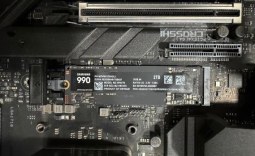 Samsung 990 2TB SSD Review - Ninth Gen QLC at PCIe Gen4 Speeds
 ASUS ExpertBook Ultra (Panther Lake) 14" Business Laptop Review
 ASUS ROG Raikiri II Xbox Wireless Controller Review - Ready to Take Control
 MOZA FMP18 Panel Bundle Review: authentic F/A-18 Hornet cockpit controls for flight sims
 Micron 6600 ION 245.76TB Enterprise SSD Review - Best in Class Programming Speeds
 MOZA MA3F EFCM Flight Control Module Review: authentic Airbus A320 autopilot panel for simulators
 How to Turn Your Windows Laptop Into a Second Monitor with Miracast and Wireless Display in Minutes
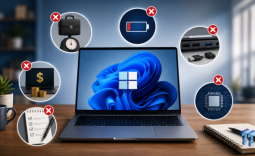 6 Mistakes to Avoid When Buying a Windows Laptop
 I capped Windows Update's bandwidth with Delivery Optimization, and my downloads stopped choking
 I use this decade-old free tool that finds files faster than Windows Search does
 I install and update most of my apps with this Windows command now, and I stopped downloading sketchy installers
 Hisense U6SF 65-inch MiniLED TV: High Performance Meets Leisurely Convenience
 I stopped digging through Windows menus after I set up this one folder
 Don't sell your Windows laptop until you do these things
 6 PC cleaning mistakes to avoid for safer hardware maintenance
 Phison and Intel Take Aim at Local AI's Memory Wall with aiDAPTIV