







Business, Financial & Legal - Page 13
Catch up on business, finance, and legal news shaping tech, gaming, and science - mergers, lawsuits, antitrust, IPOs, Big Tech earnings, and market trends. - Page 13
Stay Updated
Follow TweakTown for breaking tech news, reviews, and daily updates.


As an Amazon Associate, we earn from qualifying purchases. TweakTown may also earn commissions from other affiliate partners at no extra cost to you.
TSMC pitches an Intel Foundry joint venture idea to NVIDIA, AMD, Broadcom, Qualcomm
TSMC has reportedly pitched a joint venture foundry idea to US chip designers including NVIDIA, AMD, Broadcomm, and Qualcomm that would see the companies operating Intel's semiconductor fabs.

In a new report from Reuters, we're learning that TSMC would run the operations of Intel Foundry, but it wouldn't own more than 50% according to their sources. The talks are at an "early stage" and come after President Trump requested TSMC to help turn the US semiconductor market around as they've been bleeding out its semiconductor prowess to Taiwan and President Trump wants that business back.
Reuters reports that the details of the plan for TSMC to take "no more than a 50% stake and its overtures to potential partners are being reported for the first time. Any final deal -- the value of which is unclear -- would need approval from the Trump administration, which does not want Intel or its foundry division to be fully foreign-owned".
Pokemon GO maker Niantic bought by Scopely for $3.5 billion
Niantic, the makers of the hit app Pokemon GO have just been acquired by Scopely, a mobile gaming firm, for $3.5 billion.

Scopely has already established portfolio of mobile games, such as Monoloply Go, Stumble Guys, Star Trek TM Fleet Command, and Marvel Strike Force. Now, Scopely can add Niantic's video game business under its belt, which has been helmed by longtime leaders Kei Kawai and Ed Wu, who will remain on as studio heads. Pokemon GO launched in 2016 and quickly became a global phenomenon, drawing in millions of players, and even today, it still remains in the top 10 apps with more than 100 million players in 2024.
One of the main aspects of Pokemon GO and it's attractiveness is the social element, which has evolved into more than just catching Pokemon with your friends as themed festivals and events around the world have been setup in celebration of the game. Scopely even mentioned this in its press release, with the company stating that more people attended Pokemon GO Fest last year than Coachella, Lollapalooza, Glastonbury, Electric Daisy Carnival, and Tomorrowland combined.
Continue reading: Pokemon GO maker Niantic bought by Scopely for $3.5 billion (full post)
Trump vows to label attacks against Tesla as acts of domestic terrorism
Out the front of the White House President Donald Trump committed to deeming any acts of violence against Tesla dealerships an act of domestic terrorism.

The comments from Trump come after several Tesla dealerships and charging stations were targeted by vandals, seemingly in response to an emerging campaign against Tesla CEO Elon Musk for his involvement as head of the Department of Government Efficiency (DOGE), which is pursuing implementing sweeping cost-cutting measures throughout the US government. Trump and Musk were spotted outside of the White House in a Tesla vehicle, and after exiting the vehicle, Trump was asked about the labeling of the emerging violence against Tesla seen across the country.
Trump responded to the question, which can be seen in full below, by agreeing attackers should be labeled as domestic terrorists, and then went on to name several other American companies he has "stuck up for". Trump continued and explained he wants to protect any American company, and that "we are going to catch them". The President added that many of the dealerships have quite a lot of cameras, and that "we already know who some of them are, we're gonna catch them. And they're bad guys."
Take-Two accuses GTA online account sellers of stealing 'millions in revenue'
Take-Two Interactive, publisher of Grand Theft Auto, Borderlands and the NBA 2k franchise, has filed a lawsuit against Player Auctions, a marketplace that sells online player accounts, items, and virtual currency.

The filing joins Roblox, who lodged a similar notion last month. Take-Two's lawsuit was filed at the US Central District Court of California last week, as reported by Polygon. The company has accused PlayerAuctions of running a 'lawless enterprise' and claims that the marketplace has engaged in 'rampant infringement and other unauthorized conduct' on the site.
The filing itself alleges that PlayerAuctions runs a sophisticated sales platform, and that it actively recruits 'sellers' who engage with hacking software and exploits to create infringing goods. Specifically, they point to 'thousands of listings' that contain heavily modified player accounts, in-game assets, and virtual currency - which they claim were gained through the use of hacking software, cheats, and exploits.
Las Vegas Sphere owners plan to spawn smaller 5,000-seat mini spheres
The Las Vegas Sphere may soon get little brother and sister spheres as the company behind the $2.3 billion project is looking to expand its offerings into smaller spherical venues.

Sphere Entertainment's Executive Chairman and CEO James Doland recently spoke to industry analysts and informed them the company is looking into smaller Sphere's that would seat approximately 5,000 people, which is considerably smaller than the Las Vegas Sphere, which on paper can seat about 17,600, but could probably fit as many as 20,000 people standing.
Notably, these smaller spheres would require less property and parking, would be cheaper to build, and would likely attract many more artists that can necessarily fill the Las Vegas Sphere but can comfortably sell out 5,000 seats. There is also another barrier to entry the public may not consider when an artist wants to book the Las Vegas Sphere, and that is the considerable investment in producing custom-made video content for the 160,000-square-foot LED screen.
Continue reading: Las Vegas Sphere owners plan to spawn smaller 5,000-seat mini spheres (full post)
President Trump says US chip business was stolen from USA by Taiwan, blames former presidents
President Trump has said that Taiwan stole the US chip business from the USA, but didn't blame the country, instead placing the blame on former presidents and administrations.

In a new chat with the press in the Oval Office today, President Trump talked about ex-CEO of Intel, Andy Grove, calling him a great man, and that the fall of Intel started once he was finished as CEO.
President Trump said: "I used to read about him when I was a young man, and he did an incredible job. He really dominated the chip business, and then he died, and I guess they had a series of people who didn't know what the hell they were doing and we gradually lost the chip business, and now it's almost exclusively in Taiwan... they stole it from us, they took it from us".
TSMC chairman says US fabs are already fully booked into 2027, new 2027 lines already reserved
TSMC chairman C.C. Wei says that its US fabs are fully booked through 2027, with its new 2027 production lines also reserved.

The semiconductor champion has expanded its US operations, announcing with President Trump that TSMC would be spending another $100 billion on semiconductor fabs on US soil, and even with these huge investments, Taiwan will not suffer as there are 11 new production lines being built in Taiwan this year alone... but "it is still not enough" says the TSMC founder.
Wei made the new comments during a joint press conference with Taiwan President William Lai, adding that there isn't enough land in Taiwan for TSMC's new semiconductor fabs, to which President Lai said the government would absolutely step in and help provide more land, water, and electricity to TSMC.
NVIDIA's market value tanks again, with $200 billion wiped amid tariff fears
NVIDIA's stock took another major hit this week, dropping nearly 9% in a single day, following President Donald Trump's confirmation that new tariffs on imports from Canada, Mexico, and China would go into effect. The sell-off wiped over $200 billion from NVIDIA's market cap, bringing it down to $2.73 trillion, its lowest point since September.

Prior to this, NVIDIA had almost fully recovered from the DeepSeek panic selloff, which saw the company lose $600 billion in market value in January after concerns over low-cost AI competition. However, as reported by Yahoo, this latest drop shows how fragile market sentiment remains.
The new 25% tariffs on Canadian and Mexican imports, alongside a 10% tariff on Chinese goods, have reignited fears of rising manufacturing costs. While NVIDIA's AI chips are produced in Taiwan, which is currently exempt from tariffs, many of its products are assembled in Mexico, meaning these new trade restrictions could impact pricing and supply chains.
NVIDIA says TSMC's new fabs will be the 'foundational pillar' of tech supply chain in the USA
President Trump and TSMC just announced the largest single foreign direct investment in US history, with another $100 billion to expand TSMC's operations on US soil.

The ofifcial X account for NVIDIA posted: "TSMC's new fabs will be the foundational pillar of a new technology supply chain centered in the United States. NVIDIA will fully utilize TSMC's global manufacturing network to enhance our supply agility and resilience".
TSMC Chairman and CEO Dr. C.C. Wei, said: "Back in 2020, thanks to President Trump's vision and support, we embarked on our journey of establishing advanced chip manufacturing in the United States. This vision is now a reality. AI is reshaping our daily lives and semiconductor technology is the foundation for new capabilities and applications. With the success of our first fab in Arizona, along with needed government support and strong customer partnerships, we intend to expand our U.S. semiconductor manufacturing investment by an additional $100 billion, bringing our total planned investment to $165 billion".
President Trump announces TSMC will be investing another $100 billion into US operations
TSMC has announced its intention to expand its investment in advanced semiconductor manufacturing in the United States, pledging an additional $100 billion.

The company already has $65 billion worth of investments into advanced semiconductor manufacturing operations at its fab in Phoenix, Arizona, with TSMC's total investment in teh US expected to reach $165 billion. This expansion includes plans for 3 new fabrication plants, two new advanced packaging plants, and a major R&D team center, with the company said "solidifying this project as the largest single foreign direct investment in US history".
TSMC expects to create hundreds of billions of dollars of semiconductor value for AI and other cutting-edge chips, with TSMC's expanded investment expected to create 40,000 construction jobs over the next 4 years, as well as creating tens of thousands of high-paying, high-tech jobs in advanced chip manufacturing and R&D on US soil.
NVIDIA and Broadcom are reportedly running manufacturing tests on Intel's new 18A process
NVIDIA and Broadcom are reportedly running manufacturing tests on Intel's new 18A process node, showing some much-needed early confidence for the company and its semiconductor business.

In a new report from Reuters, we're hearing that the two tests haven't been reported previously, and indicate that the companies are moving closer to the decision of whether they'll commit hundreds of millions of dollars worth of manufacturing contracts to Intel Foundry Services (IFS).
NVIDIA and MediaTek are TSMC customers, so winning these two chip giants over would be a huge deal for Intel, while its main CPU competitor in AMD, is "also evaluating whether Intel's 18A manufacturing process is suitable for its needs but it was unclear if it had sent test chips through the factory".
TSMC to begin mass production of A16 process tech in 2H 2026 in Taiwan, new Arizona fab in 2028
TSMC is expected to begin mass production of its next-gen A16 process node in Taiwan by the second half of 2026, and then "connect Taiwan and the United States" by introducing A16 process production at its third factory in Arizona, USA by 2028.

In a new report from UDN, we're learning that TSMC's first wafer fab in Arizona has begun mass production, with TSMC's Q1 2025 board meeting specially held in the Arizona plant to allow board members to receive first-hand knowledge that mass production was achieved at its new plant in the US.
UDN reports that the market believes that TSMC is showing its attention to the US market, and goodwill to the US government and the new Trump administration. TSMC's next-gen A16 process node is the first angstrom (smaller than nano) process node used by TSMC, with the company's nano process technology named the N series (N3, N4, N5, etc).
NVIDIA AI servers used in Singapore allegedly using banned AI GPUs smuggled through Malaysia
AI servers have been used in a fraud case that Singapore announced last week, with NVIDIA AI GPUs that were supplied by US companies like Dell, with banned AI chips from entering China according to a government minister on Monday.

Singapore has charged three men with a fraud case involving smuggling NVIDIA AI GPUs from the city-state to Chinese AI firm DeepSeek. Channel News Asia reports that the cases were linked to the alleged movement of NVIDIA chips from Singapore to be used by DeepSeek, "without identifying its source" reports Reuters.
Singapore's Home Affairs and Law Minister K Shanmugam told reporters on Monday that AI servers involved in the case were supplied by Dell Technologies and Super Micro Computer, before they were sent to Malaysia. He said: "whether Malaysia was the final destination... we do not know for a certain at this point" adding that authorities were investigating the case independently after an anonymous tip-off.
Intel delays expensive $100 billion Ohio semiconductor fab into the next decade: now in 2030
Intel has officially delayed the construction of its new Ohio One semiconductor manufacturing site, delaying the launch of its new fab into the next decade.

The company originally planned its Ohio semiconductor fab for 2025, but moved it to 2027-2028 not too long ago, and now that has been pushed back again until at least 2030. The first phase of the Ohio site (Mod 1) will now be completed in 2030, with production starting between 2030 and 2031, while Mod 2 is expected in 2031, with operations in 2032.
Intel's $28 billion Ohio chipmaking factories are located in New Albany, with the semiconductor fab plan changes made so that Intel can align its factory operations with market demand and "manage capital responsibility" said Naga Chandrasekaran, general manager of Intel Foundry Manufacturing in an email to staffers that was shared in a press release.
CHIPS Act expected to be killed after mass firings of NIST employees this week
Thousands of workers are expected to receive notices of firing this week as they are considered "probationary workers," which will result in the CHIPS Act being killed.

Multiple reports have pieced together that the multi-billion-dollar CHIPS Act is currently on the chopping block as departures of hundreds of National Institute of Standards and Technology (NIST) workers are expected to receive layoff notices this week. NIST workers headed the CHIPS Act by organizing the signatures of multiple companies to receive grants, and according to reports from Bloomberg, Axios, and now Semiconductor Advisors analyst Robert Maire, employees at NIST that have worked less than two years at the agency, including those who have received a promotion, will soon be let go.
As a result, the CHIPS Act will be dissolved, as no one will be left to administer it. Trade tariffs are expected to replace it.
TSMC says plans for 2nd Japan fab remain unchanged after Japanese media reports of it delayed
TSMC plans for its 2nd fab in Japan remain unchanged, going against recent Japanese media reports that construction was being delayed at TSMC's new Kumamoto Plant 2 to "within this year".

Japanese media reported earlier today that TSMC's new Kumamoto Fab 2 construction had been delayed from March 2025 to "within this year" but the production time remains unchanged. In response to questions from reporters, TSMC said that JASM's plans for the second wafer production facility in Japan is still happening, but had no further information to share at the time.
TSMC's goal of having its 2nd fab operational and put into production before the end of 2027, with the new Kumamoto Fab 2 plant to make 6nm semiconductor wafers in Japan.
Apple to spend half a trillion dollars across the US over the next four years
The threat of trade tariffs from President Donald Trump has pressured Apple to invest half a trillion dollars into the United States across the next four years, with the company saying on Monday it will hire as many as 20,000 new workers.

According to a new article by Bloomberg's Mark Gurman, Apple said on Monday that it will be spending $500 billion over the next four years in the US, and at least part of that money will be dedicated to the construction of new server manufacturing facility slated for Houston, a new supplier academy in Michigan, and additional spending being funneled to current US-based suppliers. Notably, Apple pledging this $500 billion comes only days after Apple CEO Tim Cook met with President Trump in the Oval Office.
Trump said shortly after the meeting that Cook is "investing hundreds of billions of dollars," insinuating the company wants to avoid the new tariffs Trump has threatened to implement, which include a 10% tax on items imported from China - the location of where Apple builds the majority of its iPhones and many other products. Gurman writes that Apple's pledge of a $500 billion investment across four years marks the biggest commitment Apple has made to the US to date.
TSMC's next-gen 2nm monthly production capacity to hit 80,000 wafers by the end of 2025
TSMC is reportedly experiencing healthy development progress with its next-gen 2nm process node, with monthly production capacity expected to hit up to 80,000 wafers before the end of the year.

In a new report from UDN, we're learning that TSMC could hit 50,000 to 80,000 wafers per month by the end of the year, with TSMC chairman C.C. Wei mentioning that his company continues to expand its advanced process and advanced packaging capacity in Taiwan. This includes 3nm expansion in Tainan, 2nm expansion in Hsinchu and Kaohsiung, and the expansion of multiple advanced packaging capacity in multiple locations across Taiwan.
TSMC's cutting-edge 2nm process node has reportedly entered an intensive trial production phase, with estimations that its Hsinchu Baoshan plant having a monthly production capacity of 5000 to 10,000 wafers of new 2nm chips, with its Kaohsiung plant starting a small-scale trial production.
President Trump discusses 25% chip tariffs, Taiwan chip companies plan shift to US production
President Trump has ensured that semiconductor tariffs on chips imported into the US would increase higher over the course of 2025, with new details on the tariffs shared during a press briefing at Mar-A-Lago.

During the press briefing, President Trump was initially asked about tariffs for the automotive industry, but when pressed about his future plans for semiconductors and pharmaceuticals, President Trump said that the tariffs will "be 25% and higher" and that the tariffs would "go very substantially higher over a course of a year".
The US government will give chip companies the time to relocate their production to the United States, with President Trump adding that "we wanna give them time to come in" and that when the companies "come into the United States and they have their plant or factory here, there is no tariff".
Intel principal engineer: TSMC deal a mistake, Intel 18A is more advanced, has early adopters
Intel Principal Engineering Program Manager, Joseph Bonetti, says that the rumored TSMC deal is a mistake and that the new Intel 18A process node is more advanced, and that the company has early adopters onboard.

In a now-deleted post on LinkedIn, Bonetti said that Intel is making progress in semiconductor manufacturing and that Intel 18A -- which is destined for its upcoming Panther Lake CPUs -- is nearing completion. Bonetti said that Intel Foundry will prove itself with its own new products, and that early adopters include Microsoft and Amazon.
Bonetti talked about the concerns that Intel 18A might be beaten by TSMC's new N2 process node, noting that both nodes use gate-all-around (GAA) transistors, and that Intel 18A will have the added advantage of backside power delivery. Bonetti said that neither company (Intel nor TSMC) has a "2nm" node right now, but that Intel is on track to have theirs in production sooner than TSMC.
 Giveaway: 12 Winners Will Score MONTECH NX400 and NX600 CPU Coolers
 GTA 6 leaks have reportedly led to a morale drop at Rockstar, with Netflix frustrated as well
 The Blood of Dawnwalker won't hit 60 FPS on any console, PS5 Pro tops out at 40 FPS
 AMD claws back ground against Intel in the CPU market, climbs to 35% share in desktop CPUs
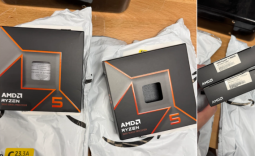 Redditor receives not one but TWO empty boxes of Ryzen 5 9600X from Amazon
 Xbox Series X25 Limited Edition Console is priced at $900, arrives November 2026
 Dave Bautista officially cast as Kratos in Amazon's 'God of War' TV Series, replaces Ryan Hurst
 Take-Two begins the hunt for GTA 6 leaker CyberLeek, subpoenas Microsoft and Discord
 PlayStation 6 handheld not expected to stay under $600, warns leaker
 AMD confirms the Radeon RX 9050 4GB will have a tiny 64-bit bus and just 16MB Infinity Cache
 Intel 'Nova-Lake-S' 28-core CPU with bLLC reportedly draws 296W at PL2
 Cooler Master MasterFan A120 Fan Review
 GIGABYTE MO27Q2A Gaming Monitor Review: 1440p, 280Hz, and QD-OLED is a winning combination
 Cooler Master V8 ACE 3DHP BLACK CPU Cooler Review
 ASUS ROG Strix XG129C Review: A $199 Gaming Monitor You Don't Play Games On
 Cooler Master HAF II 500 Mid-Tower Chassis Review
 Corsair HS35 v3 Wireless Gaming Headset Review - An Affordable Winner
 D-Link F518 5G Wi‑Fi 6 AX1800 Mobile Hotspot Review: All-Day Mobile Hotspot
 Bose Lifestyle Ultra Speaker Review - Impressively Detailed Room-Filling Sound
 MSI Z890 Gaming Plus WIFI6E Review - Z890 for under $200
 Mortal Kombat (1995) 4K Ultra HD Blu-ray Review
 Using Multiple Monitors? Change these Windows settings for a Better Experience
 Windows Sandbox is The Windows Security Feature Most People Never Use
 I ditched the Windows 11 context menu for this open-source tool, and here's why
 Windows 11 may be encrypting your drive already, and I checked where my recovery key went
 GIGABYTE's 40 Days of INFINITY celebrates 40 Years of Innovation with stunning GeForce RTX graphics cards and rewards
 I swapped File Explorer for this free file manager and finally got the layout I wanted
 How to tell if someone has been using your Windows PC without your permission
 6 Task Manager tips for troubleshooting Windows performance problems
 ASUS ROG's 20th Anniversary Line-up of Premium PC Gaming Gear has Arrived - Here's Everything You Need to Know
 Six File Explorer tips every Windows user should know