







Business, Financial & Legal - Page 16
Catch up on business, finance, and legal news shaping tech, gaming, and science - mergers, lawsuits, antitrust, IPOs, Big Tech earnings, and market trends. - Page 16
Stay Updated
Follow TweakTown for breaking tech news, reviews, and daily updates.


As an Amazon Associate, we earn from qualifying purchases. TweakTown may also earn commissions from other affiliate partners at no extra cost to you.
TSMC to begin equipment move-in at its biggest CoWoS packaging plant in Taiwan in April 2025
TSMC will reportedly begin equipment move-in at its biggest CoWoS advanced packaging and testing plant -- AP8 -- in the Southern Taiwan Science Park (STSP) in April 2025, according to the latest reports.

The company will have 2000 production line machines installed by the end of 2025, providing a huge boost to equipment makers, with TSMC's single largest advanced packaging plant and its production capacity being "very urgent" in the face of all this high-end chip demand.
TSMC's new CoWoS advanced packaging is in short supply, with production capacity doubled this year at its current factories in Nanke, Zhongke, and Zhunan. This year, TSMC is expected to double the production capacity of CoWoS again, with recent reports that the company is increasing prices of CoWoS advanced packaging by 15-20% this year.
NVIDIA and Qualcomm rumored to consider Samsung for 2nm, as TSMC 2nm costs are 'too high'
NVIDIA and Qualcomm are reportedly considering switching over production of their next-gen 2nm chips to Samsung Foundry, as the costs of TSMC making new 2nm chips is too high.

Samsung Foundry needs all the semiconductor customers it can get, and if it can poach two of the biggest in NVIDIA and Qualcomm for its next-gen 2nm (SF2) process node, then that's a huge win for the South Korean semiconductor industry against TSMC.
TSMC is currently in the lead with 2nm node production with a yield rate of approximately 60% and is conducting process testing with customers including Apple, NVIDIA, and Qualcomm, which are all major customers of TSMC. However, in new reports from Koreran media, the high price of TSMC's new 2nm chips and limited production capacity, Apple has moved away from using 2nm for its new chips until 2026, while NVIDIA and Qualcomm are now considering moving to Samsung Foundry.
TSMC has price increases of 5-10% for 3nm, 5nm processes and 15-20% for CoWoS packaging in 2025
TSMC is expected to drive up the prices of its 5nm and 3nm process nodes by 5-10% and its CoWoS advanced packaging by 15-20% thanks to unstoppable AI demand.

In a new post by LTN, we're learning that reports from the semiconductor industry that will see TSMC driving up the prices of its 5nm and 3nm advanced processes, which will fall in line with foundry prices for advanced packaging production capacity. We all know TSMC dominates the semiconductor world, and since they're the only ones capable of making the world's most advanced chips, price increases are on the way in 2025.
AI demand is also driving up TSMC's advanced process node and advanced packaging costs, with 3nm a nd 5nm nodes having tight production on capacity, with price rises of 5-10% expected starting in January 2025, while CoWoS advanced packaging costs will increase 15-20% as the market is oversaturated with mature processes.
TSMC begins mass production at its 1st Japan fab, will break ground on 2nd fab in Q1 2025
TSMC has announced it has started mass production at its first fab in Japan, with the Japanese government pushing to secure its supply chains for critical, and essential goods -- with the semiconductor industry being a key part of that.

The new fab in Kumamoto Prefecture produces logic chips with 12nm to 28nm process technologies, destined for carrs and image sensors, with recent news that TSMC's fab in Japan secured customers like Sony and auto parts maker Denso. TSMC has plans to build its second factory in Japan next to the first fab to produce higher-end 6nm chips, with construction aiming for March 2025, and operations beginning by the end of 2027.
Japan is wanting to secure its position in the semiconductor industry as soon as possible, with on-going tensions between the US and China (and Taiwan) set to continue to escalate, especially before President Trump is sworn in on January 20, 2025. TSMC has been offered $6.3 billion in subsidies from the Japanese goverrnrment, too.
TSMC silicon photonics tech first co-package optics (CPO) samples ready for NVIDIA, Broadcom
TSMC's next-gen silicon photonics advancements are hitting new strides, with its first co-packaged optics (CPO) samples expected to reach NVIDIA and Broadcom in 2025, pushing speeds of up to 1.6 terabits-per-second (1.6T) over fiber optic connections inside of new AI data centers in 2H 2025.

TSMC and Broadcom have jointly developed microring modulator (MRM) which has recently passed 3nm trial production, paving the way of integrating of top AI chips into CPO modules, with TSMC expected to use its CoWoS or SoIC advanced packaging.
In a new report from UDN, we're learning that the new advanced semiconductor packaging technology allows for 1.6T optical transmission, with NVIDIA and Broadcom being the first two customers of TSMC's latest tech. One of the leads on the silicon photonics packaging technology is the co-CEO of TSMC, Chiang Shangyi, who has industry-leading capabilities in optical communication components and semiconductor chip packaging technology, and works closely with Broadcom.
TSMC dominance leads South Korea to consider its own semiconductor biz with KSMC
TSMC is the king of the technology industry, controlling a dominant 90% of the world's advanced semiconductor manufacturing... and it's leaving South Korea shaking in its semiconductor boots.

In the rise of AI, South Korea's Samsung has been continuously falling behind -- especially with fellow South Korean memory rival SK hynix -- and that Korean media are now pointing out the fact that the South Korean government is well aware of the problem, and has plans to kick start a Korean Semiconductor Manufacturing Company, or KSMC.
KSMC would have the aim of following TMSC's successful model and would support the development of the local semiconductor industry, with experts saying that KSMC would face obvious challenges including the large technological gap with its competitors, and the lack of an industrial supply chain.
Best Christmas Gift Ever: ASML sells 'Lego' model of its TWINSCAN EXE:5000 High-NA machine
ASML is selling a Lego set of its bleeding-edge TWINSCAN EXE:5000 High-NA EUV lithography machines, but it's unfortunately only available to ASML employees.

There are many on social media calling for ASML to make its Lego set available to people outside of the company -- myself included -- but ASML spokesperson Monique Mols responded saying "sorry, but it's only for ASML employees".
Mopls was pressed about it again, but Mols said that the Lego model of the TWINSCAN EXE:5000 High-NA EUV lithography machine in its awesome Lego form is only a "fun iten for employees" as the company is celebrating its 40th anniversary. The Lego-style replica was selling for $216 on ASML's employee website, but the real machine costs over $350 million and weighs as much as two Airbus A320s... you know, the planes.
Honey extension exposed as the biggest scam in YouTube history
Honey, the browser extension marketed to consumers as a solution to easily finding the best coupons on the internet for purchasing products, has been exposed by a YouTuber for conducting shady business practices, misleading customers, and swiping affiliate marketing money from partners.

The YouTube channel MegaLag recently posted a 23-minute investigation into the extremely popular browser extension, purchased by PalPal for $4 billion in 2019. The investigation implicates some of the biggest creators on YouTube, such as MrBeast, MKBHD, Linus Tech Tips, and many others, all of which have promoted Honey to their audiences for many years. MegaLag explains Honey's nefarious business practices can be traced back to its extension, which presents itself to a user at the last phase of purchasing an item through a website.
Honey asks the user if they would like to apply the coupon codes the extension has found on the website, and after the user agrees, Honey begins "testing" the scraped coupons and adding them to the checkout. However, MegaLag discovered that if a user was carrying out a purchase through an affiliate marketing link, say through a YouTube video description which gives the creator of that YouTube video a kickback on the total purchase value of that product, Honey would covertly and unsuspectingly change the affiliate marketing link from the YouTuber's to Honey's own link.
Continue reading: Honey extension exposed as the biggest scam in YouTube history (full post)
US government asks NVIDIA how its AI GPUs have ended up in China, skirting US sanctions
The US government has asked NVIDIA to investigate how its best AI chips are ending up in China, pushing the company to ask big distributors, to start spot checks on customers in Southeast Asia.

In a new report from The Information and Reuters, we're learning that the US Department of Commerce is asking NVIDIA to look into how its chips are getting into China.
NVIDIA was being pushed to ask its big distributors Dell and Super Micro Computer (SMC) to conduct spot checks on their customers in Southeast Asia, with The Information reporting that 5 different people involved in smuggling NVIDIA chips say they've so far managed to evade detection during recent inspections by Super Micro.
Japanese semiconductor firm Rapidus announces 2nm trial production, eyes off TSMC and NVIDIA
Rapidus has just become the first Japanese semiconductor company to announce 2nm trial production, using ASML's bleeding-edge High-NA EUV lithography machines, and could enter the coveted supply chain for NVIDIA.

TSMC is ahead with its 2nm production but Rapidus is coming in quick, leaving semiconductor competitors Intel Foundry and Samsung, in its 2nm dust. Rapidus is an emerging semiconductor company, using ASML EUV scanners in a facility in Japan, with 2nm production reportedly on track and ready to compete with Taiwan semiconductor giant TSMC.
Rapidus unveiled that ASML's bleeding-edge EUV machines were being installed by the end of December 2024, which is said to be a revolutionary development for Japan's semiconductor industry. Rapidus said that it will kick off pilot production in April 2025, with commercial development expected to start in 2027.
TSMC's first fab in Kumamoto, Japan secures initial orders from Sony and Denso
The first Japanese wafer fab built by TSMC in Kumamoto will start mass production before the end of 2024, with its first batch of orders supplied to Sony and Denso.

In a new report from the Commercial Times, we're learning that TSMC said on December 17 that the construction progress of its new Japanese fab is "still in progress" and that the previously announced mass production schedule remains unchanged.
Yuichi Horita, the president of TSMC's Japanese subsidiary -- Japan Advanced Semiconductor Manufacturing (JASM) said that the Kumamoto Factory 1 had entered the final preparation stage for mass production, emphasizing that TSMC's first production line in Japan "will be of the same quality as the Taiwanese factory".
The Onion gets denied its bid to buy Alex Jones' InfoWars website
On November 15, Alex Jones confirmed that satirical website The Onion had purchased his conspiracy theory website InfoWars, following Jones being ordered to pay more than $1 billion in damages that resulted in him declaring bankruptcy.

Jones was ordered to pay more than $1 billion in damages for spreading misinformation about the tragic event that took place at Sandy Hook Elementary School. The $1 billion in damages caused Jones to declare bankruptcy, with some of his assets going to a bankruptcy auction, which is where The Onion won the bid for the InfoWars website. The Onion intended to turn the InfoWars website into "a very funny, very stupid website" with the assistance of "hall of famers" from The Onion and Clickhole.
However, Jones said he would push back against the purchase by The Onion, and it appears he has gained the favor of U.S. Bankruptcy Judge Christopher Lopez following a two-day hearing. According to reports, Lopez has denied The Onion's bid to purchase the website, saying he doesn't believe the bid is enough money. "I don't think it's enough money," he said in his ruling. "I'm not going to approve the sale...I think you've got to go out and try to get every dollar. I think that the process fell down."
Continue reading: The Onion gets denied its bid to buy Alex Jones' InfoWars website (full post)
Microsoft expects share price drop and a $800 million fine after GM exits robotaxi business
General Motors (GM) announced on Tuesday that it will exited the robotaxis business it has invested more than $10 billion in since 2016, sparking Microsoft to announce it expects an impairment charge of approximately $800 million in the second quarter of next year as a result of the departure.

According to reports, General Motors will be exiting the robotaxi business, specifically the Cruise autonomous driving company, citing "time and resources" to develop a sufficiently substantial fleet to compete against the already established businesses operating in the robotaxi market. Notably, Microsoft picked up a minority stake in Cruise back in January 2021, amounting to approximately a $2 billion investment that involved institutional investors such as Honda Motor.
General Motors doesn't appear to want to try and compete with robotaxi vendors such as Waymo, Tesla, and Amazon, with the company explaining that Cruise could generate as much as $50 billion in revenue by 2030, but this business arm of GM was expendable, especially considering that it isn't even the company's core business.
NVIDIA shows off future of 'AI compute' with silicon photonics, 3D GPU + DRAM stacking
NVIDIA's vision of the future of AI compute has been teased: the AI GPU leader sees the use of a silicon photonics interposer, 3D stacked DRAM, and GPU 'tiers' that tease GPU on GPU tech in the future.

In a new post on X from Ian Cutress, NVIDIA's vision of the future of AI compute has many different layers: module level cooling with a cold plate, die-to-die and tier-to-tier electrical connect, 3D stacked fine-grained DRAM, vertical power delivery, integrated silicon photonics, and an advanced package substrate.
Cutress reports that NVIDIA teased the silicon photonics interposer, SiPh intrachip and interchip, 12 SiPh connects wth 3 per GPU tile, 4 GPU tiles per tier, GPU 'tiers' as the image above shows, and 3D stacked DRAM with 6 per tile, fine-grained.
Samsung gearing up for 1c DRAM mass production, its competitive edge in HBM4 memory
Samsung is making advancements on its next-gen HBM4 memory, reportedly gearing up for new 1c DRAM mass production, which is a critical component of the competitiveness of its next-gen HBM4 memory chips.

In a new report from South Korean media outlet ZDNet, Samsung has started ordering equipment from its partners to start a 1c DRAM production line at its Pyeong Plant 4 (P4) with the installation expected to begin in Q1 2025. The introduction of Samsung's production equipment for its new 1c DRAM is expected to begin in February 2025, with more investments into the technology once yield rates stabilize.
ZDNet reports that Samsung had "good dies" from its 1c DRAM production, as it was in pilot line testing for the first time in Q3 2024. The new 1c DRAM represents the 6th generation 10nm-class DRAM, with a circuit line that is around 11-12nm, with it being one generation ahead of the currently commercialized 1b DRAM (5th generation) and is expected to reach full commercialization in 2025.
Russian weapons recovered on battlefield have US-made tech from Intel, Texas Instruments, more
Russia seems to still very easily get US-made tech after the US government (and its allies) imposed sanctions on the country, but weapons recovered from the special military operation in Ukraine have been found with US-made tech and semiconductors from the likes of Intel, Texas Instruments, and more.

In a new report from Bloomberg, we're learning that Russian weapons recovered from the battlefields in the region are "chock full of gear" from companies like Intel, Analog Devices, and more, adding "much to the frustration of officials in Washington, Brussels, and Kyiv".
The outlet got its hands on a "cache of records" that revealed new data showing just how easy-flowing the supply chain between Silicon Valley and Russia really is. The records show that many of the steps that suppliers to Russia's military take to get components from US chipmaker Texas Instruments, unbeknownst to the company itself. The data also reveals that identify Russian distributors handing out thousands of shipments on their way to Russia's military contractors, including multiple of them being under US sanctions.
Broadcom teases 'cutting-edge' 3.5D XDSiP tech: 4 compute tiles, 12 HBM sites fabbed by TSMC
Broadcom has just announced its new 3.5D eXtreme Dimension System in Package (XDSiP) platform technology, which enables consumer AI customers to develop next-generation custom accelerators (XPUs).

The new 3.55D XDSiP integrates over 6000 mm2 of silicon and up to 12 HBM stacks in a single package, enabling high-efficiency, lower-power computing for AI at scale. Broadcom says that it has achieved this significant milestone by developing and launching the industry's first Face-to-Face (F2F) 3.5D XPU.
Broradcom explains: "The immense computational power required for training generative AI models relies on massive clusters of 100,000 growing to 1 million XPUs. These XPUs demand increasingly sophisticated integration of compute, memory, and I/O capabilities to achieve the necessary performance while minimizing power consumption and cost. Traditional methods like Moore's Law and process scaling are struggling to keep up with these demands. Therefore, advanced system-in-package (SiP) integration is becoming crucial for next-generation XPUs".
TSMC's new 2nm chip yields are 'better than expected' in trial runs at its fab in Taiwan
TSMC's initial 2nm manufacturing yields have been better than expected during recent trial runs at its fab in north Taiwan, Hsinchu, with mass production of 2nm chips on schedule for 2025.

In a new report from Taiwanese outlet LTN and their supply chain sources, TSMC's 2nm trial production yield rate was "better than expected" and that the world's most advanced process technology will be mass-produced in 2025. TSMC's new 2nm process node will use nanosheet architecture for the very first time in the semiconductor industry, and is currently in trial production at TSMC's fab in Baoshan.
TSMC's new 2nm process node will see the company debut its next-gen nanosheet architecture, and after its 2nm node, we'll see the A16 process node that will combine the Super Power Rail architecture and nanosheet transistors, with TSMC's next-gen A16 node expected to hit mass production in 2026.
SpaceX is in talks to sell shares at new global top 25 company valuation
A new report from Bloomberg has revealed that SpaceX is in talks to sell off private shares held by employees at a price higher than expected.

Bloomberg cited people familiar with the matter, who informed the publication that SpaceX would be valued at approximately $350 billion, a stark increase from the previous estimation of $255 billion conducted earlier this year. The deal is noted as a tender offer and makes SpaceX the world's most valuable private company, putting it alongside mega-companies such as TikTok owner ByteDance. However, if you want to compare apples to apples, SpaceX stands alone in terms of valuation within the space industry, as there isn't another company that even comes close to the $350 billion mark.
This isn't surprising as SpaceX is far and away the leader in providing a reliable, reusable means of transportation to orbit. Its Falcon 9 and Falcon Heavy rockets have become the workhorses for the company, delivering payloads to the International Space Station (ISS), various orbital altitudes, and a means of ferrying astronauts to and from the ISS. Additionally, SpaceX has had quite a lot of success with its Starlink internet access program, having more than 5 million monthly customers across 114 countries.
Apple hit with lawsuit over ominous 'All-Seeing Eye' device monitoring employees
A former Apple employee has sued the company over alleged labor violations that accuse Apple of suppressing employee speech, and invading employee privacy via conducting surveilling on employees through personal iCloud accounts.

According to a new report from Semafor, the new lawsuit that was filed last Sunday in a California state court names the former Apple employee Amar Bhakta, who worked at Apple since 2020. According to Bhakta's suit, Apple used its internal policies to harm its employment prospects by preventing Apple employees from adequately describing their jobs, accomplishments while at Apple, and professional growth on job-search-based websites such as LinkedIn. Bhakta claims these policies surrounding job discussion have hindered his chances of future job prospects.
Additionally, the lawsuit alleges the Apple devices Apple employees are required to use "collect and use the valuable personal data" of employees during non-work periods. More specifically, the lawsuit states Apple employees have to agree to physical, video, and electronic surveillance by Apple and that Apple is within its rights to search any Apple or non-Apple device while an employee is on company premises. According to Bhakta's lawsuit, Apple employees are subject to "Apple's all-seeing eye" while both at work and at home.
 Giveaway: 12 Winners Will Score MONTECH NX400 and NX600 CPU Coolers
 GTA 6 leaks have reportedly led to a morale drop at Rockstar, with Netflix frustrated as well
 The Blood of Dawnwalker won't hit 60 FPS on any console, PS5 Pro tops out at 40 FPS
 AMD claws back ground against Intel in the CPU market, climbs to 35% share in desktop CPUs
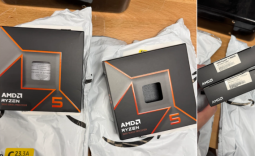 Redditor receives not one but TWO empty boxes of Ryzen 5 9600X from Amazon
 Xbox Series X25 Limited Edition Console is priced at $900, arrives November 2026
 Dave Bautista officially cast as Kratos in Amazon's 'God of War' TV Series, replaces Ryan Hurst
 Take-Two begins the hunt for GTA 6 leaker CyberLeek, subpoenas Microsoft and Discord
 PlayStation 6 handheld not expected to stay under $600, warns leaker
 AMD confirms the Radeon RX 9050 4GB will have a tiny 64-bit bus and just 16MB Infinity Cache
 Intel 'Nova-Lake-S' 28-core CPU with bLLC reportedly draws 296W at PL2
 Cooler Master MasterFan A120 Fan Review
 GIGABYTE MO27Q2A Gaming Monitor Review: 1440p, 280Hz, and QD-OLED is a winning combination
 Cooler Master V8 ACE 3DHP BLACK CPU Cooler Review
 ASUS ROG Strix XG129C Review: A $199 Gaming Monitor You Don't Play Games On
 Cooler Master HAF II 500 Mid-Tower Chassis Review
 Corsair HS35 v3 Wireless Gaming Headset Review - An Affordable Winner
 D-Link F518 5G Wi‑Fi 6 AX1800 Mobile Hotspot Review: All-Day Mobile Hotspot
 Bose Lifestyle Ultra Speaker Review - Impressively Detailed Room-Filling Sound
 MSI Z890 Gaming Plus WIFI6E Review - Z890 for under $200
 Mortal Kombat (1995) 4K Ultra HD Blu-ray Review
 Using Multiple Monitors? Change these Windows settings for a Better Experience
 Windows Sandbox is The Windows Security Feature Most People Never Use
 I ditched the Windows 11 context menu for this open-source tool, and here's why
 Windows 11 may be encrypting your drive already, and I checked where my recovery key went
 GIGABYTE's 40 Days of INFINITY celebrates 40 Years of Innovation with stunning GeForce RTX graphics cards and rewards
 I swapped File Explorer for this free file manager and finally got the layout I wanted
 How to tell if someone has been using your Windows PC without your permission
 6 Task Manager tips for troubleshooting Windows performance problems
 ASUS ROG's 20th Anniversary Line-up of Premium PC Gaming Gear has Arrived - Here's Everything You Need to Know
 Six File Explorer tips every Windows user should know