







Business, Financial & Legal - Page 19
Catch up on business, finance, and legal news shaping tech, gaming, and science - mergers, lawsuits, antitrust, IPOs, Big Tech earnings, and market trends. - Page 19
Stay Updated
Follow TweakTown for breaking tech news, reviews, and daily updates.


As an Amazon Associate, we earn from qualifying purchases. TweakTown may also earn commissions from other affiliate partners at no extra cost to you.
Qualcomm waiting for 2024 US election results before making its big move on Intel
Qualcomm is awaiting the outcome of the upcoming 2024 US presidential elections, before it sinks its teeth into an acquisition of Intel.

In a new report from BNN Bloomberg, we're learning that Qualcomm continues to discuss its takeover plans of Intel, but the company is waiting for the US 2024 presidential elections between Trump and Harris, before it makes its move. We should expect some big Qualcomm + Intel news in the first week of November, with the elections decided on November 5.
Qualcomm is awaiting a change at the White House to see what antitrust issues it'll be walking into depending on a Trump administration or Harris administration, as an acquisition of Intel is going to be incredibly difficult, no matter what happens with the 2024 US presidential elections.
NVIDIA stock closes at a record high: market value at $3.39T, just below Apple at $3.52T
NVIDIA stock closed at a new record high on Monday, topping $3.39 trillion and is expected to topple Apple as the most valuable company in the world sitting at $3.52 trillion market cap.

The rise in NVIDIA stock is driven by the unstoppable success of its AI GPUs and its newly-launched Blackwell AI GPUs including the B200 AI GPU and GB200 AI servers, which can't be fabbed by TSMC and made quick enough, with an expected $210 billion in revenue from Blackwell chips alone in 2025.
NVIDIA CEO Jensen Huang recently said that Blackwell AI GPUs are "in full production" and that the demand for them "is insane". TSMC is one of the key partners for NVIDIA and its runaway success in the AI market, with the Taiwanese semiconductor manufacturer set to enjoy a massive 40% increase in its quarterly profits, and expected to make that report later this week.
Man accused of creating Bitcoin denies involvement, points to QAnon conspiracy theories
A man who was identified as the creator of the world's most valuable cryptocurrency has denied his involvement in its creation, saying he has been wrongly accused.

HBO released a documentary on October 8 called "Money Electric: The Bitcoin Mystery," in which the creator identifies Bitcoin developer Peter Todd as the creator of the cryptocurrency. For those that don't know, a mystery surrounds the creation of Bitcoin as the individual behind it, famously named Satoshi Nakamoto, is only a pseudonym. This has led to much speculation as to who the is behind the creation of the Bitcoin algorithm, and to documentaries such as the one recently published by HBO.
Todd has since spoken out about the accusations, saying to The Register the claims made in the documentary, and the evidence to back them up is the "same kind of coincidence-based, circumstantial thinking that fuels conspiracies like QAnon." Adding, "Which is ironic, given that [Hoback's] previous big project was a documentary on QAnon. He clearly didn't try to debunk his theories either."
Valve could soon be forced to make Steam game libraries inheritable
Every day, more people are connected to the internet, and with the digital age becoming so engrained in our everyday lives, digital assets have become extremely valuable.

For example, Steam libraries can amass thousands of games which the owner has spent thousands of dollars to obtain. However, in the event of the owner passing, there are currently no laws that force Valve to transfer the account to the new owner if it's named in the original owner's will. In fact, this very scenario was proposed to Valve only earlier this year when it confirmed Steam accounts are non-transferable and that Steam Support is unable to merge account contents.
"I regret to inform you that your Steam account cannot be transferred via a will," wrote the representative from Valve. However, that might change as the European Law Institute, a non-profit organization designed to make recommendations and provide practical guidance on European legal development, has initiated work on a project that focuses on how to implement new laws that enable the succession of all digital assets, and any other "digital remains".
Continue reading: Valve could soon be forced to make Steam game libraries inheritable (full post)
New research in next-gen optical interposers: mutliple chiplets connected with low latency
The future of the semiconductor industry is the new arms race, with European researchers showing that the use of optical interposers, based on silicon photonics, could be an effective method for chiplet interconnects and could have reduced communication delays.

CEA-Leti is a European technology research institute, with their new optical interposers called Starac, with the use of silicon photonics and its conventional techniques that makes this new tech unique, and very capable. Starac's active optical interposers have infused electronic and photonic circuitry into a single package, paving the way for complex data routing and processing.
The new optical interposer technology uses a dedicated ONoC (Optical Network-on-Chip) which handles the high-speed data transmission between the chiplets, all without needing intermediate hops through the ring topology structure.
China pushes local companies to not buy AI chips from NVIDIA
A new report has cited two anonymous sources familiar with the matter that Chinese authorities have told local companies to avoid purchasing NVIDIA AI chips.

The report comes from the South China Morning Post and states that Chinese authorities have told local companies they should be choosing Chinese AI chip solutions over NVIDIA's products, which would include AI chips developed by Huawei Technologies. Notably, China hasn't officially banned NVIDIA-made GPUs, but as a result of the demand for GPU processing power fueled by the emergence of artificial intelligence, an export ban was placed on high-end chips, causing NVIDIA to create a China-specific H20 GPU in order to be able to sell its product across the region.
This isn't the first time we have heard of China asking local companies to opt for locally-made chip solutions, as it was back in May that The Information published a story that detailed Chinese regulators asking companies to reduce their purchasing number of NVIDIA GPUs. Additionally, it was only last week Bloomberg reported China asked local buyers to avoid NVIDIA. It's clear from this timeline that Chinese authorities want complete control over the AI chips within its country, seemingly meaning that NVIDIA, an American company, has a limited timeline of being able to trade in China.
Continue reading: China pushes local companies to not buy AI chips from NVIDIA (full post)
Hurricane Helene ruins North Carolina town that mines 70-100% of quartz used in semiconductors
Hurricane Helene has caused untold destruction across multiple states in the US, with a large impact on the ever-important semiconductor industry.

In what has been officially designated as the deadliest storm to hit the mainland US since Hurricane Katrina, the total quantum of its destruction is only just starting. In a small town in North Carolina that was recently hit by Hurricane Helene, is now on the radar because it could disrupt the multi-trillion-dollar global semiconductor industry because of the town's virtual monopoly over the mining of High-Purity Quartz (HPQ).
The town of Spruce Pine in North Carolina is home to just 2200 residents (as of 2022) but plays a crucial role in the global semiconductor industry through its mining that yields some of the world's purest quartz, which is then used to manufacture silicon wafers.
Qualcomm CEO is 'personally involved' with Intel takeover talks, which are at 'an early stage'
I'm sure that by now you've heard the rumors that Qualcomm has been pushing for a takeover of Intel, which would be the largest semiconductor industry acquisition in history... and it's something Qualcomm CEO Cristiano Amon is "personally involved" in.

Qualcomm CEO Cristiano Amon is "personally involved" in the negotiations to acquire 50-year-old (struggling) tech- juggernaut Intel, according to a "source who was briefed on the matter" reports Reuters. Additionally, another person familiar with the situation said that the Qualcomm CEO has been "actively examining various options for a deal for the company".
Earlier rumors pointed to Qualcomm considering acquiring bits and pieces of Intel's chip design business, and that its PC design unit was of interest to the company. Qualcomm executives were examining Intel's entire portfolio of businesses, according to Reuters, which added that the sources "requested anonymity as the discussions are confidential".
Intel scoops in $8.5 billion in new funding over the last few days, as Qualcomm eyes takeover
Apollo Global Management Inc. has offered to make a multi-billion-dollar into Intel according to the usual "people familiar with the matter" reports Bloomberg, in timing that couldn't be more perfect for the company experiencing its biggest issues in its 50+ year history.

Apollo Group manages assets worth close to $350 billion, and is putting forward an "equity-like" investment of up to $5 billion towards Intel, which should (but doesn't have to, nor should it completely) restore some confidence in Intel's turnaround strategy. Oh, and Intel qualifies for $3.5 billion in federal grants to make semiconductors for the US military.
Except, it's bleeding all over the place, losing chip deals like the next-gen PlayStation 6 to AMD, losing desktop and server + HPC market share to AMD, and struggling to even become (not stay) relevant in the discrete GPU industry.
Qualcomm tried to ninja buy Intel, made a 'takeover approach' this week as Intel struggles
Qualcomm reportedly made a takeover approach to Intel this week, according to The Wall Street Journal, and only weeks after rumors flew that Qualcomm explored buying 'pieces' of Intel's chip design business.

In the new report, Qualcomm approached Intel and taking control of the sinking ship, as Intel has been slipping in pretty much all divisions for years now. It has lost considerable desktop CPU market share to AMD, the same in the server/HPC markets, lost the GPU battle, the laptop battle is now shifting to AMD, it's firing 15,000+ staff, its semiconductor arm is struggling big time (and lost out to AMD for Sony's next-gen PlayStation 6 contract).
At this point, it's more like "what is Intel doing right?" and this is where Qualcomm seems to be heavily interested, but as Reuters points out, even if Qualcomm did acquire Intel, it would set off alarm bells across the planet, and especially the microscope of antitrust scrutiny.
Intel announces major changes ahead: manufacturing, job cuts, prioritizing x86 CPU business
Intel has been struggling for a while now, with rumors of an emergency board meeting being held where CEO Pat Gelsinger would outline his plan to turn Intel around (again) and now we're here. Yep, 15,000+ job cuts are on the chopping block for Intel.

Intel CEO Pat Gelsinger has posted a message to employees regarding the next phase of Intel's transformation after his meeting with the Board of Directors last week. Gelsinger said that he and the board have "a lot of work to drive greater efficiency, improve our profitability and enhance our market competitiveness". There were 3 key takeaways from the meeting that Gelsinger highlighted:
One of the first major announcements was that Amazon Web Services (AWS) has chosen Intel Foundry to make custom chips, with a multi-year, multi-billion-dollar framework covering products and wafers from Intel. Intel Foundry will produce an AI fabric chip for AWS on Intel 18A, the company will also make a custom Xeon 6 processor on Intel 3 that builds on the company's existing partnership, which makes Xeon Scalable processors for AWS.
TSMC, Micron, ASE seek deals to convert old display plants into CoWoS advanded packaging plants
TSMC, Micron, and ASE are working on getting deals to secure old display panel plants in Taiwan, and convert them to CoWoS advanced semiconductor packaging facilities to meet the unstoppable AI GPU demand.

In a new media report from Ctee, we're hearing that TSMC and Micron are interested in a HannsTouch factory near TSMC's Fab 18, which was purchased from HannsTouch affiliate, HannStar, back in 2020. TSMC could possibly rent display panel maker Innolux's Fab 5 due to delays with its construction at its new Chiayi CoWoS packaging plants.
Multiple chip makers are reportedly in discussions with Innolux over its Fab 2 which is empty, with ASE rumored to be eyeing off an Innolux plant in Kaohsiung, in southern Taiwan, but the plant is sitll in use so the deal probably won't go through.
US government pays $3 billion in interest every day from its national debt
A new estimate from a chief economist at an American multinational investment firm that primarily focuses on assets has shone a light on how much interest the US government is paying every day on the national debt.

The estimate comes from Apollo Global Management's Torsten Sløk, a chief economist at the company, who wrote on the official blog for the asset management company the US government is now paying on average $3 billion a day in interest expenses, which includes weekends. The new post by the chief economist cites data from the US Treasury Department, and the $3 billion in interest every day is up from the $1.5 billion the US government was paying at the beginning of 2022.
Reports estimate that continuing at this pace, the US government will pay a staggering $1.157 trillion in interest for the full fiscal year 2024. According to the Treasury Department's own data, the national debt is expected to hit a new record of $35.346 trillion by September 9, and as of September 17th, it's currently $35.378 trillion. "If the Fed cuts interest rates by 1%-point and the entire yield curve declines by 1%-point, then daily interest expenses will decline from $3 billion per day to $2.5 billion per day," writes Sløk
Intel qualifies for up to $3.5 billion in federal grants to make chips for US military
Intel has officially qualified for up to $3.5 billion in federal grants to make semiconductors for the Pentagon, in a new article published by Bloomberg.

The site reports from the usual "people familiar with the matter" saying that Intel has reached a "binding agreement" with US officials that falls under a secretive program called "Secure Enclave". This project will start production for advanced chips that will be used by the US military and intelligence applications, spanning multiple states and including a manufacturing facility in Arizona.
Bloomberg adds that while Intel was always the frontrunner for this award, there has "been pushback by other chipmakers" and concern in Washington "about the wisdom of relying on one firm, and a funding fight across multiple agencies and Capitol Hill that threatened to cut into Intel's total award".
US Department of Justice puts 3D printing in its crosshairs over custom machine guns
The US Department of Justice is turning its eye to the 3D printing industry that is fueling the creation of devices that convert semi-automatic guns into fully automatic weapons.

The announcement came from Deputy Attorney General Lisa Monaco, who issued a request last Friday asking the DOJ, along with the Bureau of Alcohol, Tobacco, Firearms and Explosives (ATF), to implement measures to prevent the growing number of machine gun version devices, or MCDs. According to the ATF, the number of MCDs of various designs has increased by more than 500% between 2017 and 2021. Monaco announced that new groups would be formed to track and tackle the issue of MCDs.
The Deputy Attorney has pleaded with the 3D printing community, along with software developers, technology experts, and any other relevant authority in the space, to help identify a solution to this problem, as "you know your industries and this technology better than anyone." The above image showcases an example of what an MCD can look like. These small devices can be the size of a USB drive and can be made out of a single sheet of plastic.
Samsung to cull up to 30% of its global workforce: admin, sales and marketing by end of 2024
Samsung is reportedly culling 30% of its global employees in its sales operations, according to a South Korean newspaper.

The South Korean electronics giant is struggling right now in multiple divisions: its semiconductor business can't keep up with TSMC, its HBM division can't beat SK hynix, and its smartphone sales aren't doing so well. Samsung replaced its semiconductor boss back in May, but we haven't seen much fruit from that tree so far.
Reuters' sources have said that one of their sources said that the job cuts at Samsung were being made in preparation for another slowdown in global demand for technology products as the global economy slows. Another source told Reuters that Samsung is "seeking to shore up its bottom line by saving costs".
TSMC expecting its first state-of-the-art High-NA EUV lithography machine from ASML this month
TSMC will get its very first High-NA EUV lithography machine from ASML later this month, after saying it didn't want or need ASML machines to make future chips, the Taiwan semiconductor giant will now get its first High-NA EUV machine and have installation begin by the end of September 2024.

According to Taiwanese media, TSMC will get its first High-NA EUV lithography machine later this month, so it can continue its dominance over South Korean semiconductor rival, Samsung. Intel has been receiving and setting up -- as well as paying billions of dollars with ASML -- its new High-NA EUV lithography machines, and now TSMC is joining the High-NA EUV fray.
ASML's new TwinScan EXE:5000 High-NA EUV lithography machines cost approximately $380 million USD per machine, but TSMC will have no problems ponying up the cash as it is swimming in it with its semiconductor dominance worldwide.
TSMC's new Arizona, USA plant achieves yields 'on par' with world-leading plants in Taiwan
TSMC has achieved production yields at its new Arizona, USA facility that is "on par" with established, world-leading plants back in Taiwan, according to new reports.

In a new piece by Bloomberg, the outlet reports that TSMC's yield rate in trial production at its Arizona plant, its first advanced plant in the US, are similar to comparable plants in the southern city of Tainan, in Taiwan, "according to a person familiar with the company, who asked not to be identified discussing private corporate matters".
TSMC said it began engineering wafer production in April 2024, with its newer 4nm process node. TSMC doesn't discuss or disclose its yield rates on chips, with investors instead relying on TSMC's ability to maintain steady margins. TSMC says it can maintain gross margin rates at 53% or higher in the long run, and has continued keeping its net profit steady at above 36% for the last 4 years... and with it being the world-leader in chipmaking, I don't see that slowing down anytime soon.
Qualcomm 'explored' buying PIECES of Intel chip design business, as Intel flounders its Foundry
Qualcomm has reportedly explored the possibility of acquiring portions of Intel's chip design business, in order to boost its own product portfolio, according to "two sources familiar with the matter" reports Reuters.

The mobile-focused company has looked into buying bits and pieces of Intel's businesses, just when Intel is struggling in multiple ways and needs to generate cash, and sell off its businesses. It's like playing Monopoly, the game, but with absolutely massive technology companies.
The client PC business for Intel is of "significant interest" to Qualcomm executives according to one of Reuters' sources, but they are "looking at all of the company's design units". There are some pieces of Intel that Qualcomm isn't interested in, Intel's server segment making less sense for Qualcomm to acquire, another source with knowledge of Qualcomm's operations told Reuters.
NVIDIA faces mounting anti-trust investigation over its AI chip dominance
A new Bloomberg report has revealed that NVIDIA is being investigated for antitrust violations related to its market dominance in the AI chip market.

According to the report, NVIDIA and other companies in the space have received subpoenas or legally binding requests to provide information on their AI chip practices. The investigation into NVIDIA specifically will look into whether the company is "making it harder to switch to other suppliers and penalizing buyers that don't exclusively use its artificial intelligence chips."
Furthermore, before the reports about NVIDIA being hit with subpoenas, the company's stock price fell by approximately 9% on Tuesday, resulting in more than $279 billion in market value being wiped away. While that definitely sounds like a bag Tuesday, it hasn't even made a dent in NVIDIA's overall growth, as the company has still more than doubled its stock value since the beginning of the year.
 Giveaway: 12 Winners Will Score MONTECH NX400 and NX600 CPU Coolers
 GTA 6 leaks have reportedly led to a morale drop at Rockstar, with Netflix frustrated as well
 The Blood of Dawnwalker won't hit 60 FPS on any console, PS5 Pro tops out at 40 FPS
 AMD claws back ground against Intel in the CPU market, climbs to 35% share in desktop CPUs
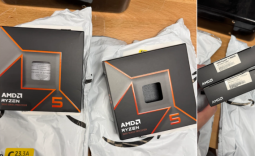 Redditor receives not one but TWO empty boxes of Ryzen 5 9600X from Amazon
 Xbox Series X25 Limited Edition Console is priced at $900, arrives November 2026
 Dave Bautista officially cast as Kratos in Amazon's 'God of War' TV Series, replaces Ryan Hurst
 Take-Two begins the hunt for GTA 6 leaker CyberLeek, subpoenas Microsoft and Discord
 PlayStation 6 handheld not expected to stay under $600, warns leaker
 AMD confirms the Radeon RX 9050 4GB will have a tiny 64-bit bus and just 16MB Infinity Cache
 Intel 'Nova-Lake-S' 28-core CPU with bLLC reportedly draws 296W at PL2
 Cooler Master MasterFan A120 Fan Review
 GIGABYTE MO27Q2A Gaming Monitor Review: 1440p, 280Hz, and QD-OLED is a winning combination
 Cooler Master V8 ACE 3DHP BLACK CPU Cooler Review
 ASUS ROG Strix XG129C Review: A $199 Gaming Monitor You Don't Play Games On
 Cooler Master HAF II 500 Mid-Tower Chassis Review
 Corsair HS35 v3 Wireless Gaming Headset Review - An Affordable Winner
 D-Link F518 5G Wi‑Fi 6 AX1800 Mobile Hotspot Review: All-Day Mobile Hotspot
 Bose Lifestyle Ultra Speaker Review - Impressively Detailed Room-Filling Sound
 MSI Z890 Gaming Plus WIFI6E Review - Z890 for under $200
 Mortal Kombat (1995) 4K Ultra HD Blu-ray Review
 Using Multiple Monitors? Change these Windows settings for a Better Experience
 Windows Sandbox is The Windows Security Feature Most People Never Use
 I ditched the Windows 11 context menu for this open-source tool, and here's why
 Windows 11 may be encrypting your drive already, and I checked where my recovery key went
 GIGABYTE's 40 Days of INFINITY celebrates 40 Years of Innovation with stunning GeForce RTX graphics cards and rewards
 I swapped File Explorer for this free file manager and finally got the layout I wanted
 How to tell if someone has been using your Windows PC without your permission
 6 Task Manager tips for troubleshooting Windows performance problems
 ASUS ROG's 20th Anniversary Line-up of Premium PC Gaming Gear has Arrived - Here's Everything You Need to Know
 Six File Explorer tips every Windows user should know