







Science, Space, & Robotics - Page 61
Explore the latest Science, Space, Health, and Robotics news from TweakTown. Coverage includes space launches, medical tech, discoveries, and rockets. - Page 61
Stay Updated
Follow TweakTown for breaking tech news, reviews, and daily updates.


As an Amazon Associate, we earn from qualifying purchases. TweakTown may also earn commissions from other affiliate partners at no extra cost to you.
NASA still watching weather as Artemis I rollback prep continues
NASA postponed the launch of Artemis 1, scheduled for September 27, because of Tropical Storm Ian's path off Florida's Atlantic coast.

The National Hurricane Center expects Ian to be upgraded to a hurricane on Monday, with it reaching normal hurricane strength the day after - when Artemis 1 was expected to launch from the Kennedy Space Center.
As of Sunday evening, NASA still hasn't ordered a rollback of the Orion spacecraft or Artemis uncrewed space launch system rocket back to the Vehicle Assembly Building. Engineers will monitor the weather situation overnight, then make a final decision tomorrow - but are hesitant to put the Artemis or Orion in danger.
Continue reading: NASA still watching weather as Artemis I rollback prep continues (full post)
MIT develops platform so robots can grip with correct force
MIT researchers have developed a new soft robotics platform able to grip items such as tools using the appropriate amount of force. The Series Elastic End Effectors (SEED) has been designed to allow robots to carry out tasks that require the application of force of a grasped tool with proper pressure.

Robotic advancements are still ongoing, but traditional rigid robots still have difficulty completing tasks that are easy for humans. To complement robots, SEED uses embedded cameras and soft bubble grippers that use deformation that is carefully mapped. Everything the robot senses can be tracked in real-time in a 3D image that changes shape around a particular object that is being used - and each experience can be later utilized as a learned model.
SEED makes it possible for robots to successfully move objects with six degrees of freedom so it can move an object back and forth, up or down, left or right, roll, yaw, and pitch. Tasks demonstrated included how to set a screw to the proper torque, use a squeegee to clean up a spill, and write with a marker.
Continue reading: MIT develops platform so robots can grip with correct force (full post)
NASA officially bans sex in space over fears of astronaut pregnancies
NASA has been concerned about astronauts conducting sexual relations during missions for quite some time, even to the point where the space agency officially prohibits sex and conception in space.

In a recent interview with The Daily Beast, Dr. Haig Aintablian, an emergency physician and fellow in space medicine at the University of California, Los Angeles, explained that there are good reasons why NASA bans sex in space, and its reasons aren't so astronauts are distracted from their duties. NASA bans conception in space simply because of the limited knowledge it, and other space agencies have about pregnant women working in space and the possible health impacts that would follow.
Humans have known for quite some time that space impacts the health of humans in various forms, hence NASA and other space agencies' enforcement of astronauts sticking to a rigorous workout schedule while aboard a long stay on the International Space Station (ISS). As for pregnancies, NASA and Russia's space agency Roscosmos have "limited success" in invertebrates and insects successfully conceiving offspring while in space. Scientists suspect that there would be limited impediments to human conception in space, but they don't know for sure.
Continue reading: NASA officially bans sex in space over fears of astronaut pregnancies (full post)
Mars has much more human trash on it than you'd expect
Mars has been a prospect for scientific exploration for more than 50 years, and every year the scientific operations grow on the Red Planet.

In a new article published in The Conversation, author Cagri Kilic, a Robotics Researcher, and Postdoctoral Fellow that focuses on the Inertial Localization for Planetary Rovers and Cooperative Localization for multi-robot systems with the Navigation Laboratory at West Virginia University, outlines that throughout humans' exploration of Mars we have left behind 15,694 pounds of debris.
The report outlines that so far, humans have sent eighteen man-made objects to Mars over fourteen missions, and that the debris left behind from these missions comes in three main categories; discarded hardware, inactive spacecraft, and crashed spacecraft. As explained by Kilic, whenever a space agency is landing a spacecraft on the Martian surface, it requires a module that is discarded after or throughout the landing process. This module contains vital protection for the rover/cargo as it contains a heat shield and a parachute.
Continue reading: Mars has much more human trash on it than you'd expect (full post)
Elon Musk gives date for when SpaceX will launch its Starship rocket
SpaceX is gearing up for its first orbital test flight of the highly anticipated Starship launch vehicle that is poised to be Earth's mode of transportation to the Moon and eventually Mars.

Elon Musk, the SpaceX CEO and founder, recently took to Twitter to give some updated details on Starship's development and when the public can expect the massive rocket to conduct its first orbital test flight. Musk shared details on SpaceX's plans for Starship and how the company is currently going through rigorous testing of Booster 7, which will be used in Starship's first stage. It was only earlier in the week that SpaceX tested seven of its Raptor 2 engines in a static fire test at its Starbase in Boca Chica, Texas.
Booster 7, when equipped to Starship, will feature thirty-three of these Raptor 2 engines, and judging by SpaceX's progress and the comments from Musk, it seems that Booster 7 will be what Starship uses in its first orbital test flight. Leading up to the launch, SpaceX will be making several improvements to Booster 7 that will increase its reliability while simultaneously adding protections to the engines in case of a malfunction. It should be noted that the Raptor engines are the most expensive part of the rocket.
Continue reading: Elon Musk gives date for when SpaceX will launch its Starship rocket (full post)
NASA gives update on critical fueling test for Artemis 1 moon rocket
NASA has provided the public with an update on its repaired Artemis 1 moon rocket named the Space Launch System (SLS) rocket.

Last month NASA wanted to kick start its Artemis missions by initiating Artemis 1, a reconnaissance journey around the Moon that would provide the space agency with the foundational knowledge that'll be used in future Artemis missions. NASA attempted to launch the SLS rocket on September 3 but encountered an unexpected liquid hydrogen leak, specifically at the "quick disconnect" interface located on the SLS's core stage. The fuel leak was unable to be remedied in time for launch resulting in the space agency postponing the launch to a later date and repairs to be conducted on the malfunctioning area.
Artemis 1 teams were able to identify the issue and replaced two seals around the quick disconnect on September 9, and following the repairs, the space agency scheduled a fueling test to see if the improvements were adequate. The fueling test was conducted on Wednesday this week, and overall, NASA has deemed the repairs a success as "all of the objects that we set out to do we were able to accomplish today".
Continue reading: NASA gives update on critical fueling test for Artemis 1 moon rocket (full post)
NASA spacecraft captures its first 'frosted cupcake' clouds on Jupiter
A worldwide team of citizen scientists collaborated with professional astronomers along with NASA's Juno team to create animations of Jupiter's cloud tops.

The team gathered data from NASA's JunoCam, which is the visible light camera that is located on NASA's Juno spacecraft that arrived in Jupiter's orbit in 2016. The Juno spacecraft was specifically equipped with JunoCam to spark more public interest in the exploration of Jupiter and its surrounding moons, and now the aforementioned citizen scientists, professional astronomers, and Juno team have demonstrated that the camera can be used for credible scientific operations.
Citizen scientist and professional mathematician and software engineer Gerald Eichstadt presented the results at the Europlanet Science Congress (EPSC) 2022 in Granada. According to the software developer, the Juno mission provides researchers with an opportunity to observe Jupiter in a way that is "essentially inaccessible" by Earth-based telescopes and that researchers are able to capture the same cloud features from different angles within only a few minutes.
Continue reading: NASA spacecraft captures its first 'frosted cupcake' clouds on Jupiter (full post)
NASA spacecraft about to collide with an asteroid photographs Jupiter
NASA is about to collide a spacecraft into a distant asteroid and on its way to its target NASA's spacecraft has snapped images of Jupiter.

NASA has taken to its blog on its website to reveal images snapped by its Double Asteroid Redirection Test (DART) spacecraft that expected to collide with the binary asteroid Didymos and its moonlet Dimorphos. The binary asteroid system doesn't pose any threat to Earth, but NASA want to test the first planetary defense technique that involves colliding a spacecraft into an asteroid in an attempt to change its orbit. The technique, called a kinetic impactor, if proven to be effective, may be used in the future to save Earth from an asteroid that is dangerous.
The DART spacecraft is equipped with an imager called the Didymos Reconnaissance and Asteroid Camera for Optical navigation, or DRACO, and during its journey it has been used by researchers to snap thousands of images of stars. The images are used by Johns Hopkins Applied Physics Laboratory (APL) team leading the mission to provide continuous support for the spacecraft in terms of making sure its trajectory lines up directly with the target asteroid. Furthermore, the images are used by DART's autonomous guidance system, which will also be used to make sure DART hits its mark.
Continue reading: NASA spacecraft about to collide with an asteroid photographs Jupiter (full post)
NASA begins investigation into James Webb Space Telescope glitch
NASA has launched an investigation into a technical glitch that presented itself on the James Webb Space Telescope's ultracold camera.

NASA took to its official blog to publish an update on the condition of the telescope's affected camera and how ground teams were forced into postponing certain observations while a remedy is created. The space agency explains that on Webb's Mid-Infrared Instrument (MIRI), there are four separate modes, and the device or mechanism that supports one of the modes is called the medium-resolution spectroscopy (MRS).
This mechanism allows for researchers to select what wavelength of light they are observing in, and according to a NASA update, the mechanism experienced an increase in friction during its setup on August 24. In response to preliminary health checks on the instrument and mechanism, NASA formed an anomaly review board on September 6 to assess the situation and provide the space agency with the best path forward.
Continue reading: NASA begins investigation into James Webb Space Telescope glitch (full post)
NASA's Webb captures the clearest image of Neptune's rings in 30 years
NASA's James Webb Space Telescope (JWST) is honing in on planets in our solar system, with NASA's newest observatory focusing its instruments on Neptune.

NASA has announced in a new release that researchers have used Webb's Near-Infrared Camera (NIRCam) to reveal an incredible view of Neptune's rings, which haven't been imaged at this level of clarity since NASA's Voyager 2 probe flew past the planet in 1989. Neptune is located approximately 30 times father from the Sun than Earth, making it our solar system's most distant planet.
Additionally, planets such as Neptune and Uranus are ice giants and are different to the gas giants such as Jupiter and Saturn. Ice giants are mostly composed of gaseous methane versus gas giants being almost entirely composed of hydrogen and helium. The methane that is present in ice giants such as Neptune and Uranus give it the blue color when observed through the visual light spectrum.
Continue reading: NASA's Webb captures the clearest image of Neptune's rings in 30 years (full post)
Flying hoverbike shown off with debut amazing flight
AERWINS Technologies has demonstrated its new XTURISMO hoverbike in flight at the latest North American International Auto Show (NAIAS) in Detroit.

The CEO of AERWINS Technologies, Shuhei Komatsu, was inspired to create the hoverbike by a love of Star Wars and its low-flying vehicles known as landspeeders. Komatsu said that he "wanted to make something from the movie real," referring to the hoverbike as "a land speeder for the Dark Side." The XTURISMO made its first appearance in the United States last week and marked the occasion by flying a few feet off the ground at Coleman A. Young International Airport.
The XTURISMO is currently being sold in Japan, as the Japanese government does not classify it as an aircraft; thus, users do not require a pilot's license to operate it. Komatsu hopes that the United States government will also consider the XTURISMO not to be an aircraft. The company plans to bring a smaller variant of the XTURISMO to market in the United States in 2023, retailing for an estimated $777,000, which will hopefully be down to $50,000 by 2025.
Continue reading: Flying hoverbike shown off with debut amazing flight (full post)
NASA's plan to crash into an asteroid next week may one day save Earth
NASA is about to attempt the very first planetary defense mission, where it will collide a spacecraft into an asteroid in an attempt to deflect it.

NASA's Double Asteroid Redirection Test (DART) was launched on November 21, and since then, a small high-speed spacecraft has been traveling to the large binary asteroid Didymos and its moonlet Dimorphos, both of which currently pose no threat to Earth at all. NASA plans on testing a new technique called a kinetic impact, which, if proven successful, will be a technique used to save Earth from an asteroid that does pose a significant threat to the planet.
In a new article published in The Conversation, author Svetla Ben-Itzhak, Assistant Professor of Space and International Relations, Air University, explains that her job is to determine the likelihood of an object crashing into Earth and if world governments are spending an appropriate amount of money developing techniques to prevent catastrophe.
Continue reading: NASA's plan to crash into an asteroid next week may one day save Earth (full post)
Incredible fireball captured on film streaking across the night sky
On September 14 residents that happened to be looking at the night sky saw a streaking ball of light move from one side of the sky to the other.

What was initially believed to be some piece of space junk or possibly a SpaceX Starlink satellite falling back to Earth, was determined to be a high-speed meteor that entered Earth's atmosphere, according to the United Kingdom Meteor Network.
Reports indicate that the meteor entered the planet's atmosphere at a ridiculous speed of 31,764 mph, and after researchers conducted analysis with the 172 different cameras located around Britain it was determined that the meteor entered Earth's atmosphere over Wales, the Irish Sea, Belfast and Ireland. So, how big was this fireball?
Continue reading: Incredible fireball captured on film streaking across the night sky (full post)
NASA releases audio it captured of meteors crashing into Mars
A study on the Mars meteoroid impacts titled "Newly formed craters on Mars located using seismic and acoustic wave data from InSight" has been published in the journal Nature Geoscience.

Researchers from Brown University have analyzed seismic waves detected by the seismometer of NASA's InSight Mars lander, which were associated with four meteoroids crashing into the surface of Mars in 2020 and 2021. The meteoroids crashed into the planet in the Elysium Planitia region and impacted between 53 and 180 miles (85.3 to 289.7 kilometers) away from InSight.
The first meteoroid to strike Mars entered the planet's atmosphere on September 5th, 2021, before it exploded into at least three fragments, each resulting in a crater on Mars' surface. NASA's Mars Reconnaissance Orbiter (MRO) satellite later flew over the impact sites, successfully located them, and captured close-up images of the craters. Earlier data revealed additional meteoroid impacts from May 27th, 2020, February 18th, 2021, and August 31st, 2021.
Continue reading: NASA releases audio it captured of meteors crashing into Mars (full post)
Most powerful laser in the US is about to be fired for the first time
The University of Michigan has officially begun commissioning experiments to make the Zetawatt-Equivalent Ultrashort pulse laser System (ZEUS) fully operational.

Researchers are preparing to use the laser to fire light pulses at an experimental target designed to receive more frequent pulses but at lower peak power. This first experiment will see the laser firing with a power output of 30 terawatts (30 trillion watts), about 1% of ZEUS' designed maximum power, and roughly 3% of the power of the most powerful lasers currently in the United States. Its maximum power output is expected to reach three petawatts (3,000 terawatts).
ZEUS's first commissioning experiment involves using infrared laser pulses sent toward a helium gas target, turning it into a plasma that then produces its own very compact X-ray pulses. Michigan alum Franklin Dollar and his team are the first to test out the laser. They are investigating new kinds of X-ray sources like this for potential use in medical applications as an alternative to X-ray machines that deliver high doses of radiation.
Continue reading: Most powerful laser in the US is about to be fired for the first time (full post)
New global database reveals how much fossil fuels remain worldwide
The first ever database of its kind, built to keep track of fossil fuel production worldwide and its impact on the global carbon budget, has been created and publicized by the Carbon Tracker Initiative.

The Carbon Tracker Initiative worked in partnership with Global Energy Monitor to develop the Global Registry of Fossil Fuels and translates the fossil fuel reserves held by countries and the number of fossil fuels they produce into the resultant amount of greenhouse gas emissions they could release. This allows the Global Registry to show the scale of carbon dioxide emissions associated with the countries in the database and see how they align with the Paris Agreement's 1.5°C temperature rise target.
The global carbon budget refers to how many more emissions the atmosphere can absorb before the 1.5°C temperature target set by the Paris Agreement is surpassed. The United Nations (UN) estimates this carbon budget to be about 360 billion tonnes of carbon dioxide equivalent emissions, or about nine years of emissions based on the current rate.
Continue reading: New global database reveals how much fossil fuels remain worldwide (full post)
'Living' artificial cells created by taking parts from bacteria
A study on the new synthetic cells titled "Living material assembly of bacteriogenic protocells" has been published in the journal Nature.

Researchers from the University of Bristol in the United Kingdom have made a big leap forward in developing synthetic cells, known as protocells, by using cellular components from bacteria. Making artificial cells more representative of real living cells helps researchers to study cell behavior, but previous approaches using microcapsules haven't been ideal.
To employ bacteria in the process, the team exposed two types of bacteria to micro-droplets of viscous fluid, causing one type to be absorbed into the droplet and the other type to stick to the other droplet's surface. Both bacteria types were then destroyed, and the cellular components within combined with the fluid to become membrane-coated protocells, containing thousands of complex biological components.
Continue reading: 'Living' artificial cells created by taking parts from bacteria (full post)
NASA announces update on Artemis 1 rocket that failed to launch
NASA's Artemis 1 mission was unfortunately postponed when a fuel leak was identified during the launch of the Space Launch System (SLS) in

The SLS rocket experienced two critical malfunctions when NASA officials detected a liquid hydrogen leak that was traced back to the fuel line seal between the SLS rocket and mobile launcher. The September 3 launch attempt was postponed as a result of the leak as engineers were unable to remedy the problem in time for the launch window to close. NASA has taken to its blog to explain that NASA engineers have analyzed the seals and replaced them.
Additionally, NASA's teams found a small indentation on the eight-inch-diameter liquid hydrogen seal, which has led the team to believe that the indentation contributed at least to some degree to the fuel leak during the launch attempt. NASA writes on its blog that it will be conducting a cryogenic demonstration test on Wednesday, September 21, which is essentially the space agency testing the repairs to the SLS by fueling, running its engines through the necessary processors prior to launch, nd then not launching.
Continue reading: NASA announces update on Artemis 1 rocket that failed to launch (full post)
NASA's Webb snaps its first images of Mars, revealing useful secrets
NASA has released the first images of Mars taken by its new James Webb Space Telescope (JWST), and the observations are already providing valuable insight into Earth's neighbor.

NASA has taken to its blog to release the images snapped by Webb and explains that the observatory, which is positioned just a million miles away from Mars, took the images of the side of the Red Planet that was lit by the Sun and facing the telescope. The images were taken on September 5, and according to NASA scientists, there was a challenge to even "see" Mars with Webb since the new observatory is designed to observe objects that are extremely faint and far away.
After some tweaking the with the exposure of Webb's infrared camera and analysis of the received data, researchers were able to observe the entire planet and capture images and spectra that astronomers will use to study patterns, Martian weather, and seasons. The first image released by NASA showcases an area of Mars called the Huygens Crater, a near 280-mile-wide that's located in the Syrtis Major Planum. The image outlines that Webb's NIRCam was used to determine the temperature of the surface and atmosphere by measuring the amount of light that is given off by the planet as it loses heat.
Continue reading: NASA's Webb snaps its first images of Mars, revealing useful secrets (full post)
Government report claims cosmic and phantom UFOs are swarming skies
A new report from astronomers claims that there are many unidentified flying objects appearing in the skies, and these objects "cannot scientifically be identified".

The report comes from the Main Astronomical Observatory of the National Academy of Sciences of Ukraine has been published on the preprint server arXiv. According to the Ukrainian astronomers behind the study, the observatory has been using its instruments to track fast-moving, low-visibility objects appearing in the daytime sky over Ukraine's capital Kyiv and surrounding villages. The observatory uses specifically calibrated cameras located at two weather stations, and according to the researchers, they are observing dozens of these objects that "cannot scientifically be identified as known natural phenomena."
Additionally, the researchers report that they are unable to determine the nature of a significant number of the objects they're observing. "We observe a significant number of objects whose nature is not clear. We see them everywhere," the team wrote. The team of researchers divided their UFO observations into two categories, "cosmic" and "phantoms". The report outlines that cosmic UFOs are objects that are brighter than the background sky, with phantom UFOs being the dark variant - objects that are darker than the background sky.
Continue reading: Government report claims cosmic and phantom UFOs are swarming skies (full post)
 The Witcher multiplayer project dubbed 'Sirius' hit with a new round of layoffs
 Xbox Elite Series 3 controller gets leaked with a built-in screen, quickly gets taken down
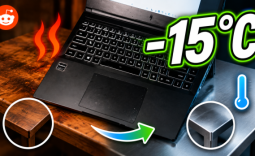 Redditor improves his gaming laptop temps by 15C simply by changing the table
 Phantom Blade Zero on PC will launch with DLSS 4.5 and Ray Tracing on day one
 Razer announces its first Artisan Keycap with the Triple-Headed Snake Edition
 ZOTAC's 20th Anniversary Edition GeForce RTX 5080 features a titanium colorway and mirror-like backplate
 GeForce NOW app for Linux leaves beta, while DLSS Frame Generation cloud latency also improves
 Twitch opts streamers into gen AI training by default, faces harsh backlash
 Sean Murray still plays the 2016 launch version of No Man's Sky
 China's YMTC has climbed to third place in global NAND flash shipments
 Corsair HS35 v3 Wireless Gaming Headset Review - An Affordable Winner
 D-Link F518 5G Wi‑Fi 6 AX1800 Mobile Hotspot Review: All-Day Mobile Hotspot
 Bose Lifestyle Ultra Speaker Review - Impressively Detailed Room-Filling Sound
 MSI Z890 Gaming Plus WIFI6E Review - Z890 for under $200
 Mortal Kombat (1995) 4K Ultra HD Blu-ray Review
 CPS PCCOOLER YS1200 ATX 3.1 80 PLUS Gold PSU Review
 ASRock X870E Taichi White Review: a premium AM5 motherboard with 10G LAN and WiFi 7
 Asetek Initium Pedal Modular Upgrades Review
 Thinkware U3000 Pro Review - Smart Dashcam with Wi-Fi quirks
 Montech TG3 Mid-Tower Chassis Review
 I ditched the Windows 11 context menu for this open-source tool, and here's why
 Windows 11 may be encrypting your drive already, and I checked where my recovery key went
 GIGABYTE's 40 Days of INFINITY celebrates 40 Years of Innovation with stunning GeForce RTX graphics cards and rewards
 I swapped File Explorer for this free file manager and finally got the layout I wanted
 How to tell if someone has been using your Windows PC without your permission
 6 Task Manager tips for troubleshooting Windows performance problems
 ASUS ROG's 20th Anniversary Line-up of Premium PC Gaming Gear has Arrived - Here's Everything You Need to Know
 Six File Explorer tips every Windows user should know
 I switched my PC to encrypted DNS in Windows 11, and browsing felt more private
 Printer Not Working in Windows? How to fix detection, print queues and drivers