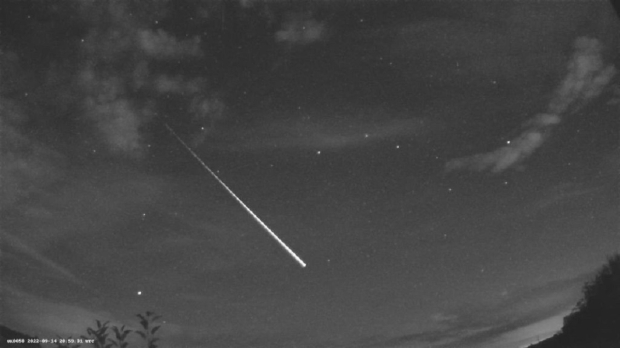




On September 14 residents that happened to be looking at the night sky saw a streaking ball of light move from one side of the sky to the other.
What was initially believed to be some piece of space junk or possibly a SpaceX Starlink satellite falling back to Earth, was determined to be a high-speed meteor that entered Earth's atmosphere, according to the United Kingdom Meteor Network.
Reports indicate that the meteor entered the planet's atmosphere at a ridiculous speed of 31,764 mph, and after researchers conducted analysis with the 172 different cameras located around Britain it was determined that the meteor entered Earth's atmosphere over Wales, the Irish Sea, Belfast and Ireland. So, how big was this fireball?
According to Steve Owens, an astronomer and Science Operations Manager at Glasgow Science Centre in Scotland, spoke to BBC and said that the fireball seen by many was likely caused by a space rock that was approximately the size of a golf ball.
It should be noted that fireballs such as the one that dazzled residents across the UK happen quite regularly, with NASA even recently saying that due to Earth being mostly covered by water humans don't see the events as they occur over open ocean. Additionally, the space agency said that these types of golf ball-sized fireballs happen every day and that the majority of them disintegrate in Earth's atmosphere.
"Normally these little shooting stars burn up and everything vanishes and evaporates in the atmosphere, but the thing last night was bigger than a little bit of dust which causes normal shooting stars," Owens said to BBC News.