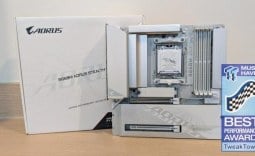
It looks like DDR5 overclocking records are falling fast at Computex 2026, and GIGABYTE just claimed the biggest one yet. GIGABYTE's in-house overclocking team hit DDR5-13556 MT/s at Computex 2026, setting a new world record for memory overclocking. The run used Corsair Vengeance DDR5 memory paired with the Z890 AORUS TACHYON DUO X ICE motherboard.
The team was led by well-known overclocker Hicookie, alongside teammates Sergmann, Saltycroissant, Madness777, and Exaberries. That same team was also invited to G.SKILL's 12th Annual OC World Record Stage at Computex, where they took 10 global first places in CPU frequency and other benchmark categories, this time using the newly launched X870 AORUS INFINITY motherboard with AMD Ryzen 9 9950X3D2 processors.

The Z890 AORUS TACHYON DUO X ICE is a two-DIMM board purpose-built for extreme memory overclocking. It uses GIGABYTE's CQDIMM technology, which is designed to improve signal integrity and push memory performance well beyond what standard platform configurations can achieve. The two-DIMM layout is key here, as fewer slots mean less electrical load on the memory controller, which is how these extreme numbers become possible.
It's worth putting this in context alongside the G.Skill Trident Z5 CK DDR5-9200 record we covered earlier. That kit was notable because it hit DDR5-9200 at just 1.1V on a four-DIMM board, the MSI MEG Z890 GODLIKE, which is a far more "realistic" setup for everyday users. GIGABYTE's 13556 MT/s record, by contrast, is a pure overclocking showcase, run under extreme conditions on a specialized two-DIMM motherboard.

Neither number is something you'll see in a retail kit anytime soon, but records like this do eventually trickle down. Today's extreme OC benchmark can become next year's high-end consumer spec, and the engineering work behind these runs often informs how memory controllers, board trace layouts, and DRAM ICs are refined for future platforms.
For enthusiasts, GIGABYTE's performance at Computex possibly means that Intel's Z890 platform still has significant headroom and that the memory overclocking competition heading into the next CPU generation will be fierce.