







Mobile Devices - Page 17
Mobile device news - smartphones, tablets, iPhone, Android, and foldables. Launches and trends from TweakTown. - Page 17
Stay Updated
Follow TweakTown for breaking tech news, reviews, and daily updates.


As an Amazon Associate, we earn from qualifying purchases. TweakTown may also earn commissions from other affiliate partners at no extra cost to you.
Revamped, upgraded Siri touted for a big iOS 18 unveiling at WWDC in June
The last few weeks have been full to the brim with rumors of impending AI improvements coming to the iPhone and other Apple platforms. Those improvements have so far revolved around new features coming to existing apps like Messages, Notes, and others. But now a New York Times report hints at a big improvement coming to one aspect of the iPhone that really does need it.

Siri has been around since 2011 but it has proven to be lacking in a variety of ways, especially when compared with more modern alternatives like ChatGPT from Open AI and Google's Gemini generative AI. Apple is rumored to be nearing a deal with the former to bring its technology to the iPhone, and now the New York Times claims that the technology will help give Siri a big shot in the arm.
The report claims that Apple has been aiming for Siri improvements since executives Craig Federighi and John Giannandrea spent weeks testing OpenAI's new chatbot, ChatGPT. The executives found that while Siri often struggled to respond to requests properly, and even when it did it could only do it to one request at a time, ChatGPT and similar tools are completely different beasts. Generative AI tools can understand subsequent requests and use the context of the existing conversation when responding.
Apple's nears deal to bring Open AI's ChatGPT generative AI to IOS 18
All of the rumors ahead of Apple's Worldwide Developers Conference next month point to some big new AI features coming to the iPhone and other Apple platforms, likely including the Mac and iPad. We've been hearing a lot about what those features might be as well as how they'll actually work, and a new report suggests that Apple might finally have found itself an AI partner to handle some of the more complex AI features.

Previous Bloomberg reports had Apple in discussions with OpenAI about using the generative AI technology behind the popular ChatGPT to power futuristic AI features on the iPhone. The same reports also suggested that Apple was having similar discussions with Google, potentially choosing to use its Gemini chatbot technology instead. Now, Bloomberg has added an update to those reports, saying that Apple now appears to be within touching distance of agreeing a deal with OpenAI.
The report from Bloomberg's Mark Gurman cites unnamed sources familiar with the matter when saying that Apple has closed in on an agreement. It's believed that the OpenAI technology could be just part of the AI push that Apple is about to undertake, too.
Continue reading: Apple's nears deal to bring Open AI's ChatGPT generative AI to IOS 18 (full post)
The iPhone 16 Pro could have a 20% brighter display than your boring old iPhone 15 Pro
While the iPhone 15 Pro might have only been on sale for a few months, Apple and its supply chain partners are already likely gearing up for what comes next. For Apple, that's thought to be the iPhone 16 Pro and the larger iPhone 16 Pro Max and we've been hearing l;eaks relating to the two phones for a few months now. The latest leak suggests that buyers can look forward to a big display upgrade.

That leak, which comes via the Weibo leaker known as Instant Digital, suggests that Apple intends to make a change to the display that is used in its best iPhones later this year. The leaker says that the new iPhone 16 Pro models will feature a display that is 20% brighter than the previous models when displaying SDR content. That means that when using the phone normally, using apps, and sending messages, the display will be notably brighter when required. Such a feat would be useful for a variety of situations, not least using the iPhone outside in strong sunshine.
The Weibo post, seen by MacRumors, claims that the iPhone 16 Pro will be capable of a brightness of 1,200 nits when showing SDR content. That's a 20% increase over the iPhone 15 Pro while the peak HDR brightness is expected to remain the same at 1,600 nits. Apple hasn't increased the SDR brightness of the iPhone's display since the iPhone 13 Pro arrived in 2021 so this improvement would be a significant one.
New iPhone 16 dummy unit leak shows off its refreshed camera design and more
With the iPhone 15 and iPhone 15 Plus having not been around all that long, you might be surprised to learn that plans are already afoot to replace them in the lineup. But you probably shouldn't be, Apple gets the ball rolling well ahead of the expected September release date and that means that we tend to start seeing more and more leaks the closer we get to September. The latest leak comes via a post on the X social network that appears to show an iPhone 16 dummy unit in all its pink glory, including the expected camera redesign.

The dummy unit was shared to the X social network by Jon Rettinger and it definitely appears to be the real deal. The unit has the same pill-shaped camera layout change that previous rumors have told us to expect as well as the color-infused back glass that looks so good on the current iPhone 15 models.
The most obvious change that we see in the photo shared by Rettinger is that new camera system, with Apple ditching the familiar diagonal layout in favor of a more vertical one. It's similar to the iPhone X and iPhone XS layout, but the change is about more than nostalgia.
Analysts expect an iPad Pro sales slowdown despite new models, here's why
Apple announced the new iPad Pro with a superfast M4 chip earlier this week as well as what is reportedly the best display money can buy in terms of a tablet. The OLED displays are incredibly bright, but despite that in combination with the new chip, the analysts at TrendForce aren't expecting any big sales boost. In fact, they think that Apple could have to deal with a slowdown in sales instead.

That's according to a TrendForce report picked up by 9to5Mac that suggests Apple will sell between 4.5 million and 5 million iPad Pro tablets this year. That represents a year-on-year fall in demand, but the report suggests that there are a couple of good reasons why people might not flock to the new tablet.
At the top of the list is price. The new iPad Pro models are $200 more costly than the ones that they replaced, thanks in part to the increased costs incurred by the OLED display and that M4 silicon. Couple that with the fact that buyers will need a new Magic Keyboard and Apple Pencil Pro to make the most out of their new tablet and it won't take long for that order to get very expensive indeed.
Apple's new 13-inch M2 iPad Air has a brighter display than its smaller 11-inch sibling
When Apple announced the new 6th-generation iPad Air earlier this week it updated the existing 11-inch model and then added a whole new 13-inch model for good measure. We expected that beyond the new display size the two iPads would be identical, but as it turns out, that isn't the case at all. In fact, that 13-inch display isn't just bigger, it's also 20% brighter than the display used in the 11-inch iPad Air.

The news was first spotted by YouTuber Saran of the SaranByte channel and then picked up by MacRumors. The information itself comes from Apple's tech specs for the two devices, and it's confirmed that the 13-inch display is indeed brighter than the 11-inch one.
The figures themselves confirm that the peak SDR brightness for the 11-inch iPad Air is 500 nits whereas the peak SDR brightness for the 13-inch model is 600 nits. The change isn't a huge one, but it's notable and an interesting statistic given the fact that we don't know what. Our guess would be that the two displays are produced by two different manufacturers - likely LG Display and Samsung Display - and that's where the different capabilities come from.
Apple to bring AI-powered summarization an audio transcription to iPhone, iPad, and Mac
Apple is expected to make big improvements to its AI capabilities when it announces a slew of big new software updates at the WWDC event on June 10 and while Apple hasn't confirmed anything so far, we're starting to see more and more leaks surrounding what new features users can look forward to.

Reports have so far suggested that while there will be upgrades to Siri, some AI features will be baked into apps like Safari, Messages, and Mail. Those features will help people do everyday tasks more effectively, and the latest report suggests that new AI-powered audio summarization features will be included.
The report, via AppleInsider, cites people familiar with the matter when reporting that Apple is working on such features including greatly enhanced audio subscription capabilities for its various software platforms. The iPhone's iOS 18, iPad's iPadOS 18, and Mac's macOS 15 updates are expected to be those that benefit from the new AI initiative.
New M4 iPad Pro benchmarks confirm it's faster than your M3 Max MacBook Pro
When Apple announced the M4 iPad Pro earlier this week we were already expecting the tablet to be the fastest that Apple had ever offered, and it doesn't look like we are going to be disappointed. But early benchmarks confirm that while the iPad Pro is the fastest yet, it's also competing with Apple's high-end MacBook Pro as well.

In fact, the M4 chip used in the iPad Pro is so fast that its single-core performance is faster than the M3 Max found in Apple's very best laptops, while the multi-core performance is comparable to that of the M2 Max that was used in the previous generation MacBook Pro.
This is all based on new Geekbench results that have been spotted and shared by MacRumors, and it makes for interesting reading. The 10-core version of the M4 chip which is found in the 1TB and 2TB iPad Pro managed an average single-core score of 3,695 while it managed an average multi-core score of 14,550 across a total of 10 different benchmarks. It's those figures that put the MacBook Pro to the sword; the M3 Max manages 3,128 in single-core performance while the M2 Max scores 14,800 in multi-core tests. The M3 Max manages a much improved multi-core score of 10,957 however, so there's no suggestion that the M4 can compete with that just yet. We can expect good things from future M4 Pro and M4 Max chips, though.
Apple apologies for new iPad Pro ad that 'missed the mark' and pulls it from airing on TV
Apple recently announced its new iPad Pro line-up, powered by its new M4 chip and sporting the company's first groundbreaking OLED display, which pushed the technology's brightness to new heights. It's also the thinnest device in the company's history, with the 13-inch variant featuring a thickness of just 5.1mm - incredible.

And it seems that the display and thickness drove the inspiration and message behind Apple's latest ad for the new iPad Pro. "Meet the new iPad Pro," Apple CEO Tim Cook wrote in a social media post debuting the ad. "The thinnest product we've ever created, the most advanced display we've ever produced, with the incredible power of the M4 chip. Just imagine all the things it'll be used to create."
However, to try to sell the device's thin profile and creative capabilities, whoever Apple put in charge of the ad decided that it would be a good idea to take a treasure trove of iconic art-driven technology and gear from history and put them in one of those flattening machines, completely destroying them.
The iPhone's big new iOS 18 AI features will be powered by data centers running Apple silicon
There have been a lot of rumors and reports of late that claim Apple is going to bring some big much-needed AI-powered features to the iPhone when iOS 18 is released later this year and while we've heard that those features will run on-device, others will require a server. Those cloud servers will allow Apple to handle more complex tasks, including generative AI workflows, and a new report now suggests that the servers will run Apple's own custom chips.

We've been hearing more and more about Apple's plans to put its own chips into servers of late, and it's a plan that makes sense. Apple's Macs, iPhones, and iPads all use custom-designed chips that are built by TSMC and it's proven to be a real boon for the company. More control means that Apple has a better lock on power usage and performance, and it can tailor chips to specific needs as well. In the case of servers, it's suggested Apple will produce chips that can run AI-related workflows particularly well.
There was previously no timeline for when the Apple-designed chips would be used, but a new Bloomberg report by Mark Gurman suggests that Apple will have its in-house server chips ready soon enough to power the cloud component for the iOS 18 AI push.
Apple's iOS 17.5 update will bring offline News browsing to the iPhone for the first time
Apple's currently testing the iOS 17.5 software update ahead of what is likely to be a release to the public within the next few weeks. It's already been testing the update for some time now, but the latest beta release brings a new feature that we didn't see coming and can make a big difference to the way people enjoy the News app.

According to a new report, the iOS 17.5 Release Candidate build that was made available to developers recently includes a new feature that will allow people to use the News app when they don't have an internet connection.
As 9to5Mac notes, Apple News currently stops working when there is no internet connection unless a user intentionally makes specific stories available for offline viewing. However, the iOS 17.5 update looks set to change that by offering the full news experience even when no connection is available.
Apple wants its fancy titanium Apple Cards back so it can recycle them
If you're an Apple Card owner who also happened to have asked for one of those titanium cards to go with it, you're probably starting to notice that it's getting ready to expire. The Apple Card launched back in 2019 in the United States and remains only available in that country. Now, the first cards are starting to expire and Apple is ready to ship new ones. But it isn't as easy as just cutting up your old one and getting on with your day.

Apple has started to contact Apple Card owners to alert them that they will need a new physical card. The company says that it will send a replacement card to billing addresses within the next couple of weeks. But those cards will also come with a prepaid shipping label so that customers can send their old Apple Card back to be recycled. As it turns out, having titanium recycled isn't as easy as you might think.
Apple has confirmed that the previous card will stop working at its expiry date while the new card can be activated as soon as it arrives.
Continue reading: Apple wants its fancy titanium Apple Cards back so it can recycle them (full post)
Is this the next Apple CEO when Tim Cook finally steps aside?
Apple CEO Tim Cook has been Apple CEO since 2011 when then-CEO and co-founder Steve Jobs stood aside as a result of the ill health that would ultimately kill him. Since then Apple has seen unprecedented success including huge iPhone sales, the entry into new markets like the Apple Watch and now Apple Vision Pro, and more. But it's a fact that Tim Cook won't be able to stick around forever and Apple is likely already starting to look at who could be a likely replacement. According to one report, there's one man in particular that seems most likely to take over.

Writing for Bloomberg, Mark Gurman suggests that while any imminent change could see the arrival of Chief Operating Officer Jeff Williams in the top job, Apple is making plans beyond then - and it doesn't expect that Cook is going away any time soon.
Gurman says that Apple does have Jeff Williams in line should Cook step aside sooner rather than later, citing people familiar with Apple's inner workings. However, Williams is 61 this year which means that he isn't all that much younger than Cook who turns 64 later in 2024. That means that Williams is unlikely to be a long-term replacement for Cook, which means that Apple will have plans for a more permanent solution.
Continue reading: Is this the next Apple CEO when Tim Cook finally steps aside? (full post)
Weight quirk means the M2 iPad Air is actually heavier than the high-performance M4 iPad Pro
Back when Apple started to use the Air name with the MacBook Air and original iPad Air, it was used as a way to symbolize just how thin and light the devices were. It made a ton of sense and it's remained that way for years. However, as the rest of Apple's tablet and laptop lineups have continued to also shrink in size and weight, things have started to get a little more complicated. Now, the release of the M4 iPad Pro and M2 iPad Air have proved that point once more.

As noticed by MacRumors, the new M4 iPad Pro is actually lighter than the M2 iPad Air, something that seems strange when you remember that the iPad Air is supposed to be the thin and light tablet of the two.
To put things into perspective, the 13-inch iPad Pro weighs just 1.28 points or 579 grams whereas the 13-inch iPad Air comes in at 1.36 pounds or 617 grams. Those who prefer their tablets to be a little on the smaller side will notice that the 11-inch iPad Pro weighs just 0.98 pounds or 444 grams, while the 11-inch iPad Air measures 1.02 pounds or 462 grabs.
The new iPad Pro and iPad Air sport familiar battery life figures despite power-sipping chips
When Apple announced the new M4 iPad Air and a revamped M2 iPad Air, including the all-new 13-inch display option, the company didn't make a big deal about the battery life that buyers can expect from either one. Apple did however note that the M4 chip is more power efficient than the previous-generation M-series chips, but that was as far as things got. So it's perhaps interesting that Apple's published battery life for the new iPads is essentially the same as it has been for years.

As MacRumors points out, Apple says that the new iPads both manage the same 10 hours of battery life that the company has been advertising for years, and that's notable given the fact that both of these tablets now have better, more power-efficient chips than the models that they replaced. It's notable that the new chips are also faster of course, so there's a trade-off to be made there.
The new M4 chip is built on a second-generation 3nm manufacturing process which means that it's more power efficient than even the M3 that came before it. It also has six efficiency cores which is two more than the M2 that was in the 2022 iPad Pro that this new model replaces. The tandem OLED display is also thought to be more energy efficient, all things that might have been expected to allow Apple to save some battery life and increase performance.
Buying an M4 iPad Pro or M2 iPad Air? You won't get one iconic thing in the box anymore
The new M4 iPad Pro and a refreshed M2 iPad Air are now available for preorder after they were announced during the Let Loose event yesterday. The event was a big one despite its relatively short length, unveiling not only the new tablets but also a new Apple Pencil Pro and a refreshed Magic Keyboard. All of those new things are now available for preorder and they'll officially go on sale on May 15. But those who choose to pick up a new iPad Pro or iPad Air won't get something that Apple device buyers have become so used to.

That thing isn't something that's a big deal but it's something we're so familiar with. The thing? The familiar Apple stickers that have been included in boxes for decades at this point.
The news hasn't been confirmed by Apple but a 9to5Mac report based on a memo that has been distributed to Apple Store teams notes that there will be no stickers included in any of the new iPad boxes.
The M4 iPad Pro has a new OLED display with a variable refresh rate, but no always-on display
Apple announced the brand-new M4 iPad Pro yesterday and it brings with it some big upgrades, not least that superfast M4 chip that everyone's talking about. But the thing that most people will notice first is likely to be the new OLED display and it's something that Apple focused on heavily, too. But there's one feature that we would have liked to have seen arrive that was sadly missing - an always-on display like the iPhone 15 Pro.

An always-on display was never seriously rumored for the arrival of the new iPad Pro but the news that it would be using an OLED display similar to the iPhone had given some hope that Apple might spring a surprise. Now, Apple has published technical specifications for the new iPads and has confirmed that the new OLED display features a variable refresh rate that can go as high as 120Hz and fall to just 10Hz. And as impressive that is, and as much battery life it could help the iPad save, it doesn't go as low as the iPhone 15 Pro display's 1Hz. And it's that 1Hz refresh rate that is needed to offer an always-on display.
The iPad Pro has offered a 10Hz refresh rate since 2017 with the tablet fluctuating between 24Hz and 120Hz depending on what the device is being used for at the time. The high refresh rate is useful for high-speed on-screen content and fluid animations, but refreshing the display that many times per second can impact the battery life terribly. Moving to a 10Hz lower refresh rate will help Apple save battery life to be sure, but 1Hz would have been even better.
Buying a 1TB M4 iPad Pro will get your double the RAM and an extra CPU core thrown in
Apple announced the brand-new M4 iPad Pro yesterday alongside the new M2 iPad Air and the Apple Pencil Pro, not to mention the revamped Apple Magic Keyboard for the iPad Pro. There was plenty announced during the event, but it's the M4 iPad Pro that's particularly notable. It's a hugely powerful tablet and one that comes with plenty of RAM and storage. But it turns out that if you pick two particular storage options you'll also get some other things thrown in for good measure, too.

Apple didn't make a big deal out of the news when it announced the M4 iPad Pro, but it's since been discovered that anyone who spends the extra $600 to upgrade from 256GB of storage to the 1TB model (or higher) will also get an additional CPU core and twice as much RAM.
Apple has historically not chosen to give details about what cores the iPad has and how much RAM is offered, but in the case of the M4 it turns out that the base model with 256GB of storage comes with an M4 chip that has a 9-core CPU. But if you then choose to buy a 1TB or 2TB storage option you'll actually get an M4 chip that has a 10-core CPU instead. You'll still get the same number of GPU cores so there is nothing of note there, but it's interesting that Apple is putting two versions of the same M4 chip into the same tablet here.
Google chose the worst possible time to announce the Pixel 8a budget Android phone
It's impossible to miss the fact that Apple announced the new M4 iPad and M2 iPad Air yesterday alongside a new Apple Pencil Pro and a refreshed Magic Keyboard, but did you know that Google also announced a new product? You probably didn't, because it chose to announce it on the same day that Apple sucked all the air out of the room. Which is a shame, because the phone is actually pretty good.

The Pixel 8a was a phone that we'd seen leaked here and there in recent weeks, a phone that offers people the chance to get their hands on a new phone with high-end features at a price that doesn't cost high-end figures. The Pixel 8a is sure to be a popular device, as well as it should because it has a ton of features that make for a great experience. And at $499, it's going to be hard to beat.
Google's Pixel 8a features a new Actua display that measures 6.1 inches. It has a high-speed 120Hz refresh rate and is 40% brighter than the display that was already a solid option in last year's Pixel 7a. The good news doesn't end there, either, with a new 256GB storage option available for those who want it.
Apple's new iPad Pros feature dual OLED displays and are the company's thinnest devices ever
Apple has unveiled the new iPad Pro line-up, powered by the company's new 3-nanometer M4 chip. Available in two sizes, 13-inch and 11-inch, both feature the company's new 6K resolution Ultra Retina XDR display built with OLED technology.

Each iPad Pro uses two OLED panels to combine the light to "phenomenal full-screen brightness." We're talking 1000 nits of full-screen brightness for SDR and HDR content and 1600 nits of peak brightness for HDR.
"Tandem OLED technology enables sub-millisecond control over the color and luminance of each pixel, taking XDR precision further than ever," Apple writes. "Specular highlights in photos and video appear even brighter, and there's more detail in shadows and low light than ever before on iPad - all while delivering even more responsiveness to content in motion."
 SteamOS now works on the Intel Arc B580 without workarounds on the latest beta
 GeForce RTX 3080 cards with 20GB of VRAM are being sold in second-hand markets
 Snapdragon X2 Elite Extreme outpaces Intel's Panther Lake by up to 87%
 Hydra unlocks VRAM overclocking and 125% power limits for all GeForce RTX 50 Series GPUs
 ASRock DeskMeet X300 build significantly outperforms the Steam Machine for the same price
 Star Citizen livestream full of bugs, glitches, and performance issues raises fresh concerns about the $1 billion game
 GTA 6 gameplay leaks ahead of its big reveal, showcasing full map, six-star wanted level, and more
 US Army is giving soldiers time off to play GTA 6 as an incentive
 GTA 6 nears $500 million in pre-order revenue with 77% sales on PS5, per analysis
 Crucial offers a $250 refund for a RAM kit that costs $1,800, forgets to ship back the working module
 Cooler Master V8 ACE 3DHP BLACK CPU Cooler Review
 ASUS ROG Strix XG129C Review: A $199 Gaming Monitor You Don't Play Games On
 Cooler Master HAF II 500 Mid-Tower Chassis Review
 Corsair HS35 v3 Wireless Gaming Headset Review - An Affordable Winner
 D-Link F518 5G Wi‑Fi 6 AX1800 Mobile Hotspot Review: All-Day Mobile Hotspot
 Bose Lifestyle Ultra Speaker Review - Impressively Detailed Room-Filling Sound
 MSI Z890 Gaming Plus WIFI6E Review - Z890 for under $200
 Mortal Kombat (1995) 4K Ultra HD Blu-ray Review
 CPS PCCOOLER YS1200 ATX 3.1 80 PLUS Gold PSU Review
 ASRock X870E Taichi White Review: a premium AM5 motherboard with 10G LAN and WiFi 7
 Using Multiple Monitors? Change these Windows settings for a Better Experience
 Windows Sandbox is The Windows Security Feature Most People Never Use
 I ditched the Windows 11 context menu for this open-source tool, and here's why
 Windows 11 may be encrypting your drive already, and I checked where my recovery key went
 GIGABYTE's 40 Days of INFINITY celebrates 40 Years of Innovation with stunning GeForce RTX graphics cards and rewards
 I swapped File Explorer for this free file manager and finally got the layout I wanted
 How to tell if someone has been using your Windows PC without your permission
 6 Task Manager tips for troubleshooting Windows performance problems
 ASUS ROG's 20th Anniversary Line-up of Premium PC Gaming Gear has Arrived - Here's Everything You Need to Know
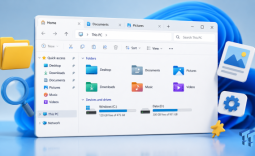 Six File Explorer tips every Windows user should know