

Newsletter IconGoogle IconFacebook IconX IconThreads IconInstagram IconYouTube Icon

NASA telescope captures the violent past of an object millions of light years away

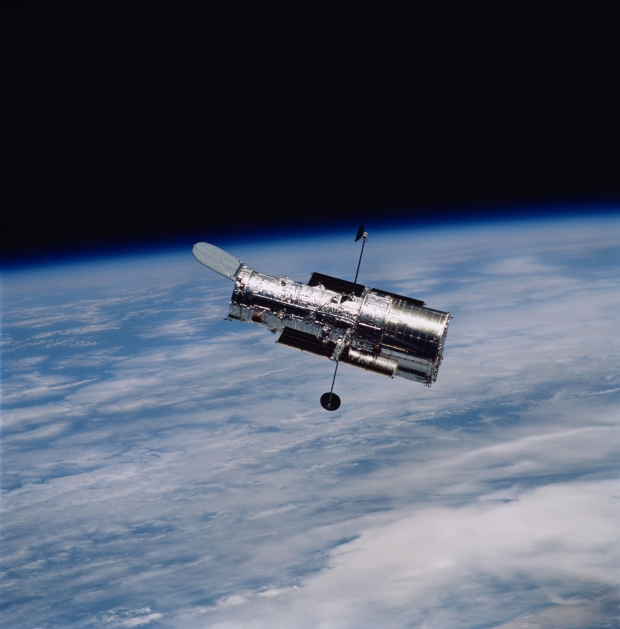
NASA has pointed the iconic Hubble Space Telescope at an object with an explosive past that resides 55 million light years away from Earth.

NASA telescope captures the violent past of an object millions of light years away
Facebook IconX IconReddit Icon
Comments
Tech and Science Editor
Published
Updated
1-minute read time

NASA has honed the instruments aboard the Hubble Space Telescope at a distant cosmic object that had an extremely violent past.

NASA telescope captures the violent past of an object millions of light years away 14654

Using data acquired by its Advanced Camera for Survey's, NASA and the European Space Agency's Hubble Space Telescope produced the above image of the spiral galaxy known as NGC 941. While the spiral galaxy is certainly gorgeous to view, astronomers are more interested in an event that occurred years earlier - the supernova called SN 2005ad.

Popular Now: Xbox Series X can now run PS5 games thanks to a new emulator

This supernova was discovered by amateur astronomer Kōichi Itagaki, and after follow-up observations by professional astronomers, it was verified as a hydrogen-rich supernova called a type II supernovae. So, what makes this supernova so special? SN 2005ad represents the importance of amateur astronomers and the role they play in discovering astronomical events. Online systems have been set up for amateur astronomers to report identifying events, which are then followed up on by professional astronomers and cataloged.

Amateur astronomers keep the data flowing in from various regions and sometimes not where professional astronomers are looking. This strategy pays off as when something is discovered and verified, multiple telescopes are pointed at the object, and a deeper understanding of the universe is developed. In the instance of SN 2005ad, an amateur astronomer led professional astronomers to conduct an in-depth study on type II supernovae, leading to a better understanding of the event and, ultimately, the evolution of stars.

Photo of the Starfield: Standard Edition - Xbox Series X

Best Deals: Starfield: Standard Edition - Xbox Series X

Prices last scanned 1 hour and 59 minutes ago

* Prices may be inaccurate. As an Amazon Associate, we earn from qualifying purchases. We earn affiliate commissions from Newegg and PCCG sales.

Join Our Newsletter

Join the TweakTown Newsletter for daily tech updates delivered to your inbox.

See previous giveaways.

News Source:science.nasa.gov

Comments

About the author

Tech and Science Editor

Jak joined TweakTown in 2017 and has since reviewed 100s of new tech products and kept us informed daily on the latest science, space, and artificial intelligence news. Jak's love for science, space, and technology, and, more specifically, PC gaming, began at 10 years old. It was the day his dad showed him how to play Age of Empires on an old Compaq PC. Ever since that day, Jak fell in love with games and the progression of the technology industry in all its forms.

Stay Updated

Follow TweakTown for breaking tech news, reviews, and daily updates.

Follow TweakTown on GoogleAdd TweakTown as a preferred source on Google
Newsletter Subscription