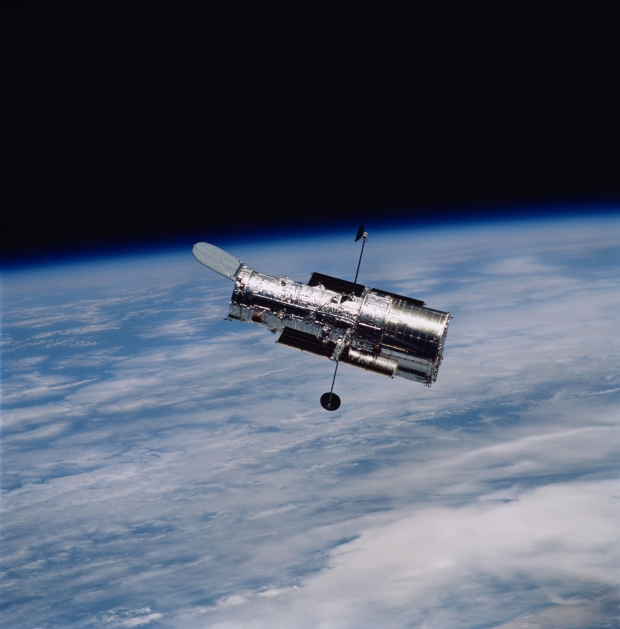





NASA has honed the instruments aboard the Hubble Space Telescope at a distant cosmic object that had an extremely violent past.

Using data acquired by its Advanced Camera for Survey's, NASA and the European Space Agency's Hubble Space Telescope produced the above image of the spiral galaxy known as NGC 941. While the spiral galaxy is certainly gorgeous to view, astronomers are more interested in an event that occurred years earlier - the supernova called SN 2005ad.
Popular Now: Xbox Series X can now run PS5 games thanks to a new emulatorThis supernova was discovered by amateur astronomer Kōichi Itagaki, and after follow-up observations by professional astronomers, it was verified as a hydrogen-rich supernova called a type II supernovae. So, what makes this supernova so special? SN 2005ad represents the importance of amateur astronomers and the role they play in discovering astronomical events. Online systems have been set up for amateur astronomers to report identifying events, which are then followed up on by professional astronomers and cataloged.
Amateur astronomers keep the data flowing in from various regions and sometimes not where professional astronomers are looking. This strategy pays off as when something is discovered and verified, multiple telescopes are pointed at the object, and a deeper understanding of the universe is developed. In the instance of SN 2005ad, an amateur astronomer led professional astronomers to conduct an in-depth study on type II supernovae, leading to a better understanding of the event and, ultimately, the evolution of stars.