












Coinciding with AMD's Advancing AI 2026 event, the company has launched its latest AMD Instinct data center GPUs purpose-built for the AI era, with the Instinct MI400 Series led by the flagship AMD Instinct MI455X GPU. Built on a 2nm process, it sports 320 billion transistors, a maximum clock speed of 2.4 GHz, and 432 GB of high-speed HBM4 memory with a peak memory bandwidth of 23.3 TB/sec.

According to the company, the AMD Instinct MI455X GPU is its first GPU to be designed and built for rack-scale AI deployments, which is why it serves as a key part of the new AMD Helios rack, which features 72 Instinct MI455X GPUs for 31TB of HBM4 memory with an impressive 1.7 PB/s memory bandwidth and up to 2.9 exaflops of compute performance.
Popular Now: GTA Technical Director comments on GTA 6 running at 60 FPS on consolesAnd with the AMD Instinct MI455X being built for Helios, this means the GPU has been designed with scale-up and scale-out capability with shared-memory capacity, communication bandwidth, and more connectivity compared to previous AMD Instinct GPU generations.
- Read more: AMD teases next-gen Helios rack-scale platform: new EPYC + Instinct chips, battles NVIDIA Rubin
- Read more: AMD Helios rackscale solution for AI offers 15% more AI Compute than NVIDIA Vera Rubin NVL72
- Read more: AMD launches Instinct MI350 series AI chips: 185 billion transistors, 288GB HBM3E memory

Powering the AMD Instinct MI455X GPU is the company's latest CDNA 5 architecture, which introduces several improvements to accelerate and expand AI performance. Like its predecessor, the AMD Instinct MI355X, the new MI455X features eight Accelerator Complex Dies, or XCD, chiplets. However, where previously you had 32 Active Compute Units per XCD, the AMD Instinct MI455X GPU has the same number of Work Group Processors (WGPs), with each XCD divided into two Shader Engines (Ses) with 16 WGPs each.
The new WGP design comes from CDNA 5, which optimizes performance and latency. Each WGP itself is comprised of four 32-thread SIMD (single-instruction, multiple-data) execution Units, and four scalar execution units. With parallel processing, peak throughput in math operations per clock (MXFP8 and MXFP4) has increased by up to 4X compared to the AMD Instinct MI355X, and up to 2X when looking at tensor and vector data.

And when it comes to token throughput measured in tokens per second, the AMD Instinct MI455X GPU is reportedly an impressive 34 times faster than the Instinct MI355X. This in turn, leads to a significant reduction in token cost.

Frequently Asked Questions
TweakBot answers common questions about this news using TweakTown's own coverage from this page and related content from our archive. Tap a question to reveal the answer, or type your own below.
What are the key hardware specifications of the AMD Instinct MI455X (process node, transistor count, clock speed, HBM4 capacity, and peak memory bandwidth)?
How is the MI455X configured differently from the MI355X in terms of XCDs, Shader Engines, and Work Group Processors?
How much faster is the MI455X in math throughput (MXFP8/MXFP4) and tensor/vector workloads compared to the MI355X?
What token throughput improvement does AMD claim for the MI455X versus the MI355X, and how does that affect token cost?
Have a question not listed here? Ask below and TweakBot will answer it.

In addition to the flagship AMD Instinct MI455X GPU, AMD has also launched the Instinct MI430X GPUs for sovereign AI and HPC, which can deliver up to 288 TFLOPS of hardware-based FP64 performance.


 AMD shows off next-gen Zen 6-based EPYC 'Venice CPU, Instinct MI455X GPU for Helios AI racks
 AMD reveals new Instinct MI430X AI GPU with HBM4 for 'leadership performance' on AI systems
 AMD's confirms Instinct MI400 series AI GPUs drop in 2026, next-gen Instinct MI500 in 2027
 AMD's new Instinct AI GPUs will possibly bring in up to $12 billion in revenue for 2026
 AMD teases next-gen Helios rack-scale platform: new EPYC + Instinct chips, battles NVIDIA Rubin
 No amount of backlash will change Sony's mind on disc cancellation, says ex-Santa Monica dev
 The PS6 controller could eliminate stick drift by using magnetic joysticks
 Xbox confirms free game streaming with ads, clarifies how it'll work and ethos around monetization
 Ex-PlayStation boss can't understand why there isn't a Bloodborne remaster for PS5, but he hasn't given up hope yet
 AMD's Ryzen AI Embedded X100 Series processors are built for autonomous robots and physical AI
 AMD Helios rackscale solution for AI offers 15% more AI Compute than NVIDIA Vera Rubin NVL72
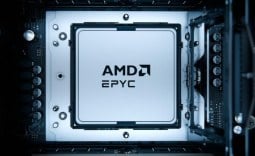 AMD announces 6th Gen AMD EPYC 'Venice' CPUs, up to 256 cores and 512 threads and built for AI
 Apple is preparing 11 new Macs, including touchscreen OLED MacBooks
 Bethesda union files legal complaint calling Fallout announcements a smokescreen for labor law violations
 Sony silenced developers with a social media gag order over PlayStation disc backlash
 Thrustmaster T.Flight HOTAS 5 MSFS Edition Review
 SteelSeries Arctis Nova Pro Omni Wireless Headset Review - One Headset to Rule Them All
 SteelSeries Arctis Nova 7 Wireless Gen 2 Headset Review - New and Improved, But Is It Enough?
 AMD Ryzen 7 7700X3D Review - Days of Future Past
 Samsung 990 2TB SSD Review - Ninth Gen QLC at PCIe Gen4 Speeds
 ASUS ExpertBook Ultra (Panther Lake) 14" Business Laptop Review
 ASUS ROG Raikiri II Xbox Wireless Controller Review - Ready to Take Control
 MOZA FMP18 Panel Bundle Review: authentic F/A-18 Hornet cockpit controls for flight sims
 Micron 6600 ION 245.76TB Enterprise SSD Review - Best in Class Programming Speeds
 MOZA MA3F EFCM Flight Control Module Review: authentic Airbus A320 autopilot panel for simulators
 6 Mistakes to Avoid When Buying a Windows Laptop
 I capped Windows Update's bandwidth with Delivery Optimization, and my downloads stopped choking
 I use this decade-old free tool that finds files faster than Windows Search does
 I install and update most of my apps with this Windows command now, and I stopped downloading sketchy installers
 Hisense U6SF 65-inch MiniLED TV: High Performance Meets Leisurely Convenience
 I stopped digging through Windows menus after I set up this one folder
 Don't sell your Windows laptop until you do these things
 6 PC cleaning mistakes to avoid for safer hardware maintenance
 Phison and Intel Take Aim at Local AI's Memory Wall with aiDAPTIV
 How to Remap Keyboard Keys in Windows using Microsoft PowerToys