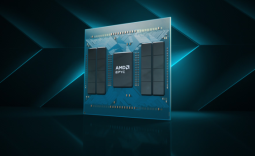
AMD has officially launched its AMD Helios rackscale solution for AI infrastructure and large-scale foundational-model training and inference. As a supercomputer, AMD Helios combines the new AMD Instinct MI455X GPU, 72 of them, with the latest 6th Gen AMD EPYC 'Venice' server CPUs, AMD ROCm software, and AMD Pensando networking. It's a lot of cutting-edge tech coming together, delivering 2.9 ExaFlops of FP4 Compute.

According to AMD, it's enough to deliver 15% more compute (peak FP4 performance) than NVIDIA's latest Vera Rubin NVL72 rack-scale solution. And when it comes to raw specs, there is a notable difference in favor of Helios. For example, the 31TB of HBM4 memory capacity is 50% more than Vera Rubin. And with 43 TB/s scale-out bandwidth and 1.7 PB/s of memory bandwidth, AMD notes that Helios can offer AI companies 30% more tokens per dollar.
"As demand grows for AI factories and frontier AI, customers need infrastructure that scales efficiently from a single rack to large gigawatt-scale AI clusters while maximizing performance, performance per watt and cost per token," AMD explains. "AMD Helios delivers an integrated rack-scale building block that simplifies deployment while providing the compute, networking and open software foundation needed for the next generation of AI infrastructure."


Frequently Asked Questions
Open a question for an answer from TweakTown's coverage of this news, or ask your own below.
How does Helios achieve the claimed 15% more peak FP4 compute than NVIDIA's Vera Rubin NVL72?
What are the GPU and CPU components used in the AMD Helios rack-scale system?
What networking hardware does Helios use for rack-to-rack and cluster connectivity?
What total FP4 compute performance (in ExaFlops) does a single Helios rack deliver?
Have a question about this content not listed here? Ask below and TweakBot will answer it.

Of course, AMD Helios isn't confined to a single rack, as it's designed for gigawatt-scale AI clusters thanks to the new AMD Pensando Vulcano 800 AI NICs providing high-bandwidth, low-latency connectivity for growth. And with that, AMD Helios is already being deployed to a wide range of leading AI companies like Anthropic, Meta, Microsoft, Oracle, OpenAI, as well as supporting the infrastructure of companies like Dell Technologies, Lenovo, IBM, and others.