Our Verdict
Pros
- Build quality
- BTF compatibility
- Thermal performance
- Pricing
Cons
- No included fans or hub
- Other cases
- Congested segment of the market with other options available
Should you buy it?
Introduction, Specifications, and Pricing
Following my recent review of the Antec Flux SE mid-tower, today I am taking a look at a case from their Constellation range, the Antec C8 Curve Wood. The Constellation range includes the C3, C5, C7, and C8 models. There are differences between them, which include curved or flat glass, ARGB, and different form factors to cater to most end users.
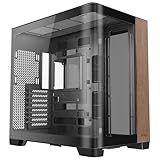
Available only in black at this time, the Antec C8 Curve Wood features a single-piece, 4mm-thick tempered glass side panel for uninterrupted views of the internals, with the front edge clad in real Walnut. Antec markets the case as designed for vertical cooling; it is compatible with a range of BTF-connect motherboards and features a dual-chamber design.
Priced at $169.99, the Antec C8 Curve Wood doesn't ship with any fans or hubs, and here in the UK, taking into account the pricing, it sits around the Corsair Frame 5000D RS (non ARGB), and be quiet! Light Base 600 DX, in terms of competition, to name just two examples. There are plenty of other cases available at this price point, and it is indeed a congested segment of the case market. So, does the Antec C8 Curve Wood have enough up its sleeve to stand out, perform well enough, and tick enough boxes for us to recommend? Time to find out.
| Item | Details |
|---|---|
| Model | Antec C8 Curve Wood |
| Form Factor | ATX Full Tower |
| Dimensions | (D) 464mm x (W) 303mm x (H) 476mm |
| Weight | 10.7kg / 23.5lbs |
| Materials | Steel, Wood, Plastic |
| Color | Black |
| Motherboard support | Mini-ITX, Micro-ATX, ATX, E-ATX (Up to 280mm) |
| BTF Motherboard Support | Selected models from ASUS, MSI, Colorful. More to be confirmed by Antec |
| Cooling Compatibility | Top: 3x120mm / 2x140mm / 2x160mm or 120mm / 140mm / 240mm / 280mm / 360mm Radiator | Rear: 1x 120mm / 140mm or 120mm Radiator | Side: 3x 120mm / 2x 140mm or 120mm / 140mm / 240mm / 280mm / 360mm Radiator | Bottom: 3x120mm / 3x140mm / 2x160mm or 120mm / 140mm / 240mm / 280mm / 360mm Radiator |
| ARGB / FAN Hub | None |
| Drive Support | Behind Motherboard: 2 x 2.5"" SSD and 1x 3.5"" HDD |
| Front I/O | Power, Reset, USB 3.0 x 2, Type-C 10Gbps x 1, Headphone/Mic Combo Jack |
| CPU cooler height (max.) | 175mm |
| PSU Length (max.) | 210mm Not including cables |
| GPU Card Length (max.) | 440mm |
| Warranty | 2 Years |
Packaging

The Antec C8 Curve Wood arrived safely in standard brown packaging. The front of the box provides a clear view of the case and its internal detailing.

Best Deals: Antec C8 Curve Wood Full-Tower Chassis
Price Trend:
Prices last scanned 2 hours ago

7 days ago: $265.99 CAD30 days ago: $264.99 CAD
7 days ago: £126.9930 days ago: £126.99

7 days ago: $19930 days ago: $199

Information on the case, as part of the Antec Constellation Series, is provided on the back, along with further details on Airflow, Appearance, Functionality, and Added Features.

Standard information in a range of languages is printed on the side of the box with carry handles above.
Overall, the packaging is unremarkable, but it's good to see all the details and information Antec has provided here, should you be looking at this case in a store without having to search online for more information about it.
Our Latest Full-Tower Cases Review Coverage


On opening the top, we are greeted with an Antec accessory kit that is included with the C8 Curve Wood. The kit consists of the product manual, zip and Velcro ties, a screw parts bin (always a nice inclusion), and finally, a fan adapter rail for the bottom of the case.

Sliding the case from the box, Antec even includes extra reinforced cardboard corners for added protection during transport. Below these, open cell foam padding and a clear plastic bag complete the packaging included.
Outside the Antec C8 Curve Wood


My first impressions of this case are positive; handling it out of the box indicated good build quality, and I like the design of the chassis. I'm not the biggest fan of wood-accented cases, but Antec has done a good job with the included real Walnut trim to the front.


The exterior aesthetic is classy, and with the curved, tinted tempered glass wraparound panel, this wouldn't look out of place in a professional setting or around the home in areas where you would usually expect to find a PC. It would slot in perfectly in a living room setup, and despite its size, wouldn't be overbearing on its surroundings.

The top of the case features IO that includes Power, Reset, USB 3.0 x 2, Type-C 10Gbps x 1, and a Headphone/Mic Combo Jack. The rest of the top is dedicated to ventilation, with the case panels made of robust 0.8mm & 1mm thick steel. The top and rear side panels feature tool-free removal, eliminating the need for captive thumb screws to secure them in place.


The entire backside panel features ventilation, with a round hole pattern that matches the top. This is a dual-chamber case, which I will show more of on the interior. However, externally, the whole panel provides space for the case to breathe.


Moving to the rear, there is more evidence that this is a dual-chamber case, with the power supply mount positioned to the left of the motherboard's IO. There's familiarity here with some Hyte, be quiet! and Lian Li offerings, and it's a layout that works well. There is space for a 120mm or 140mm fan, eight PCIe slots, and a couple of external tie-down points.

The underside of the Antec C8 Curve Wood features a full-frame, full-length dust filter that is accessed from the front of the case, rather than the side or back. On removal of the dust filter, the bottom is entirely open to prevent restricting airflow into the case. This is the only area of the Antec C8 Curve Wood that offers dust filtration; however, the focus of this case is vertical cooling, so this does make sense, with the top and side acting as exhausts.
The case feet offer more than enough clearance for bottom intake fans to draw in fresh air, and the rubber feet help keep the case in place.
Inside the Antec C8 Curve Wood


To access the interior, first pull off the top vent panel. This reveals the mounting point for our top fans. The Antec C8 Curve Wood can hold up to three 120mm, three 140mm, or two 160mm fans, or water-cooled equivalents up to 360mm in length and 70mm in thickness. Here, you get an idea of the curve of the case, with a nice, even flow from the front into the side. Antec also includes dust covers for the top-mounted IO, and in the bottom right, you can see the mounting pins for an SSD caddy located in the rear.


Removing the tempered glass side panel involves removing a single screw at the front of the case. With this gone, the panel slides forward and is then lifted out of its locating channels.


Upon examining the interior, it is evident that the Antec C8 Curve Wood is compatible with select BTF motherboards, making wire-free builds possible. Cable grommets surround the tray, should you be installing a traditional motherboard, with a generous cutout to support AIO or air cooler mounting. Antec also includes right-angle grommets on the side of the tray, with the side-mounted fan bracket capable of supporting three 120mm or two 140mm fans. Again, as the top radiator support is up to 360mm, thickness options are also available, with a maximum thickness of 100mm, as stated by Antec on the product page.
The Antec C8 Curve Wood does support vertical GPU installation, but requires an aftermarket bracket. If this is a consideration, also take into account that the bottom of the case can support a total of 135mm for cooling, allowing for a push/pull configuration with a traditionally mounted card. The included bracket from the accessory kit can be installed for 120mm fans, with 140mm set up as standard. I do query this design choice, though. Why not include the rails as part of the chassis, rather than making them an optional accessory? I am not complaining about having both options open to me.

A fair bit is going on around the back. First and foremost, the rear is spacious, with a distinct front and rear section. This is where Antec has separated the two areas for independent cooling of the CPU and GPU on the left side, with the power supply and drives on the right.
To the left is our fan mount, with the IO panel wiring tucked neatly into an enclosure above. This is a nice touch, and although this is likely never to be seen in a build, it shows the attention to detail Antec is putting in here, with other manufacturers maybe needing to take note on how to tidy up exposed wiring.

In the middle, you can see the vertical bracket Antec has installed to facilitate the separated cooling areas. On the right, there are three pre-installed Velcro ties, including the IO cabling, and space for power supplies up to 210mm next to it. The Antec C8 Curve Wood can also support side interface power supplies, as these become more popular within builds.


Above the motherboard tray is the 2.5" drive caddy that we saw the mounting locations for on the top, while below the power supply mount, we have the other storage caddy. Unlike other cases, this caddy can only be removed internally, whereas Hyte, for example, offers the ability to remove these by sliding them out the rear of the case. The lower caddy can support a single 3.5" HDD, while the top can support two 2.5" drives. Both are released using a thumbscrew, while the lower bay also requires the removal of a screw on the back of the case.
Installation, Testing, Finished Product, and Final Thoughts
Kris' Test System Specifications
| Item | Details |
|---|---|
| CPU | AMD Ryzen 5 9600X (Buy at Amazon) |
| Motherboard | MSI MAG B850 Tomahawk MAX WiFi (Buy at Amazon) |
| GPU | ASUS Prime GeForce RTX 4070 Super OC (Buy at Amazon) |
| RAM | Corsair VENGEANCE DDR5 16GB (2x8GB) (Buy at Amazon) |
| SSD | Corsair MP700 Elite 1TB (Buy at Amazon) |
| Cooler | be quiet! Dark Rock Elite (Buy at Amazon) |
| Power Supply | be quiet! Dark Power 13 1000W (Buy at Amazon) |
| Monitor | Acer VG272U V3 (Buy at Amazon) |
| OS | Microsoft Windows 11 Pro (Buy at Amazon) |


The Antec C8 Curve Wood offers plenty of internal room to build a system. Given that the case doesn't include any fans, I have swapped out our be quiet! Dark Rock Elite, for the be quiet! Pure Loop 2 360mm AIO to give the system some space to breathe. The installation of the AIO within the case was as straightforward as it gets, along with all the other components I used for this test system.
While I haven't gone overboard on cable management, there is plenty of room to work with and tie-down points to be used. If you do start to run out, though, and are not using a 3.5" drive, then the lower caddy can be removed entirely to free up even more space for cables and other items. I didn't encounter any problems with grommets falling out, either. Where wiring ran over metal edges, everything was smooth, preventing cuts and tears.
The system I have built for testing includes an AMD Ryzen 5 9600X CPU, housed in an MSI B850 Tomahawk Max Wi-Fi Motherboard, paired with two sticks of 16GB Corsair Vengeance DDR5-6000 memory. Our CPU is kept cool using the be quiet! Pure Loop 2 360mm AIO. For storage, I am using a Corsair MP700 Elite 1TB NVMe M.2 drive. Finally, for graphics, I have an ASUS Prime RTX 4070 12 GB Super. Testing is completed with PBO enabled, AXMP1, and MSI Smart fan configuration.
All testing was completed using Aida64 Engineer's System Stability Test v7.65.7400 for 2 hours. Other software used was HWiNFO 64 v8.30-5800, TechPowerUp GPU-Z v2.68.0, and CPU-Z v2.15.0 x64.

With our AIO installed, testing offered a negative-pressure setup within the case. With Antec promoting this case for its vertical ventilation, it would be interesting to see what results it could achieve with a full complement of fans installed. After pushing the system for over two hours, the CPU with the AIO reached a maximum temperature of 79.8 °C, with an average of 76.4 °C. The average result places the Antec C8 Curve Wood in the middle of the pack, around the Endorfy ARX 700 and the GAMDIAS Neso P1 Pro. Notably, both of these come with included case fans, so with fans added, these results may improve even more.
The graphics results show a maximum of 73.5 °C and an average of 72 °C, which places this case further towards the cooler ones I have tested. With autumn on its way, temperatures are declining here in the UK. All today's results were recorded at an ambient temperature of 20 °C, so we need to take into account the higher temperatures for the other cases mentioned. It's only a couple of degrees, so overall, the Antec C8 Curve Wood performs well.


In conclusion to this review, Antec has once again produced a case that ticks many boxes at the price point. The Antec C8 Curve Wood doesn't do anything extravagant; it's competent, has space to expand, and performs well without going over the top. The exclusion of fans and related ARGB/PWM hubs is the only real downside of the Antec C8 Curve Wood. This is a case that offers ample room for water-cooled builds, allowing you to go quite berserk with radiator thickness and layout options. If water cooling isn't your thing, and you just want something that can handle a standard air cooler or AIO, then the case gives you the option to keep things simple.
The paint, fit, and finish are all excellent, and the case overall feels well-built. While there is no GPU support bracket or other extras, it is more than a capable canvas for your next build. A white version with an aluminum front plate is available for those who want to brighten things up; it's essentially the same case. However, this version of the C8 doesn't include the curved glass, but it is an alternative.
I mentioned the Corsair Frame 5000D RS (Non ARGB), and be quiet! Light Base 600 DX at the start of this review, with the Corsair case sitting around $14 cheaper, and the be quiet! $14 more. Both these cases include fans, and when I tested the Corsair Frame 5000D RS ARGB earlier this year, it performed pretty much on par with the Antec C8 Curve Wood. Both the Antec and Corsair options are good cases, and ultimately, I think it will come down to the style and feature set of each offering that best fits your needs.