
A study on the new robots titled "Submillimeter-scale multimaterial terrestrial robots" has been published in the journal Science Robotics.
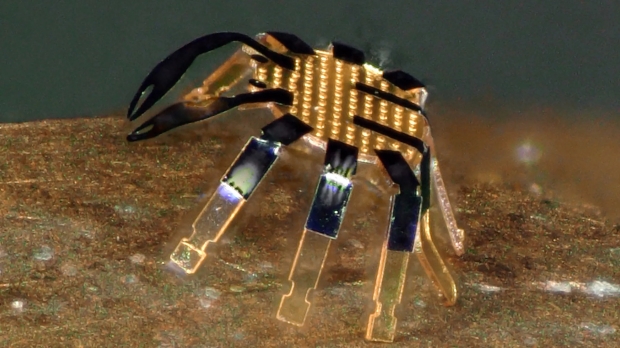
Exploratory research by engineers from Northwestern University has led to the creation of the smallest controllable robot yet, in the form of a crab smaller than the size of a flea. It can jump, bend, twist, crawl, walk, and turn without being powered by hydraulics, electricity, or other complex hardware.
The crab is controlled by applying a laser beam to its various body parts, heating them and causing them to change shape. The shape-memory alloy material used to construct the crab allows it to return to its original form once it has cooled. The robot's size allows it to cool very quickly, and using a scanning laser enables it to move in the direction the laser scans.
"Our technology enables a variety of controlled motion modalities and can walk with an average speed of half its body length per second. This is very challenging to achieve at such small scales for terrestrial robots," said Yonggang Huang, who led the theoretical work.
"Robotics is an exciting field of research, and the development of microscale robots is a fun topic for academic exploration. You might imagine micro-robots as agents to repair or assemble small structures or machines in industry or as surgical assistants to clear clogged arteries, to stop internal bleeding or to eliminate cancerous tumors-all in minimally invasive procedures," said John A. Rogers, who led the experimental work.
You can read more from the study here.


Adam's Top 3 Recommended Articles:
Read more: Crazy video shows a test vehicle catapulted toward space at 1,000+ mph
Read more: New DARPA hypersonic missile prototype test flew 5x the speed of sound
Read more: Elon Musk loses over $12 billion of wealth in one day after tweets