













Our Verdict
Pros
- Full 8TB
- Throughput performance
- SSD Toolbox
- TweakTown Elite Performer
Cons
- None
Should you buy it?
Introduction & Drive Details
Consumer 8TB NVMe SSDs have been a thing for over 5 years now. Our first encounter came via Sabrent's 8TB Rocket Q PCIe Gen3 SSD way back in June 2020. As you can imagine, back then, this SSD was priced WAY out of reach for most consumers, costing a whopping $1,500. Additionally, being arrayed with QLC flash and its controller struggling to deal with that much capacity, the drive was never among the top performers of its day.
Our next experience at 8TB came via Sabrent's 8TB Rocket 4 Plus PCIe Gen4 SSD back in December 2021. This drive came arrayed with TLC flash and the requisite, mind-bending $2,000 price tag. Again, way out of reach for the common consumer. Additionally, the drive didn't perform nearly as well as its lower-capacity siblings.
Then last year came the 8TB WD_BLACK SN850X PCIe Gen4 SSD. This TLC arrayed capacity king brought with it, finally, a reasonable level of affordability along with a much higher level of performance than its 8TB predecessors. In fact, its overall real-world performance was nearly as good as its smaller capacity siblings - at least much closer than ever before.
And finally, back in September of this year, Samsung's 8TB 9100 PRO arrived on the scene, offering our first taste of 8TB running on a PCIe Gen5 interface. In addition, this drive offers something we'd never experienced before at 8TB, truly elite real-world performance and efficiency so good it boggles the mind.
That brings us to today, where we are getting our latest taste of 8TB NVMe goodness. This SSD is a familiar one for us, having just recently tested its smaller 2TB capacity sibling back in November 2025. Biwin's Black Opal X570 Pro Series is one of our current favorites because it delivers full PCIe Gen5 throughput and a higher level of efficiency via its Silicon Motion SM2508 controller and Micron G8 TLC flash array.
In addition to its performance and efficiency, the X570 Pro Series is one of our favorites because it employs an advanced 0.5 mm thick graphene thermal pad for effective heat dissipation, giving the drive superior temperature control, ensuring stable performance even under high-load scenarios. Furthering the value proposition, Biwin has created a spectacular SSD toolbox called Biwin Intelligence, available free to complement Biwin SSDs.

Best Deals: Biwin Black Opal NV7400 4TB SSD
Price Trend:
Prices last scanned 3 hours and 19 minutes ago

7 days ago: $489.99 USD30 days ago: $489.99 USD
7 days ago: £429.9930 days ago: £429.99


Now, let's get into this review so we can show you firsthand what Biwin's 8TB X570 Pro SSD can do for you by the numbers.
Our Latest SSD Review Coverage
- Biwin M560 2TB SSD Review - Best Overall Retail-Ready DRAMless SSD
- Samsung 990 2TB SSD Review - Ninth Gen QLC at PCIe Gen4 Speeds
- Phison E37T SSD Controller Exclusive Preview - The Fastest DRAMless SSD Platform Yet
- Seagate FireCuda X1070 4TB SSD Review - A New Mainstream Contender
- Micron 3610 2TB SSD Review - DRAMless QLC at 11,000 MB/s
Drive Details
| Item | Details |
|---|---|
| Model | Biwin Black Opal X570 Pro 2TB |
| MSRP | n/a |
| Model Number | BX570DN08TB-RGX |
| Interface | PCIe Gen5 x4 |
| Form Factor | M.2 2280 |
| Performance | Up to 14,000 MB/s |
| Warranty | 5-Years Limited |


The drive we have in hand is Silicon Motion SM2508 controlled and Micron G8 TLC arrayed. Additionally, the drive offers a full 8TB (8192GB) raw capacity - a first for its capacity point.
When you buy a Biwin SSD, you get free supporting software that makes maintenance and system migration simple and free. Click HERE to download it.
Biwin Intelligence is multifunctional management software, designed to support Biwin consumer-brand storage products. For a more convenient and secure storage experience, this software helps users manage their Biwin SSDs with features like performance testing, data migration, firmware update, and more.

Jon's Test System Specifications
Intel Test System
| Item | Details |
|---|---|
| Motherboard | ASUS Z890 APEX (Buy at Amazon) |
| CPU | Intel Core Ultra 9 285K (Buy at Amazon) |
| GPU | MSI SUPRIM X RTX 3080 12GB (Buy at Amazon) |
| Cooler | Alphacool Eissturm Hurricane Copper 45 (Buy at Amazon) |
| RAM | Patriot Viper Xtreme 5 8000 48GB (Buy at Amazon) |
| Power Supply | be quiet! Dark Power Pro 12 1200W (Buy at Amazon) |
| Case | PrimoChill's Praxis Wetbench (Buy at Amazon) |
| OS | Microsoft Windows 11 Pro (Buy at Amazon) |
AMD Test System
| Item | Details |
|---|---|
| Motherboard | ASUS ROG Crosshair X870E APEX (Buy at Amazon) |
| CPU | AMD Ryzen 9 9950X (Buy at Amazon) |
| GPU | MSI SUPRIM X RTX 3080 12GB (Buy at Amazon) |
| Cooler | Alphacool Eissturm Hurricane Copper 45 (Buy at Amazon) |
| RAM | Sabrent Rocket DDR5 32GB (Buy at Amazon) |
| Power Supply | be quiet! Dark Power Pro 12 1200W (Buy at Amazon) |
| Case | PrimoChill's Praxis Wetbench (Buy at Amazon) |
| OS | Microsoft Windows 11 Pro (Buy at Amazon) |
Please note: We employ an M.2 AIC for testing on our Intel Core Ultra 9 285K platform.
Sony PlayStation 5 - M.2 Storage Expansion
PS5 Read Performance
With Sony's wildly popular PlayStation 5 console now enabled for M.2 NVMe SSDs to be used as fast storage expansion, we are including results for PS5-compatible SSDs we test as a part of our reviews going forward.


For SSDs that don't have an adequately sized PS5 compatible heatsink or other SSDs where the heatsink provided doesn't fit right and can be removed, we both use and recommend Sabrent's unparalleled PS5 heatsink available HERE.


We only chart SSDs that can deliver a minimum of 5,500 MB/s read, which is Sony's original recommendation.
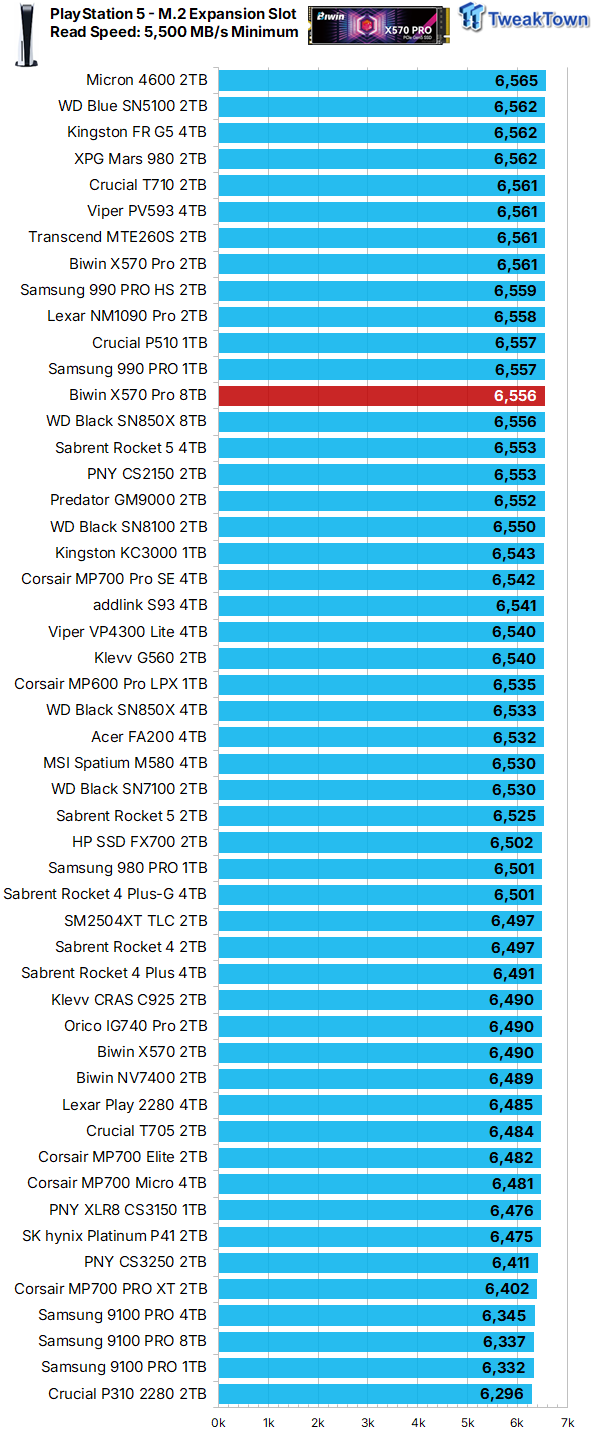
As it is with all SM2508-controlled SSDs, we see the Black Opal X570 Pro 8TB as one of the best options going for PS5 fast storage expansion. Just think how many games can fit on this baby. Additionally, the drive is so power-efficient and thereby cool-running that it's ideally suited for this role.
Synthetic Benchmarks: CDM, Max IOPS, ATTO
CrystalDiskMark
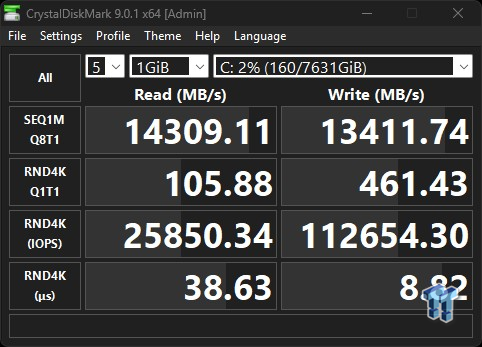
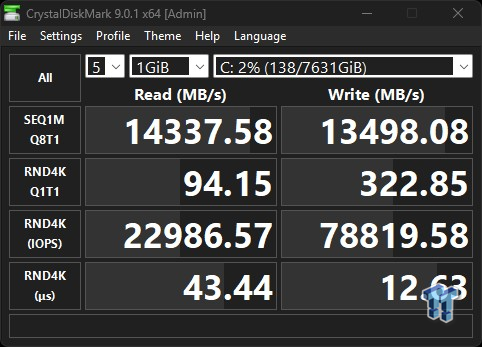
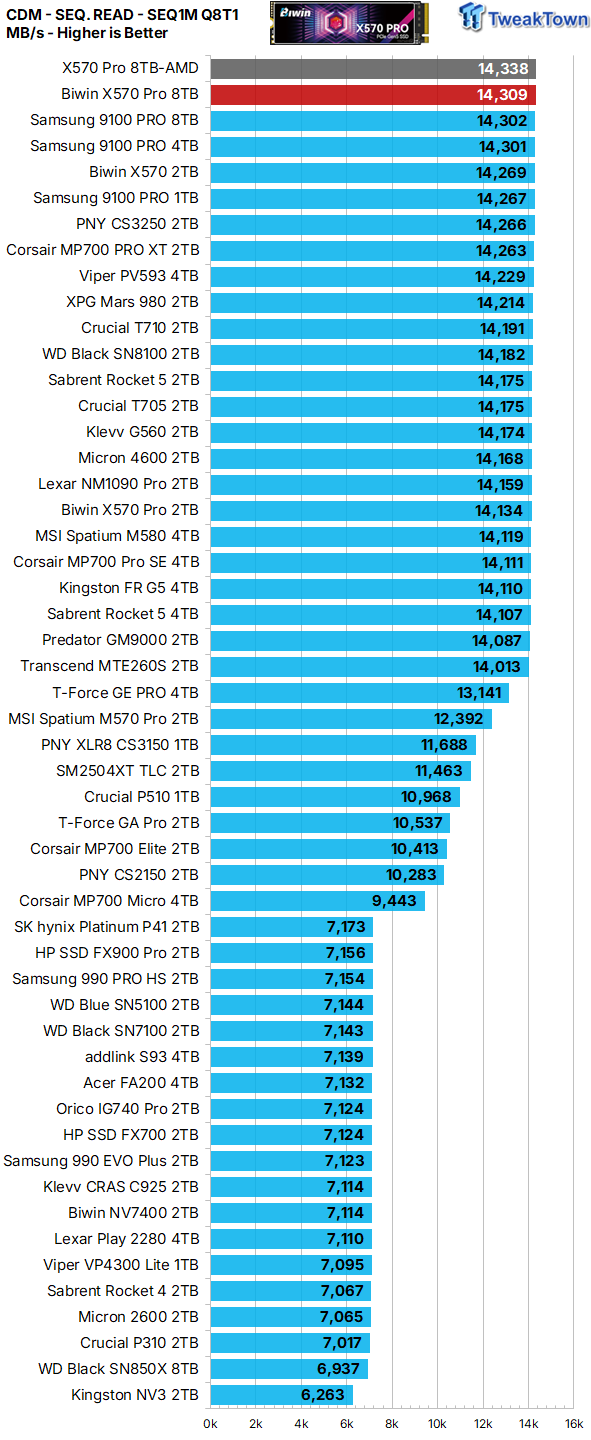
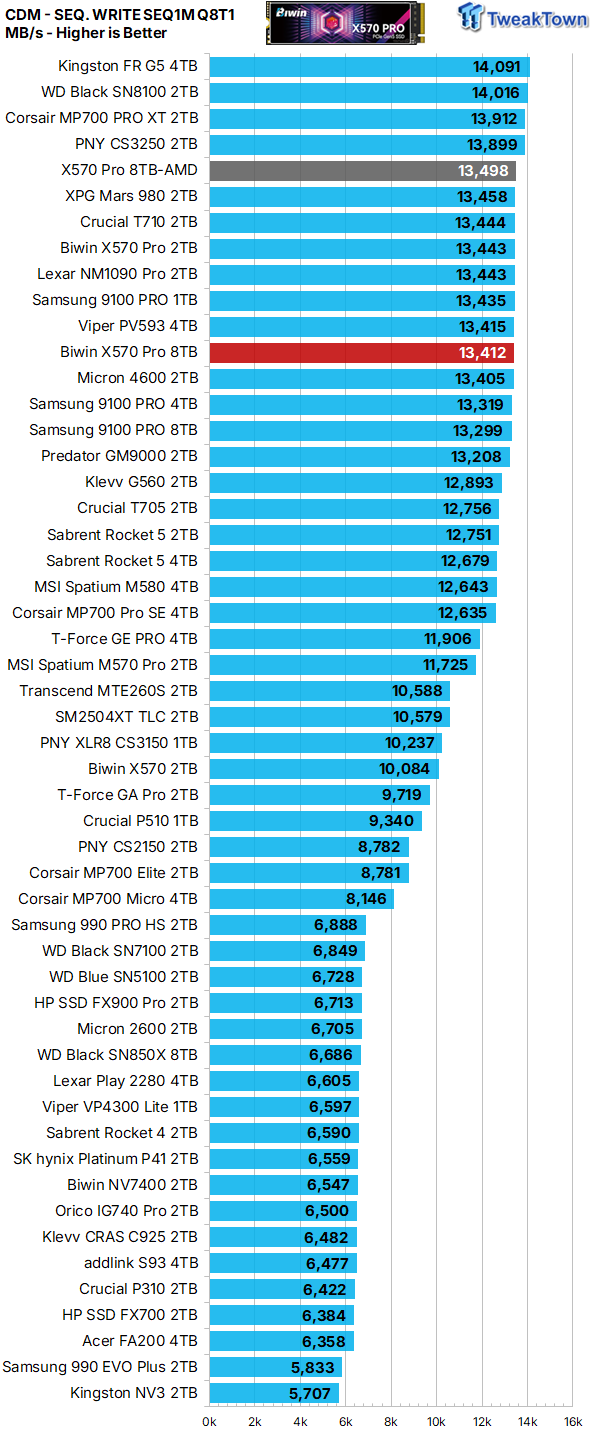
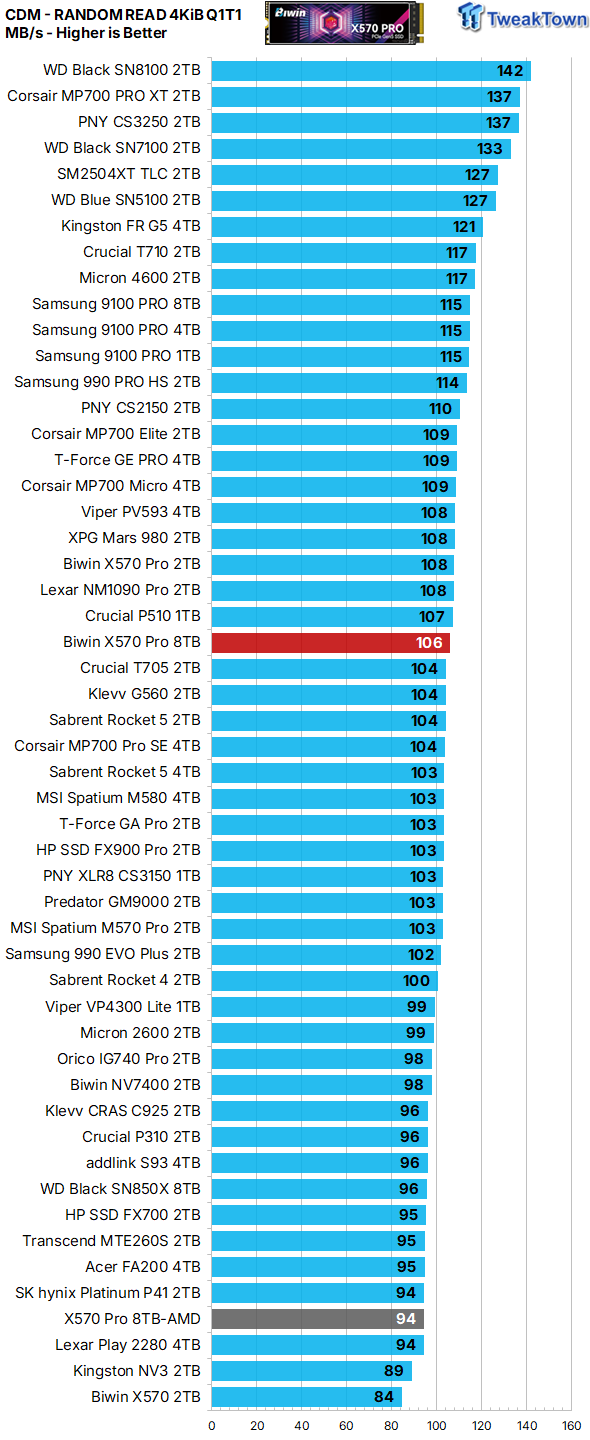
We employ CDM as our standard measurement for both sequential throughput and Q1T1 random read. In terms of sequential throughput, the X570 Pro delivers exactly as advertised and then some, even in our more demanding user state. In fact, our high-capacity contender delivers a new lab record for sequential read on an Intel platform. Impressive.
Zeroing in on the all-important Q1T1 random read speed, our Micron G8 arrayed contender is delivering very well for its NAND type, indicating that its real-world performance should be excellent, right in there with its 2TB sibling.
Max IOPS
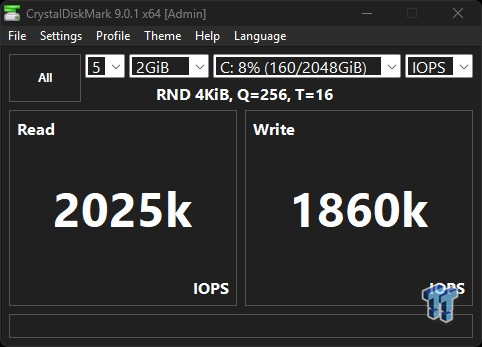
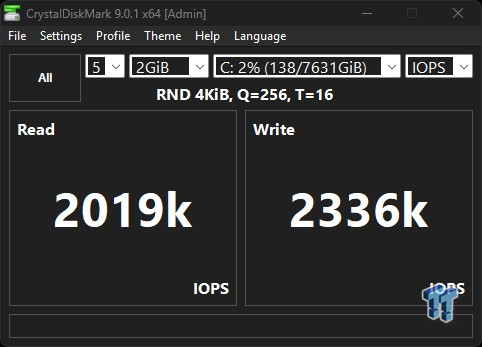
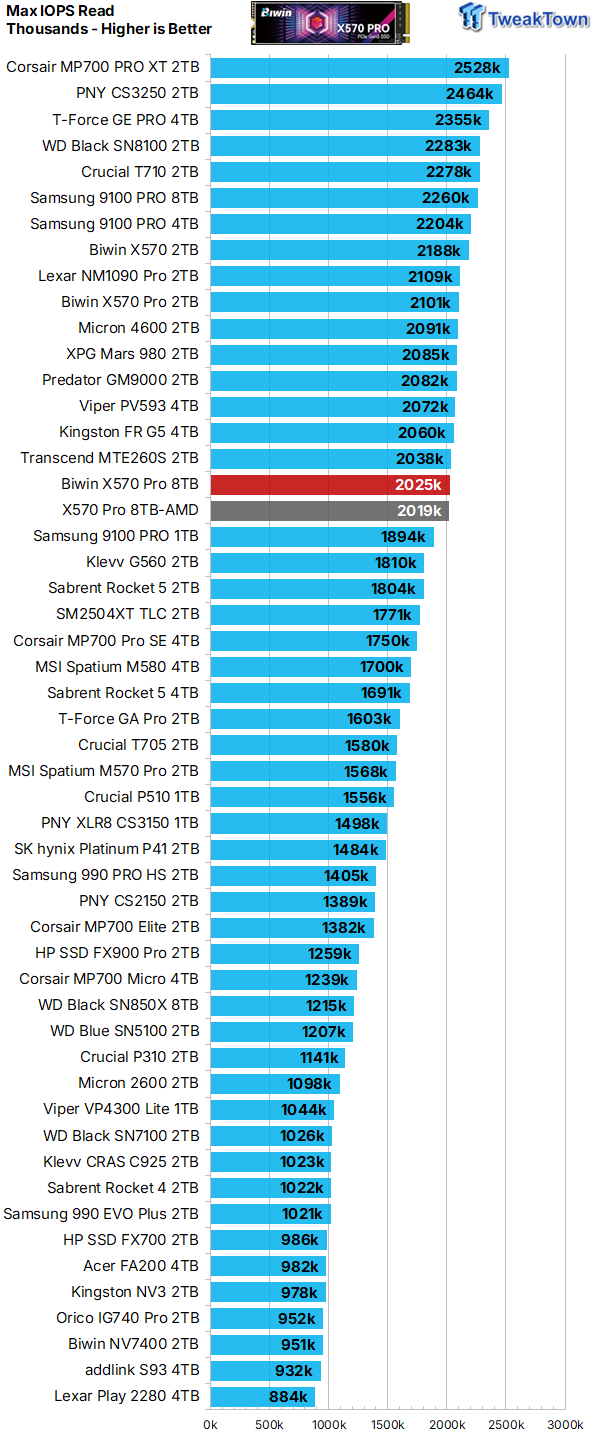
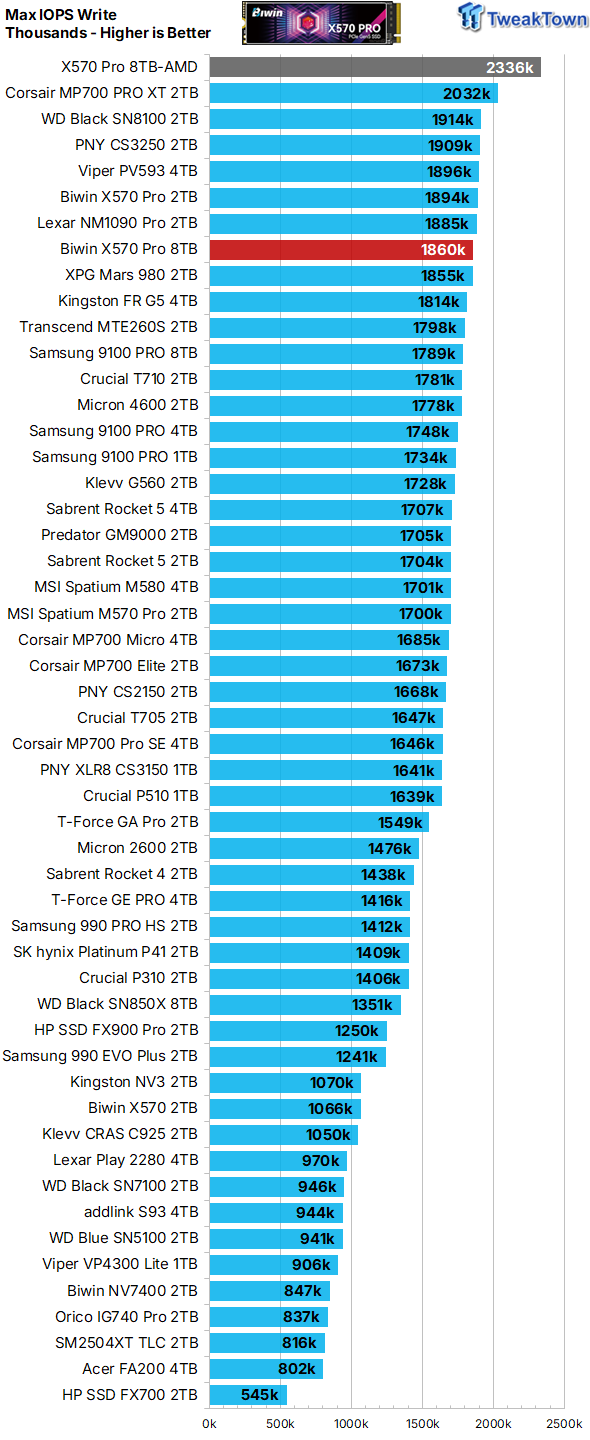
Again, we have no issues meeting and/or exceeding the quoted factory performance specifications. With up to 2,025K 4K random read IOPS and a whopping 2,336K 4K random write IOPS, our ultra-high-capacity juggernaut delivers as advertised and then some, even under our more demanding user state. Excellent.
ATTO
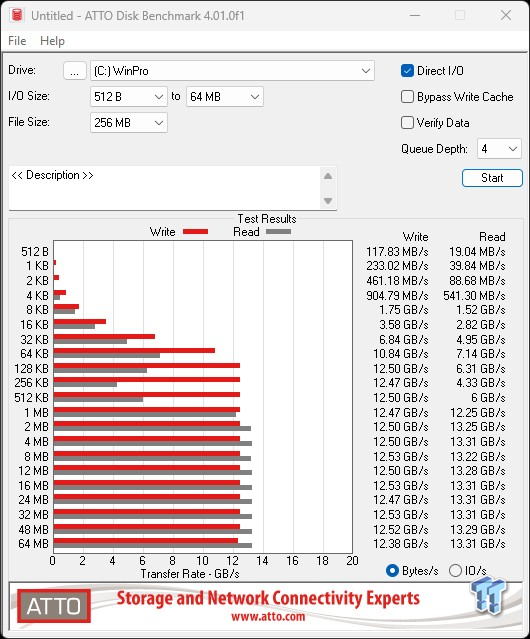
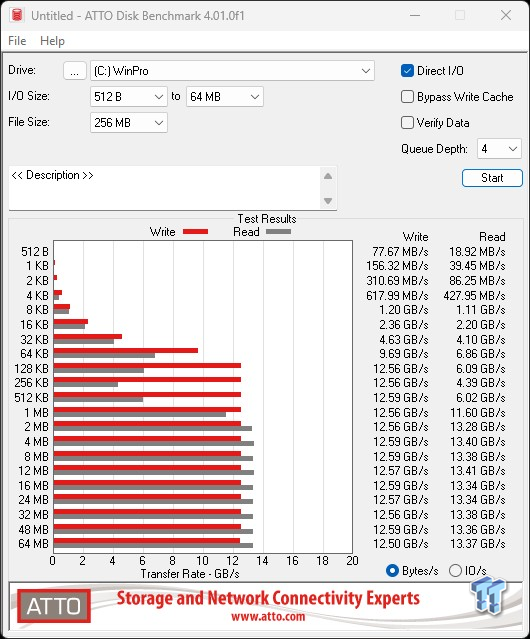
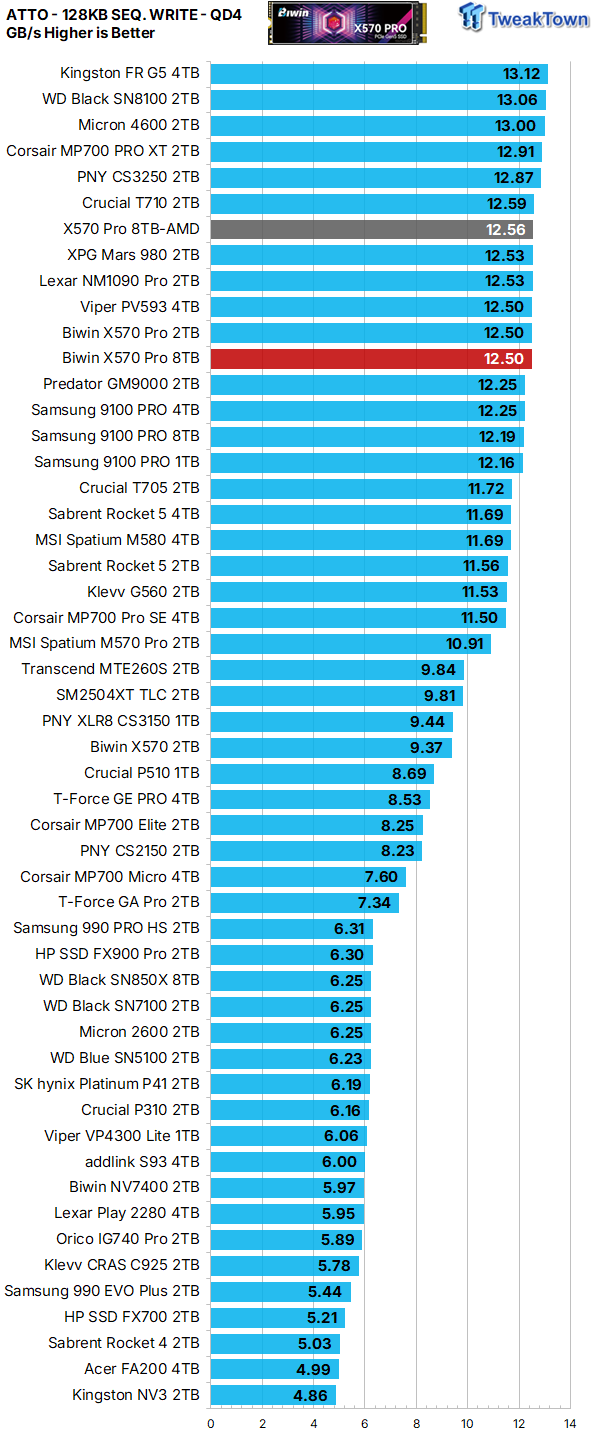
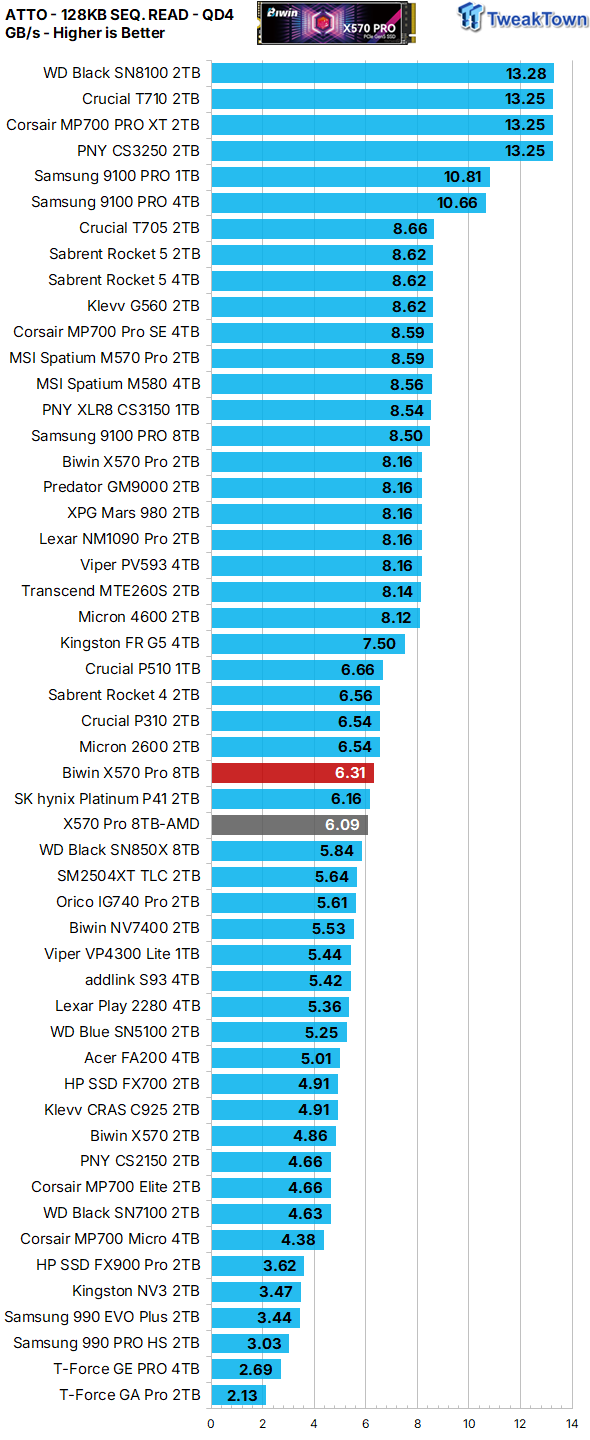
ATTO gives us a clear picture of what transfer sizes a particular SSD favors in terms of QD4 sequential throughput. We chart 128K transfers. At a queue depth of four, the X570 Pro 8TB favors sequential transfers of 2MB or larger when serving data to the host (reading) and 128KB or larger when programming (writing) data.
Real-World Testing: Transfers, 3DMark SSD Gaming Test, PCM10 Storage
Transfer Rates
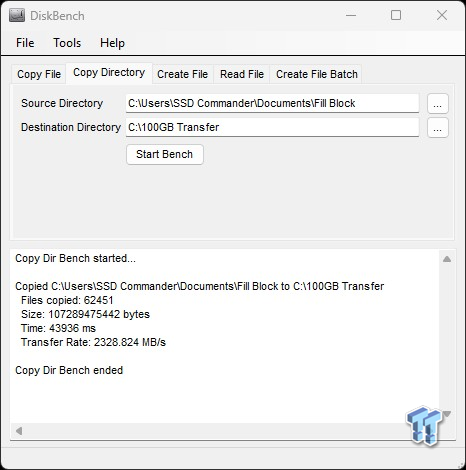
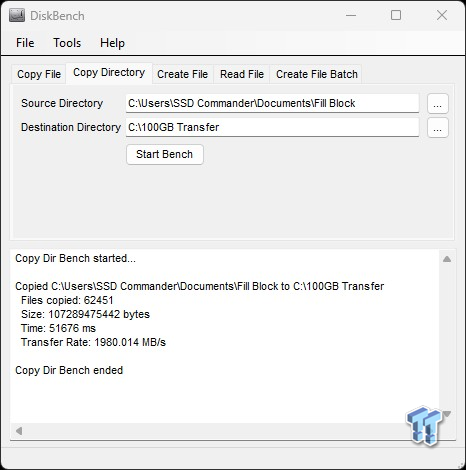
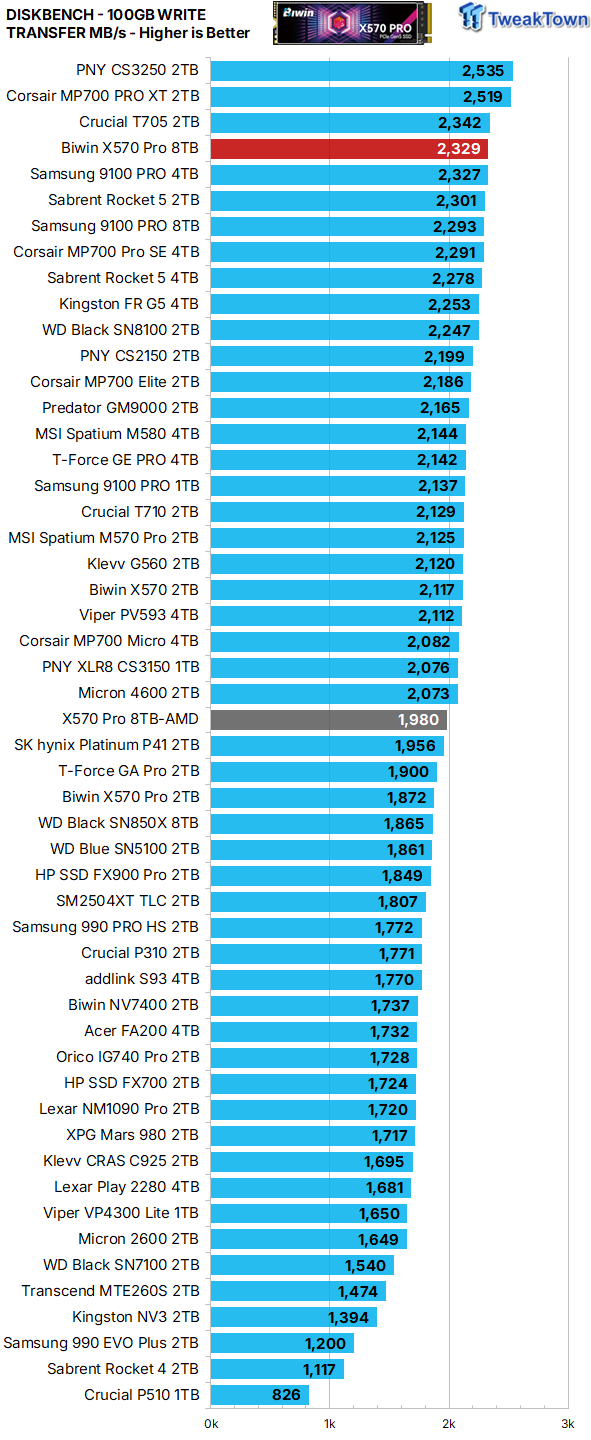
Our 100GB data transfer test is not your ordinary 100GB of data; ours is a crushing mix composed of more than 62K files. Writing performance, random or sequential, is an infrequent operation, and thus, we do not consider it to be an important performance metric in the consumer space. An example is how many times a game is installed vs. how many times it's played. The transfer rate here is mind-blowing, the best we've ever seen coming from any 8TB SSD.
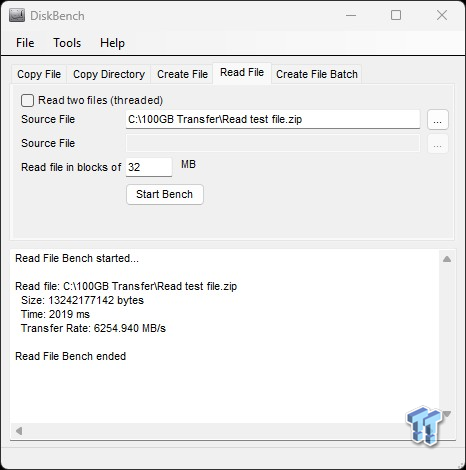
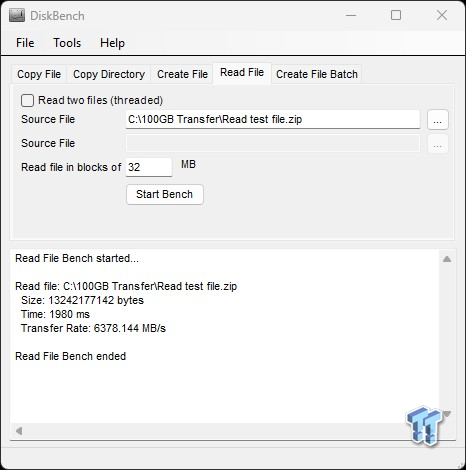
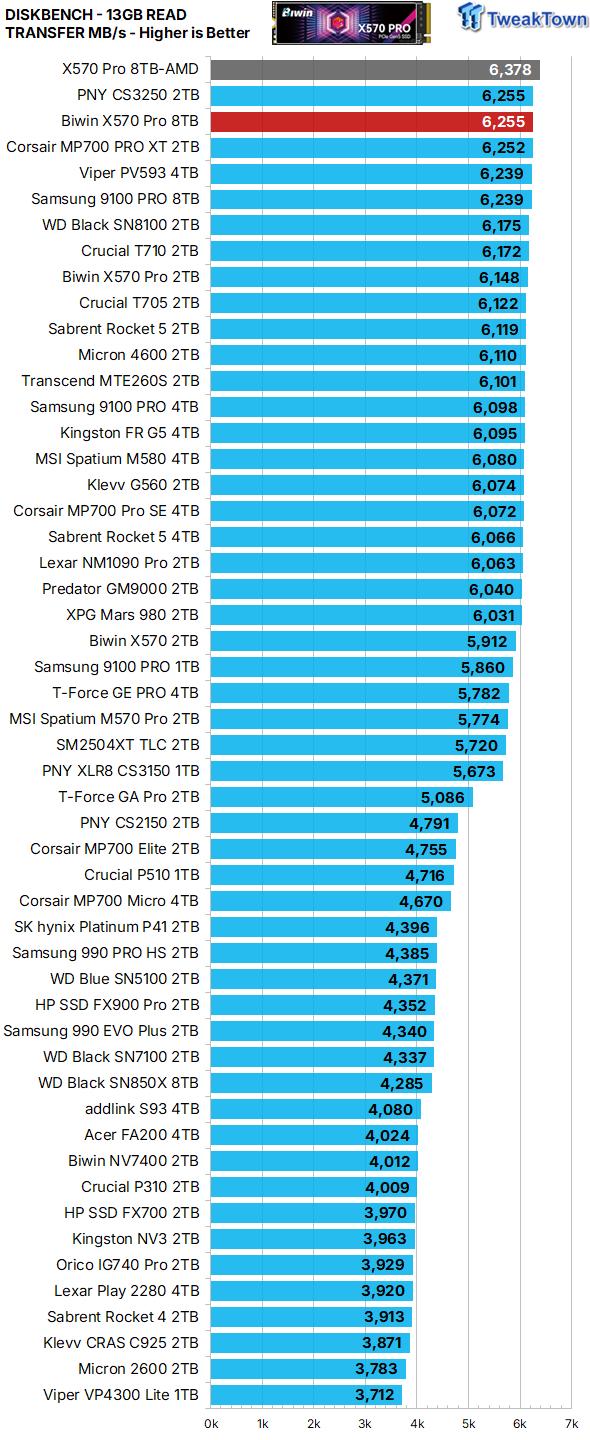
Unlike programming (writing) data, serving data to the host (reading) is typically an important performance metric as it relates to the consumer space. This is where transfer rates matter most, and our 8TB X570 Pro sets the bar, delivering the highest rate we've ever encountered from a flash-based SSD running on an Intel-based platform. Impressive.
3DMark SSD Gaming Test
UL's newest 3DMark SSD Gaming Test is the most comprehensive SSD gaming test ever devised. We consider it superior to testing against games themselves because, as a trace, it is much more consistent than variations that will occur between runs on the actual game itself. This test is the same as running the actual game, just without the inconsistencies inherent to application testing. In short, we believe that this is the world's best way to test an SSDs gaming prowess and accurately compare it against competing SSDs. The 3DMark SSD Gaming Test measures and scores the following:
- Loading Battlefield V from launch to the main menu.
- Loading Call of Duty Black Ops 4 from launch to the main menu.
- Loading Overwatch from launch to the main menu.
- Recording a 1080p gameplay video at 60 FPS with OBS (Open Broadcaster Software) while playing Overwatch.
- Installing The Outer Worlds from the Epic Games Launcher.
- Saving game progress in The Outer Worlds.
- Copying the Steam folder for Counter-Strike Global Offensive from an external SSD to the system drive.


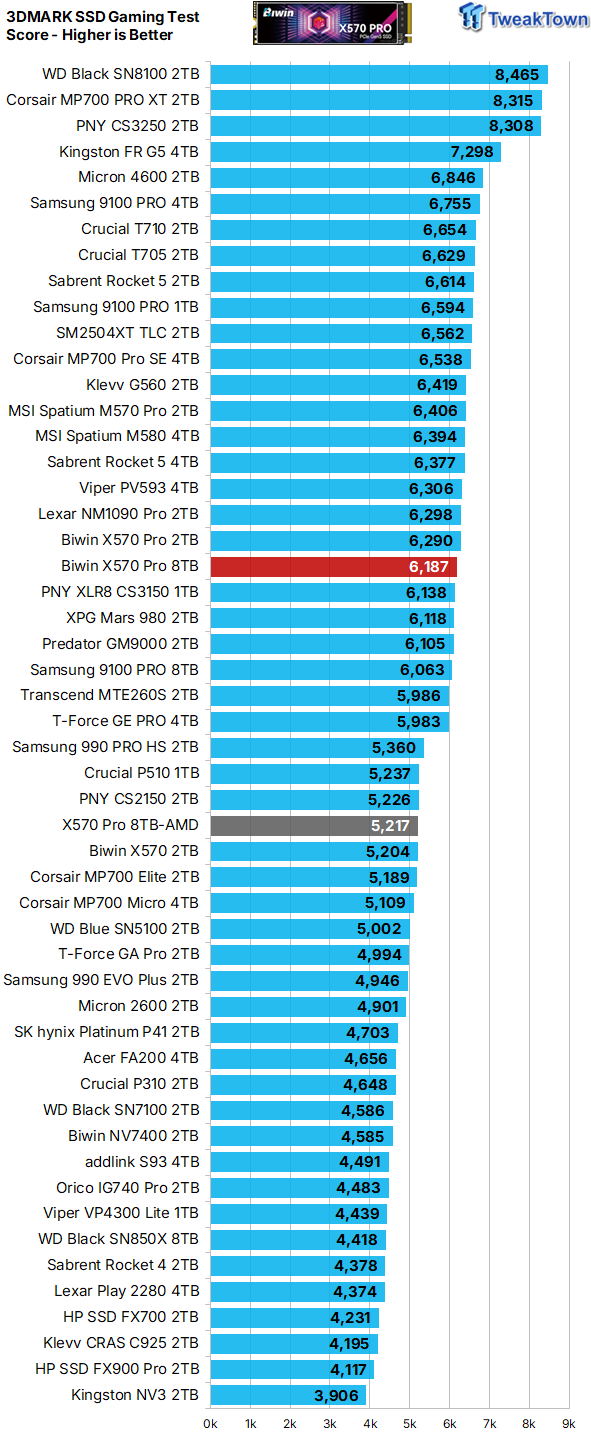
Gaming is a performance metric that matters to most DIY consumers, especially for the enthusiast crowd that TweakTown caters to. Now we've reached the point where results start to matter as they are a direct reflection of user experience.
We consider a score of 6,000 here to be somewhat of a milestone achievement. Our test subject delivers that and a bit more. Biwin's X570 Pro is the best Gaming SSD we've ever encountered at 8TB, it's even better than Samsung's 8TB 9100 PRO here which cements in our minds that this drive, all things considered, is indeed the most desirable gaming SSD we've ever encountered, and it also offers almost 200GB more usable capacity than any other 8TB SSD we've ever encountered.
PCM10 Storage Tests
PCMark 10 Storage Test is the most advanced and most accurate real-world consumer storage test ever made. There are four different tests you can choose from; we run two of them. The Full System Drive Benchmark and the Quick System Drive Benchmark. The Full System Drive Benchmark writes 204 GB of data over the duration of the test. These tests directly correlate with mainstream user experience.
PCMark 10 Full System Drive Benchmark
This test writes 204GB of data and covers a broad range of common consumer tasks, including booting Windows 10, file transfers, Adobe and Office applications, and startup times for games such as Battlefield V, COD Black Ops 4, and Overwatch. Unlike synthetic numbers, this is comprehensive real-world data, which is why we use it to rank SSDs in terms of user experience.


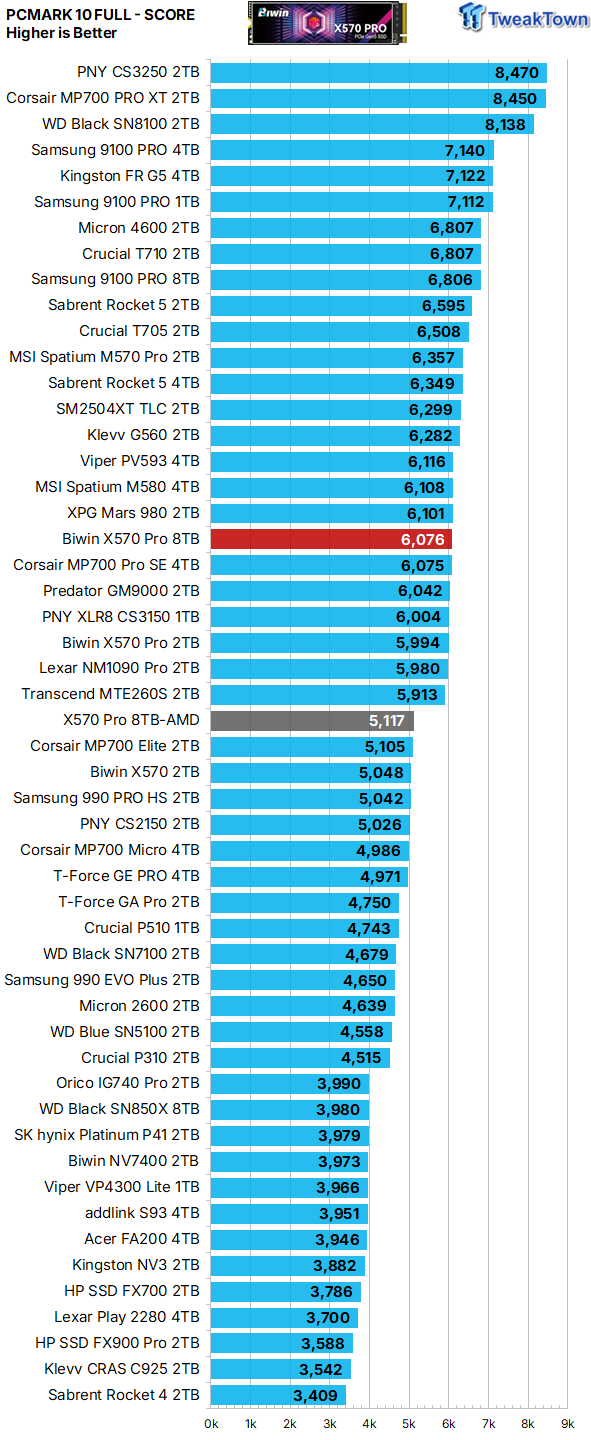
This round, our test subject gets bested handily by Samsung's 8TB 9100 Pro but notably manages to outperform its 2TB sibling here - delivering the third-best score for this common hardware configuration. Excellent.
PCMark 10 Quick System Drive Benchmark
The Quick System Drive Benchmark writes 23 GB of data over the duration of the test.


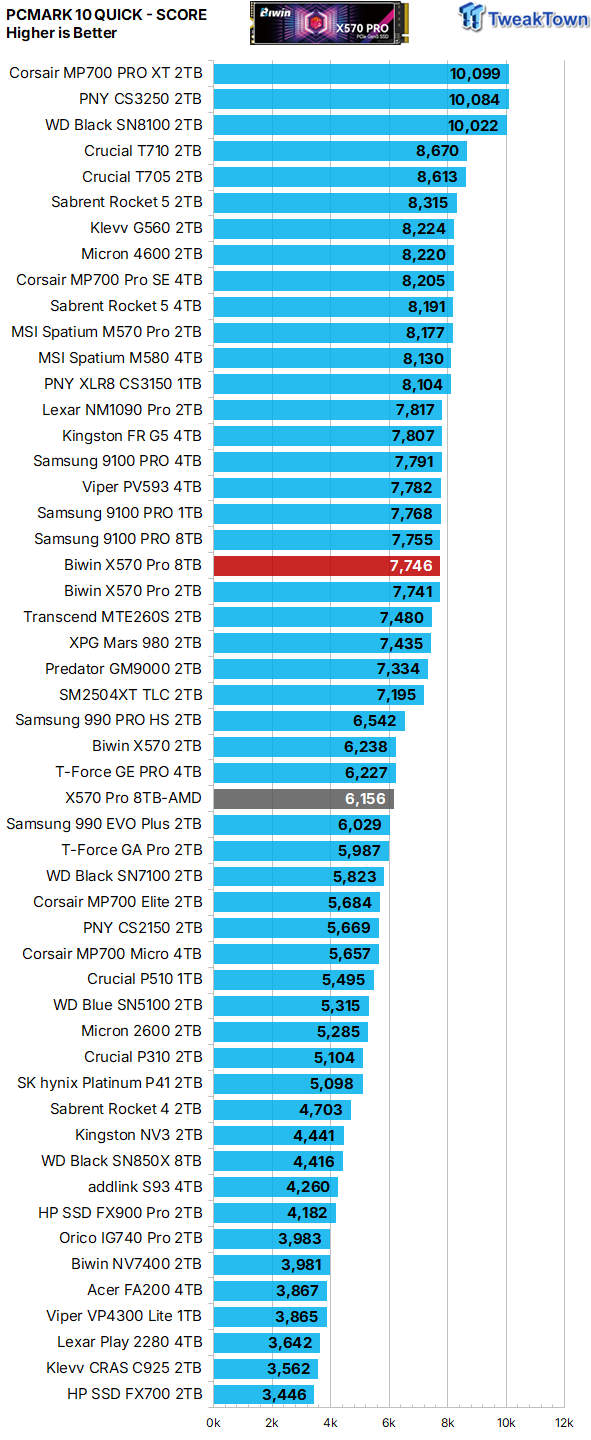
Of all the benchmarks we run, it can be argued that this one offers the best reflection of a typical consumer use case scenario. Here, our 8TB contender responds by delivering exactly what the 8TB 9100 Pro is delivering. Impressive.
Final Thoughts
As we see things, there is a good argument to be made that Biwin's Black Opal X570 Pro 8TB is the ultimate gaming SSD money can buy. Its capacity is literally unmatched, having 192GB more available drive space than any other 8TB class NVMe SSD we've encountered to date. Furthering this argument is the fact that today's test subject outperformed Samsung's 8TB 9100 PRO on our 3DMARK gaming test, and finally, our ultra-high-capacity contender ran equal to the 9100 PRO when tested against common consumer workload simulations.
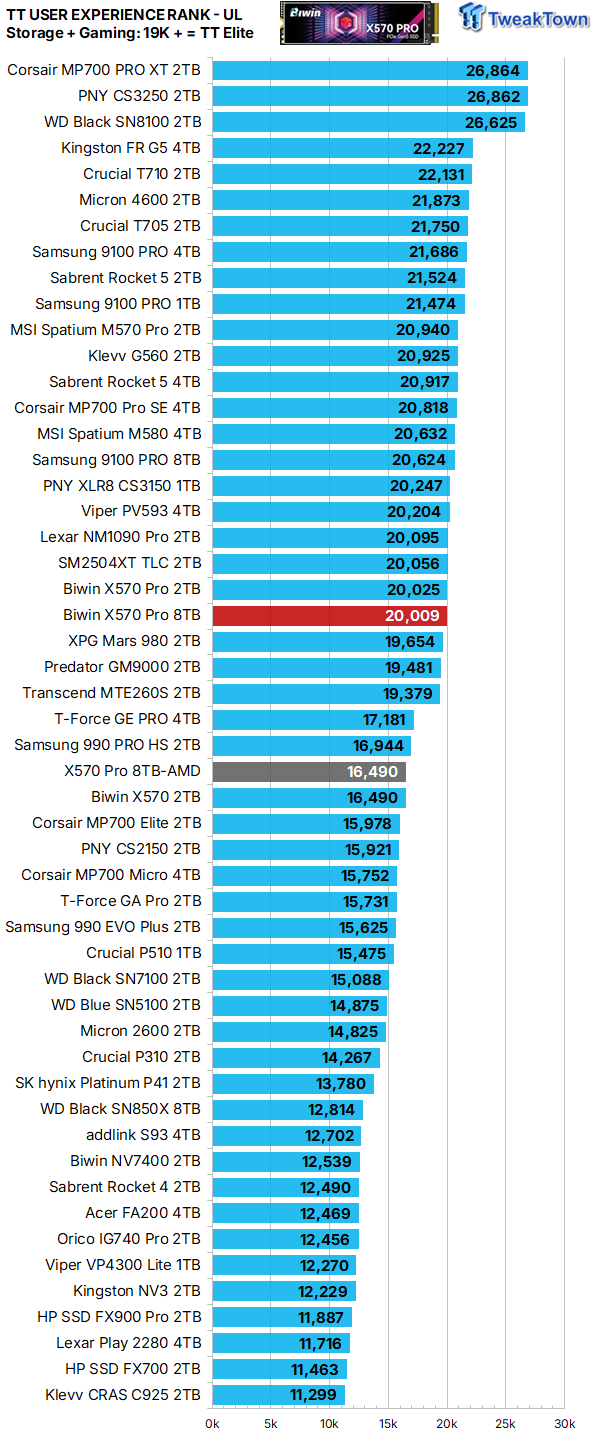
We rank SSDs in terms of overall user experience (performance where it matters most) as expressed by PCMark 10 storage and 3DMark gaming storage tests. Currently, we consider a user experience score of 19K or more to verify an SSD as a TweakTown Elite performer. Just as we saw at 2TB, we see at 8TB. 20K Elite speaks for itself.

If the price is right, we are of the opinion that 8TB of this makes for the ultimate gaming SSD. Editor's Choice.


 Biwin M560 2TB SSD Review - Best Overall Retail-Ready DRAMless SSD
 Samsung 990 2TB SSD Review - Ninth Gen QLC at PCIe Gen4 Speeds
 HighPoint Rocket 1604L Gen5 x16 NVMe Software RAID AIC Review: half the price with full 59 GB/s speed
 UGREEN NASync DXP4800 GT Review: powerful 4-bay NAS with AMD Ryzen and dual 10GbE ports
 Phison E37T SSD Controller Exclusive Preview - The Fastest DRAMless SSD Platform Yet
 Giveaway: 12 Winners Will Score MONTECH NX400 and NX600 CPU Coolers
 Sandisk NAS 800 NVMe SSD delivers PCIe Gen5 speeds for demanding NAS environments
 RayNeo announces new iO Smart Glasses and GT Series with 'cinema-grade' display
 IQUNIX launches premium EC75 Hall Effect keyboard with 0.01mm Rapid Trigger
 AVerMedia announces new pro-grade HDMI capture devices with up to 4K RGB24 True Color support
 Beyerdynamic announces new affordable MMX 100 and MMX 130 wireless gaming headsets with studio-grade sound
 AMD's latest Radeon driver adds support for Star Wars Zero Company, Call of Duty, and Radeon RX 9050 4GB GPU
 Razer's new Huntsman is the 'world's first low-profile analog optical esports keyboard'
 GTA 6 appears to have leaked from Rockstar India, also suspected to be a PC version
 Xbox struggles to move physical discs, accounts for only 4% of disc sales in the US this year
 Samsung Foundry raises manufacturing prices, may impact the Nintendo Switch 2
 GIGABYTE MO27Q2A Gaming Monitor Review: 1440p, 280Hz, and QD-OLED is a winning combination
 Cooler Master V8 ACE 3DHP BLACK CPU Cooler Review
 ASUS ROG Strix XG129C Review: A $199 Gaming Monitor You Don't Play Games On
 Cooler Master HAF II 500 Mid-Tower Chassis Review
 Corsair HS35 v3 Wireless Gaming Headset Review - An Affordable Winner
 D-Link F518 5G Wi‑Fi 6 AX1800 Mobile Hotspot Review: All-Day Mobile Hotspot
 Bose Lifestyle Ultra Speaker Review - Impressively Detailed Room-Filling Sound
 MSI Z890 Gaming Plus WIFI6E Review - Z890 for under $200
 Mortal Kombat (1995) 4K Ultra HD Blu-ray Review
 CPS PCCOOLER YS1200 ATX 3.1 80 PLUS Gold PSU Review
 Using Multiple Monitors? Change these Windows settings for a Better Experience
 Windows Sandbox is The Windows Security Feature Most People Never Use
 I ditched the Windows 11 context menu for this open-source tool, and here's why
 Windows 11 may be encrypting your drive already, and I checked where my recovery key went
 GIGABYTE's 40 Days of INFINITY celebrates 40 Years of Innovation with stunning GeForce RTX graphics cards and rewards
 I swapped File Explorer for this free file manager and finally got the layout I wanted
 How to tell if someone has been using your Windows PC without your permission
 6 Task Manager tips for troubleshooting Windows performance problems
 ASUS ROG's 20th Anniversary Line-up of Premium PC Gaming Gear has Arrived - Here's Everything You Need to Know
 Six File Explorer tips every Windows user should know