


Introduction and Drive Details
The PBlaze7 7A40 Ocean is Memblaze's first ultra-high-capacity PCIe 5.0 QLC NVMe SSD. The Chinese-based storage giant has designed its Ocean Series SSDs for large-scale AI and cloud deployments. These QLC behemoths combine extreme storage density, high-read throughput, and exceptional energy efficiency to support the rapidly growing demands of AI data pipelines, GPU clusters, and hyperscale data lakes, or should we say data oceans.
The U.2 form factored PBlaze 7 Ocean Series can be had at capacities up to 122.88TB, enabling super dense storage arrays approaching 3 petabytes of storage in a standard 2U server. The side effect of this kind of density upgrade is, of course, an order of magnitude better efficiency across all fronts, including footprint and power draw per terabyte of storage, enabling increased compute node deployment to significantly accelerate AI workloads.
Leveraging the bandwidth of PCIe 5.0 and Memblaze's advanced firmware, the QLC arrayed PBlaze7 7A40 Ocean Series SSDs deliver read throughput that's right at the upper limit of the PCIe Gen5 interface for both sequential and random data retrieval. This high level of read performance minimizes storage bottlenecks and helps keep GPUs fully utilized during AI training and inference workloads, where write performance is of little consideration.
Memblaze states that its PBlaze 7 Ocean Series is designed to world-class enterprise-grade reliability standards, such as 2.5 million hours MTBF and 0.7 DWPD endurance. This level of reliability sustains long-term AI workload growth by optimizing your enterprise TCO and ROI, which in the end is the priority of any sustainable infrastructure.
Okay, now that we are somewhat acquainted with what the PBlaze 7 Ocean Series SSDs are bringing to the table, let's see what kind of performance its 61.44TB variant can deliver via our Xeon-powered enterprise test bench.
Specs/Comparison Products

Best Deals: Solidigm D5-P5336 SSD
Price Trend:
Prices last scanned 9 hours and 33 minutes ago


| Item | Details |
|---|---|
| Model | Memblaze Pblaze 7 7A40 Ocean 61.44TB |
| MSRP | NA |
| Model Number | P7A40DT6144Y02 |
| Interface | PCIe Gen5 x4 |
| Form Factor | U.2 |
| Sequential BW | Up to 14,200 MB/s |
| Random IOPS | Up to 3350K IOPS |
| Warranty | 5-Years Limited |
Memblaze PBlaze 7 7A40 Ocean 61.44TB PCIe Gen5 x4 U.2 SSD


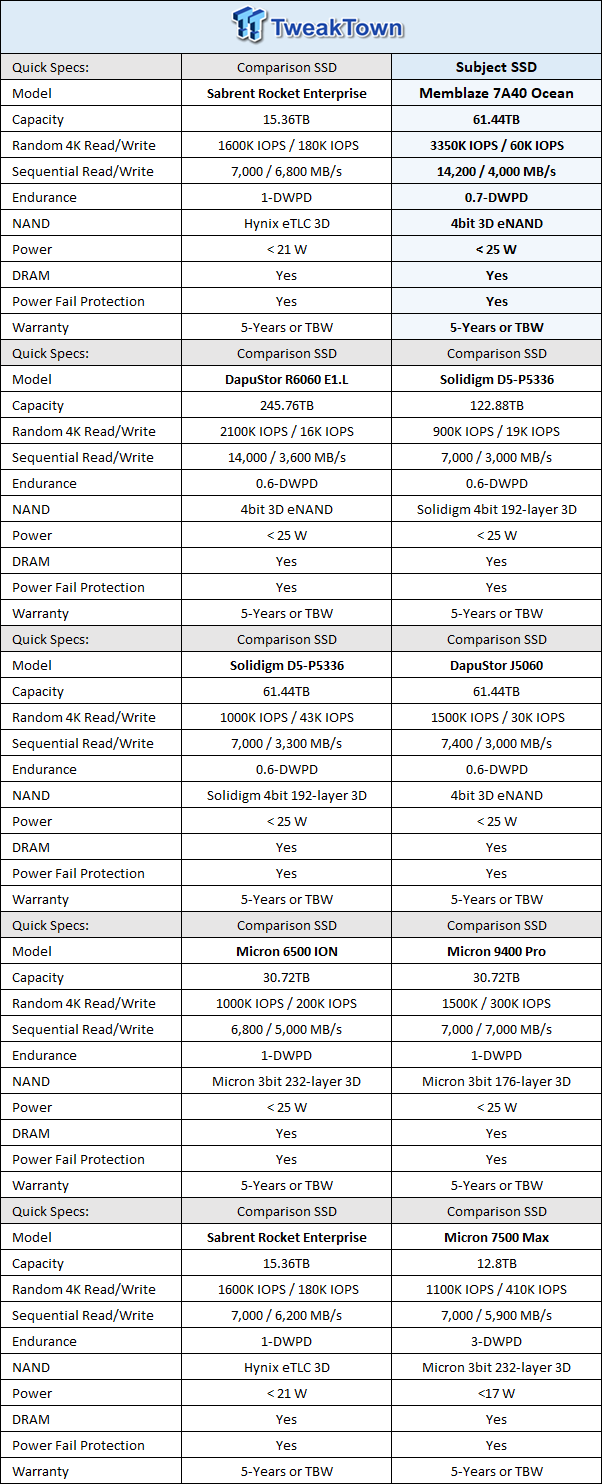
The drive we have in hand is a 0.7-DWPD design, U.2 form factor, 61.44TB in capacity, eQLC arrayed, and 16-channel controlled. This configuration is rated for up to 3.35 million IOPS and up to 14.2 GB/s sequential throughput. Ocean Series SSDs are compliant with the NVMe 2.1 specification, including Full Data Path Protection, Power Failure Protection, NVMe-MI over SMBus/PCIe VDM, and Firmware Upgrade without Reset.
Memblaze PBlaze 7 7A40 Ocean Series SSDs are compatible with major operating systems such as RHEL, SLES, CentOS, Ubuntu, Windows Server, and VMware ESXi.
Our Latest SSD Review Coverage
- KIOXIA CM9-R 15.36TB E3.S Enterprise SSD Review - Performance King at 1-DWPD
- Micron 6600 ION 245.76TB Enterprise SSD Review - Best in Class Programming Speeds
- KIOXIA CD9P-R 7.68TB E3.S Review - The Best-In-Class Data Center SSD
- DapuStor Roealsen6 R6060 E1.L 245.76TB SSD Review - Massive Capacity with Fast Retrieval
- Phison Pascari X200P 7.68TB Enterprise SSD Review - Sequential Read Champion
Test System Specs & Enterprise Testing Methodology
Enterprise SSD Test System
| Item | Details |
|---|---|
| Motherboard | ASUS Pro WS W790E-SAGE SE (Buy at Amazon) |
| CPU | Intel Xeon w7-2495X (Buy at Amazon) |
| GPU | GIGABYTE GeForce GTX 1650 (Buy at Amazon) |
| Cooler | Alphacool Eissturm Hurricane Copper 45 (Buy at Amazon) |
| RAM | Micron DDR5-4800 RDIMM (Buy at Amazon) |
| Power Supply | be quiet! Dark Power Pro 12 1200W (Buy at Amazon) |
| Case | PrimoChill's Praxis Wetbench (Buy at Amazon) |
| OS | Ubuntu 24.04.1 LTS |
A special thank you goes to Allyn Malventano, without whose help we wouldn't be where we are with our Linux-based Enterprise SSD testing platform.
Testing Methodology
TweakTown strictly adheres to industry-accepted Enterprise Solid State Storage testing procedures. Each test we perform repeats the same sequence of the following steps:
- Secure Erase SSD
- Write the entire capacity of SSD 2x (2 loops) with 128KB sequential write data, seamlessly transition to the next step (sequential testing skips step 3)
- Precondition SSD by filling the drive twice with 4K or 8K random writes or IU of SSD
- Run test-specific workload with a 30-second ramp up for 5 minutes at each measured Queue Depth, and record average result
Benchmarks - Sequential
128K Sequential Write/Read

We precondition the drive with 100 percent sequential 128K writes at QD256 using 1-thread for 2-drive fills, receiving performance data every second. We plot this data to observe the test subject's descent into steady-state and to verify that steady-state is in effect as we seamlessly transition into testing at queue depth. A steady-state is achieved after a 1-drive fill. Average steady-state 128K sequential write performance at QD256 is approximately 3,950 MB/s.


Memblaze specs its PBlaze 7 7A40 61.44TB SSD as capable of delivering up to 4,000 MB/s 128K sequential write throughput. We are getting up to 4,038 MB/s, so the factory spec seems to be spot on. The drive is the fastest of its kind here that we've encountered to date.


Here, the drive is factory spec'd for up to 14,200 MB/s 128K sequential read throughput. We are hitting up to 14,222 MB/s, so again exactly as advertised and at a place where throughput matters most for read-intensive applications. Looking at the chart, we can see a clear advantage that PCIe Gen5 brings to the table as compared with the PCIe Gen4 SSDs that populate our chart. Roughly double the sequential throughput potential. Impressive.
Benchmarks - Random
4K Random Write/Read

We preconditioned the drive using 100 percent random 16K (IU aligned precon) writes at QD256 for 2-drive fills, receiving performance data every second. We plot this data to observe the test subject's descent into steady-state and to verify that steady-state is in effect as we seamlessly transition into testing at queue depth. A steady-state is achieved after a 1-drive fill. Average steady-state random write performance at QD256 is approximately 68K IOPS - factory spec here is 60K IOPS, so significantly better than advertised. We note exceptional consistency here.


4K random write performance is not advertised, only 16K random write, which is what we used to precondition the drive, because at 4K preconditioning would take roughly 14 days due to the capacity of our test subject. Performance here at 4K is expected to be significantly lower than it is at 16K IU, but surprisingly, we are still doing a bit better than the quoted 60K IOPS at 16K. Impressive and again the highest we've ever experienced coming from a QLC arrayed SSD.


Factory spec here is up to an eye-popping 3.350K IOPS. We are getting up to 3,364K with our configuration. As we reckon, performance here, where it matters most, is the highest we've ever seen coming off a QLC SSD at any capacity. True TLC level peak rates coming from QLC. Amazing.
4K 7030


This type of workload is not what this type of SSD is designed to tackle, so results here are mostly irrelevant. Although we will note this is again the best we've seen coming from any 4-bit arrayed enterprise SSD.
4K 5050


Again, this type of workload is not what this type of SSD is designed to tackle, so results here are mostly irrelevant. Although we will note this is again the best we've seen coming from any 4-bit arrayed enterprise SSD.
8K Random Write/Read

We preconditioned the drive using 100 percent random 16K (IU aligned precon) writes at QD256 for 2-drive fills, receiving performance data every second. We plot this data to observe the test subject's descent into steady-state and to verify that steady-state is in effect as we seamlessly transition into testing at queue depth. A steady-state is achieved after a 1-drive fill. Average steady-state random write performance at QD256 is approximately 68K IOPS - factory spec here is 60K IOPS, so significantly better than advertised. We note exceptional consistency here.


8K random write performance is not advertised, only 16K random write, which is what we used to precondition the drive, because at 4K preconditioning would take roughly 7 days due to the capacity of our test subject. Performance here at 4K is expected to be significantly lower than it is at 16K IU, but surprisingly, we are still doing a bit better than the quoted 60K IOPS at 16K. Impressive and again the highest we've ever experienced coming from a QLC arrayed SSD.


Outstanding performance curve here. Yet again, we find our test subject cranking out by far the most IOPS we've encountered coming from a QLC arrayed SSD. Outstanding.
8K 7030


8K 7030 is representative of a common database workload. Again, this type of workload is not what this type of SSD is designed to tackle, so results here are mostly irrelevant. However, we will note that surprisingly, our test subject can deliver performance here that is very close to that of some high-capacity TLC arrayed PCIe Gen4 SSDs. Impressive.
8K 5050


Again, this type of workload is not what this type of SSD is designed to tackle, so results here are mostly irrelevant. Although we will note this is again and by far the best we've seen coming from any 4-bit arrayed enterprise SSD.
Final Thoughts
As we see it, our test subject has indeed raised the performance bar for ultra-high capacity QLC SSDs. No other of its kind that we've ever encountered can even come close to matching the peak performance of Memblaze's PBlaze 7 7A40 61.44TB. It is indeed the first QLC SSD we've seen that can max out the PCIe Gen5 interface when retrieving data, and also the first that can do some mixed workloads at rates approaching that of PCIe Gen4 TLC arrayed SSDs.

It's the best of its kind that we've encountered to date. Editor's Choice.