
Our Verdict
Pros
- Throughput performance
- Gaming performance
- 20K Elite performance
Cons
- Lack of supporting software
Should you buy it?
Introduction & Drive Details
With most of the current PCIe Gen5 buzz having been centered around major SSD players like Samsung, Sandisk, etc., the SK hynix Platinum P51 is a contender that has gone relatively unnoticed here in North America and indeed across much of the SSD global landscape. We couldn't find any reviews of it done by any of the major players here in the USA.
The SK hynix Platinum P51 is the PCIe Gen5 successor to its PCIe Gen4 performance flagship SSD, the Platinum P41. The Platinum P41 arrived on the scene way back in May of 2022 and immediately snatched the performance crown away from its Phison and InnoGrit-controlled contemporary competition, surprisingly doing so with its own in-house-made Aries controller, along with its own V7 176-Layer flash, and of course with its own LPDDR4 DRAM. Vertical integration at its finest, delivering performance at its finest, is the reputation the South Korean memory giant forged with its Platinum P41 SSD.
However, for some reason, the company let its pole position as the consumer performance leader slip away over time as the company shifted focus to the enterprise sector, having acquired Intel's SSD portfolio and flash business. For whatever reason, it seemed as though SK hynix had let its grip on its consumer SSD endeavors slip away into the ether, and maybe would not be going fully in on the consumer PCIe Gen5 SSD revolution.
Well, fortunately, the memory giant didn't abandon the consumer SSD space and finally brought to market its own PCIe Gen5 challenger, although they have been very lowkey about it, virtually ignoring the USA market until recently. In fact, we STILL cannot find any official product page for the Platinum P51. Quite the opposite of what we got with the Platinum P41, which arrived with much fanfare.
Okay with the backstory somewhat explained, let's shift focus squarely to the subject of today's review, the SK hynix Platinum 2TB SSD. Like its immediate predecessor, the drive is another product of total vertical integration. The Platinum P51 employs SK hynix's in-house PCIe 5.0 SSD controller, the Alistar ACNT093 controller. This 10nm architected controller sports an eight-channel architecture supporting transfer rates up to 2,400 MT/s. Arraying the drive is 2TB of the company's 238-layer 3D V8 TLC NAND, along with a 2GB module of its own LPDDR4 DRAM.
Now that we know what our test subject is made of, let's dive in and see what the Platinum P51 2TB can do for you by the numbers.

Best Deals: SK Hynix Platinum P51 2TB SSD
Price Trend:
Prices last scanned 6 hours and 14 minutes ago

7 days ago: $495 USD30 days ago: $495 USD
7 days ago: $1319.57 CAD30 days ago: $1327.11 CAD


Drive Details
| Item | Details |
|---|---|
| Model | SK hynix Platinum P51 2TB |
| MSRP | $270 |
| Model Number | SHPP51-2000GM-2 |
| Interface | PCIe Gen5 x4 |
| Form Factor | M.2 2280 |
| Performance | Up to 14,700 MB/s |
| Warranty | 5-Years Limited |


On the hardware front, the Platinum P51 has a lot to offer, but on the software front, apparently not much, if anything. At least we couldn't find anything useful.
Our Latest SSD Review Coverage
- Biwin M560 2TB SSD Review - Best Overall Retail-Ready DRAMless SSD
- Samsung 990 2TB SSD Review - Ninth Gen QLC at PCIe Gen4 Speeds
- Phison E37T SSD Controller Exclusive Preview - The Fastest DRAMless SSD Platform Yet
- Seagate FireCuda X1070 4TB SSD Review - A New Mainstream Contender
- Micron 3610 2TB SSD Review - DRAMless QLC at 11,000 MB/s
Jon's Test System Specifications
Intel Test System
| Item | Details |
|---|---|
| Motherboard | ASUS Z890 APEX (Buy at Amazon) |
| CPU | Intel Core Ultra 9 285K (Buy at Amazon) |
| GPU | MSI SUPRIM X RTX 3080 12GB (Buy at Amazon) |
| Cooler | Alphacool Eissturm Hurricane Copper 45 (Buy at Amazon) |
| RAM | Patriot Viper Xtreme 5 8000 48GB (Buy at Amazon) |
| Power Supply | be quiet! Dark Power Pro 12 1200W (Buy at Amazon) |
| Case | PrimoChill's Praxis Wetbench (Buy at Amazon) |
| OS | Microsoft Windows 11 Pro (Buy at Amazon) |
AMD Test System
| Item | Details |
|---|---|
| Motherboard | ASUS ROG Crosshair X870E APEX (Buy at Amazon) |
| CPU | AMD Ryzen 9 9950X (Buy at Amazon) |
| GPU | MSI SUPRIM X RTX 3080 12GB (Buy at Amazon) |
| Cooler | Alphacool Eissturm Hurricane Copper 45 (Buy at Amazon) |
| RAM | Sabrent Rocket DDR5 32GB (Buy at Amazon) |
| Power Supply | be quiet! Dark Power Pro 12 1200W (Buy at Amazon) |
| Case | PrimoChill's Praxis Wetbench (Buy at Amazon) |
| OS | Microsoft Windows 11 Pro (Buy at Amazon) |
Please note: We employ an M.2 AIC for testing on our Intel Core Ultra 9 285K platform.
Sony PlayStation 5 - M.2 Storage Expansion
PS5 Read Performance
With Sony's wildly popular PlayStation 5 console now enabled for M.2 NVMe SSDs to be used as fast storage expansion, we are including results for PS5-compatible SSDs we test as a part of our reviews going forward.


For SSDs that don't have an adequately sized PS5 compatible heatsink or other SSDs where the heatsink provided doesn't fit right and can be removed, we both use and recommend Sabrent's unparalleled PS5 heatsink available HERE.


We only chart SSDs that can deliver a minimum of 5,500 MB/s read, which is Sony's original recommendation.
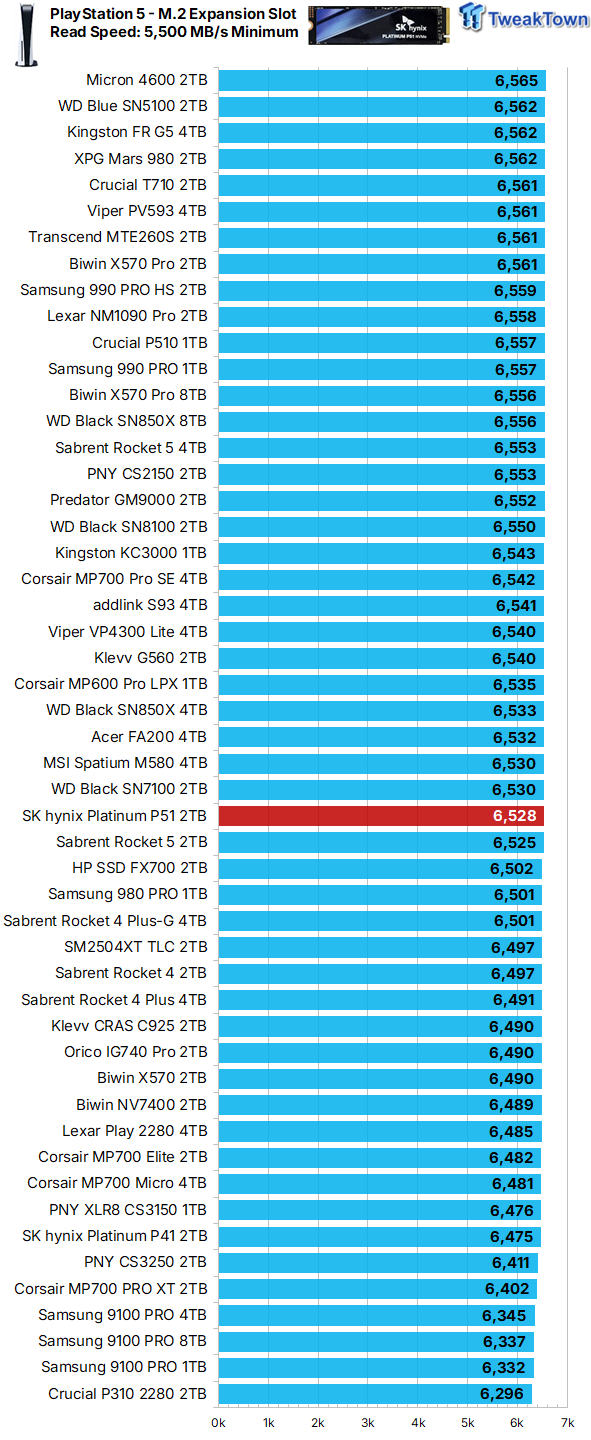
Its sequential read speed in a PS5 environment suggests the Platinum P51 makes for a good choice, better than some of its PCIe Gen5 competition like the 9100 Pro or the Phison E28-controlled SSDs.
Synthetic Benchmarks: CDM, Max IOPS, ATTO
CrystalDiskMark
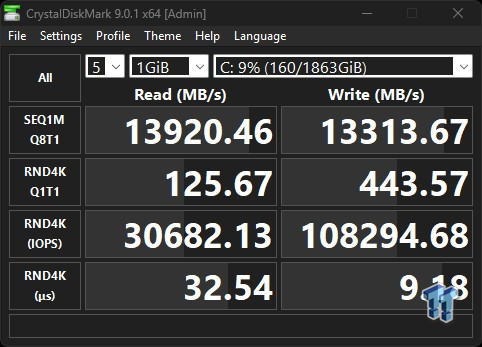
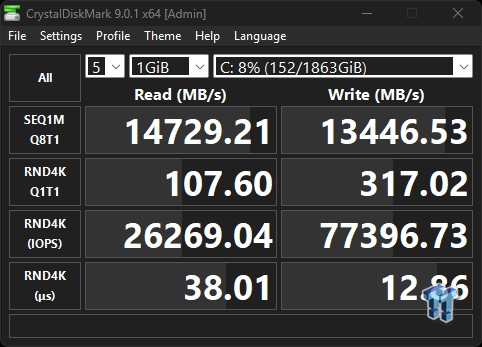
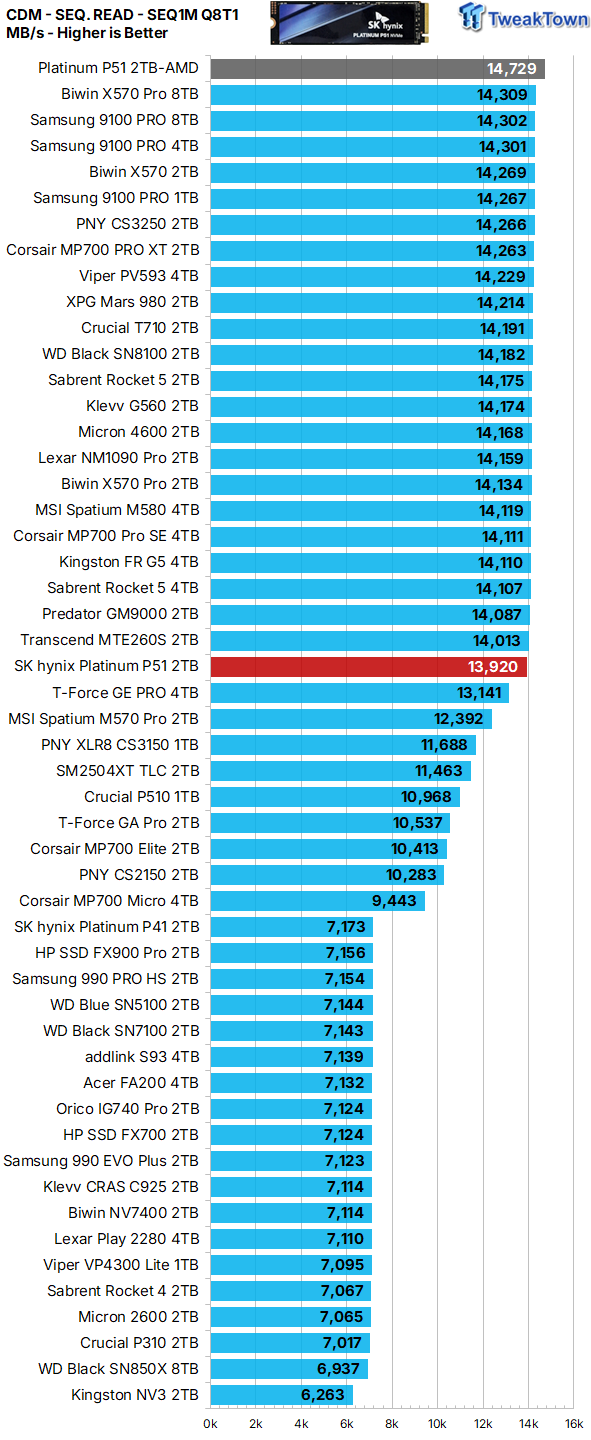
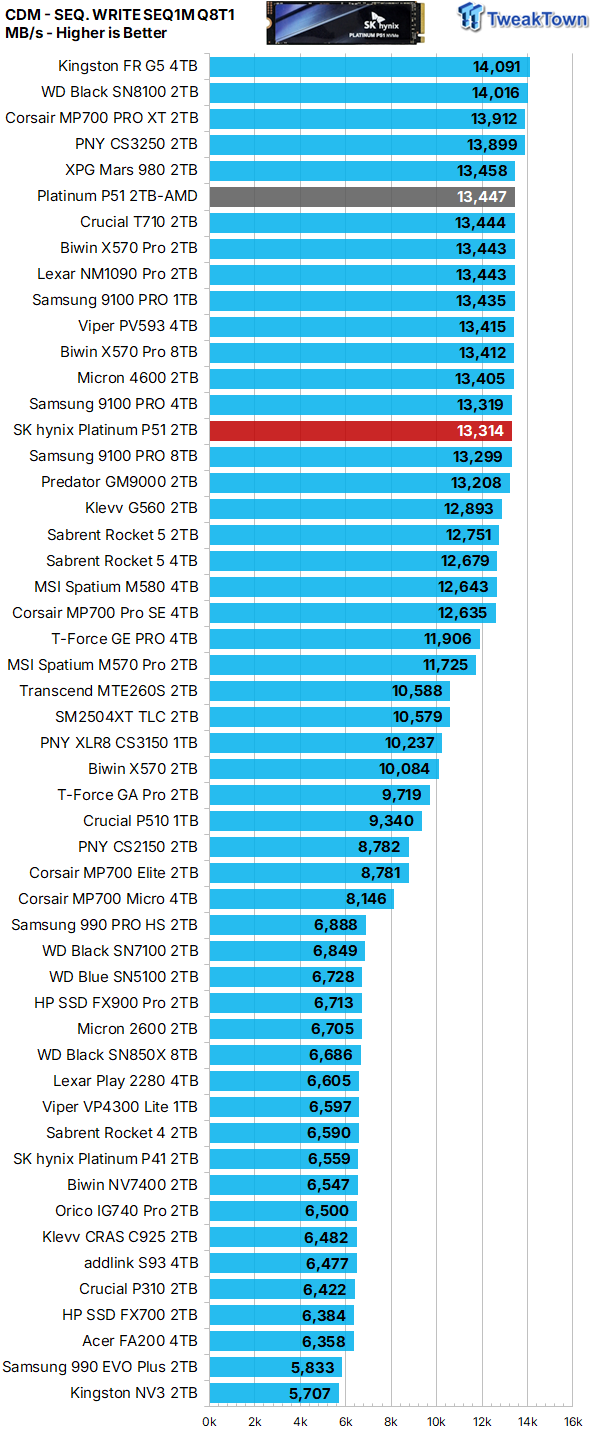

We employ CDM as our standard measurement for both sequential throughput and Q1T1 random read. In terms of sequential throughput, the Platinum P51 delivers exactly as advertised, even in our more demanding user state. Excellent.
Zeroing in on the all-important Q1T1 random read speed, our V8 hynix arrayed contender is delivering a head-turning 126 MB/s. Impressive.
Max IOPS
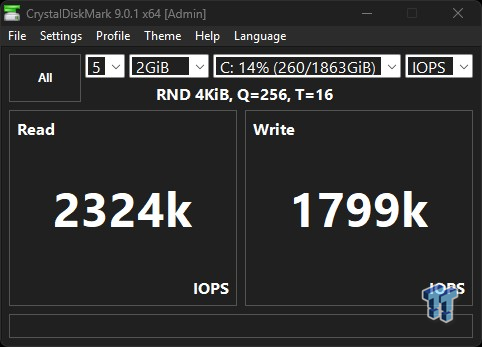
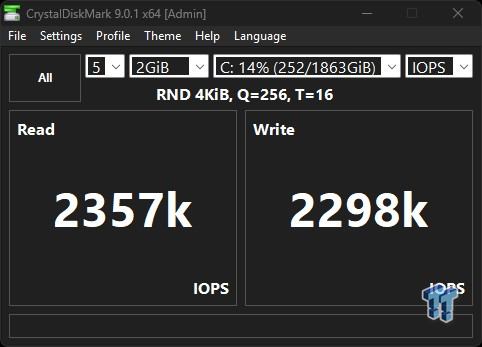
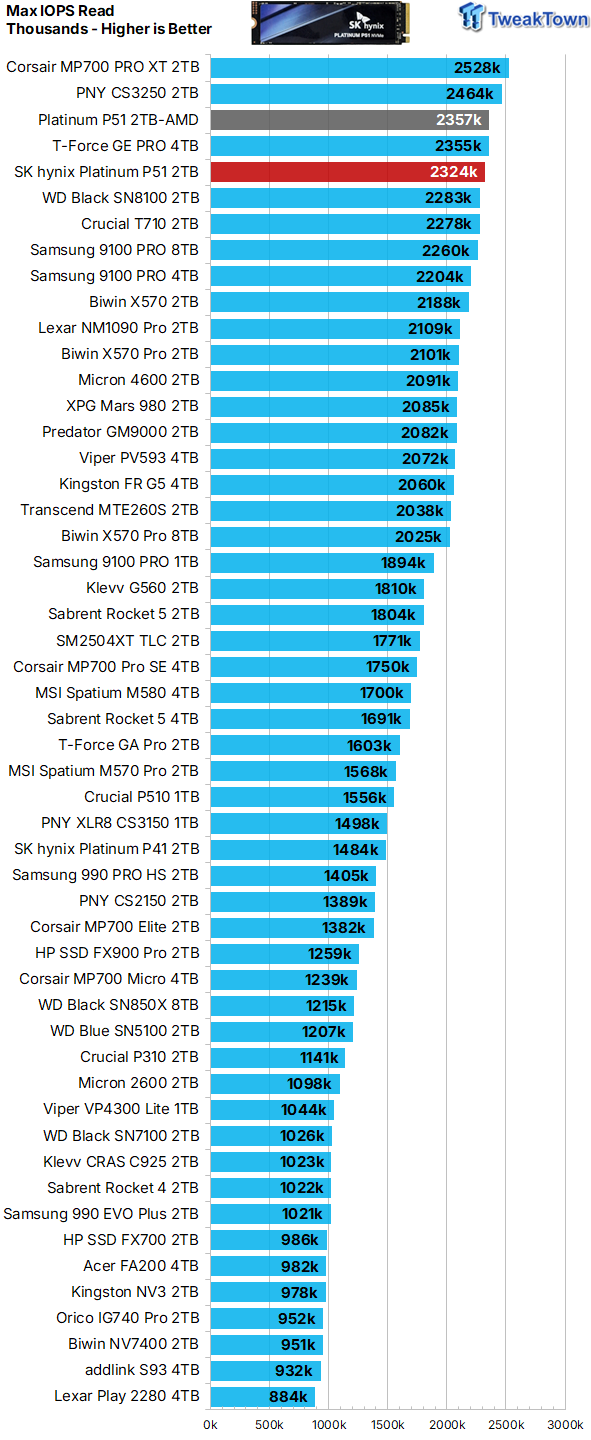

Here we have no issues meeting quoted up to factory random read performance specifications; however, we fall a bit short on the random write side of the equation. Nevertheless, and as our charts clearly demonstrate, our test subject delivers some of the highest random performance available.
ATTO
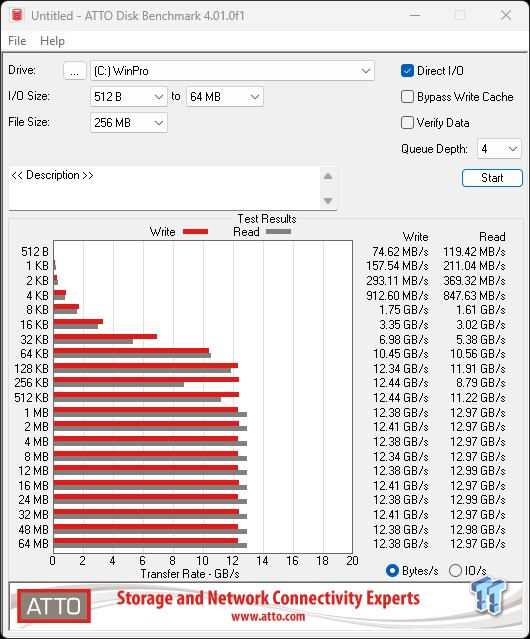

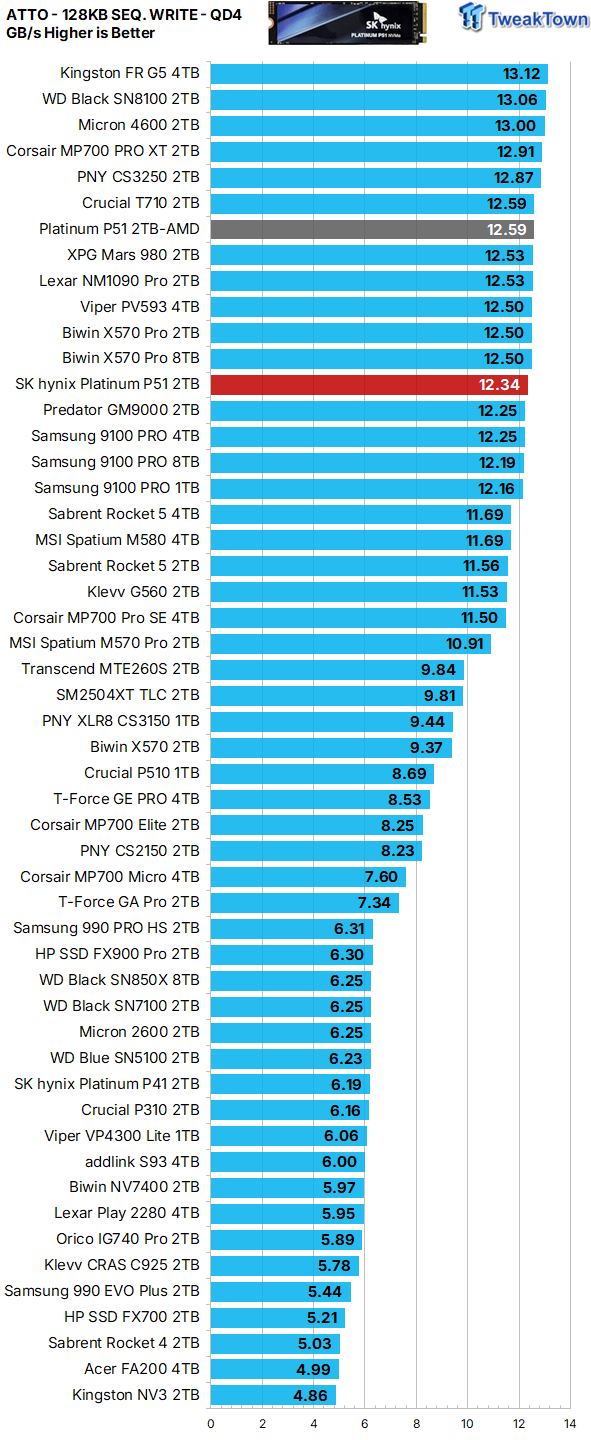

ATTO gives us a clear picture of what transfer sizes a particular SSD favors in terms of QD4 sequential throughput. We chart 128K transfers. At a queue depth of four, the Platinum P51 2TB favors sequential transfers of 1MB or larger when serving data to the host (reading) and 128KB or larger when programming (writing) data. Exceptional small-file performance.
Real-World Testing: Transfers, 3DMark SSD Gaming Test, PCM10 Storage
Transfer Rates
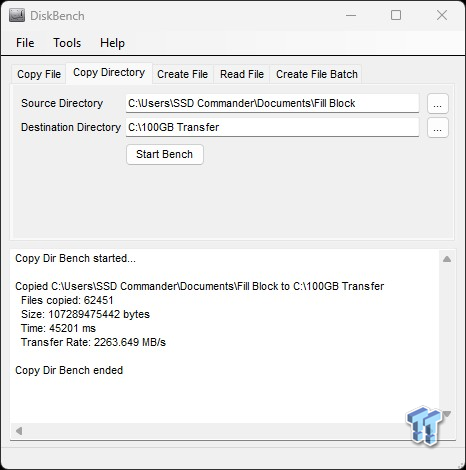
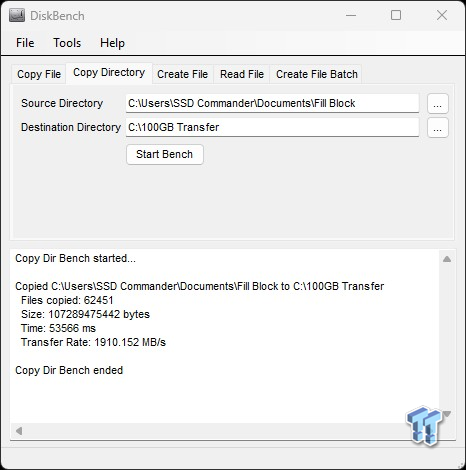
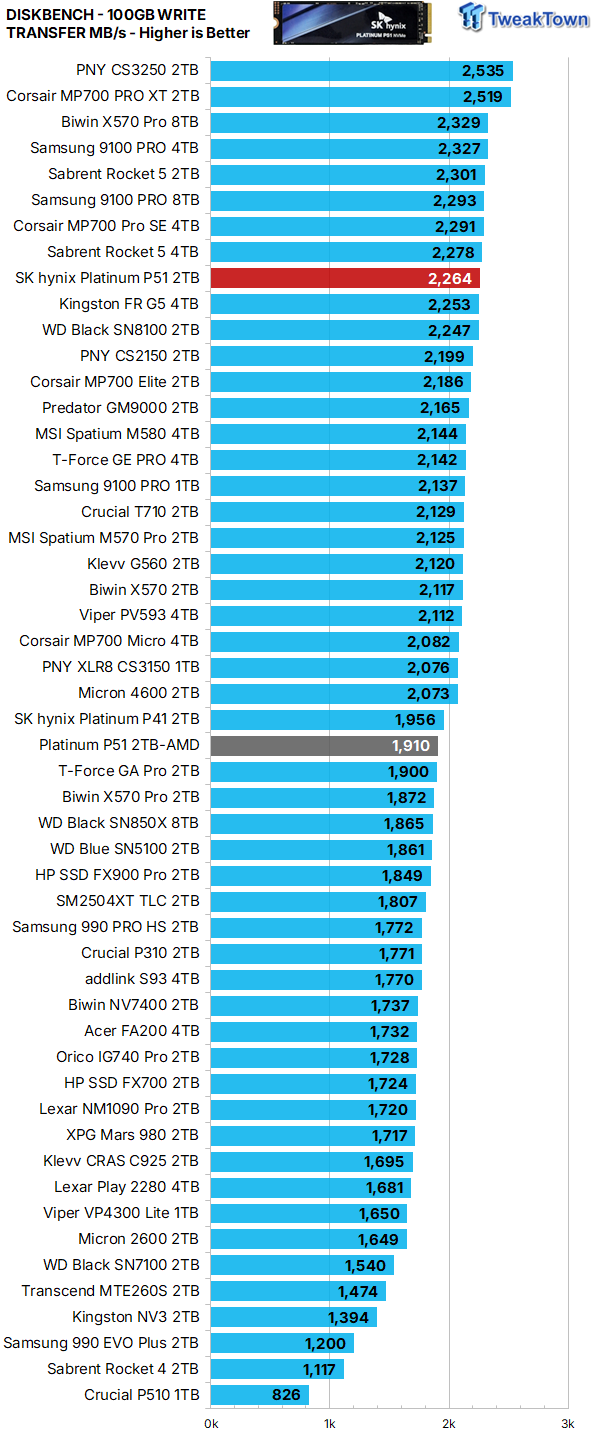
Our 100GB data transfer test is not your ordinary 100GB of data; ours is a crushing mix composed of more than 62K files. Writing performance, random or sequential, is an infrequent operation, and thus, we do not consider it to be an important performance metric in the consumer space. An example is how many times a game is installed vs. how many times it's played. The transfer rate here is again elite, being the 9th best we've encountered to date.


Unlike programming (writing) data, serving data to the host (reading) is typically an important performance metric as it relates to the consumer space. This is where transfer rates matter most, and our 2TB contender delivers impressively once again. Outstanding.
3DMark SSD Gaming Test
UL's newest 3DMark SSD Gaming Test is the most comprehensive SSD gaming test ever devised. We consider it superior to testing against games themselves because, as a trace, it is much more consistent than variations that will occur between runs on the actual game itself. This test is the same as running the actual game, just without the inconsistencies inherent to application testing. In short, we believe that this is the world's best way to test an SSDs gaming prowess and accurately compare it against competing SSDs. The 3DMark SSD Gaming Test measures and scores the following:
- Loading Battlefield V from launch to the main menu.
- Loading Call of Duty Black Ops 4 from launch to the main menu.
- Loading Overwatch from launch to the main menu.
- Recording a 1080p gameplay video at 60 FPS with OBS (Open Broadcaster Software) while playing Overwatch.
- Installing The Outer Worlds from the Epic Games Launcher.
- Saving game progress in The Outer Worlds.
- Copying the Steam folder for Counter-Strike Global Offensive from an external SSD to the system drive.


Gaming is a performance metric that matters to most DIY consumers, especially for the enthusiast crowd that TweakTown caters to. Now we've reached the point where results start to matter as they are a direct reflection of user experience.
We consider a score of 6,000 here to be somewhat of a milestone achievement. Our test subject delivers that and much more, ranking as the 10th best gaming SSD appearing on this chart. Excellent.
PCM10 Storage Tests
PCMark 10 Storage Test is the most advanced and most accurate real-world consumer storage test ever made. There are four different tests you can choose from; we run two of them. The Full System Drive Benchmark and the Quick System Drive Benchmark. The Full System Drive Benchmark writes 204 GB of data over the duration of the test. These tests directly correlate with mainstream user experience.
PCMark 10 Full System Drive Benchmark
This test writes 204GB of data and covers a broad range of common consumer tasks, including booting Windows 10, file transfers, Adobe and Office applications, and startup times for games such as Battlefield V, COD Black Ops 4, and Overwatch. Unlike synthetic numbers, this is comprehensive real-world data, which is why we use it to rank SSDs in terms of user experience.


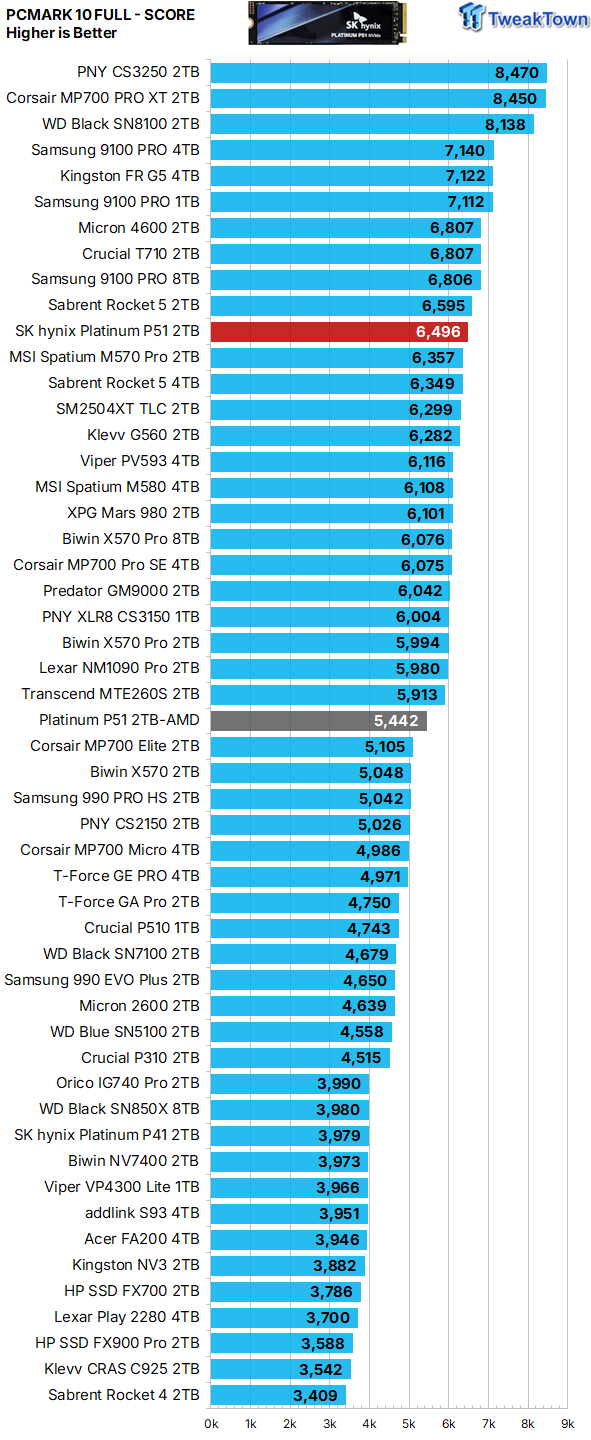
Another strong showing here, better than most of the E26-controlled SSDs and the SM2508 SSDs arrayed with B58R flash.
PCMark 10 Quick System Drive Benchmark
The Quick System Drive Benchmark writes 23 GB of data over the duration of the test.


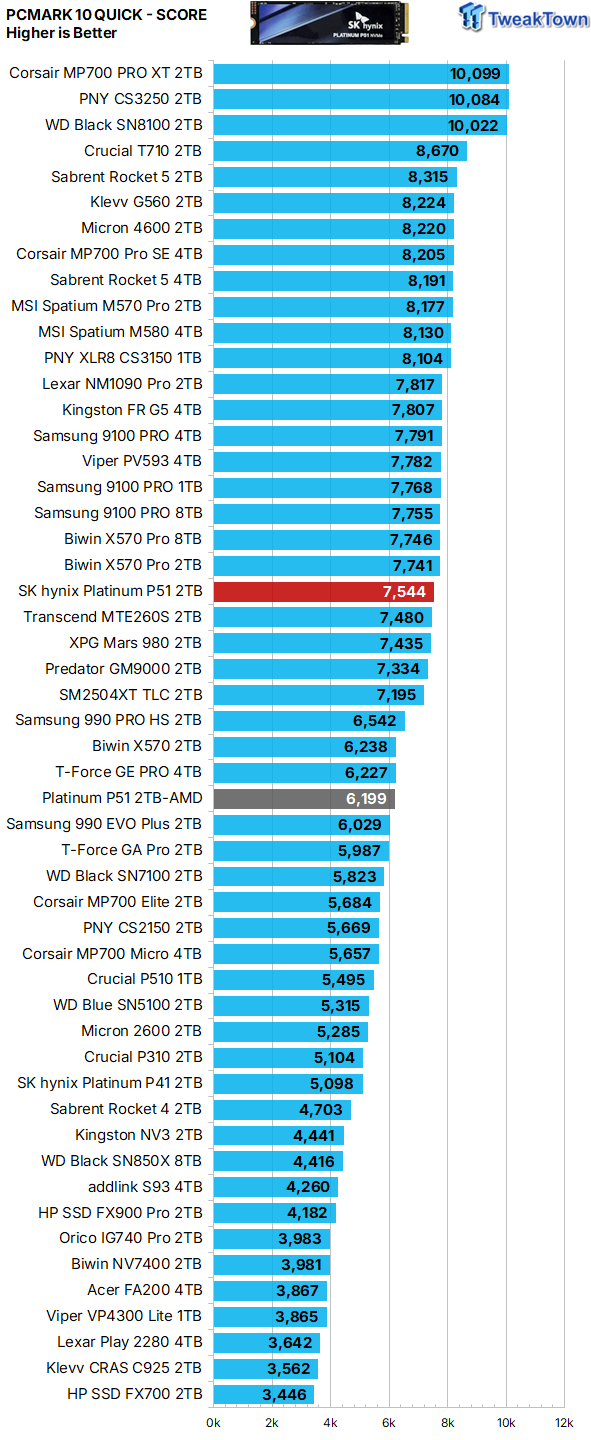
Of all the benchmarks we run, it can be argued that this one offers the best reflection of a typical consumer use case scenario. We would like to see a bit more here, but overall, a score of 7,500 here is still decent.
Final Thoughts
More than anything, we are happy to see SK hynix is still in the business of producing flagship consumer SSDs. Its latest and greatest, while not overall the highest performing of its kind currently in circulation, still makes for a compelling alternative. We are still a bit confused as to why this drive is flying under the radar, so to speak, because it is a strong contender, especially as a gaming SSD.
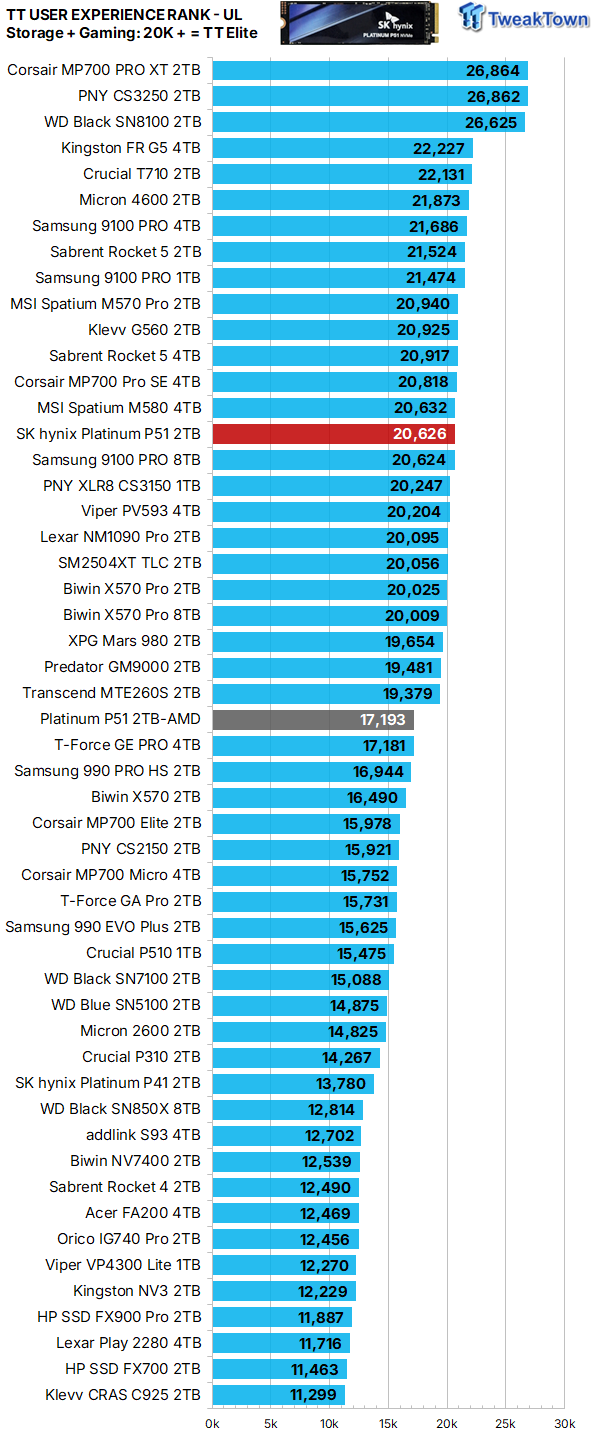
We rank SSDs in terms of overall user experience (performance where it matters most) as expressed by PCMark 10 storage and 3DMark gaming storage tests. Currently, we consider a user experience score of 20K or more to verify an SSD as a TweakTown Elite performer. 20K Elite speaks for itself.

If the price is right, we are of the opinion that the Platinum P51 makes for an excellent choice at 14,700 MB/s.