







Business, Financial & Legal - Page 24
Catch up on business, finance, and legal news shaping tech, gaming, and science - mergers, lawsuits, antitrust, IPOs, Big Tech earnings, and market trends. - Page 24
Stay Updated
Follow TweakTown for breaking tech news, reviews, and daily updates.


As an Amazon Associate, we earn from qualifying purchases. TweakTown may also earn commissions from other affiliate partners at no extra cost to you.
TSMC's work on CoWoS advanced packaging halted in Taiwan after archaeological ruins found
TSMC plans to build two new CoWoS advanced packaging plants in Chiayi Science Park are underway, with the first of the CoWoS plants starting construction in May with geological drilling operations. However, suspected archeological ruins were discovered at the site earlier this month, and now construction has been suspended.

The news is coming from Taiwan news outlet LTN, reporting that in accordance with cultural capital procedures, TSMC has also proposed a plan to build a second CoWoS advanced packaging facility in the Southern Science Park Administration of the National Science and Technology Council, and the Southern Science and Technology Bureau expressed its "full assistance".
The South Science and Technology Management Bureau confirmed that TSMC's first new CoWoS plant in Chiayi Science Park discovered suspected remains, suspending construction, with a response strategy formed that would propose to build a second CoWoS factory first. When the suspected ruins were found, a change of development behavior was submitted to adjust the location of the park land and reduce the impact.
TSMC to raise 3nm manufacturing costs by 5%, new CoWoS advanced packaging 10-20% in 2025
TSMC's 3nm supply exceeds demand right now, with major US tech companies including AMD, Apple, NVIDIA, Qualcomm, and more have full production capacity, with orders expected to be filled through to 2026.

In a new report from Ctee, we're learning that TSMC's 3nm OEM price adjustment is expected to be "more than" 5%, and that the annual quotation for advanced packaging in 2026 will also increase, between 10-20% or so. TSMC's stock price closed at 922 yuan (around $129 USD or so), leading TSMC's market value to rise to a record 23.91 trillion yuan (around $894 billion USD or so).
Foreign investors have purchased around 395,000 units this year, with TSMC chairman Wei Zhejia's "value theory" cemented in, and will increase the advanced processing and packaging technologies, which is expected to be a "double success".
Solar panels installed in France in 1992 retain 79% of their original output, 31 years later
The usual lifespan of solar panels is estimated to be between 20 and 40 years, with efficiency and power generation degrading over time. However, installation in France from 1992 is still pumping away with 79% of their output.

Technicians dismantled the vintage 10-square-meter 1-kilowatt solar array last year, running the solar panels through rigorous lab testing per international standards and finding impressive results. Even after 31 years of service, an average of 79.5% of the initial rated power output is achieved.
Solar panel manufacturers usually guarantee around 80% of their original performance for up to 25 years, but the "Phébus 1" solar system has been running for 31 years and counting, with an average annual decline of just 0.66%. The solar system celebrated its 20th anniversary of installation back in 2012, with the panels pumping 91.7% of their rated output, but with the years clicking away the drop-off in efficiency has increased on particular modules.
DJI drones could be banned in the US by 2025 with 'Countering CCP Drones Act' in the Senate
Well... the United States House of Representatives passed a ban on future sales of DJI drones in the US on Friday, which means we're looking down the barrel of a DJI ban in the US coming into effect under the "Countering CCP Drones Act."

The upcoming "Countering CCP Drones Act" is a part of the United States' 2025 National Defense Authorization Act (FY25 NDAA) which is a major piece of yearly legislation put aside for defense spending in the year ahead. DJI is a Chinese-owned company with a gigantic 70% of the world's drone market share, making US lawmakers a little nervous.
Around 6% of DJI stock is owned by Chinese state-owned businesses, which is leading to fears that the Chinese government has backdoors in DJI drones flying over US soil, national security risks, and other worries about China's surveillance. Another big issue is that US lawmakers are worried that DJI's continued success would strengthen the Chinese economy.
Valve being sued for $843 million in the UK for overcharging 14 million PC gamers
Valve Corporation is being sued for £656 million (around $843 million USD or so) with the largest digital distribution platform for PC gamers being accused of using its market dominance to overcharge 14 million PC gamers in the UK.

Vicki Shotbolt, a digital rights campaigner who is bringing the case, said: "Valve is rigging the market and taking advantage of UK gamers". The claim has been filed with the Competition Appeal Tribunual in London, accusing Valve of "shutting out" competition in the PC gaming market.
They're claiming that Valve "forces" game publishers to sign up to price parity obligations, which prevents games from being sold at cheaper prices on rival digital platforms. Shotbolt said that this has enabled Steam to charge an "excessive commission of up to 30%" making UK consumers pay too much to buy PC games and add-on content for those games.
Apple and OpenAI made an unbelievable deal to bring ChatGPT to the iPhone
At WWDC Apple unveiled its impending iOS 18 update schedule to be rolled out later this year will feature integration with OpenAI's ChatGPT, and as you would probably imagine, the deal between the two companies would have included millions of dollars. However, that reportedly isn't the case.

Known Apple insider and Bloomberg reporter Mark Gurmann has published a new article explaining the deal between OpenAI and Apple for integrating ChatGPT into the next version of Apple's operating system didn't involve a single penny of money. How? Apple simply views giving OpenAI access to its customer base as a commodity.
According to anonymous sources talking to Gurmann, "Apple believes pushing OpenAI's brand and technology to hundreds of millions of its devices is of equal or greater value than monetary payments." In fact, Apple will likely benefit monetarily when it rolls out generative AI capabilities to consumers, which will likely cost them a payment in some form. Gurmann also points out that as more people use ChatGPT the more OpenAI's expenses increase as it pays Microsoft to host the AI-powered service on its Azure servers.
Elon Musk's X is demanding former employees to return their pay
X is reportedly coming after its former employees for being allegedly overpaid through currency conversion between the US and Australian dollars.

The Sydney Morning Herald reported that laid-off Australian X workers received an email from Elon Musk's social media platform requesting that they return entitlements that were overpaid to them. The former employees received emails from X's Asia Pacific human resources department, which stated there was a "significant overpayment in error in January 2023". Notably, the company is requesting anywhere between $1,500 and $70,000 for each employee.
As you can probably imagine, a total number of zero employees have paid back the requested amount, according to the Sydney Morning Heral. More specifically, X said the overpayment is related to the "deferred cash compensation" that occurred when the company issued employees shares when the employee joined then-Twitter. "These shares were valued at $US54.20 ($82) each, the price at which Musk bought Twitter in 2022, and the total number of shares acquired by an employee was based on the length of their tenure at the company."
Continue reading: Elon Musk's X is demanding former employees to return their pay (full post)
ASML expects it will offer Hyper-NA chipmaking machines by 2030: reaching just 0.75 NA
ASML has announced more plans for a new lithography tool of the fut ure, something that will extend design limits for the very highest transistor-density chips.

ASML's former president, Martin van den Brink, surprised experts with the announcement of a next-gen "Hyper-NA" EUV lithography technology that is still "in the early stages of development," according to global R&D organization imec, which is working closely with ASML, reports EE Times.
ASML's former president, Martin van den Brink, said in a May presentation at imec's ITF World in Antwerp: "Moving forward long term, we need to improve our illumination system, and we have to go to Hyper-NA. In parallel, we have to drive the productivity on all of our systems to 400 to 500 wafers per hour".
US government stops China's access to GAA chip tech and HBM memory, the keys to AI accelerators
The US government is considering further restrictions on China's access to chip technology required for AI, aiming at new hardware that's hitting the market: GAA (Gate-All-Around) technology and HBM, two key parts of AI chips.

China would have its access to Gate-All-Around (GAA) transistor technology blocked, which is used to manufacture bleeding-edge chips, as well as access to High Bandwidth Memory (HBM), which comes in many forms: HBM3 has been powering NVIDIA's current-gen Hopper H100, while ultra-fast HBM3E is inside Blackwell B200, and HBM4 is coming shortly.
GAA nanosheet technology improves density while providing power and performance improvements, but it's only used on the most cutting-edge process nodes. Samsung has been using GAA technology with its 3nm node, Intel will use GAA in its upcoming Intel 20A node, and TSMC will use GAA with its upcoming A16 process node.
Intel reportedly halts its plans for $25 billion chipmaking plant in Israel
Intel is reportedly halting plans on a new chipmaking facility in Israel, that would've come at a cost of $25 billion.

The news is coming from Israeli financial news website Calcalist, with Intel neither confirming or denying the news. Intel was asked about the report into its facility in Israel, with an Intel spokesperson saying in a statement: "Israel continues to be one of our key global manufacturing and R&D sites and we remain fully committed to the region.
"Managing large-scale projects, especially in our industry, often involves adapting to changing timelines. Our decisions are based on business conditions, market dynamics and responsible capital management".
NVIDIA hits record-breaking $3 trillion market cap, each NVIDIA employee is worth over $100M
NVIDIA now has a market cap of over $3 trillion, thanks to the insatiable AI GPU demand that has been fueling the money for the last 12 months.

NVIDIA stock has increased by over a whopping 3224% in the last 5 years, with the company splitting its stock 10-to-1 later this month. NVIDIA isn't the only one in the $3 trillion+ milestone club, with Apple hitting $3 trillion in market cap during intraday trading in January 2022, while Microsoft hit $3 trillion in January 2024.
It was only back in February 2024 that NVIDIA reached a $2 trillion market cap... and now, just months later, another $1 trillion has been added for the glorious milestone of $3+ trillion. This is all with the current-gen Hopper H100 AI GPU absolutely dominating -- with estimates that NVIDIA has 90%+ of the AI GPU market share -- with the beefed-up H200 AI GPU coming soon, and the next-gen Blackwell GPU architecture coming soon.
TSMC's 3nm process production lines booked through 2026: Apple, Qualcomm, NVIDIA, and AMD
Apple, AMD, NVIDIA, and Qualcomm have reportedly signed "major contracts" with TSMC, which has eaten up all of its 3nm family process production capacity... with a queue of customers spreading out all the way into 2026.

In a new report from UDN, the outlet quotes industry insiders as saying that TSMC isn't a company that will increase its prices casually and that even if the company has a leading edge in advanced manufacturing processes (which it does, by far), there are "many ways to reflect value to customers."
TSMC has a huge 3nm family process, with N3, N3E, N3P as well as N3X, N3A, and more. Existing N3 technology continues to get upgraded, with N3E being mass-produced in Q4 2023, targeting applications like AI accelerators and AI GPUs, high-end smartphone chips, and data centers.
FTC, US Justice Department to open antitrust investigation into Microsoft, OpenAI, and NVIDIA
In a new report by The New York Times, Microsoft, OpenAI, and NVIDIA are being targeted for an antitrust investigation led by the US Justice Department and Federal Trade Commission (FTC).

Under the new arrangement, the Justice Department will lead the investigation into the behavior of NVIDIA, which is by far the biggest AI GPU maker on the planet with AI GPU dominance of 90%+ market share. The Justice Department will see if NVIDIA has violated antitrust laws, according to The New York Times' sources.
According to The New York Times' sources, the FTC will play the lead role in investigating the conduct of OpenAI, the maker of the infamous ChatGPT chatbot, and Microsoft, which has invested $13 billion in OpenAI and made multiple other deals with AI people.
South Korea finds potentially 14 billion barrels of oil, gas off its coast worth $1.4 TRILLION
South Korea has found what could potentially be a global game-changer: a massive reserve of oil and gas offshore close to its southeastern territory in the East Sea.

The news comes from South Korean President Yoon Suk Yeol, who provided the world with the news in his first televised national briefing, where the president gave the energy minister the green light to begin exploration drilling for the oil and gas prospects. Yoon told the press: "The possibility of the area containing as much as 14 billion barrels of oil and gas is very high. Today, I gave my approval for the Ministry of Trade, Industry and Energy to go ahead with the drilling for exploration deep in the East Sea".
Last year, the presidential office said the government commissioned an in-depth analysis of the area, searching for potential oil and gas reserves with US-based research firm ACT-Geo, after an earlier study teased the high possibility of oil and gas reserves near the Donghae gas field.
UALink standard announced: AMD, Intel, Google, Microsoft, Meta to combat NVIDIA NVLink
We're counting down the hours into Computex 2024, where NVIDIA will be showing off a bunch of the coolest things we can imagine... and now, their NVLink dominance is being fought against.

The interconnect market is a hot one for servers right now, especially in the age of AI. We've now got technology giants including Intel, AMD, Broadcom, Cisco, Google, HPE, Meta, and Microsoft have formed an Ultra Accelerator Promotor Group that focuses on developing an AI-focused interconnect system specifically aimed at data centers.
The group has announced its lofty intentions with UALink (Ultra Accelerator Link) which aims to connect accelerators through an open -- non NVIDIA exclusive -- protocol.
Samsung Foundry will tease its 1nm process node in July, mass production coming in 2026
Samsung Foundry is expected to unveil plans for its cutting-edge 1nm process node in July, with mass production expected to kick off in 2026.

The South Korean giant has plans to unveil its next-gen 1nm process node schedule at the Foundry Forum & SAFE Forum 2024, which will be held in the US between June 12-13, according to Korean media. It wasn't too long ago that Samsung bumped up its 1nm production timeline from 2027 to 2026, with the 2nm "SF2" process debuting in 2025, we still don't know much about it... for now.
Samsung looks to be ahead of its semiconductor competitors, with Intel planning to mass produce its new Intel 10A (1nm) process in 2028, while TSMC plans its next-gen 1nm process node for 2030. If Samsung can nail this, then the company would be many years ahead of its competitors. But now, we need to see performance, quality, great yields, and most of all... customers flocking to the new node (AMD, NVIDIA, Qualcomm, Apple, etc).
NVIDIA CEO Jensen Huang has dinner with TSMC founder in Taiwan
NVIDIA founder and CEO Jensen Huang is in Taiwan once again, meeting with TSMC founder Morris Chang, as well as Quanta and MediaTek executives for dinner ahead of Computex 2024 next week.

The NVIDIA and TSMC founders enjoyed their dinner, leaving the restaurant and talking to the media, with NVIDIA CEO Jensen Huang responding to fans' requests for autographs, with media outlet CNA reporting he showed his "usual friendly attitude".
Jensen hanging out with TSMC founder Morris Chang is a big deal, but we know the relationship between NVIDIA and TSMC is strong. NVIDIA has its current-gen GeForce RTX 40 series, its upcoming Blackwell-based GeForce RTX 50 series cards made at TSMC, and its entire fleet of H100, H200, B100, B200 AI GPUs (and everything in between) fabbed at TSMC.
Continue reading: NVIDIA CEO Jensen Huang has dinner with TSMC founder in Taiwan (full post)
NVIDIA plans 2nd AI R&D center in Taiwan, in the southern city of Kaohsiung
NVIDIA is planning its second R&D center in Taiwan, with new reports suggesting that Team Green is looking at the southern city of Kaohsiung, Taiwan.

The new R&D center will be partly financed by the Taiwanese government and the Ministry of Economic Affairs and its "Big+ Project" subsidies. In a new report from Ctee, we're learning that with AI leading the charge, the Ministry of Economic Affairs' "Leading Enterprise R&D Deepening Plan" (aka Big+) will encourage overseas tech companies to set up forward-looking R&D centers in Taiwan.
NVIDIA was first with the Big+ funding, setting up the first AI innovation R&D center in Neihu, Taipei, then completing its supercomputer (HPC) at the NVIDIA building in Kaohsiung Software Park towards the end of 2023, with the company providing part of the computing power for new applications and the development of AI-powered products and services.
Two cities in Taiwan are fighting for AMD's new R&D center investment
AMD will be spending over 5 billion yuan ($155 million USD or so) on a second R&D center in Taiwan, with both Tainan and Kaohsiung "actively seeking" AMD's favor to settle down.

In a new report from news outlet UDN, AMD CEO Lisa Su will visit Tainan next week, as well as visiting Nanke and Sharon to look for suitable places for its new R&D center. It's not just AMD that is eyeing off another R&D center in Taiwan, with GPU competitor NVIDIA also building a new R&D center in the country.
Both companies have applied to the Ministry of Economic Affairs' and its "Big+ Project" subsidy, with local governments rubbing their hands together with glee that NVIDIA and AMD are opening up new R&D centers in the country, especially in the southern parts of Taiwan.
Continue reading: Two cities in Taiwan are fighting for AMD's new R&D center investment (full post)
Chinese SK hynix worker on trial in South Korea: stole semiconductor tech, gave it to Huawei
A Chinese national who worked for SK hynix is currently on trial for allegedly stealing key semiconductor technology from the South Korean memory giant, giving it to Chinese company Huawei.

In the report, The Korea Times reports that the Gyeonggi Nambu Provincial Police that a woman in her 30s, a Chinese national, was sent to prosecutors last month on the suspicion of violating the Act on Prevention of Divulgence and Protection of Industrial Technology.
The Chinese national who worked for SK hynix was hired all the way back in 2013, working in the department that handled analyzing defects in semiconductor designs. From 2020 to 2022, she was involved with consultations with business-to-business clients in CHina, according to the police agency.
 Giveaway: 12 Winners Will Score MONTECH NX400 and NX600 CPU Coolers
 GTA 6 leaks have reportedly led to a morale drop at Rockstar, with Netflix frustrated as well
 The Blood of Dawnwalker won't hit 60 FPS on any console, PS5 Pro tops out at 40 FPS
 AMD claws back ground against Intel in the CPU market, climbs to 35% share in desktop CPUs
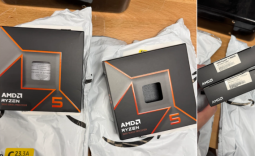 Redditor receives not one but TWO empty boxes of Ryzen 5 9600X from Amazon
 Xbox Series X25 Limited Edition Console is priced at $900, arrives November 2026
 Dave Bautista officially cast as Kratos in Amazon's 'God of War' TV Series, replaces Ryan Hurst
 Take-Two begins the hunt for GTA 6 leaker CyberLeek, subpoenas Microsoft and Discord
 PlayStation 6 handheld not expected to stay under $600, warns leaker
 AMD confirms the Radeon RX 9050 4GB will have a tiny 64-bit bus and just 16MB Infinity Cache
 Intel 'Nova-Lake-S' 28-core CPU with bLLC reportedly draws 296W at PL2
 Cooler Master MasterFan A120 Fan Review
 GIGABYTE MO27Q2A Gaming Monitor Review: 1440p, 280Hz, and QD-OLED is a winning combination
 Cooler Master V8 ACE 3DHP BLACK CPU Cooler Review
 ASUS ROG Strix XG129C Review: A $199 Gaming Monitor You Don't Play Games On
 Cooler Master HAF II 500 Mid-Tower Chassis Review
 Corsair HS35 v3 Wireless Gaming Headset Review - An Affordable Winner
 D-Link F518 5G Wi‑Fi 6 AX1800 Mobile Hotspot Review: All-Day Mobile Hotspot
 Bose Lifestyle Ultra Speaker Review - Impressively Detailed Room-Filling Sound
 MSI Z890 Gaming Plus WIFI6E Review - Z890 for under $200
 Mortal Kombat (1995) 4K Ultra HD Blu-ray Review
 Using Multiple Monitors? Change these Windows settings for a Better Experience
 Windows Sandbox is The Windows Security Feature Most People Never Use
 I ditched the Windows 11 context menu for this open-source tool, and here's why
 Windows 11 may be encrypting your drive already, and I checked where my recovery key went
 GIGABYTE's 40 Days of INFINITY celebrates 40 Years of Innovation with stunning GeForce RTX graphics cards and rewards
 I swapped File Explorer for this free file manager and finally got the layout I wanted
 How to tell if someone has been using your Windows PC without your permission
 6 Task Manager tips for troubleshooting Windows performance problems
 ASUS ROG's 20th Anniversary Line-up of Premium PC Gaming Gear has Arrived - Here's Everything You Need to Know
 Six File Explorer tips every Windows user should know