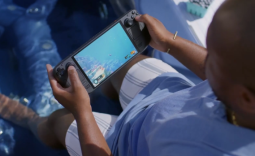
Originally published by Sony as a PlayStation 5 exclusive, developer Shift Up subsequently brought its smash-hit third-person action game Stellar Blade to PC. With a sequel currently in production, the studio is also working to bring Stellar Blade to the Nintendo Switch 2.
In a new interview with DongKi Lee, CTO and technical director at Shift Up, on Nintendo Everything, he confirms the game will use NVIDIA's DLSS technology to achieve 60 FPS in both docked (1080p) and handheld modes (720p). Because the Switch 2 runs on a custom low-power SoC based on the GeForce RTX 30 Series' Ampere architecture, its DLSS support will use a custom-tuned, lightweight model for AI-powered upscaling.
However, because it doesn't support DLSS Frame Generation, Shift Up will use AMD's FSR 3.1 Frame Generation on top of DLSS upscaling to hit the 60 FPS target.
"What we did was take AMD's FSR 3.1 for PC and used the feature called frame interpolation to achieve the target for 60 frames per second," DongKi Lee says. "We use DLSS for upscaling, and then use frame interpolation from FSR 3.1 to be able to target 60 frames per second."
It's an interesting solution, but one that could lead to a few issues. Even though Shift Up says that "latency" is important, using any form of Frame Generation to hit a smooth 60 FPS does mean that the gameplay and movement would still "feel like" 30 FPS. Not to mention image quality taking a hit, as AMD's FSR 3.1 Frame Generation's generated frames do feature artifacts, with the technology also known for delivering inconsistent frame-pacing and performance when compared to DLSS Frame Generation.

Frequently Asked Questions
Open a question for an answer from TweakTown's coverage of this news, or ask your own below.
Will Stellar Blade on Nintendo Switch 2 run at 60 FPS in both docked and handheld modes?
How is Shift Up combining DLSS and FSR 3.1 to reach 60 FPS on Switch 2?
Why is the Switch 2 using a custom DLSS model instead of standard DLSS/Frame Generation?
What potential latency or input-feel trade-offs should players expect from using FSR 3.1 frame interpolation?
Have a question about this content not listed here? Ask below and TweakBot will answer it.

This is the first time we've heard of a developer using both DLSS Super Resolution and FSR Frame Generation on a Nintendo Switch 2 console port, so it'll be interesting to see how it turns out.