Our Verdict
Pros
- Solar panel removes most charging woes
- Supports local or cloud storage
- Decent video quality day or night
- Smart AI tracking
Cons
- Limited vertical pitch
- Requires mounting high up for optimal results
- Large size
- Can't zoom directly on recordings
- No magnetic mounting options
Should you buy it?
Introduction

There's no shortage of home security camera options open to you at just about any budget, but most of them come with some form of limitation or another.
One that they all pretty much share is the issue of power; outside of permanently wired security cameras (for which, at least here in Australia, you must have a qualified electrician install), you're going to be trailing cables or moving cameras every month or so to ensure that they stay powered up. A smart security camera with no power isn't much use at all.
TP-Link Tapo C660 Kit's big selling point is the inclusion of a solar panel that, as per TP-Link, gives it a "forever" battery. That's not quite true - battery chemistry and entropy insist that at some point the battery itself will fail - but for the purposes of the likely life of the camera, it's going to be accurate for most people.
Specifications & Close Up
| Item | Details |
|---|---|
| Model | TP-Link Tapo C660 Kit Solar-Powered Pan/Tilt Security Camera Kit |
| Image Sensor | 1/2.7" Progressive Scan CMOS Starlight Sensor |
| Lens Focal Length | 4.0mm |
| Lens Aperture | F1.6 |
| Lens Field Of View | 105° (Diagonal), 88°(Horizontal), 45°(Vertical) |
| Night Vision | 850 nm IR LED (40 ft / 12 m) / Full Colour Night Vision |
| Lighting | 2x Built-in Spotlights |
| Interface | Power Button, Reset Button |
| Storage | 1xMicroSD card slot (up to 512GB) |
| Pan/Tilt Range | Pan Mechanical Range:326° (360° Pan Coverage) / Tilt Mechanical Range: 45° (90° Tilt Coverage) |
| Video Resolution (Maximum) | 4K 8MP (3840 x 2160 px) |
| Frame Rate | 15/20 FPS |
| Digital Zoom | Up to 18x |
| 2-Way Microphone | Yes |
| Storage | Cloud or MicroSD (MicroSD card not included) |
| Wi-Fi | Wi-Fi 4 (EEE 802.11a/b/g/n 2.4GHz/5GHz) |
| Battery | 10000mAh sealed battery |
| Charging | USB-C / Solar Panel (up to 5.2V/2.5W solar) |
| Camera Size | 185 x 147 x 75 mm |
| Solar Panel Size | 173.4 x 120.4 x 15.7 mm |
Design

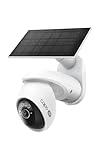
The TP-Link Tapo C660 is not a small camera when you unpack it, with something of a resemblance to a classic Portal turret gun. It only comes in white, which does mean that for any outside installation, it's likely to show the dust and grime a little quicker, though the flipside of that is that a white camera will be rather more apparent to anyone visiting your premises for any purpose.
Best Deals: TP-Link Tapo C660 Kit Solar-Powered Pan/Tilt Security Camera Kit
Price Trend:
Prices last scanned 6 hours and 56 minutes ago

7 days ago: $118.99 USD30 days ago: $118.99 USD

7 days ago: $214.99 USD
7 days ago: $179.99 CAD30 days ago: $189.99 CAD


The TP-Link Tapo C660 Kit has the "Kit" suffix because it ships with both its rather large camera as well as a small solar panel that can be screwed into place just above the camera in an integrated mount, or separately if you're in a situation where your sunlight source isn't conveniently placed for optimal charging.

That was definitely the case for my own installation, where (largely because I did want to test out how well the TP-Link Tapo C660 handled different scenes and lighting setups) I wasn't going to permanently install it in any case, at least for now.
This did reveal one issue with the TP-Link Tapo C660 that's worth bearing in mind. While some competing smart cameras offer simpler bases and setups that allow for horizontal orientation, the TP-Link Tapo C660 optimally works when installed up high, because its camera orientation is for a wide view beneath its camera.
Our Latest Network Cameras Review Coverage
While you can use its motors to adjust the viewing angle, this is predominantly down and horizontal, not up. One feature that would have been nice to see here is support for a magnetic mount - I could have used this with some of the beams in my carport - but it's not a feature of the TP-Link Tapo C660. I persevered with a slightly odd temporary setup, but actual physical installation is simple enough, with drill guides in the box for either the combined camera plus panel unit or for standalone mounting of each.
My own testing setup did lead to some odd viewing angles, but I freely admit my test system here isn't optimally what you'd do with the TP-Link Tapo C660 in a real-world situation long-term. The entire camera setup is rated at IP65, so it should be robust enough for all but the wildest stormy weather or flooding.
Installation

Installation of the TP-Link Tapo C660 is via TP-Link's Tapo app, which does require an email login. One small point of difference between it and competing smart cameras that all tend to use QR codes for pairing is that this isn't an option for you; you've got to power the camera on and identify the model (not shockingly, it's the TP-Link Tapo C660) before it'll pair over Bluetooth and then configure itself for your local Wi-Fi.
While solar power is supported and is obviously the way that you'd want to charge the TP-Link Tapo C660 long-term, the first step in setup is to charge the Tapo C660 camera via USB-C and a direct connection to ensure that it starts out with a full charge. That's smart enough; a solar panel of this size is going to be best suited to a very slow, very low top-up of a battery rather than trying to run it from flat.

There's quite a lot of competition in the cloud security space, and here I'll give TP-Link plaudits for keeping matters very simple. Out of the box you get a trial 30-day subscription to TapoCare, which includes 30 days of cloud video history and weekly reporting; once that trial is up if you want those features they'll run you $4.99/month or $48.99/year, but what's refreshing here is that you don't strictly have to use them to make the TP-Link Tapo C660 Kit function.
One very welcome feature here is that the 30-day trial doesn't require credit card details upfront; most "free" trials of this sort absolutely rely on the idea that you'll forget to cancel the trial, but TP-Link hasn't thought that way, which is pleasing to see.
Base-level notifications, AI tracking, and activity zones are all built into the free-tier Tapocare plan, and the camera itself supports local SD card storage up to 512GB, enough for around 16 days of recording. That's especially appealing if you don't like the idea of your video files ending up in the cloud somewhere.
You'll still need a Tapo login and for the service to be functional for the TP-Link Tapo C660 Kit to work, but at least beyond the cost of a microSD card (one isn't included), you don't have to spend any more money to make use of its smart camera functions.
Performance

I did have some concerns about how well the TP-Link Tapo C660 Kit might cope with my setup environments, predominantly because it does warn you not to install it near "swaying trees". I live opposite a national park, and there are absolutely no views that I want secured that don't include quite a few trees.
That being said, it handled the trees that were there without false positives becoming a problem. The TP-Link Tapo C660 Kit supports Wi-Fi 4, which isn't particularly cutting edge, and that could have some implications if you wanted to place the camera at a significant range from your Wi-Fi system router. For the purposes of this review, I paired it up to a TP-Link BE6500 Mesh system, not that it requires within-brand Wi-Fi per se.

I'm not sharing screenshots here because this was genuinely tested in my home, and I'm a private individual, so those shots are very much private to me - or in one case, to my neighbour, because the AI tracking on the TP-Link Tapo C660 is quite sharp, and it did pick him up working in his garden at one point. Typically speaking, day or night, the pickup was good, and notifications flowed through quickly to my paired smartphone.
The 105-degree viewpoint range was decent, and as a motorized camera, it's also capable of shifting around to track subjects if you need that kind of detail. If you set it up in an area where you're going to want a lot of image shifting, you can also pre-set viewpoints to get it to quickly shift to looking to (for example) the extreme left or right of your camera with a single tap.
Resolution tops out at 4K, which also gives it some scope for zooming in at up to 18x. Push it that far, and the detail does get rather blocky. One annoyance here is that within the app, you can only zoom in the live view, not into any recordings you've made, though that can be worked around if you're happy to download a recorded file to your phone and then zoom in that way.
Low-light recording did drop a little detail, and it is worth noting that the maximum frame rate of the TP-Link Tapo C660 is just 20fps. That's not super high, but it's sufficient for most home or small office security purposes. Nobody's shooting an Oscar-worthy epic on one of these cameras. Knowing that you can grab details of unwanted visitors is typically enough.

On the power front, being surrounded by trees as I am, I was curious to see how well the TP-Link Tapo C660 Kit's solar panel could manage with slightly obstructed sunlight. Charging from such a small solar panel was never going to be a rapid matter anyway, but could it keep up with my tracking needs while at least keeping power stable?
The short answer is yes, it could. Over a number of days, from a 70% charge, I saw it both working and being tested while creeping up in power at around 1% per day. It's more likely for most that you're not going to be using it as heavily as I was during my test period, so even if you do have somewhat obstructed sun views, you're likely to be good for power without too much fuss. For those with unobstructed sunlight, it absolutely would not be an issue.
Final Thoughts

The TP-Link Tapo C660 Kit is a rather specific product, because if you don't have a high spot to place a camera in a permanent fixed position, it's rather too inflexible to be particularly useful.
If you can get past that, however, it is otherwise one of the more flexible home security camera setups out there. The inclusion of a small solar panel at this price does open up the door for battery life that'll effectively last as long as the camera might - or possibly at least until TP-Link switches off the Tapo servers in the distant future, because it does still rely on those. The choice between cloud-based storage for money - the classic subscription trap of many smart home cameras - and local storage is wonderfully handled, as are the basics of notifications and smart AI-led tracking.
There are quirks to the product; I could see some real benefit in a camera array that allowed upwards tilting for some users, and it's not exactly the fastest camera, or one that works with the highest-level Wi-Fi standards. At this price, however, there's not too much to complain about.