











Our Verdict
Pros
- 8TB of Gen5
- Sequential throughput performance
- Real-world performance
- Efficiency
Cons
- High MSRP
- Double-sided design
Should you buy it?
AvoidConsiderShortlistBuyIntroduction & Drive Details
Over the years, we've had occasions to assert that, all factors taken into consideration, capacity is King in the realm of solid-state storage. These occasions have become relevant each time an SSD at the 8TB capacity point has been introduced, which is also capable of delivering full throughput over the current fastest interface.
Today, another Samsung SSD has the distinction of once again being crowned as the King of consumer storage devices. Not since days long ago when SATA was still mainstream has Samsung brought forth an 8TB consumer storage device. Well, today is that day, and our criteria of achieving full throughput at the most current interface generation have indeed been met.
As you might imagine, it is no easy thing to fit 8TB of TLC flash on a tiny M.2 2280 PCB, at least not with current 16 die flash packaging technology. To break through this real estate barrier, Samsung has done something they've not done before - employ a 2280 double-sided PCB. That's correct, until this very day, Samsung has never produced a double-sided consumer NVMe SSD. This is indeed something we thought we would never see Samsung do.
Samsung's 9100 PRO 8TB is factory spec'd identically to that of the 4TB model in all respects except for power draw, which is to be expected as more of the same die are going to require more power. Having identical performance throughput specs at 8TB as at 4TB is something we've seen before coming from the WD_BLACK SN850X 8TB, however, actual performance, real-world performance, in all cases, has proven to be a bit lower at 8TB than at 4TB. Samsung's first 8TB NVMe SSD is no exception to this rule, as it is indeed a bit less powerful at 8TB than 4TB, even though it is a bit "faster" in terms of sequential read throughput.
Samsung's new and first-of-its-kind PCIe Gen5 capacity King is built around its own 8-channel PCIe Gen5 controller. Codenamed "Presto", this super-efficient controller is built on Samsung's own 5nm process node, potentially making it among the most efficient of its kind currently in circulation. The DRAM-enabled Samsung Presto controller features a 5-core ARM 32-bit Cortex-R8 architecture with 8-flash channels @ 2,400MT and four chip enables. Samsung arrays its 9100 PRO 8TB with four 2TB flash packages of its 2,400MT 1024Gbit V8 V-NAND, along with an 8GB package of its own LPDDR4X DRAM.
Drive Details
| Item | Details |
|---|---|
| Model | Samsung 9100 PRO 8TB |
| MSRP | $1,000 |
| Model Number | MZ-VAP8T0 |
| Interface | PCIe Gen5 x4 |
| Form Factor | M.2 2280 |
| Performance | Up to 14,800 MB/s |
| Warranty | 5-Years Limited |

MSRP for the world's highest capacity M.2 2280 PCIe Gen5 SSD is higher than we would like to see. However, if it follows its predecessor's pricing trajectory, street pricing will be significantly lower.
Our Latest SSD Review Coverage
- Phison E37T SSD Controller Exclusive Preview - The Fastest DRAMless SSD Platform Yet
- Seagate FireCuda X1070 4TB SSD Review - A New Mainstream Contender
- Micron 3610 2TB SSD Review - DRAMless QLC at 11,000 MB/s
- SK hynix Platinum P51 2TB SSD Review - A Powerful Gen5 Alternative
- Biwin Black Opal X570 Pro 8TB SSD Review - Massive Capacity with Elite Performance

Best Deals: Samsung 9100 PRO 4TB SSD
Price Trend:
Prices last scanned 7 hours and 43 minutes ago

7 days ago: $849.99 USD30 days ago: $771.17 USD

7 days ago: $1849.97 CAD30 days ago: $1849.97 CAD
7 days ago: $1849.99 CAD30 days ago: $1849.99 CAD

7 days ago: $198930 days ago: $1989

We will note the extremely efficient power draw here as it's the best we've seen for an 8TB PCIe SSD.


As always, when you buy a Samsung SSD, you get free supporting software that makes maintenance and system migration simple and free. Click HERE to download it.
Note: We have enabled full power mode using Magician to do so for the purposes of this review.
Jon's Test System Specifications
Intel Test System
| Item | Details |
|---|---|
| Motherboard | ASUS Z890 Apex (Buy at Amazon) |
| CPU | Intel Core Ultra 9 285K (Buy at Amazon) |
| GPU | MSI SUPRIM X RTX 3080 12GB (Buy at Amazon) |
| Cooler | Alphacool Eissturm Hurricane Copper 45 (Buy at Amazon) |
| RAM | Patriot Viper Xtreme 5 8000 48GB (Buy at Amazon) |
| Power Supply | be quiet! Dark Power Pro 12 1200W (Buy at Amazon) |
| Case | PrimoChill's Praxis Wetbench (Buy at Amazon) |
| OS | Microsoft Windows 11 Pro (Buy at Amazon) |
AMD Test System
| Item | Details |
|---|---|
| Motherboard | ASUS ROG Crosshair X870E APEX (Buy at Amazon) |
| CPU | AMD Ryzen 9 9950X (Buy at Amazon) |
| GPU | MSI SUPRIM X RTX 3080 12GB (Buy at Amazon) |
| Cooler | Alphacool Eissturm Hurricane Copper 45 (Buy at Amazon) |
| RAM | Sabrent Rocket DDR5 32GB (Buy at Amazon) |
| Power Supply | be quiet! Dark Power Pro 12 1200W (Buy at Amazon) |
| Case | PrimoChill's Praxis Wetbench (Buy at Amazon) |
| OS | Microsoft Windows 11 Pro (Buy at Amazon) |
Please note: We employ an M.2 AIC for testing on our Intel Core Ultra 9 285K platform.
Sony PlayStation 5 - M.2 Storage Expansion
PS5 Read Performance
With Sony's wildly popular PlayStation 5 console now enabled for M.2 NVMe SSDs to be used as fast storage expansion, we are including results for PS5-compatible SSDs we test as a part of our reviews going forward.


For SSDs that don't have an adequately sized PS5-compatible heatsink or other SSDs where the heatsink provided doesn't fit right and can be removed, we both use and recommend Sabrent's unparalleled PS5 heatsink available HERE.


We only chart SSDs that can deliver a minimum of 5,500 MB/s read, which is Sony's original recommendation.
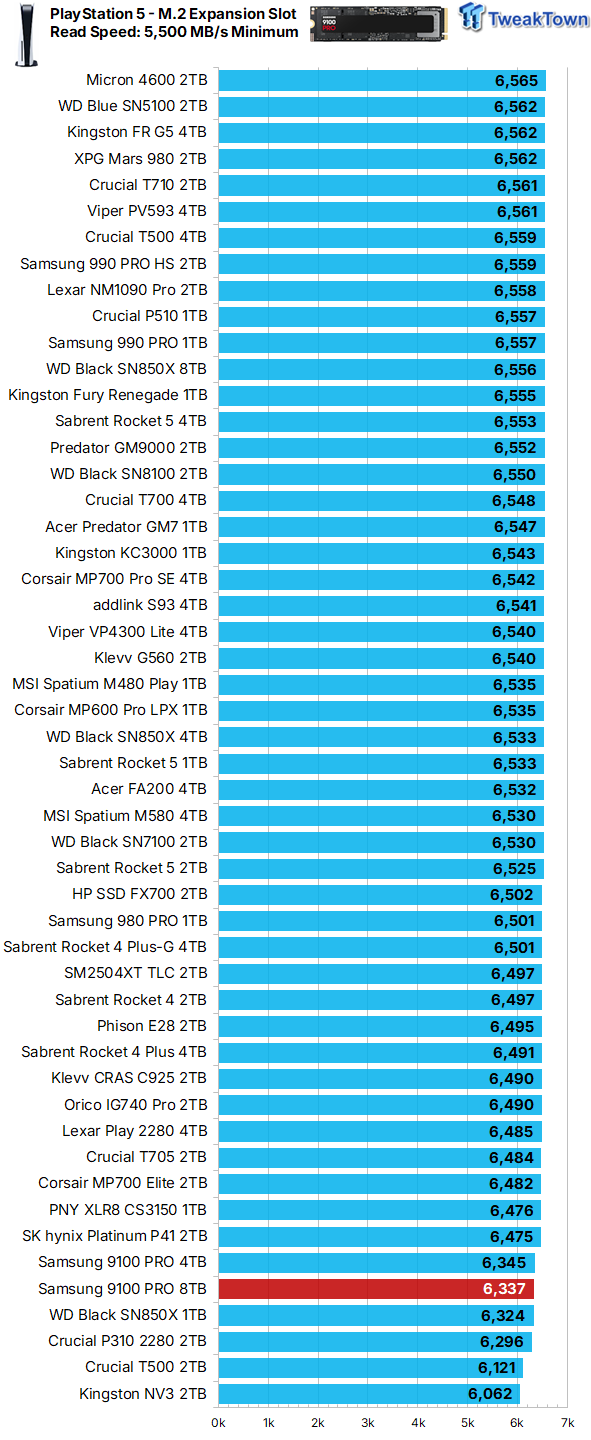
As noted at 4TB, the 9100 PRO is apparently not well-tuned for the PS5. It easily makes the cut, but its sequential read performance is significantly lower than its PCIe Gen4 relatives.
Synthetic Benchmarks: CDM, Max IOPS, ATTO
CrystalDiskMark
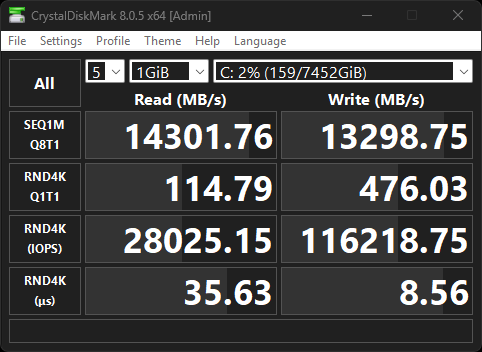
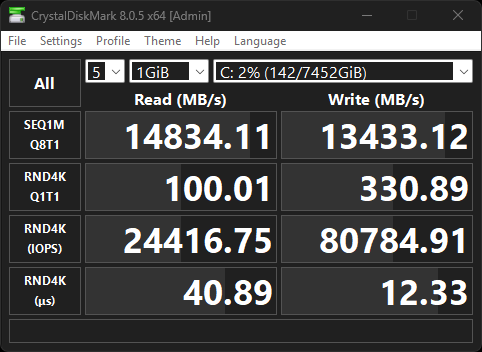
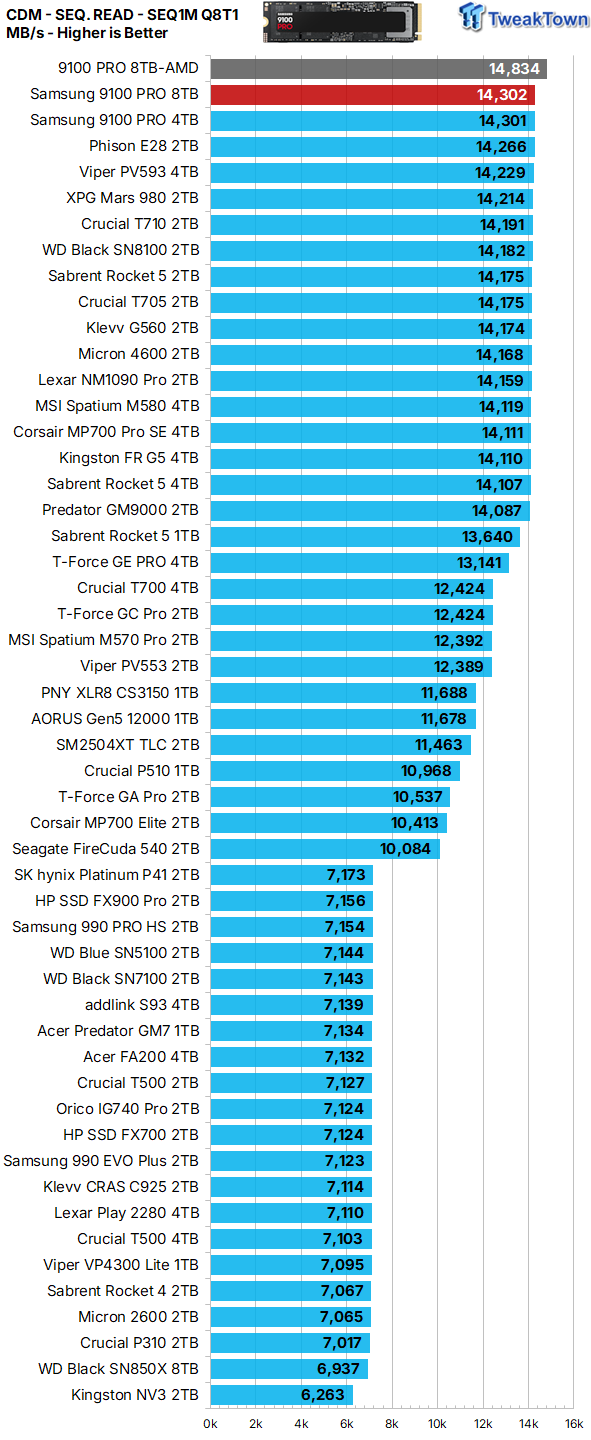
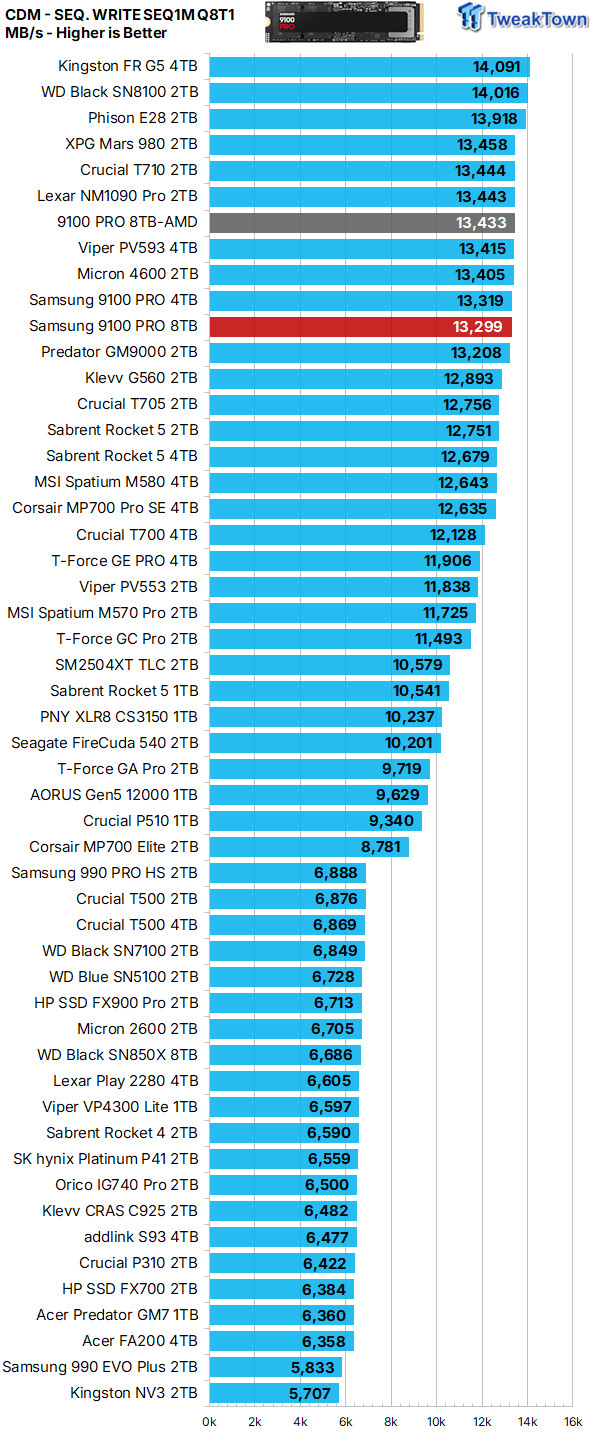
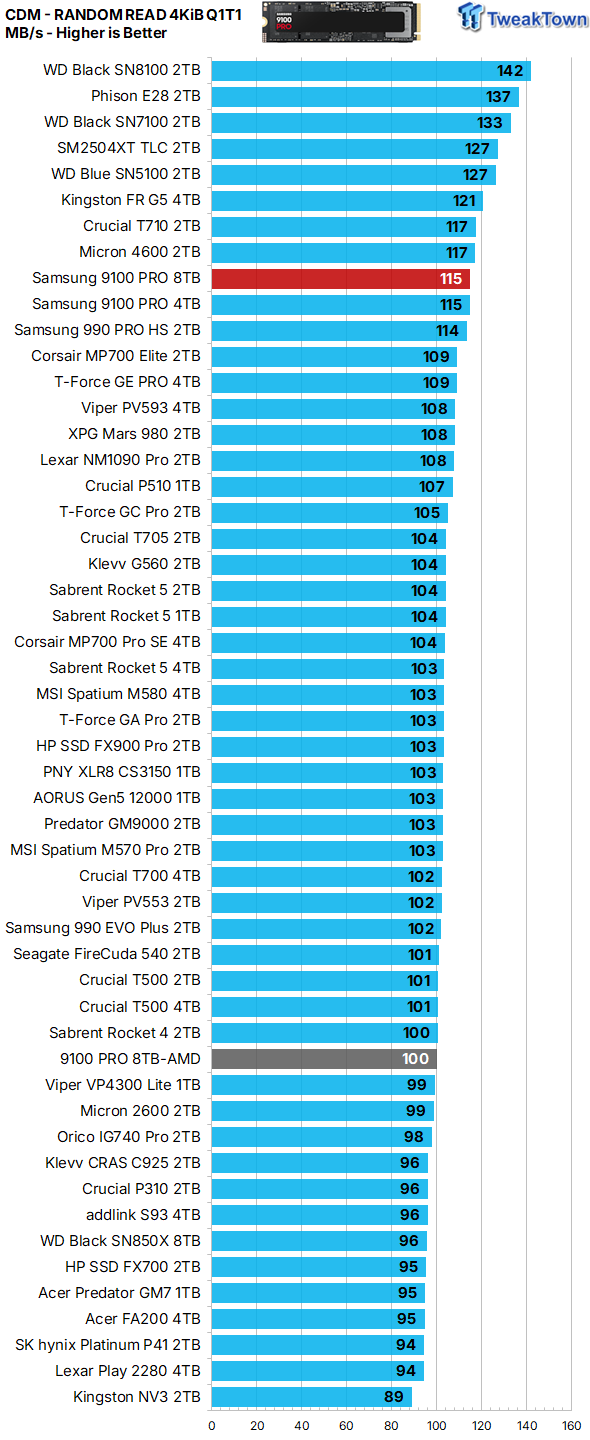
We employ CDM as our standard measurement for both sequential throughput and Q1T1 random read. In terms of sequential throughput, the newly crowned King gets nearly 14.9GB/s with our AMD system. This is even better than the 4TB model. Running on our Intel system, our test subject just edges out the 4TB 9100 Pro for a new lab sequential read record. Q1T1 4K random read throughput is also looking excellent at 115 MB/s. Impressive.
Max IOPS
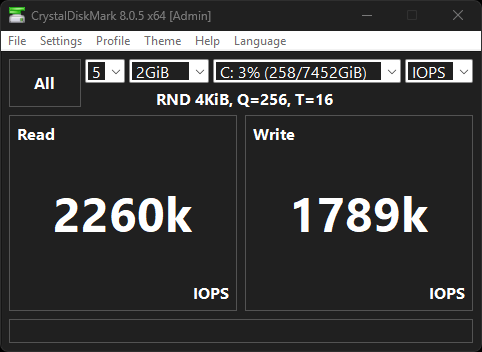
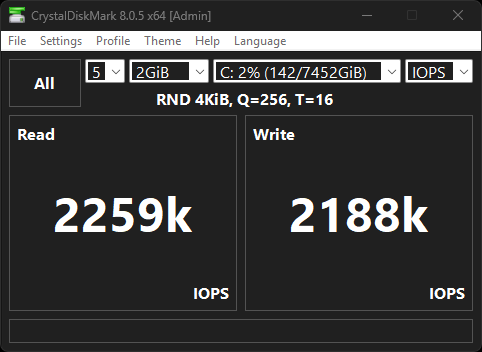
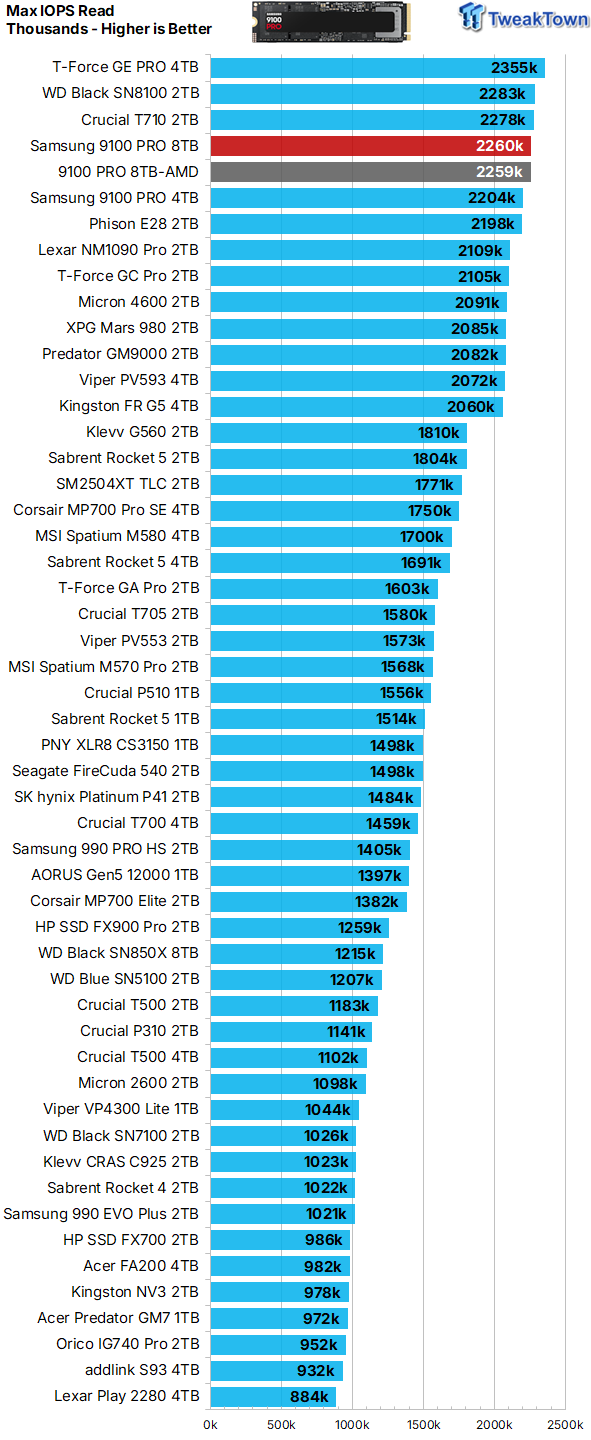
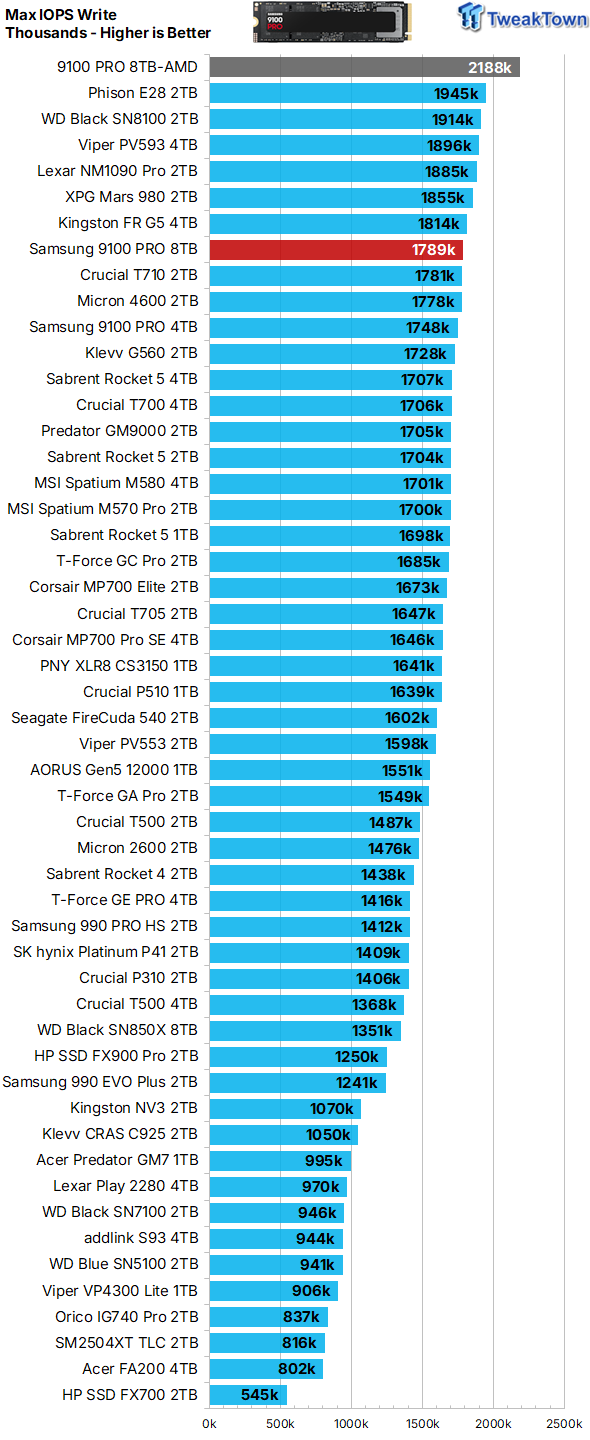
Max 4K random read performance for the 9100 PRO 8TB is factory specified for up to 2.2 million IOPS, and that's exactly what we are getting from both our Intel and AMD test platforms. 4K random write is factory spec'd at up to 2.6 million IOPS, and here we don't even come close to that. Here, the 8TB model can generate a bit more peak throughput than the 4TB model.
ATTO
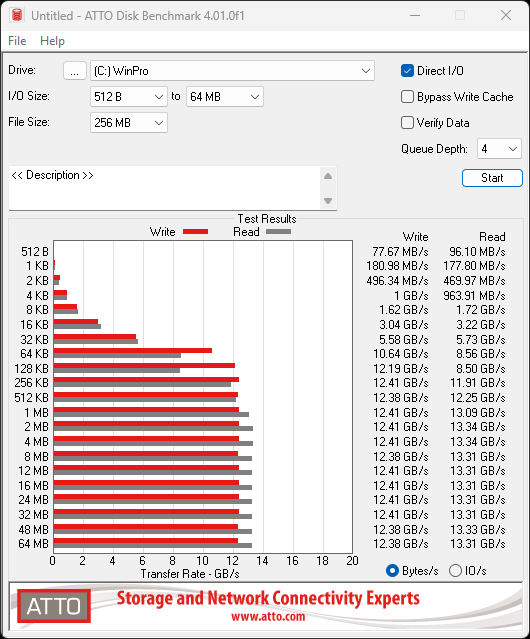
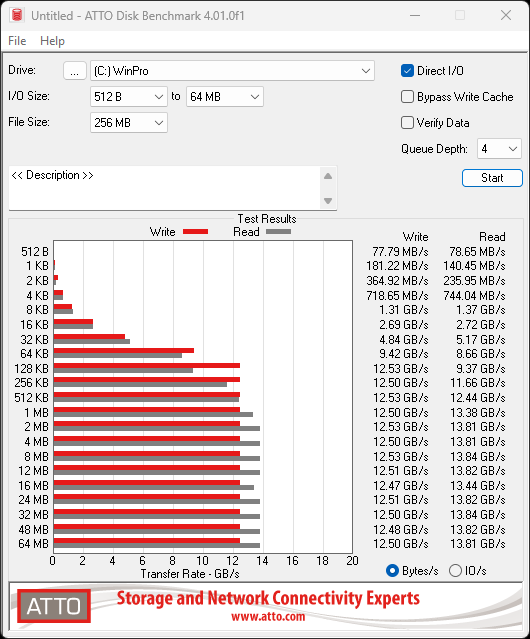
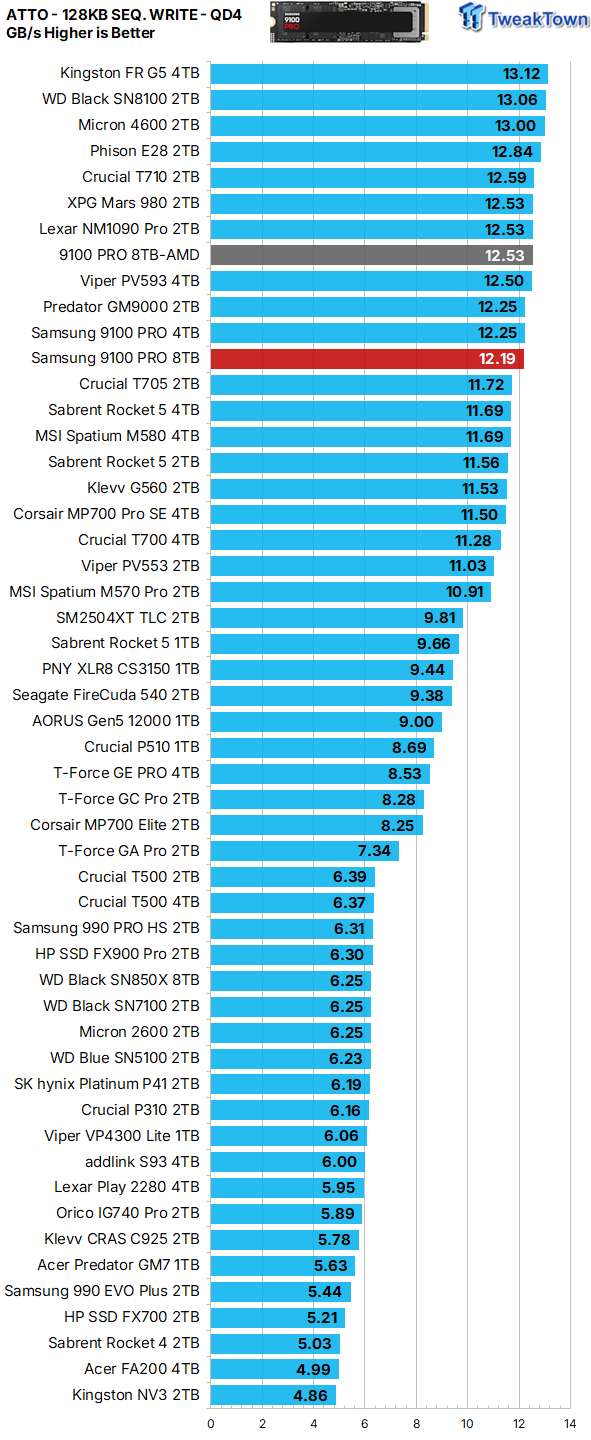
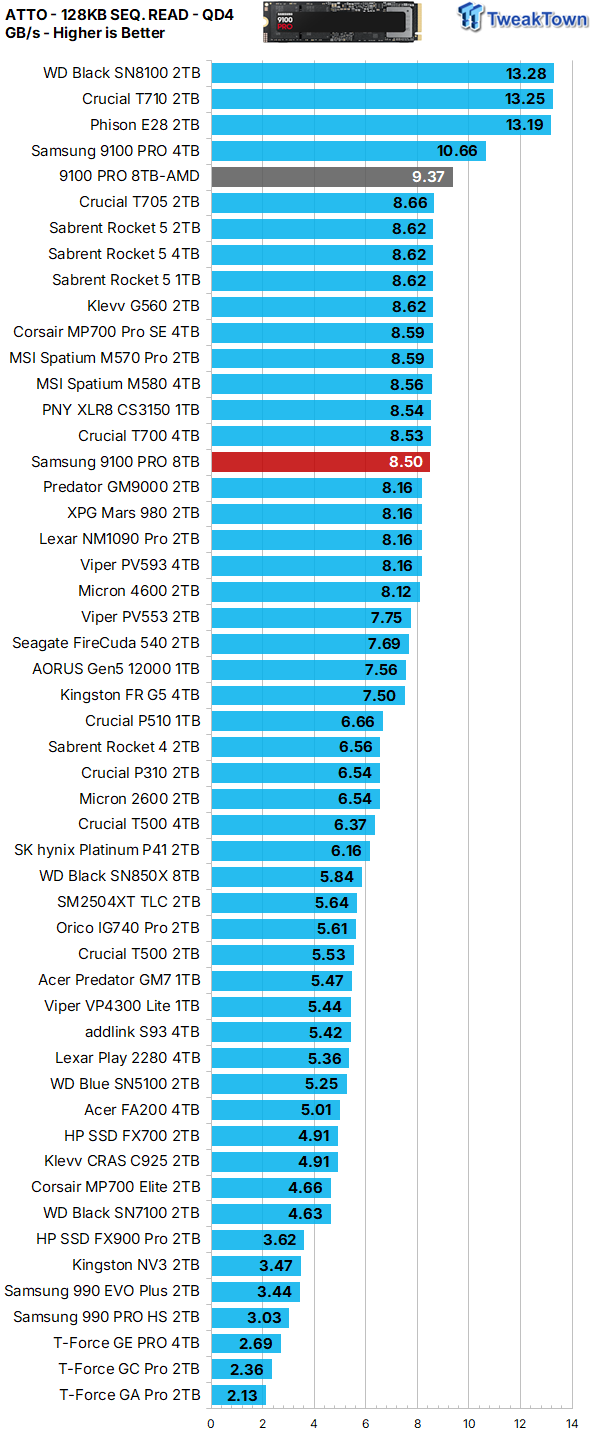
ATTO gives us a clear picture of what transfer sizes a particular SSD favors in terms of QD4 sequential throughput. We chart 128K transfers. At a queue depth of four, the 8TB 9100 PRO favors sequential transfers of 1MB or larger when serving data to the host (reading) and 128KB or larger when programming (writing) data. Excellent small-file performance for an 8TB capacity SSD.
Real-World Testing: Transfers, 3DMark SSD Gaming Test, PCM10 Storage
Transfer Rates
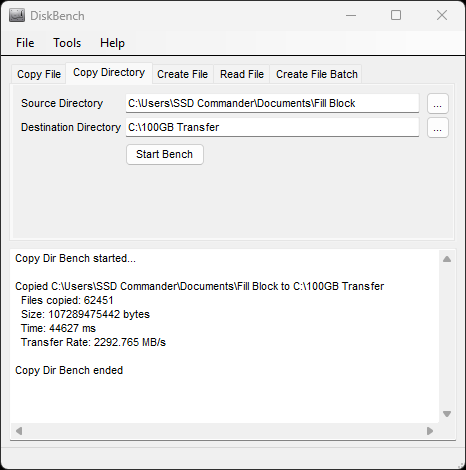
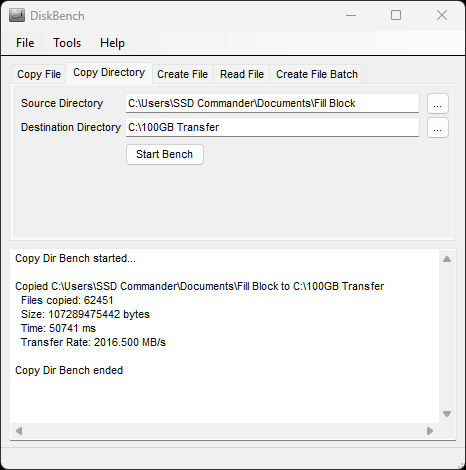
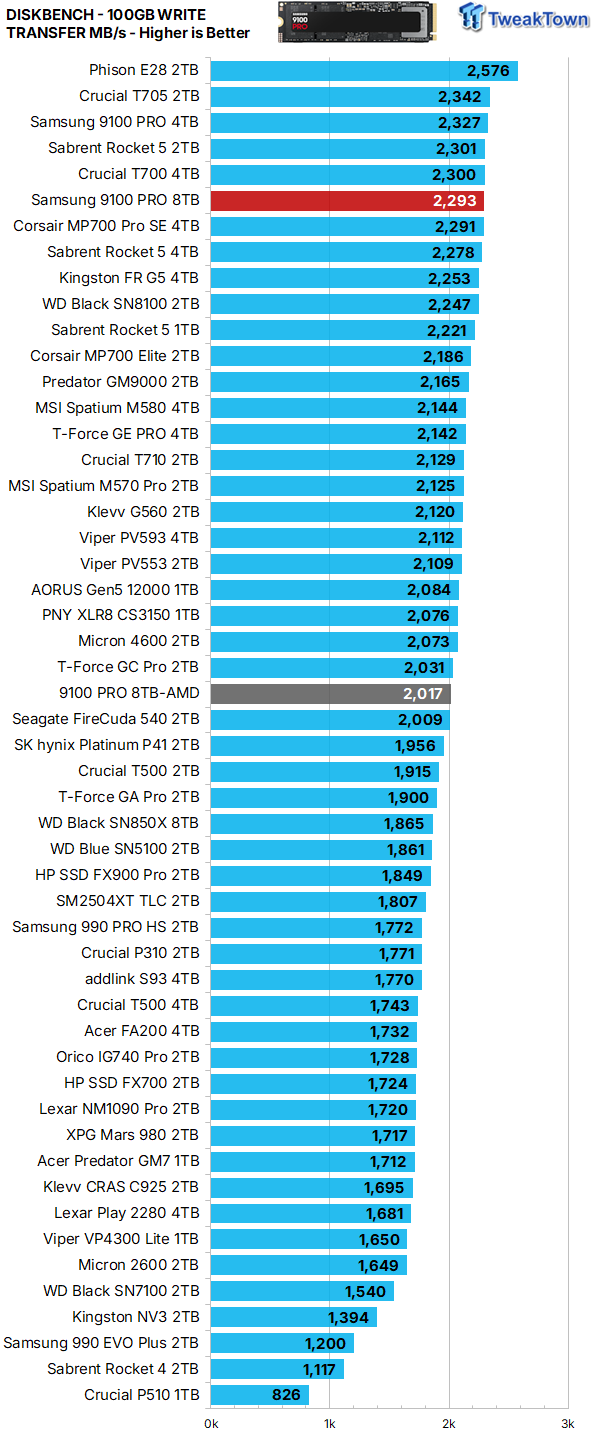
Our 100GB data transfer test is not your ordinary 100GB of data; ours is a crushing mix composed of more than 62K files. Write performance, random or sequential, is an infrequent operation, and as such, we do not consider it to be an important performance metric in the consumer space. An example is how many times a game is installed vs. how many times it's played. As expected, our test subject delivers top of the food chain performance here. Impressive.
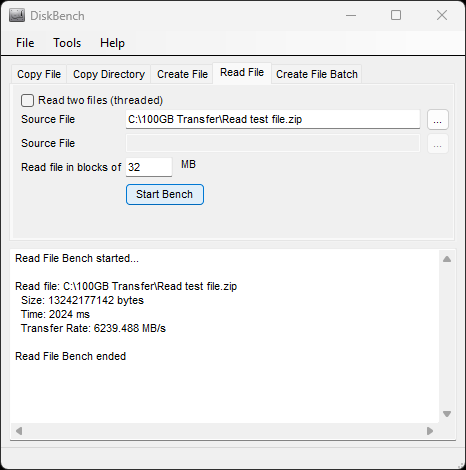
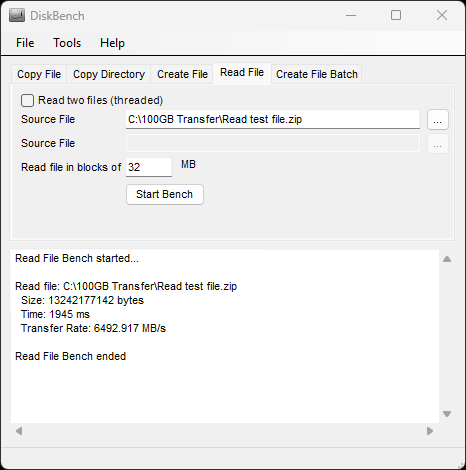
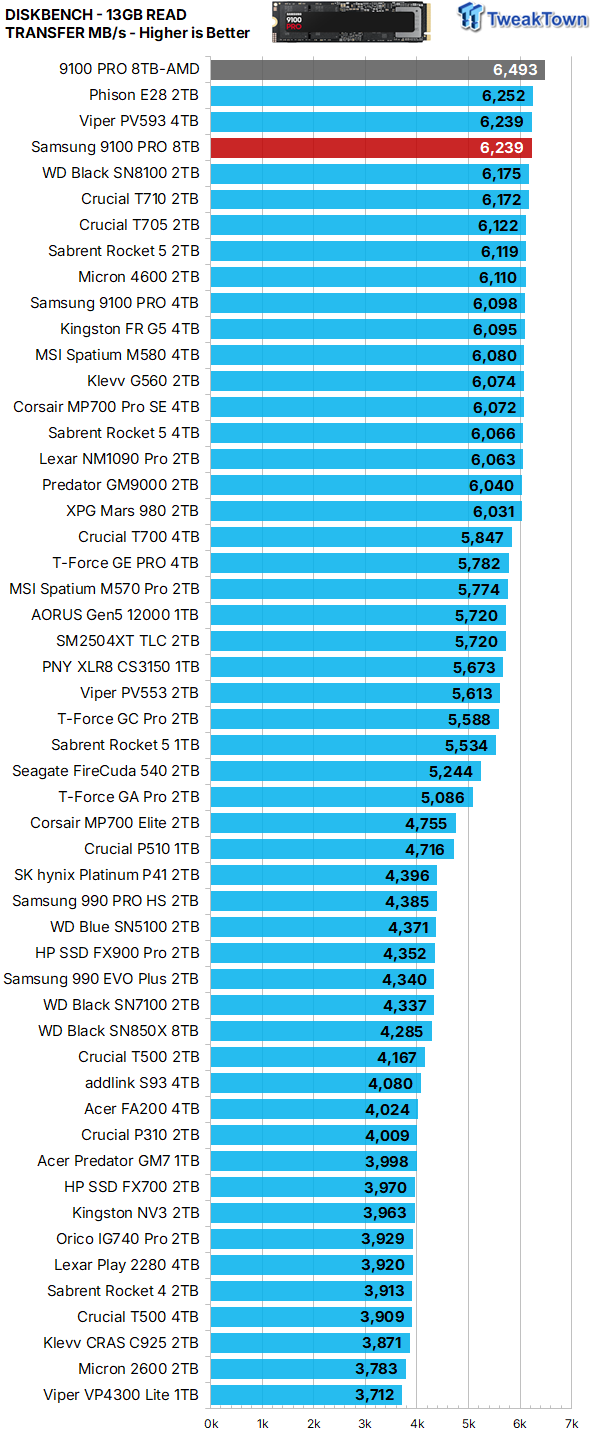
Unlike programming (writing) data, serving data to the host (reading) is typically an important performance metric as it relates to the consumer space. This is where transfer rates matter most, and we love what we see from our test subject. This is the best we've ever extracted from any retail SSD. It is again better than what we got from its 4TB sibling.
3DMark SSD Gaming Test
UL's newest 3DMark SSD Gaming Test is the most comprehensive SSD gaming test ever devised. We consider it superior to testing against games themselves because, as a trace, it is much more consistent than variations that will occur between runs on the actual game itself. This test is the same as running the actual game, just without the inconsistencies inherent to application testing. In short, we believe that this is the world's best way to test an SSDs gaming prowess and accurately compare it against competing SSDs. The 3DMark SSD Gaming Test measures and scores the following:
- Loading Battlefield V from launch to the main menu.
- Loading Call of Duty Black Ops 4 from launch to the main menu.
- Loading Overwatch from launch to the main menu.
- Recording a 1080p gameplay video at 60 FPS with OBS (Open Broadcaster Software) while playing Overwatch.
- Installing The Outer Worlds from the Epic Games Launcher.
- Saving game progress in The Outer Worlds.
- Copying the Steam folder for Counter-Strike Global Offensive from an external SSD to the system drive.


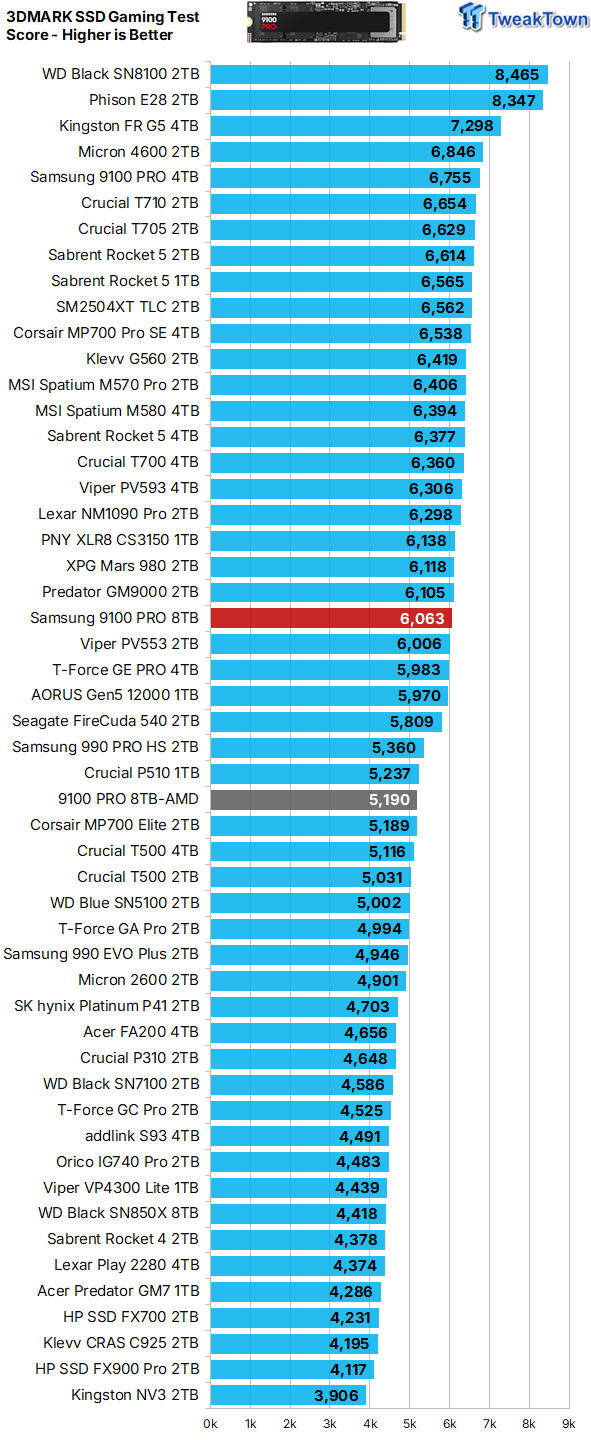
Gaming is a performance metric that matters to most DIY consumers, especially for the enthusiast crowd that TweakTown caters to. Now we've reached the point where results start to matter as they are a direct reflection of user experience.
Here in the real world, we start to see that 8-channels on a 4TB SSD is generally going to deliver more performance than it can at 8TB. However, performance here is still good enough that having double the capacity of any retail PCIe Gen5 SSD to date can be considered more advantageous, especially as it relates to one's massive gaming library.
PCM10 Storage Tests
PCMark 10 Storage Test is the most advanced and most accurate real-world consumer storage test ever made. There are four different tests you can choose from; we run two of them. The Full System Drive Benchmark and the Quick System Drive Benchmark. The Full System Drive Benchmark writes 204 GB of data over the duration of the test. These tests directly correlate with mainstream user experience.
PCMark 10 Full System Drive Benchmark
This test writes 204GB of data and covers a broad range of common consumer tasks, including booting Windows 10, file transfers, Adobe and Office applications, and startup times for games such as Battlefield V, COD Black Ops 4, and Overwatch. Unlike synthetic numbers, this is comprehensive real-world data, which is why we use it to rank SSDs in terms of user experience.


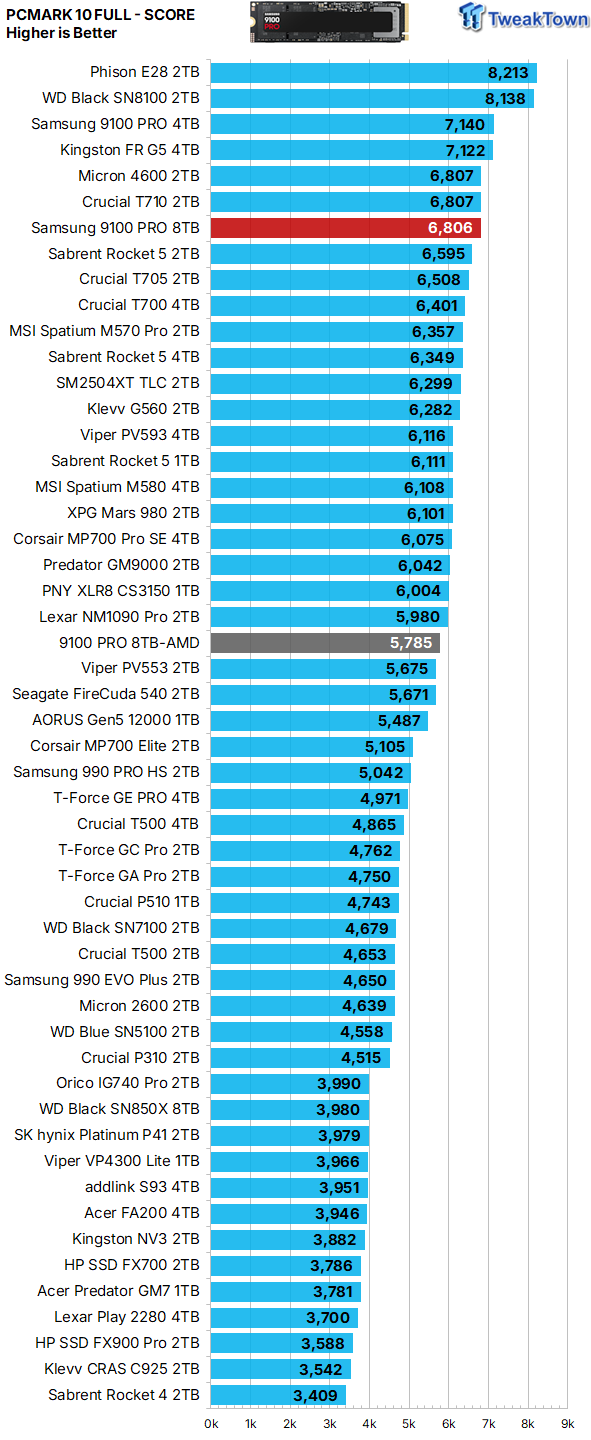
This time, our test subject delivers the goods almost as good as its 4TB sibling. Excellent.
PCMark 10 Quick System Drive Benchmark
The Quick System Drive Benchmark writes 23 GB of data over the duration of the test.


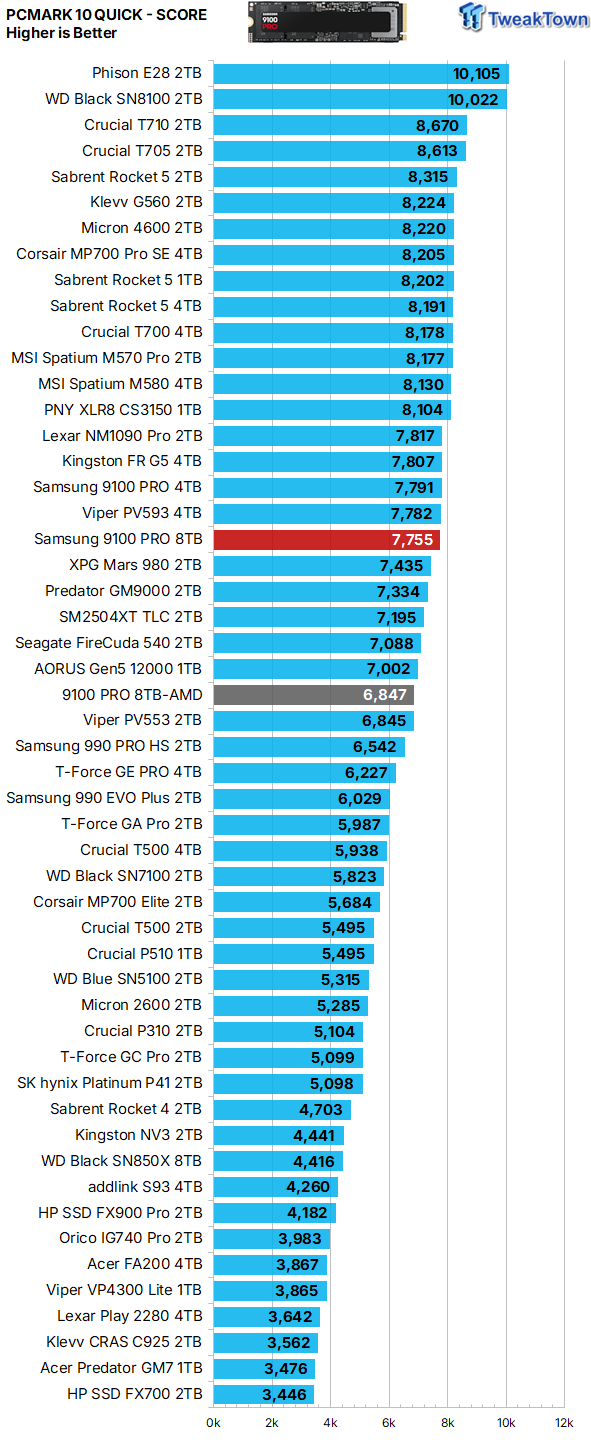
Of all the benchmarks we run, it can be argued that this one offers the best reflection of a typical consumer use case scenario. What you get here from the 8TB model is exactly what you will get from the 4TB model. Giving up nothing here where it matters most seals the deal for us.
Final Thoughts
As we see it, capacity is indeed King once again. Think about it, what could be better than 8TB of tier 1 PCIe Gen5 storage? With this offering, Samsung has done something it hasn't done in years: beat everyone to the punch as it relates to the complete package of highest capacity, throughput, and real-world performance all-in-one SSD to rule them all. The reign of the new King will no doubt be short-lived as others scramble to bring forth a worthy challenger, but the task won't be easy, as Samsung has set the bar high.
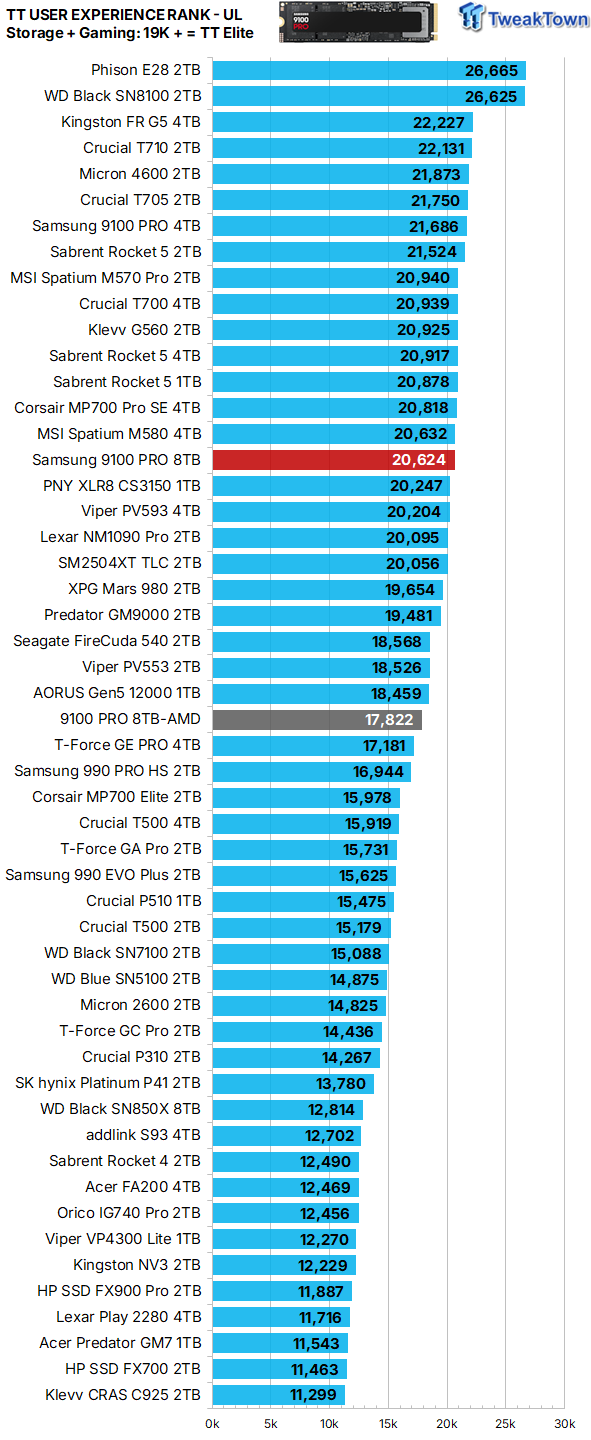
We rank SSDs in terms of overall user experience (performance where it matters most) as expressed by PCMark 10 storage and 3DMark gaming storage tests. Currently, we consider a user experience score of 19K or more to verify an SSD as a TweakTown Elite performer. We no longer consider any flash-based PCIe Gen4 SSD to be a TT Elite performer.
With a user experience score of 20,624 at a whopping 8TB capacity point, Samsung's 9100 PRO is as impressive an SSD as we've ever encountered.

As of today, and as we see it, Samsung is back on top with the single most desirable retail SSD in current circulation.


 Phison E37T SSD Controller Exclusive Preview - The Fastest DRAMless SSD Platform Yet
 Seagate FireCuda X1070 4TB SSD Review - A New Mainstream Contender
 ASUSTOR Lockerstor 2 Gen2+ AS6702T v2 NAS Review - Fast Performance
 TERRAMASTER D1 SSD Pro Thunderbolt/USB Portable Enclosure Review - Incredible Potential
 Orico K20 Mini 2TB Magnetic Portable SSD Review - Ultra-Thin MagSafe Drive
 Apple's first touchscreen MacBook Pro is '100% confirmed', leaker says
 AMD reversed a warranty rejection for a swollen Ryzen 9 7950X3D after Hardware Unboxed called it out publicly
 ASUS' $50 ROG Equalizer cable meant to stop GPU connector burns reportedly burns itself
 Intel's 18-core Core Ultra 7 251HX is matching its 20-core siblings in early PassMark results
 Elon Musk is the world's first trillionaire - enough to spend $1 million a day for nearly 3,000 years
 Anthropic's latest AI model 'Fable' was so powerful the US government banned the world from it
 Xbox prioritizes Elder Scrolls VI, Fallout, and Halo in new strategy shift
 Xbox exec wants to use ads to open up new access points, not just to collect money
 Redditor buys RTX 2080 Ti Super engineering sample on eBay, has the same number of cores as an RTX Titan but half the VRAM
 Report: Xbox may be spun off into subsidiary or joint venture with another company
 MOAIPLAY ORA PRO G1 850W ATX 3.1 PSU Review: high efficiency and 10-year warranty for $119.99
 Navman MiVue Smart True 4K Surround Dashcam Review - Seeing In All Directions At Once
 IQUNIX Magi96 Pro Aluminum Low Profile Mechanical Keyboard Review - Premium Build, Satisfying Sound
 Asetek Forte S-Series Racing Simulator Bundle Review
 Razer Pro Type Ergo Wireless Split Ergonomic Keyboard Review - Built for Comfort and Support
 ASUS ROG Strix Morph 96 Wireless Gaming Keyboard Review - Great Performance, More Affordable
 SAPPHIRE Radeon RX 9070 GRE PULSE OC Review - A New 1440p Challenger Has Arrived
 NZXT H6 RGB+ Compact Dual-Chamber Chassis Review
 ASRock Radeon RX 9070 GRE Steel Legend Review - The RDNA 4 Mid-Range Reshuffle
 ASRock Z890 Taichi Aqua Motherboard Review - Flagship features without the flagship price
 This Windows security feature protects Documents from ransomware, but it is off by default
 Windows 11 already has a voice typing tool, and it is the one most people are not using
 Quick Assist is the only remote-support tool I open when a relative calls about their PC
 The PowerToys utilities I keep enabled on every Windows 11 PC, and the ones I turned off within a week
 TweakTown's Best of Computex 2026 Awards - The Best Hardware, Gaming Gear, and AI
 USB Ports Not Working in Windows 11? Try These Fixes
 ASUS WiFi Routers and Networking Solutions Deliver Long-term Security and Reliability with No Additional Cost
 Second Monitor Not Detected in Windows 11? Try These Fixes
 Turn Your Old Smartphone Into a Dedicated Webcam for Your Windows PC