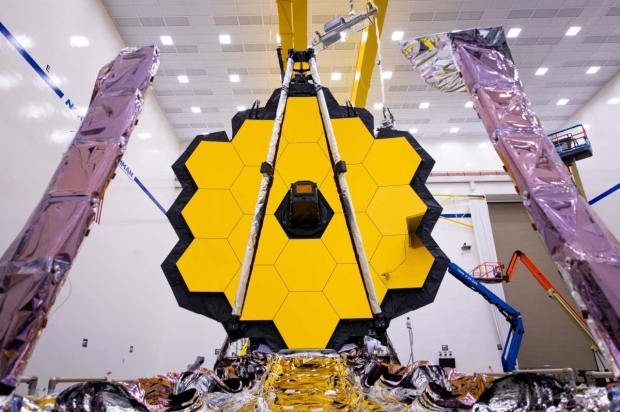





NASA and the European Space Agency have selected a new picture of the month, and this time around, it's an image snapped by the James Webb Space Telescope (JWST), the world's most powerful space telescope.
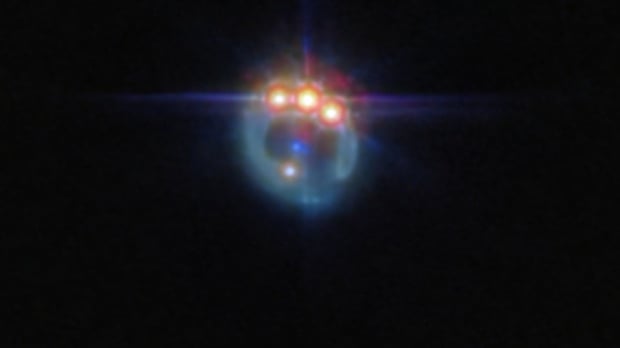
The ESA explains via a blog post on its website that Webb has honed its extremely sensitive instruments in on an astronomical object called RX J1131-1231. This object is known as a quasar and is located approximately 6 billion light years away from Earth within the constellation Crater. The ESA writes it's one of the best "lensed" quasars discovered to date as the galaxy located in the foreground of the image smears the image of the background quasar, creating a bright arc and four objects.
Popular Now: New PS5 jailbreak means almost every console can now be unlocked, with one catchWhat is causing this distortion? Astronomers call this effect gravitational lensing, which was first predicted by Einstein. Gravitational lensing, in a nutshell, is very similar to how a magnifying glass works. In space, objects that have mass bend space and time through gravity. This distortion through gravity creates a magnifying effect that enables astronomers to see further into space than they would without gravitational lensing.
"All matter in the Universe warps the space around itself, with larger masses producing a stronger effect. Around very massive objects, such as galaxies, light that passes close by follows this warped space, appearing to bend away from its original path by a clearly visible amount. One of the consequences of gravitational lensing is that it can magnify distant astronomical objects, letting astronomers study objects that would otherwise be too faint or far away," explains the ESA
![Photo of the $10 -PlayStation Store Gift Card [Digital Code]](https://m.media-amazon.com/images/I/41MT2s0Gm2L._SL160_.jpg)