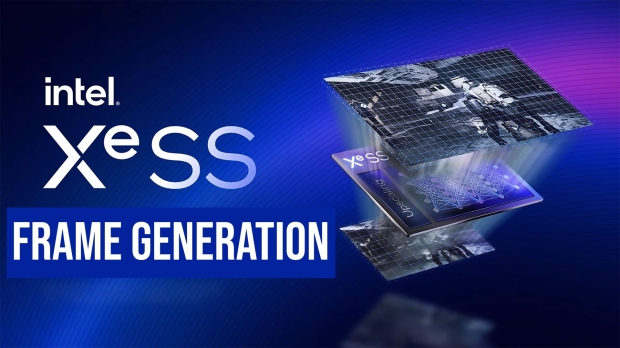




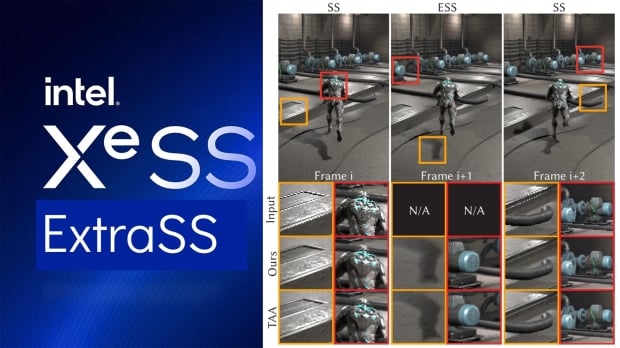
At SIGGRAPH Asia 2023 in Sydney, Intel showcased an interesting new technology called ExtraSS as part of its XeSS framework for boosting rendering performance. XeSS, Intel's AI-powered upscaling answer to NVIDIA DLSS, looks to be getting its own (and very different) version of Frame Generation.
With the debut of the GeForce RTX 40 Series, NVIDIA introduced a new performance-boosting bit of technology called Frame Generation as part of its updated DLSS 3 suite.
Leveraging the advanced AI hardware and capabilities of the company's new Ada Lovelace architecture, the performance increase arrives via creating and generating new frames. Mix in latency reduction tech like NVIDIA Reflex, and it's no secret that DLSS 3 has been one of the most talked about PC gaming features in the past year- a massive increase in perceived in-game performance with excellent image quality.
So much so that AMD quickly announced its own Frame Generation technology when it debuted its new RDNA 3-powered Radeon line-up in 2022, though its FSR 3 Frame Generation technology took until September 2023 and the arrival of the Radeon RX 7800 XT to start appearing in games.
With NVIDIA's DLSS 3 and Frame Generation requiring the use of specialized hardware, AMD's FSR 3, like FSR 2 before it, was "platform agnostic" in that it works across all modern GPUs from AMD, NVIDIA, and even Intel.
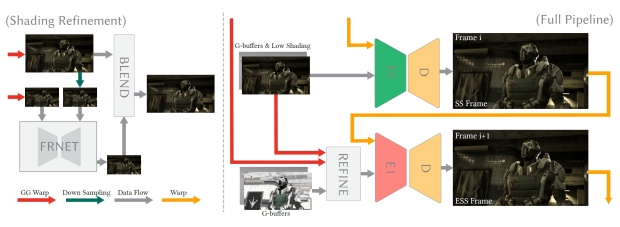
With ExtraSS, it's now Intel's turn to enter the Frame Generation pool, as outlined in a new paper titled "ExtraSS: A Framework for Joint Spatial Super Sampling and Frame Extrapolation." The first takeaway is that Intel, unlike NVIDIA or AMD, will use a 'Frame Extrapolation' method for generation instead of 'Frame Interpolation.'
ExtraSS integrates the supersampling of Intel XeSS with Frame Extrapolation to achieve "a balance between performance and quality, generating temporally stable and high-quality, high-resolution results." Extrapolation is not as accurate as Interpolation, as it uses less information (prior frame data only) to produce new frames. Still, the hit to overall latency is less than what's found in DLSS 3 and FSR 3 - so there isn't as much of a need for Reflex or AMD's Anti-Lag.
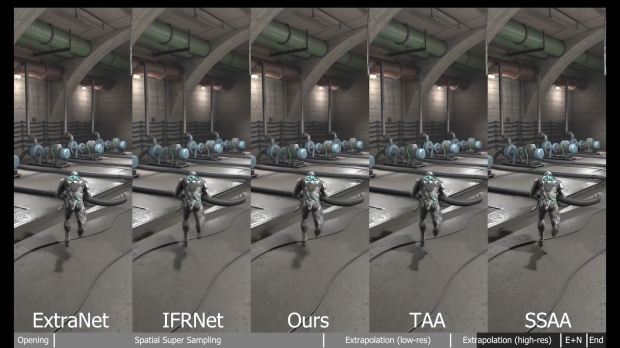
"Frame extrapolation has less latency but has difficulty handling the disoccluded areas because of lacking information from the input frames. Our method proposes a new warping method with a lightweight flow model to extrapolate frames with better qualities to the previous frame generation methods and less latency comparing to Interpolation based methods."
ExtraSS is still "optical flow-based" and AI-powered, with Intel's paper showcasing results with better image quality than TAA. ExtraSS will probably arrive some time in 2024, and it will be interesting to see it in motion. The consensus is that when it comes to upscaling and supersampling, DLSS sits on top, followed by Intel XeSS and then AMD's FSR. Will it be the same situation with Frame Generation? Time will tell.