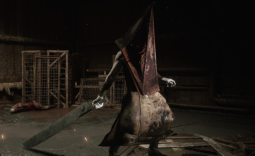


If you have been following the latest in Konami's Silent Hill franchise, it's hard to miss how recent entries feel distinctly different from the spooky Americana of the original series we are all familiar with.
Silent Hill f, for example, moves the series to 1960s Japan, while Silent Hill Townfall relocates the action to 1990s Scotland and uses a first-person perspective. Turns out this creative independence is entirely by design, with Konami actively pushing for studios to try something new with Silent Hill, and it has a pretty clever way of achieving that goal.
In an interview with Radio Times Gaming, Silent Hill series producer Motoi Okamoto said Konami maintains an internal bible defining what constitutes Silent Hill as a franchise. The interesting part is what Konami does with it.

"We do technically have an internal bible for what constitutes Silent Hill," Okamoto said, "but we try not to distribute that to our development teams too much because I think it's more important that they organically can do their own research and try to figure out what is symbolic to them."
Rather than handing studios a document and telling them to follow it, Konami asks development teams to research the series themselves and determine what Silent Hill means to their own project. As a result, every new entry can approach the franchise from a genuinely fresh perspective without being constrained by what came before.

This approach has paid off. Silent Hill f sold one million copies in its first week. Silent Hill Townfall, developed by Glasgow-based Screen Burn Interactive, formerly known as No Code, showed how far the series could stretch without losing its psychological horror identity. The studio introduced a new location, protagonist, enemies, and the CRTV device as an evolution of the franchise's traditional radio mechanic.
Okamoto also said that what the team learns from this creative independence feeds back into the broader franchise. He previously stated ahead of Silent Hill f's release that future titles would "probably carry their own flavour" depending on the team behind them, and the releases since have backed that up.


Story Q&A
Powered by TweakBot
From TweakTown's coverage of this story.
How does Konami preserve Silent Hill’s psychological-horror identity while letting each studio reinterpret the series?
What gameplay and story details has Konami revealed about Silent Hill f beyond its 1960s Japan setting?
What does Silent Hill Townfall’s CRTV do, and how does it build on the series’ radio mechanic?
What story details has Konami shared about Silent Hill Townfall’s protagonist and 1990s Scotland setting?
Want something else? Ask TweakBot.

As Konami pushes to release a new Silent Hill game every year, that approach is also what keeps a franchise from eating itself. Originality is increasingly rare in the games industry, and is more than welcome by gamers right now, as we are seeing with Remedy's latest Control Resonant.