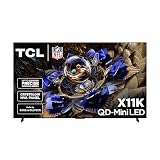


Some TVs (notably OLEDs) are marked down for not being bright enough, and there can be concerns around daytime viewing with such screens, particularly in well-lit rooms - but one criticism you can't level at the TCL X11 is that its brightness is subpar.
According to TV expert and reviewer Vincent Teoh (via VideoCardz), the new 85-inch Super Quantum Dot Mini LED TV from TCL comes close to 11,000 nits.
That's as measured by Teoh as you can see in the above video clip posted on X, with the brightness level reaching 10,931 nits to be precise.
In the computing world, we're more accustomed to displays that are around the 300 to 500 nits level. As Teoh observes, this actually exceeds the ceiling of the PQ HDR10 standard, which is 10,000 nits.
Teoh calls it: "A genuinely historic moment for consumer television technology."
Of course, we need to bear in mind that the measurement is of peak HDR brightness from a small pure white rectangle in the middle of the display, which obviously doesn't reflect real-world usage.
Even so, clearly this is a screen with the capability to get very bright - too bright, perhaps? Just looking at the video footage of the glaringly stark white rectangle on X makes me think I'm going to get a headache, let alone seeing it for real.
I have a Sony OLED and personally I actually like the fact that it doesn't get too bright. Often I'm watching TV in the evening when it's dark (or dimly lit), and an in-your-face level of brightness is going to get tiresome quickly.
I'm not alone, as some of the reaction on X indicates. One poster observes:
"What is the purpose of this brightness race? I don't want my TV to mimic a window looking out in the middle of the Sahara desert, it's like shining a torch in your face at night really uncomfortable to see."
Another person questions whether watching a high brightness TV is really all that good for your eyes, and the same point has occurred to me. Not to mention the power usage of bright screens such as this, which are obviously more demanding than a more typical TV display.
Seemingly the maximum rated power consumption of the TCL X11 is 740W, so not only is there a danger of it burning a hole in your retinas, but also your wallet via your electricity bill. I joke, of course, but I really do wonder if watching a screen as bright as this for any length of time is going to be a fatiguing experience if you do indeed crank the brightness.
Still, each to their own, and clearly if you're in the market for super-punchy brightness, the TV industry has some tempting options freshly on the scene.