

Valve recently unveiled the Steam Machine, a mini gaming PC shaped like a console, scheduled to launch early next year. With the exact price of the device still unknown, many potential buyers want to know what the announced hardware specifications will be able to achieve in games and whether the performance they deliver can be improved through upgrades if they are unhappy with the result.
Gamers Nexus visited Valve and spoke with engineers about the design of the upcoming gaming PC/console, during which they showcased the Steam Machine without its shell. The interview with the engineer revealed that Valve actually began designing the Steam Machine with its thermals, specifically the fan. A Steam Machine system engineer explained they designed the fan first, as the laws of thermodynamics are "not flexible".
When discussing the design, Gamers Nexus shows that, by disassembling the Steam Machine, users can upgrade the system memory to SO-DIMM RAM sticks. However, they will likely be quite difficult to access, as SO-DIMM (laptop memory) sits flat on the motherboard and is likely located beneath the large heat sink. Additionally, Gamers Nexus said they aren't sure if it's one or two RAM sticks, but they can verify the RAM isn't soldered to the board.


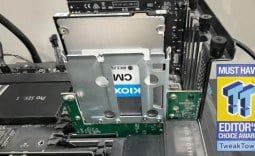
What also isn't soldered to the board, and is definitely more than likely going to be replaced by users, given the ease of access, is the SSD. The Steam Machine comes with a smaller 2230 M.2 SSD, but it supports a full 2280 SSD, which users can simply swap out as the storage section of the machine is directly exposed.
Now, what users won't be able to swap out is the GPU, which is an AMD RDNA 3 GPU with 28 compute units up to 2.45GHz clock speeds, and the stinger, 8 GB of GDDR6 VRAM. Modern AAA games have proven to be quite heavy for systems with limited VRAM pools, as when all VRAM is consumed, performance tanks. Users concerned about the future-proofing of the Steam Machine may point directly to the VRAM limitation, and they would be right to do so, especially given that Valve is marketing the Steam Machine as a 4K 60FPS device, albeit through the power of FSR 3.
Given the specifications of the Steam Machine, we can anticipate it will be leaning quite heavily on FSR 3 to achieve the 4K 60FPS target, especially if Ray-Tracing is involved. Furthermore, we don't yet know what resolution the Steam Machine will be upscaling from to reach 4K, as the baseline resolution may be quite low, resulting in an image that lacks clarity at the cost of reaching the target 60FPS.
However, that is all speculation until the benchmark results have been published. What we know for sure is that owners of the Steam Machine won't be able to swap out the GPU for a more powerful one; if they are unhappy with the results, they can only add more RAM and storage.