












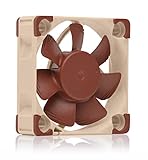
Noctua's fans and various cooling solutions are notable not only for their unique brown and tan colorways, but also for consistently delivering industry-leading performance and durability. Recently, the company partnered with Pulsar to release its first gaming mouse with active cooling, powered by the Noctua NF-A4x10 fan.

According to the company, adding a fan to the Pulsar Feinmann F01 Noctua Edition gaming mouse isn't as simple as it seems - at least not for a company that builds what it calls "custom-built torture-test rigs" to ensure that their fans perform as expected, without any issues.
To demonstrate the detail and rigorous testing that went into validating the Noctua NF-A4x10 fan for the Pulsar Feinmann F01 Noctua Edition gaming mouse, the company has posted a detailed article outlining its process. As a gaming mouse is a peripheral that is, more or less, in constant movement when in use, this led to the development of a custom machine to stress test horizontal in-plane movement with an asynchronous motor, gears, and other bits and pieces. Yes, it's a "custom-built torture-test rig" that essentially shakes the fan to replicate 20g acceleration force.

And to properly test the various forces, this required integrating an accelerometer into one of the mouse samples.
"With gaming mice, there are two basic types of movement that can create acceleration forces which could potentially be problematic for fans," Noctua explains. "Horizontal in-plane movements along the x and y axis, where the mouse is moved sideways, forward or backward, and vertical or z-axis movements that occur when the mouse is lifted from the table and brought back down, hitting the table surface."
And with that, the team at Noctua developed a secondary vertical validation machine for drop testing. And if you're wondering how the Noctua NF-A4x10 fan held up with these demanding tests, the answer is surprisingly well. After 280,000 cycles of the horizontal movement test, only one of 12 test fans failed; but that was due to one of the cables becoming loose. After 20,000 drops on the vertical movement machine, all eight fans survived unscathed; another 5,000 drops caused all fans to fail because the foam padding at the base of the "custom-built torture-test rig" shattered, dramatically increasing the impact force.
"When analyzing the test results, it quickly became clear that our initial concern whether the NF-A4x10 would be able to withstand the acceleration forces that can occur inside a gaming mouse was unfounded," Noctua concludes. "Thanks to our custom-built validation setups, we can now confidently say that the fans can not only tolerate acceleration forces that go way beyond what can happen even in the most extreme gaming situations, but they can also withstand these forces for a number of repetitions that even the most avid gamers are unlikely to reach within a decade."

Frequently Asked Questions
TweakBot answers common questions about this news using TweakTown's own coverage from this page and related content from our archive. Tap a question to reveal the answer, or type your own below.
What specific tests did Noctua run on the NF-A4x10 when validating it for the Pulsar Feinmann F01 Noctua Edition mouse?
Based on Noctua's test results, what longevity or usage expectations did they claim for the NF-A4x10 inside a gaming mouse?
Will the Pulsar Feinmann F01 Noctua Edition review include additional stress or durability testing results beyond Noctua’s validation?
Have a question not listed here? Ask below and TweakBot will answer it.

And on that note, stay tuned as we'll be reviewing the Pulsar Feinmann F01 Noctua Edition gaming mouse in the coming weeks.


 Pulsar and Noctua launch Feinmann F01 Noctua Edition gaming mouse with built-in fan for sweaty palms
 Noctua's Pulsar Feinmann F01 gaming mouse is coming soon, and it's got an embedded fan for the sweaty gamer
 Noctua preparing to enter the AIO liquid cooling market in Q2 2026, right before Computex
 ASUS's GeForce RTX 5080 Noctua Edition is a quad-slot GPU with 'ultraquiet' performance
 Noctua announces Chromax black version of its high-performance NF-A12x25 G2 120mm fan 10 months after launch
 More PC gamers are using GPUs with 16GB of VRAM than 8GB, according to the latest Steam data
 GeForce RTX 5070 is now the third most popular desktop gaming GPU among PC gamers
 Original Game Boy versions of Pokémon Red and Blue ported to PC with 3D voxel graphics
 TSMC is ramping up 2nm production, 100K monthly wafers by the end of 2026
 CXMT is considering a second Beijing DRAM fab as it targets Micron-level output by late 2026
 Spider-Man games are back in Steam's top 10 and on sale for up to 60% off following Brand New Day's success
 Redditor finds $600 Kingston Fury 32GB DDR5-6000 kit at a thrift store for just $14
 The Steam Frame could be priced at $1,500 at launch, according to insider
 NVIDIA GeForce RTX 50 series GPUs get up to 30% more expensive in South Korea
 Giveaway: Win an ASUS TUF Gaming B850-PRO WiFi 7 Motherboard and 360mm ARGB AIO
 Thinkware U3000 Pro Review - Smart Dashcam with Wi-Fi quirks
 Montech TG3 Mid-Tower Chassis Review
 ASUS ROG Strix X870E-A Gaming WiFI7 Neo Review - A New Enticing Option
 Noctua NL-LC1-36 Liquid CPU Cooler Review
 Logitech G316 X 98 Wired Gaming Keyboard Review - Retro-Inspired Board that Falls a Little Short
 Biwin M560 2TB SSD Review - Best Overall Retail-Ready DRAMless SSD
 Logitech G512 X 98 Analog Mechanical Gaming Keyboard Review - An Innovative Two-in-One
 Thrustmaster T.Flight HOTAS 5 MSFS Edition Review
 SteelSeries Arctis Nova Pro Omni Wireless Headset Review - One Headset to Rule Them All
 SteelSeries Arctis Nova 7 Wireless Gen 2 Headset Review - New and Improved, But Is It Enough?
 How to tell if someone has been using your Windows PC without your permission
 6 Task Manager tips for troubleshooting Windows performance problems
 ASUS ROG's 20th Anniversary Line-up of Premium PC Gaming Gear has Arrived - Here's Everything You Need to Know
 Six File Explorer tips every Windows user should know
 I switched my PC to encrypted DNS in Windows 11, and browsing felt more private
 Printer Not Working in Windows? How to fix detection, print queues and drivers
 The Ultimate Guide to Personalizing Your Windows 11 Taskbar
 How to Turn Your Windows Laptop Into a Second Monitor with Miracast and Wireless Display in Minutes
 6 Mistakes to Avoid When Buying a Windows Laptop
 I capped Windows Update's bandwidth with Delivery Optimization, and my downloads stopped choking