
Our Verdict
Pros
- Intel Core Ultra 9 285K (24C/24T) CPU
- GeForce RTX 5090 32GB GDDR7 and 64GB RAM
- Awesome styling and fantastic cooling
- It's bloody huge and upgradeable to 128GB RAM
- Quick access USB-C drive on the top drive bay
Cons
- It's bloody HUGE!
- Only a Gen4 SSD
- No AMD Radeon RX GPU variant
Should you buy it?
Introduction, Specifications, and Pricing
Introduction
Acer sent over their flagship Predator Orion 7000 desktop gaming PC a couple of months ago. Between Christmas, moving house, packing, flying to the USA for CES 2026, and being incredibly ill with some heart-related issues earlier this year, I've spent some considerable time using this absolute beast of a PC.
Diving right in, Acer sent over a top-spec Predator Orion 7000 with an Intel Core Ultra 9 285K (24C/24T) processor, a chunky 64GB of DDR5 RAM, and the flagship NVIDIA GeForce RTX 5090 graphics card with 32GB of GDDR7. This system absolutely melts anything you throw at it, be it 4K gaming, productivity workloads, or content creation.
Normally, pre-built gaming PCs from the big boy companies are mostly junk, but they've gotten better over time, that's for sure. I've used custom-built systems that I have assembled for close to 30 years now (man, I'm getting old... 43rd birthday is coming up next month), but receiving a high-end pre-built system like the Acer Predator Orion 7000 has been a treat to use.
Acer has baked in the best components on the market (without considering AMD's fantastic X3D chips) into the Predator Orion 7000, so you would want to pair this system with - at the very least - a high refresh rate 1440p gaming monitor, or better yet: a full 4K 240FPS high-end OLED gaming monitor. Perfection.
As with all of my gaming laptop reviews, I've moved away from my desktop Aftershock Nimbus Gaming PC, which packs an AMD Ryzen 7 7800X3D, 32GB RAM, 1TB Gen4 SSD, and GeForce RTX 4070 SUPER graphics card. This is a great system for a comparison against the RTX 5070 Laptop GPU and Core i9-14900HX processor, with the same RAM + SSD count as the desktop system.
Let's rock and roll, shall we?
Best Deals: Acer Predator Orion 7000 Gaming Desktop


Specs Reviewed:
- CPU: Intel Core Ultra 9 285K (24C/24T)
- GPU: NVIDIA GeForce RTX 5090 + 32GB GDDR7
- RAM: 64GB
- Storage: 1TB Gen4
Overview
Acer is utilizing higher-end cooling technology inside the Predator Orion 7000, with the Predator CycloneX 360 3-in-1 fan that the company designed to increase airflow by 15%, which efficiently directs cool air over your CPU and motherboard to prevent any overheating during intensive workloads.
Our Latest Gaming Desktop PCs Review Coverage
The 360mm radiator is paired with the Predator CycloneX 360, which helps heat dissipation once more, which Acer says lowers the motherboard power component temperatures by up to 9C, too. It's not just impressive in performance, but it looks awesome too, as the liquid cooling system has customizable ARGB lighting that you can tweak through settings, too.

Acer's impressive 360mm radiator, when combined with its specialized mesh, expels heat, maximizing airflow and providing consistent cooling for high-end workloads.
It's backed up with enhanced cold plate thickness, with the Orion 7000 system improving the Radiant Cooling Area through superior thermal management, and the pump operating at 3400RPM (it has been upgraded since the last system), which offers improved cooling efficiency, paving the way for stable, high-speed performance under any workload.
Features + I/O
One of the major downsides of the Predator Orion 7000 is its I/O, which is severely lacking for a system this high-end and this expensive. On the rear, we've only got a single - yes, a SINGLE - Thunderbolt 4/USB-C port, with 5 x USB-A ports, 2.5GbE Killer NIC ethernet, and the standard audio jacks. There is another USB-C port on top, but for a system sold in late 2025 and into 2026, I would've expected far more I/O.
I don't think there needs to be multiple Thunderbolt 4 ports, but at least 2-3 USB-C ports would've been nice to see, Acer... maybe this year?
However, what the Predator Orion 7000 lacks in I/O, it makes up for in other areas with its Wi-Fi 7 connectivity, Killer Ethernet E3100G networking which provides 2.5GbE speeds on wired networking for lower latency and faster in-game response time, and its EMI-compliant tempered glass panel that lets you have a look inside your Predator Orion 7000 so you can keep an eye on all that expensive hardware... oh yeah.
Acer also has its own PredatorSense software, which I have loved using on their gaming laptops, and it's the same thing here on the desktop. You've got a home page that you can monitor your system stats and switch between modes with, with Quiet, Balanced, and Performance modes that are optimized for gaming. It's an easy tool to use, and gives you the feeling of having far more power over your system, without having to manually overclock anything.
Detailed Look
Now, let's look around and inside the Acer Predator Orion 7000 desktop gaming PC, shall we?

From the front, the Acer Predator Orion 7000 is an absolute BEAST... it is huge, and it is HEAVY. It commands power from the very moment you take it out of the box, and rides that lightning through every single game and task you will throw at it. You can see the monster amount of cooling inside, and its RGB lighting looks wicked at night.

On top of the system, you've got an LED-lit power button, and beyond that, you've got another USB-C port, 3 x USB 3.0 ports, and an audio/mic port.


Just past that is Acer's removable M.2 SSD... another fantastic addition to the system. It's easily removable, providing you with more SSD storage that can be taken out and plugged into another system through a USB-C port.

Cable management on a pre-built system is something that you'd be surprised by, as many system builders don't even consider this in their creation of a desktop gaming PC. It should be neat, it should be organized, and Acer has done a good job at that. It could be better (cable sleeving, etc), but it does the job.

On the rear, you've got the I/O coming out of the RTX 5090, which includes the usual 1 x HDMI 2.1 and 3 x DP 1.4 ports.

Continuing on the rear, is the disappointing I/O on the Predator Orion 7000... only a single Thunderbolt 4 / USB-C port, 3 x USB 3.0 ports, 2 x USB ports, 2.5GbE ethernet, and your standard audio output.
Now... let's take a look INSIDE the system! Starting with the AIO liquid cooler on the Core Ultra 9 285K CPU.


Acer's inclusion of a high-end AIO cooler on the Predator Orion 7000 ensures that the Core Ultra 9 285K processor doesn't skip a beat at its peak CPU boost clocks. During my weeks of testing (plenty of Overwatch 2, benchmarking, etc.), I had zero issues with temperature or any hot air blowing out of the back of the system. No complaints, and very pleasantly surprised with Acer's work here.

Some system integrators just dump in some third-party cooling solution, without putting any love into it, but Acer has done the opposite: there is plenty of love on the thermal side for the Predator Orion 7000 system.


The crown jewel of the Acer Predator Orion 7000: the flagship NVIDIA GeForce RTX 5090 graphics card with the full 32 GB of ultra-fast GDDR7 memory.

Inside, the system was configured with an SK hynix 2TB Gen4 SSD, capable of 7GB/sec reads.


You can install a few monster 3.5-inch HDDs with tens of terabytes inside the Predator Orion 7000, without a problem. Kept away from the rest of the system, and cables are managed behind the system when they're installed.


Cable management inside

There's a 1200W power supply inside, feeding more than enough juice to the power-hungry Core Ultra 9 285K processor and beefy GeForce RTX 5090 32GB graphics card.
Benchmarks (Synthetic + CPU + SSD)
Cinebench R24

Acer's flagship Predator Orion 7000 system uses the Core Ultra 9 285K, which is a 24-core, 24-thread CPU... just barely beating out the Ryzen 9 9955X3D laptop processor inside of the MSI Raider A18 HX A9W gaming laptop (which is a 16-core, 32-thread chip).
CrystalDiskMark
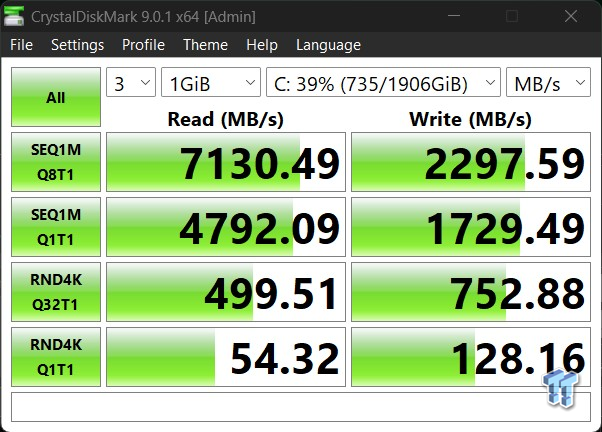
The 2TB Gen4 SSD from SK hynix hits 7.1GB/sec reads (7130MB/sec) and (only) 2.2GB/sec writes (2297MB/sec).
3DMark Speed Way + Steel Nomad

Right out of the gate, the Speed Run of 3DMark shows the immense power of the full RTX 5090 + 285K combo with 14,205 points total... compare this to the former fastest result on the card: the Acer Predator Helios 18 AI gaming laptop with just 6084 points (and the RTX 5090, but in Laptop GPU form).

The same domination is seen in Steel Nomad, with the Predator Orion 7000 absolutely in first with 14,030 points compared to 6048 points from the RTX 5090 Laptop GPU-powered Acer Predator Helios 18 AI gaming laptop.
3DMark TimeSpy Extreme + TimeSpy


And once again, in both TimeSpy Extreme and TimeSpy, the Predator Orion 7000 desktop gaming PC reigns supreme.
Benchmarks (Gaming)
Note: Moving onto the gaming benchmarks, I re-ran the benchmarks on the systems that I had on-hand at the time, running Cyberpunk 2077 twice. First, without RT and DLSS enabled to see the raw performance of the gaming laptop, and then once more with RT + DLSS + GF + RR enabled.
- RT = Ray Tracing
- DLSS = Deep Learning Super Sampling (AI upscaling)
- FG = Frame Generation
- RR = Ray Reconstruction
Cyberpunk 2077


Cyberpunk 2077 at 4K on its High preset with DLSS + RT + FG disabled, so pure native 4K rendering has the Predator Orion 7000 with 137FPS average, compared to just 70FPS from 65-70FPS on the RTX 5090 Laptop GPU.
Cyberpunk 2077 + RT + DLSS


Enabling RT, FG, RR, and DLSS set to Balanced, and the Acer Predator Orion 7000 desktop gaming PC with its 285K + RTX 5090 combo is incredible: 4K @ 185FPS average is an awesome result, double the 83-91FPS on the RTX 5090 Laptop GPU-powered gaming laptops.
Forza Horizon 5


HA! A huge 367FPS average at 4K on the High preset of Forza Horizon 5, close to double the 218-221FPS average on the RTX 5090 Laptop GPUs. If you want to see some raw FPS, at 1080p the RTX 5090-powered Predator Orion 7000 spits out a huge 467FPS average... close to 500FPS.
Shadow of the Tomb Raider


Lastly, in our Shadow of the Tomb Raider testing, the Acer Predator Orion 7000 scores a huge 328FPS average at 4K... over double the 147-148FPS average from the RTX 5090 Laptop GPU.
Performance Thoughts
I used the Acer Predator Orion 7000 desktop gaming PC as my daily driver for months, and I fell in love... all I do outside of work + benchmarking in terms of gaming is play Overwatch. The 285K + RTX 5090 combo was perfect for that and my 4K 144Hz gaming monitor, pushing out 4K at a huge 300-400FPS minimum for the most part, perfection.
If you're buying this type of system and want to really use its power, then that would be on the content creator and workstation side of things. The 24C/24T processor is great, but it leans more towards being a great gaming CPU and a pretty good workstation CPU... that's where AMD Ryzen processors offer more cores and threads (up to 16C/32T versus 24C/24T on the 285K).
However, the CPU has more than enough grunt for virtually anything you throw at it, especially when it's mixed with the 64GB of RAM and 2TB of Gen4 SSD storage. There's also plenty of space to install 3.5-inch HDDs if you want to have huge amounts of additional storage.
Final Thoughts
Acer's flagship Predator Orion 7000 desktop gaming PC is an absolute dominant beast of a system, something you wouldn't regret buying. It has enough power to run games at their max 4K 120FPS+ settings, and if you're into the esports-style of games, then the sky is your limit in terms of performance.
In this new world of super-expensive DRAM that affects the prices of RAM and VRAM on graphics cards, you'll know before you buy a system this expensive if you've got the budget. If you do, you'll have no regrets on the Predator Orion 7000.
It's a no-holds-barred desktop gaming PC experience that'll leave a smile on your face from the very beginning.
The system is presented well from the beginning of the unboxing experience right through to when it's fired up on your desk and glowing beautifully with its RGB lighting. Acer takes care of the aesthetics and performance, squeezing the most out of it with some wicked cooling, an AIO cooler on the power-hungry 285K processor, and enough fans to suck out all of the hot air generated from the uber-powerful RTX 5090 graphics card.
The Acer Predator Orion 7000 will handle 4K @ 240FPS gaming if you're speccing up a new system with a 4K 240Hz OLED gaming monitor, or a monster-huge 4K 120Hz-capable TV. It's great to see Acer building bloody decent high-end desktop gaming PCs, and I can't wait to see what we see this year with the 2026 build... hopefully an introduction to AMD's new Ryzen 7 9850X3D processor.