



Samsung will use its in-house 4nm foundry process to mass produce its next-generation HBM4 memory to directly take on South Korean competitor SK hynix and TSMC in the race for AI memory supremacy.
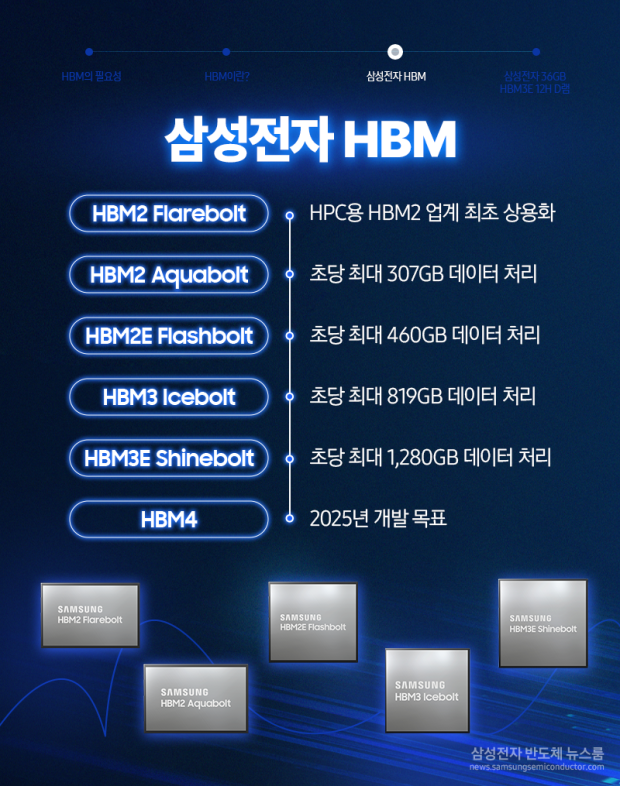
In a new report from the Korea Economic Daily, we're hearing that Samsung will use its 4nm foundry process for the logic die of HBM4 memory chips (sixth-generation HBM) according to industry sources of KED. The logic die itself sits at the base of the stacks of dies and is one of the core components of an HBM chip used on AI chips.
SK hynix, Samsung, and Micron all make HBM, with logic dies used on the latest HBM3E memory, but the new HBM4 memory of the future requires a foundry process that's ready with customized functions required by AI chip makers like NVIDIA, AMD, and Intel, and more.
The new 4nm process node is Samsung's signature chip foundry manufacturing process, with yields of over 70%. Samsung uses the 4nm process for its new Exynos 2400 chipset, which powers Samsung's new fleet of Galaxy S24 family AI smartphones.
KED's industry source explained: "The 4 nm process is much costlier than the 7 nm and 8 nm but is significantly better than them in terms of chip performance and power consumption. Samsung, which manufactures HBM3E with the 10 nm process, aims to take the throne in the HBM sector by applying the 4nm process".
Samsung has been using its 7nm process node since 2019, with the company expected to use 7nm or 8nm foundry processes to produce its HBM4 logic dies, but it seems all signs are pointing to the newer 4nm process node. SK hynix has been dominating the HBM memory business alongside NVIDIA over the last couple of years, diving into a huge partnership with TSMC to produce next-generation HBM4 memory.
There's also the new "triangular alliance" between NVIDIA, TSMC, and SK hynix for the future of AI memory -- specifically HBM4, with SK hynix speeding up development on HBM4 for a release in 2025, and future-gen HBM4E memory coming in 2026.
NVIDIA's next-generation Blackwell B100 and B200 AI GPUs will use the newer HBM3E memory standard, but the company has already revealed its future-gen Rubin R100 AI GPU that will use ultra-fast HBM4 memory, with Rubin R100 AI GPUs to drop in Q4 2025.