














The more frames per second, the more a viewer can see, but what if the frames per second reached the trillions? How slow can slow motion actually be?
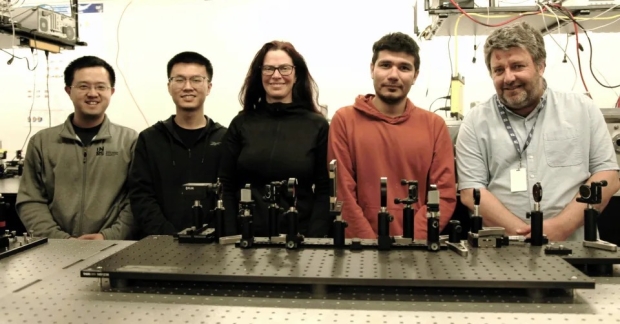
A team of researchers has decided to answer that question by creating a new scientific camera called SCARF, which stands for Swept-Coded Aperture Real-time Femtophotography. The creation of this camera has been detailed in a new study published in the esteemed scientific journal Nature, where research led by Professor Jinyang Liang of Canada's Institut national de la recherche scientifique (INRS), who is known for breakthroughs in high-speed cameras, explained that traditional frame-by-frame capturing techniques has its limitations.
"For example, phenomena such as femtosecond laser ablation, shock-wave interaction with living cells, and optical chaos cannot be studied this way," Liang said.
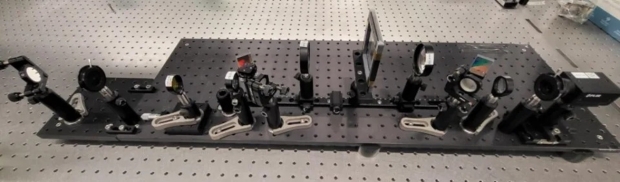
To overcome these challenges, Liang's team built a new camera that uses a computational imaging modality that is designed to capture spatial information. The camera achieves this by letting light enter its sensor at slightly different times, enabling the camera to capture at 156.3 trillion frames per second. The data the camera captures is then injected into a computer algorithm for decoding, which pinpoints each of the time-staggered inputs and then transforms it into complete pictures.
"Its imaging modality enables ultrafast sweeping of a static coded aperture while not shearing the ultrafast phenomenon. This provides full-sequence encoding rates of up to 156.3 THz to individual pixels on a camera with a charge-coupled device (CCD). These results can be obtained in a single shot at tunable frame rates and spatial scales in both reflection and transmission modes," explained INRS communication officer Julie Robert
Notably, the team was able to create SCARF using "off-the-shelf and passive optical components" and described the extremely high-speed camera as low-cost, low power consumption, and high measurement quality.
![Photo of the $25 PlayStation Store Gift Card [Digital Code]](https://m.media-amazon.com/images/I/41cEZpeUA1L._SL160_.jpg)


 Scientists create world's fastest microscope capable of capturing electrons in motion
 Scientits discover how many bits per second the human brain can process
 Scientists squint their eyes concerningly at Earth-sized shadows appearing on Jupiter's surface
 Scientists discover how to turn live mice transparent to see their organs
 AI creates a playable version of the original Doom, generating each frame in real-time
 Iconic N64 shooter GoldenEye 007 is getting a native PC port
 Diablo 4 is coming to the Switch 2 with both expansions in a special Age of Hatred Collection
 CXMT DDR5 memory hits 9,000 MT/s speed milestone on AMD AM5 motherboard
 Sony says PlayStation 6 release date and pricing are still up in the air
 Lexar's DRAM-less Thor Ultra series PCIe Gen 5 SSDs are built for desktop and laptop PC gaming
 Gaming monitors are next in line for a price hike as manufacturers can no longer absorb costs
 Linux 7.2 makes TSC support mandatory for x86 CPUs, but it's not like Windows 11's TPM 2.0 check
 ChatGPT can now build a timeline of everything you do on your Mac
 Redditor finds a working RTX 2080 Super in the dump, gets a huge free upgrade
 Redditor sends a gaming laptop with 64GB RAM for repair, comes back with 32GB RAM
 ASUS ROG Strix XG129C Review: A $199 Gaming Monitor You Don't Play Games On
 Cooler Master HAF II 500 Mid-Tower Chassis Review
 Corsair HS35 v3 Wireless Gaming Headset Review - An Affordable Winner
 D-Link F518 5G Wi‑Fi 6 AX1800 Mobile Hotspot Review: All-Day Mobile Hotspot
 Bose Lifestyle Ultra Speaker Review - Impressively Detailed Room-Filling Sound
 MSI Z890 Gaming Plus WIFI6E Review - Z890 for under $200
 Mortal Kombat (1995) 4K Ultra HD Blu-ray Review
 CPS PCCOOLER YS1200 ATX 3.1 80 PLUS Gold PSU Review
 ASRock X870E Taichi White Review: a premium AM5 motherboard with 10G LAN and WiFi 7
 Asetek Initium Pedal Modular Upgrades Review
 Using Multiple Monitors? Change these Windows settings for a Better Experience
 Windows Sandbox is The Windows Security Feature Most People Never Use
 I ditched the Windows 11 context menu for this open-source tool, and here's why
 Windows 11 may be encrypting your drive already, and I checked where my recovery key went
 GIGABYTE's 40 Days of INFINITY celebrates 40 Years of Innovation with stunning GeForce RTX graphics cards and rewards
 I swapped File Explorer for this free file manager and finally got the layout I wanted
 How to tell if someone has been using your Windows PC without your permission
 6 Task Manager tips for troubleshooting Windows performance problems
 ASUS ROG's 20th Anniversary Line-up of Premium PC Gaming Gear has Arrived - Here's Everything You Need to Know
 Six File Explorer tips every Windows user should know