

Newsletter IconGoogle IconFacebook IconX IconInstagram IconYouTube Icon

NASA telescope spots two objects with masses 120 trillion times the mass of the Sun

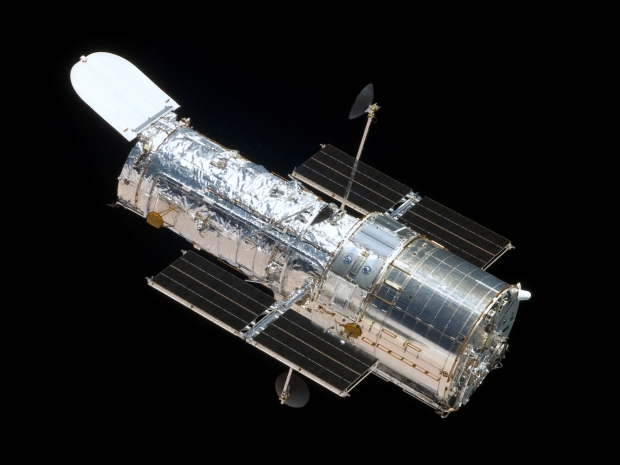
NASA has released a new image snapped by the Hubble that showcases two objects with masses equivalent to around 120 trillion times the mass of the Sun.

NASA telescope spots two objects with masses 120 trillion times the mass of the Sun
Facebook IconX IconReddit Icon
Comments
Tech and Science Editor
Published
Updated
1-minute read time

NASA has taken to its website to reveal a new image snapped by the iconic Hubble Space Telescope. The image is of two objects located in deep space that have masses equivalent to around 30 trillion and 120 trillion times the mass of the Sun.
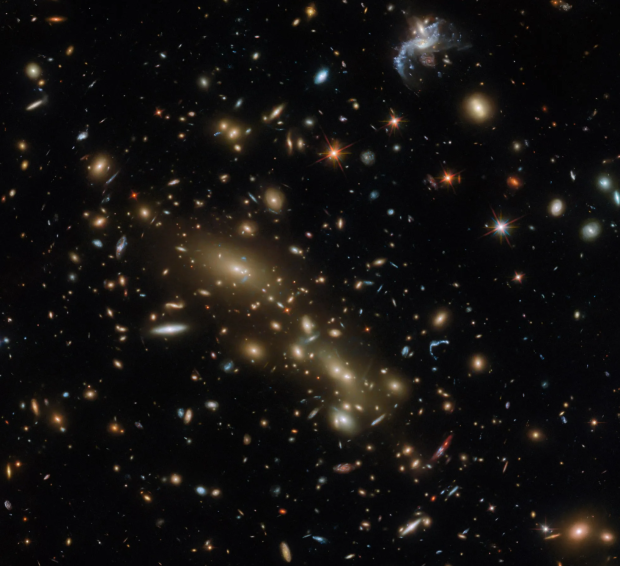
NASA telescope spots two objects with masses 120 trillion times the mass of the Sun 266226

The Hubble Space Telescope has honed its powerful instrument on the galaxy cluster known as Abell 3192, which is located in the constellation Eridanus. Originally, Abell 3192 was documented in 1989 in an update of the catalog of galaxy clusters that was first published in 1958. In that 1989 update, astronomers believed Abell 3192 was a single cluster of galaxies that was located at a specific distance. However, follow-up observations revealed something surprising to astronomers - the galaxy cluster's mass appeared to be in two distinct points and not one.

This discovery led astronomers to update their description of Abell 3192 to include two independent galaxy clusters, one located in the foreground that's located 2.3 billion light-years from Earth, and the other background galaxy located 5.4 billion light years from our planet. NASA writes on its website that researchers estimate that the masses of these galaxy clusters would be anywhere between 30 trillion and 120 trillion times the mass of the Sun.

"All this unseen material - not to mention the many galaxies visible in this image - comprises such a huge amount of mass that the galaxy cluster noticeably curves spacetime around it, making it into a gravitational lens. Smaller galaxies behind the cluster appear distorted into long, warped arcs around the cluster's edges," writes NASA

Photo of the Starfield: Standard Edition - Xbox Series X

Best Deals: Starfield: Standard Edition - Xbox Series X

Prices last scanned 8 hours and 48 minutes ago

* Prices may be inaccurate. As an Amazon Associate, we earn from qualifying purchases. We earn affiliate commissions from Newegg and PCCG sales.

Join Our Newsletter

Join the TweakTown Newsletter for daily tech updates delivered to your inbox.

See previous giveaways.

News Source:science.nasa.gov

Comments

About the author

Tech and Science Editor

Jak joined TweakTown in 2017 and has since reviewed 100s of new tech products and kept us informed daily on the latest science, space, and artificial intelligence news. Jak's love for science, space, and technology, and, more specifically, PC gaming, began at 10 years old. It was the day his dad showed him how to play Age of Empires on an old Compaq PC. Ever since that day, Jak fell in love with games and the progression of the technology industry in all its forms.

Stay Updated

Follow TweakTown for breaking tech news, reviews, and daily updates.

Follow TweakTown on GoogleAdd TweakTown as a preferred source on Google
Newsletter Subscription