












The UK's Competition Appeals Tribunal has denied Sony's request to strike down and eliminate an anti-competitive lawsuit. Now the appeals court wants more information from Sony before the courts decide what to do next.

Sony Interactive Entertainment is being sued in the UK. The $6 billion class-action lawsuit is on the behalf of 8.9 million UK gamers, and alleges that Sony has abused its position to negatively affect consumers.
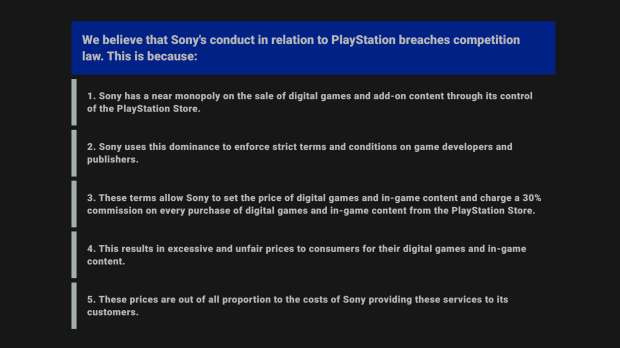
Alex Neill, the lawyer representing consumers in this case, says that Sony has a "near monopoly" on digital game and content sales on PlayStation, and it uses this power to mandate "strict terms" that "allow Sony to set the price of digital games and in-game content" while charging a 30% fee for all games and DLC/microtransaction content sold on the PlayStation Store. Neill alleges that this practice leads to "excessive and unfair" prices for consumers.
Sony instituted a digital policy in 2019 that prohibited the sale of PlayStation games at third-party retailers and storefronts, effectively locking digital PlayStation game purchases to Sony's digital marketplace.
Sony initially wanted this case to be thrown out, but the Competition Appeal Tribunal--the very same institution who oversaw the CMA case against the Microsoft-Activision merger--ruled that the case would continue. Sony didn't adequately rebut the claims and will now have a chance to defend against and reply to the allegations.
"We have concluded that, aside from the question of class definition, which we have dealt with as an eligibility point above, the applications by Sony for strike out/reverse summary judgment should be dismissed, given our conclusion that Sony has failed to establish that the PCR has no reasonable grounds for making the claims/no real prospect of succeeding at trial," the Tribunal wrote in its judgement.
Given the topics that the CAT has outlined, this case may deliver a boon of interesting information.
A preliminary list of the issues which the Tribunal is likely to explore is as follows:
- Market definition
- Systems competition/primary v aftermarket sales
- Two-sidedness
- Exclusive dealing/Tying/Bundling abuse
- Excessive pricing abuse
- Profit share v wholesale supply issues



 PS Store gamers would receive less than $2 in Sony's 'coupon' antitrust settlement
 Sony has been summoned to court over PlayStation Store pricing
 Sony ordered to pay $7.8 million to PlayStation players over PSN Store policies
 Sony v Tencent copyright lawsuit settled, offending Light of Motiram game pulled from stores
 Opinion: PS5 Pro's absent disc drive isn't about choice, it's about profit and future economics
 RAM crisis is getting worse, Valve engineer warns
 Xbox's return to exclusives was decided 'very early on' by CEO Asha Sharma
 Xbox console exclusives can include multiplayer games too
 Assassin's Creed Black Flag Resynced sells over 3 million copies, New Game+ is coming
 Modder plays GTA Vice City and GTA III on a TV inside GTA San Andreas
 Enthusiast puts 11 fans and an AiO on an RTX 3080, gains only 4 FPS
 Spotify removed 75 million AI-generated tracks in 2025 as it cracks down on royalty abuse
 YouTuber claims Sony is using social media bots to push back against backlash over its physical disc announcement
 Apple's first OLED iPad mini could launch as early as October
 Ryzen 7 7700X3D outperforms Ryzen 7 5800X3D with just one stick of DDR5, making AM4 a terrible option for your next build
 SteelSeries Arctis Nova 7 Wireless Gen 2 Headset Review - New and Improved, But Is It Enough?
 AMD Ryzen 7 7700X3D Review - Days of Future Past
 Samsung 990 2TB SSD Review - Ninth Gen QLC at PCIe Gen4 Speeds
 ASUS ExpertBook Ultra (Panther Lake) 14" Business Laptop Review
 ASUS ROG Raikiri II Xbox Wireless Controller Review - Ready to Take Control
 MOZA FMP18 Panel Bundle Review: authentic F/A-18 Hornet cockpit controls for flight sims
 Micron 6600 ION 245.76TB Enterprise SSD Review - Best in Class Programming Speeds
 MOZA MA3F EFCM Flight Control Module Review: authentic Airbus A320 autopilot panel for simulators
 Turtle Beach Stealth Pro II Wireless Gaming Headset Review - Premium Sound, Fantastic Features
 MOZA MGX1000 Instrument Panel Review: a realistic Garmin G1000 replica for immersive flight sims
 I use this decade-old free tool that finds files faster than Windows Search does
 I install and update most of my apps with this Windows command now, and I stopped downloading sketchy installers
 Hisense U6SF 65-inch MiniLED TV: High Performance Meets Leisurely Convenience
 I stopped digging through Windows menus after I set up this one folder
 Don't sell your Windows laptop until you do these things
 6 PC cleaning mistakes to avoid for safer hardware maintenance
 Phison and Intel Take Aim at Local AI's Memory Wall with aiDAPTIV
 How to Remap Keyboard Keys in Windows using Microsoft PowerToys
 7 tips to organize your Windows files for faster, easier access
 Intel Arc G3 Extreme first impressions with MSI's Claw 8 EX AI+ - Incredible power for an extreme price