










NASA's 55-pound CAPSTONE satellite that was recently launched from New Zealand on July 4 experienced a communications issue.
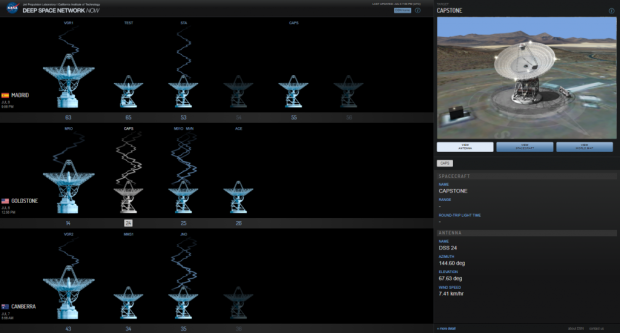
The space agency revealed the news via its blog, where it wrote on July 5 that the spacecraft was unable to communicate with the Deep Space Network while it was on its journey to the moon. The spacecraft is relatively small, but will provide very important data on the moon, which will be used by NASA researchers to inform decisions leading up to humans revisiting the lunar surface.
NASA provided an update on the spacecraft on July 5 and wrote that its health is in good shape and that it's been in partial communication with ground systems. From the partial contact, mission operators were able to determine the speed and position of CAPSTONE, but due to the choppy communication, the spacecraft's first maneuver had to be delayed.
On July 6, NASA took to its blog to announce it had re-established contact with CAPSTONE, and from the data, the space agency has received, the spacecraft still remains in good health, and it has already deployed its solar array to charge its battery in preparation for its coming maneuver.
NASA writes that the agency is planning on conducting the spacecraft's first maneuver on July 7, which will take CAPSTONE into its intended destination of an elongated lunar orbit. CAPSTONE will enter a never-before-flown orbit where the small spacecraft will fly within 1,000 miles of the moon's North Pole, as well as 43,500 miles from the South Pole at its most distant point. CAPSTONE is expected to arrive in its lunar orbit on November 13.
Notably, CAPSTONE also has new technologies that will be tested during its orbit of the moon, and one of those technologies is the Cislunar Autonomous Positioning System, which is spacecraft-to-spacecraft communication and navigation system that, if proven to be effective, will allow for spacecrafts to locate other spacecrafts and rovers without any data from Earth.



 NASA confirms the fate of the two astronauts Boeing left stranded in space
 Boeing's Starliner spacecraft returns to Earth without the crew it took to space
 SpaceX's offer to rescue stranded NASA astronauts early was rejected for 'political reasons'
 Astronauts detect mysterious 'pulsing' sound coming from spacecraft attached to ISS
 SpaceX helps the ISS from tumbling back to Earth with a quick 12 minute boost
 Krafton CEO's ChatGPT legal strategy backfires as Subnautica 2 breaks records
 Elon Musk loses OpenAI trial: statute of limitations prevented a Musk victory
 NVIDIA hand-delivers the first Vera CPU systems to Anthropic, OpenAI, SpaceXAI, and more
 Alienware 15 Laptop is a new, affordable, entry point for portable PC gaming
 LG breaks the 1000Hz barrier at 1080p - here's who should buy it
 ZOTAC celebrates 20 years and is giving away custom GeForce RTX 50 Series GPUs
 Lisuan Technology's LX 7G100 DirectX 12 gaming GPU launches in China
 Nintendo's new Pictonico app gamifies digital photos, coming May 28
 Xbox is undergoing more change in the next few years than in its entire 25-year history
 Steam has finally given Vampire Survivors and similar games its own genre tag
 Montech Ten SFF Chassis Review
 PCCooler CPS RZ620M X CPU Cooler Review
 Memblaze PBlaze 7 7A40 Ocean 61.44TB Enterprise SSD Review - Oceans of QLC at 3.3 million IOPS
 MOZA SGP Sequential Sim Racing Shifter Review
 COLORFUL iGame GeForce RTX 5070 Ultra OC Review - When Style and Performance Meet
 GIGABYTE Z890 AORUS Elite WiFi7 Plus Motherboard Review - Right in the sweet spot
 PNY GeForce RTX 5080 Slim OC Review - A Compact 4K Powerhouse
 HP OmniBook 7 (Panther Lake) 16" Laptop Review
 ASUS ROG Strix X870E-E Gaming WiFi7 NEO - A Crosshair by any other name
 Cooler Master Cosmos Alpha Full-Tower Chassis Review
 Fast Internet on Your Phone but Slow on Your PC? Try These Fixes
 The Snipping Tool quietly became the only screenshot app I keep installed on Windows 11
 How to Set Up a Windows Computer for a Senior User
 Bluetooth Toggle Missing in Windows? Try These Fixes
 GPU Overclocking Basics in Windows 11: Safe Performance Gains Without the Guesswork
 GIGABYTE's new Ultimate OLED Gaming Monitor Bundle includes Xbox Game Pass
 I automated 5 annoying Windows maintenance tasks, and my PC basically runs itself
 How to Fix Windows 11 Black Screen on Boot or After Login
 The first 8 settings I disable on every fresh Windows 11 install in 2026
 Is Your Ethernet Performance Slower Than Wi-Fi? Here's How to Fix It