










A recently discovered comet is expected to make a close fly-by of Earth within the coming weeks, and it may even be visible to the unaided eye.
Comet Leonard, or C/2021, will be making its closest approach to Earth on December 12, bringing it 22 million miles away from our planet, which is about 90 times farther away than the Moon. NASA says in the above video that comets are notoriously difficult to predict in terms of brightness/visibility, but Comet Leonard is predicted to be bright enough to be able to view it with binoculars. However, the possibility of it being visible to the unaided eye is still on the table as well.
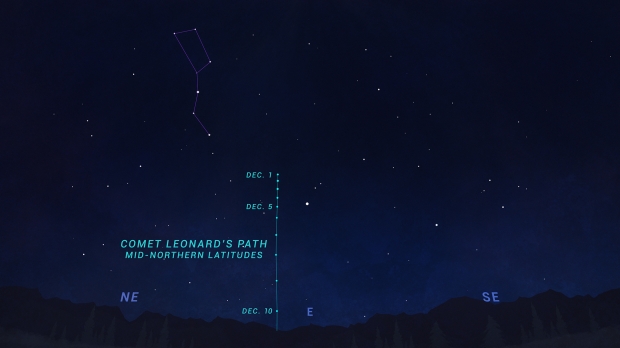
EarthSky reports that Comet Leonard is "likely to be 2021's best comet, and its brightest comet by year's end". For the first two weeks of December, Leonard is visible in the sky in the east before sunrise, and according to NASA, it can be seen passing between the Big Dipper's handle and Arcturus. The space agency also states that the time of Leonard's closest approach to Earth will coincide with its approach to the horizon in the sky, which means that it will likely be brighter but more difficult to observe.
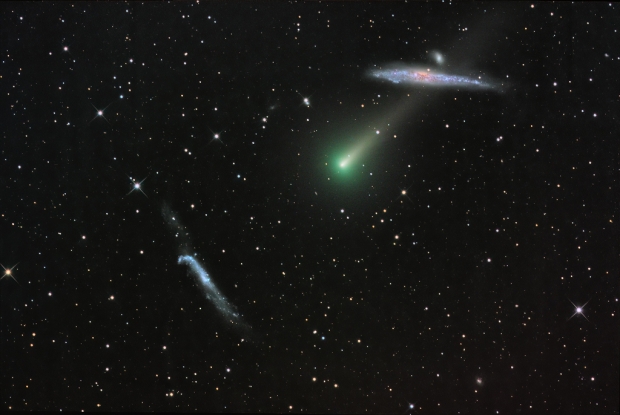
Astronomers Gregory Leonard discovered C/2021 on January 3, 2021, and according to Leonard, the last time the comet visited our solar system was likely 75,000 to 80,000 years ago. After it passes Earth and our Sun at the stunning speed of 158,084 miles per hour, it will be ejected from our solar system for millions of years, making this possible observation of Leonard a truly a once-in-a-lifetime event.
"So it's already had one passage, but of course nobody was really around to record that event. And now it appears this comet is on what we call hyperbolic orbit so once it passes the Sun, it will be ejected from the Solar System and is going to be flown out for millions of years until likely stumbling into another star system," says astronomer Gregory Leonard who discovered C/2021 told Inverse.
For more information on this coming comet sighting, check out this link here.


 NASA releases images of peanut-shaped object making close approach to Earth
 NASA discovers asteroid that's now the most significant threat to Earth
 Light No Fire, the new fantasy RPG sim from No Man's Sky dev, may still be in pre-production
 Sorry, Dire Wolf fans - It's still extinct despite what you have heard
 Opinion: Game Pass tier with first-party games won't fix the subscription's biggest problem
 HDMI 2.2 products are coming in 2027 as chip makers begin sampling FRL2 silicon this year
 Solo dev tries to make his own GTA 6 with AI, as he got tired of waiting for Rockstar
 A HandBrake update just gave Threadripper owners up to a 215% performance boost for free
 Repair channel buys ASUS RTX 4090 for $222 and finds plastic die with fake NVIDIA markings
 Epic's gen AI use deters partners, Vampire Survivors x Fortnite might get cancelled
 Sony seems to confirm singleplayer first-party PlayStation games will remain console exclusive
 NVIDIA GeForce GTX 1650 modded with 8GB of GDDR6 memory doubles performance in God of War and Unigine Superposition
 Apple will be working with Intel to design and build its chips in the USA, confirms President Donald Trump
 GTA 6 pre-order date revealed by Rockstar
 Anthropic's CEO confirms he can be fired as CEO through the company's own authority
 Speed Racer (2008) 4K Ultra HD Blu-ray Review: a stunning remaster of the cult classic
 MOAIPLAY ORA PRO G1 850W ATX 3.1 PSU Review: high efficiency and 10-year warranty for $119.99
 Navman MiVue Smart True 4K Surround Dashcam Review - Seeing In All Directions At Once
 IQUNIX Magi96 Pro Aluminum Low Profile Mechanical Keyboard Review - Premium Build, Satisfying Sound
 Asetek Forte S-Series Racing Simulator Bundle Review
 Razer Pro Type Ergo Wireless Split Ergonomic Keyboard Review - Built for Comfort and Support
 ASUS ROG Strix Morph 96 Wireless Gaming Keyboard Review - Great Performance, More Affordable
 SAPPHIRE Radeon RX 9070 GRE PULSE OC Review - A New 1440p Challenger Has Arrived
 NZXT H6 RGB+ Compact Dual-Chamber Chassis Review
 ASRock Radeon RX 9070 GRE Steel Legend Review - The RDNA 4 Mid-Range Reshuffle
 7 ways to transfer data from Android to Windows PC quickly and easily
 I read the Windows Backup app screen carefully, and it does not back up what most people think
 Low Sound Volume on Windows 11? How to fix audio issues and restore normal volume
 8 Critical Warning Signs You Should Never Ignore in Windows 11
 This Windows security feature protects Documents from ransomware, but it is off by default
 Windows 11 already has a voice typing tool, and it is the one most people are not using
 Quick Assist is the only remote-support tool I open when a relative calls about their PC
 The PowerToys utilities I keep enabled on every Windows 11 PC, and the ones I turned off within a week
 TweakTown's Best of Computex 2026 Awards - The Best Hardware, Gaming Gear, and AI
 Phison E37T SSD Controller Exclusive Preview - The Fastest DRAMless SSD Platform Yet