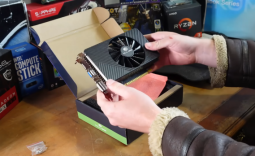


Modders have figured out how to double the memory capacity of NVIDIA's six-year-old entry-level GTX 1650 from 4GB to 8GB. YouTube channel Paulo Gomes published a video showing off their work modding the entry-level Turing GPU with 8GB of GDDR6, and showed off impressive performance results from the card due to the extra memory capacity. For instance, in Unigine Superposition, the GTX 1650's benchmarking score doubled from 624 points to 1245 points moving from 4GB to 8GB of VRAM.
Upgrading the memory on the GTX 1650 was straightforward and required no extra firmware modifications. The modders swapped out the GTX 1650's existing 1GB GDDR6 modules with 2GB Samsung HC16 GDDR6 modules by desoldering the old modules and soldering the new modules on the PCB. Their first attempt at booting the card failed as a result of installing two faulty HC16 modules, but after swapping out the faulty modules with working counterparts, their second attempt was successful.
One major caveat the modding team noted was that their 8GB mod requires a very specific variant of the GTX 1650 to work - the TU106 version of the GTX 1650 with GDDR6 memory. For the uninitiated, NVIDIA has four different variants of the GTX 1650 (not even counting the GTX 1650 Super), featuring TU117, TU116, and TU106 dies paired to either GDDR5 or GDDR6 memory. The TU106 version was one of the later trim models NVIDIA launched to use up defective TU106 silicon. TU106 was one of NVIDIA's most popular Turing dies and was used to make nearly all of NVIDIA's mid-range RTX 20 series GPUs, such as the RTX 2060, RTX 2060 Super, and RTX 2070. The modders did not fully explain why only the TU106 version is compatible, but likely memory controller and/or firmware limitations are the culprit on other variants of the GTX 1650.
As previously mentioned, the GTX 1650's performance improved drastically with the extra memory capacity. In Superposition, the modders tested the card in the benchmark's 8K optimized mode, which is the most demanding preset in the benchmark, resolution-wise. The modders also saw performance double in God of War with certain graphical settings at 2560x1080. At the game's "original" settings, performance stayed at around 40 FPS with both 4GB and 8GB memory configurations, but frame times were better on the 8GB configuration. At ultra settings, the GTX 1650 performed significantly better with 8GB of memory, jumping from 10 FPS to 20 FPS with the extra 4GB.
The results show that the GTX 1650 is capable of taking advantage of 8GB of VRAM, making this mod a potentially viable solution for increasing the GPU's lifespan in games that require more than 4GB of VRAM. The only issue the modders had upgrading the GTX 1650 to 8GB was some stuttering when the GPU was idling.
The GTX 1650 came out 7 years ago, and was an underwhelming GPU at its launch thanks to strong competition from AMD's RX 570 and even NVIDIA's own GTX 1660. Despite this, in 2026, the GTX 1650 is still one of the most popular GPUs in the world and holds 6th place currently in the Steam hardware survey.