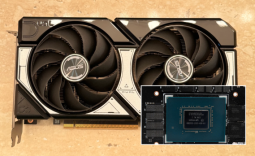
MSI is now manufacturing some of its RTX 5060s with NVIDIA's GB205 die with the introduction of its new RTX 5060 "V1" graphics cards. Spotted by Uniko's Hardware on X, the new cards feature a different mounting hole layout compared to MSI's existing RTX 5060 lineup that matches RTX 5070 graphics cards. This subtle difference confirms that the new MSI RTX 5060 graphics cards use NVIDIA's larger GB205 die found in the RTX 5070.
The initial version of the RTX 5060 arrived with the GB206 die, which comes with 4,608 CUDA cores in total and powers both the 5060 and 5060 Ti. The GB206 die is physically different from GB205 in that it is designed with a square die and mounting holes matching its shape. The GB205 die is a more powerful Blackwell die responsible for powering the RTX 5070 but comes in a rectangular shape with mounting holes that reflect its shape, and a total of 6,400 CUDA cores.
There is no performance difference between the RTX 5060 versions; NVIDIA disables cores on each version to reach the GPU's designated 3,840 CUDA core count. On the GB205 version of the RTX 5060, the memory bus is also partially disabled to meet the GPU's 128-bit spec. NVIDIA and its partners commonly use multiple die variants for a single GPU model to save money by recycling defective dies that are still good enough for powering lower-end SKUs. For instance, a defective GB205 die with 2,560 defective CUDA cores is still good enough to ship in an RTX 5060.
The die change is the biggest difference between MSI's original and new V1 RTX 5060 graphics cards. The only other changes include subtle differences in power consumption and clock speed for some of the V1 models. For instance, the RTX 5060 V1 Gaming and RTX 5060 Gaming have a 38MHz difference in boost frequencies and a 5W difference in TDP. All the V1 cards, however, do weigh several grams more than their "V0" counterparts.

Frequently Asked Questions
Open a question for an answer from TweakTown's coverage of this news, or ask your own below.
Which specific MSI RTX 5060 models are being sold with the GB205 "V1" die?
How can I visually identify an MSI RTX 5060 V1 card compared to the original V0 model?
Are there differences in power draw, boost clock, or weight between MSI's RTX 5060 V1 and V0 cards?
Why did MSI change the model name to include "V1" for these RTX 5060 cards when most AIBs keep the same model name?
Have a question about this content not listed here? Ask below and TweakBot will answer it.

MSI's new cards are a rare case of an AIB partner creating a new graphics card model with a blatantly different model name to indicate the card has a different die inside. Normally, AIB partner cards are more subtle and keep the model name the same as an existing card, even if they introduce a technically new model with a different die.