










AMD has semi-confirmed the existence of low-power, low-performance "LP" cores in Zen 6, through a new Linux kernel patch. AMD engineer Vishal Badole recently submitted a patch series that extends the Linux x86 topology code to recognize a "Low Power" core class, separate from the Performance and Efficiency types Linux already tracks.
The core type appears in CPUID (Fn0x80000026, EBX bits 31:28), where a value of 2 flags a core designed for minimal power draw during background and idle work. Boost scaling for these cores would follow the same method AMD already uses for its Efficiency cores.
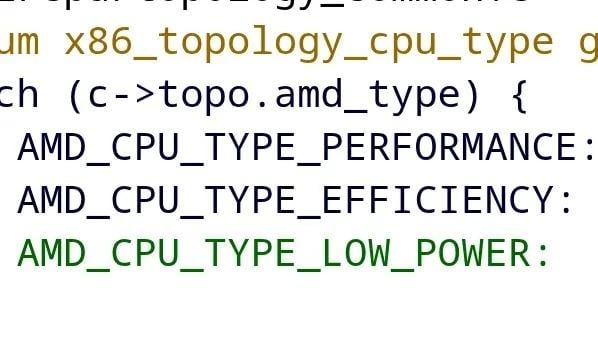
The patch itself never mentions Zen 6, Medusa, or a specific chip. It's plumbing work, the kind AMD tends to push into the kernel well before hardware ships. However, it lines up almost exactly with what leakers have been saying about the PS6 Portable's "Canis" APU for months. There are rumors about 4 Zen 6c cores paired with 2 Zen 6 LP cores, with the LP pair reportedly handling the PlayStation OS, so the rest of the chip can dedicate more headroom to games.

The PS6 Portable itself is still shaping up mostly through leaker reports rather than anything official from Sony. Earlier leaks put the handheld's "Canis" APU on a 3nm process with around 24GB of LPDDR5X memory, aimed at running PS6 games natively rather than on a separate, scaled-down library. If the LP cores really are earmarked for OS duties, that would track with what handheld makers have been chasing for a while now: more battery life without gutting game performance.

Sony's rumored home console APU, "Orion," has also popped up in leaks with a similar 2x LP core allocation alongside a larger Zen 6c cluster. On the mobile side, AMD's upcoming Medusa Point laptop chips are said to include 2 Zen 6 LP cores with a modest 512KB of L2 and 2MB of L3, which would make this a three-tier setup spanning full Zen 6, Zen 6c, and now Zen 6 LP.
The Intel comparison is hard to avoid here. Intel already ships low-power background cores on Meteor Lake and Lunar Lake for the same reason, keeping idle and light tasks off the main core cluster to save battery. AMD's version reportedly keeps the same x86 instruction set across all three core types, unlike Intel's mix of P-core, E-core, and LP E-core designs, which could make scheduling a little less messy for Windows and Linux alike.
Frequently Asked Questions
Have a question not listed here? Ask below and TweakBot will answer it instantly.


None of this is confirmed by AMD outside the kernel code, so treat the PS6 Portable pairing as still unofficial. If it holds up, it would mark AMD's first real move into a three-tier core hierarchy, something that could eventually trickle down to Medusa Point laptop chips and beyond as AMD chases better battery life on thin-and-light hardware.



 AMD's new CPPC 'Highest Frequency' feature could improve CPU scheduling and boost behavior in Windows 11
 AMD's confirms Zen 6 on TSMC 2nm, officially confirms future-gen Zen 7 on an even newer node
 AMD confirms next-gen Zen 6 'Medusa' CPUs for 2027: up to 32C/64T CPU, RDNA 5 GPU, on TSMC 2nm
 AMD's semi-custom Orion APU specs full leak: PS6 will be ready for next-gen gaming in 2027
 AMD is aiming for an insane 7.0GHz or more clock speed with its next-gen Zen 6-based Ryzen CPUs
 Microsoft finally improves File Explorer launch speed in Windows 11
 Xbox to convert discs to digital games for Project Helix, new reports indicate
 PlayStation 6 soft confirmed to launch without physical disc drive
 Xbox Helix won't have a disc drive as Sony officially gives death date for physical games
 Anthropic brings Fable 5 back, but customers get fewer free days than originally offered
 GTA 6 will take over a day to download for millions of gamers
 PS Vita, PS3 stores go offline starting August 2026
 PlayStation ending physical game discs in 2028, Sony officially confirms
 GTA 6 for Switch 2 is reportedly coming, with Rockstar working with Nintendo on the port
 Xbox says it's not reducing its 'overall investment in games' as rumors of studio closures continue
 Next Level Racing ERS3 Haptic Seat Review: immersive sim racing comfort with integrated haptics
 ASUS TUF Gaming X870-Pro WiFi7 W NEO Review - Tuffed up
 GIGABYTE GO27Q24G Gaming Monitor Review: Glossy OLED Gaming at 240Hz
 Lian Li B4-mATX Review: a compact mATX SFF case with excellent airflow and premium features
 MSI MPG 322UR QD-OLED X24 Review: A Brighter, Tougher 4K 240Hz QD-OLED for $1099
 UGREEN NASync DXP4800 GT Review: powerful 4-bay NAS with AMD Ryzen and dual 10GbE ports
 Dell XPS 14 (2026) Laptop Review - Premium Quality, Impressive Performance
 Ocypus Sigma F36 BK ARGB Cooling Fan Review: high airflow and unified design in one frame
 PCCooler CPS RZ820 Display Review: a flagship-level CPU air cooler with an LCD screen
 UGREEN FineTrack Mini 2 Air Tracker Tag Review - Long battery life, lesser performance
 Intel Arc G3 Extreme first impressions with MSI's Claw 8 EX AI+ - Incredible power for an extreme price
 How to fix Wi-Fi Adapter Not Working on Windows laptops: troubleshooting tips
 Hisense U7SG 4K TV: Modern Entertainment for the New Age
 6 underrated Microsoft Word features worth using to boost your productivity
 Level Up Your PC Gaming with these Fantastic ASUS Prime Day Deals on GPUs, Motherboards, and More
 GIGABYTE Wants to Kickstart Your New Gaming PC or Upgrade with These Limited-Time Deals
 7 Windows settings to change right after installation for better privacy, security, and performance
 I stopped Windows 11 notifications from interrupting me with Do Not Disturb, Focus, and a priority list
 7 ways to transfer data from Android to Windows PC quickly and easily
 I read the Windows Backup app screen carefully, and it does not back up what most people think