












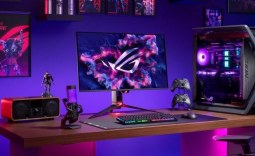
It looks like OLED monitors are flying off shelves at a pace that would have seemed unthinkable just a couple of years ago. According to the latest research from global market intelligence firm TrendForce, global OLED monitor shipments soared 78% year over year in Q1 2026. That said, shipments dipped 11% on a quarter-over-quarter basis compared to Q4 2025.
That drop is largely seasonal, and part of it is down to the aggressive promotional campaigns at the end of last year that pulled forward a chunk of demand. For context, full-year 2025 OLED monitor shipments already posted a 92% year-over-year increase, with roughly 2.7 million units shipped globally.
So what is actually fueling this kind of growth? A few things have clicked into place at the same time. Burn-in concerns that kept many gamers on the sidelines have largely faded after real-world durability tests have proven modern OLED panels can take a beating. Prices have also come down significantly, and the 27-inch QHD format running at 240Hz is now the sweet spot that checks all the boxes for gaming performance and value.

A huge part of the supply-side story is QD-OLED. Quantum Dot OLED panels layer a quantum dot film over an organic LED base to significantly boost brightness and color volume compared to standard WOLED panels. TrendForce identifies the increasingly abundant supply of QD-OLED panels as the key catalyst for Q1 2026 growth, as it has enabled newer market entrants to ramp up volumes and fill gaps that previously did not exist.
On the brand side, ASUS held the top position in Q1 2026 with a 24% market share. Its strength comes from a wide and well-differentiated product lineup, including a new 34-inch gaming monitor running at 360Hz and a 16-inch portable OLED launched in the first quarter. Samsung followed in second with 16.4%, backed by its own in-house QD-OLED panel supply and exclusive models like the 27-inch QHD 180Hz Odyssey.

The third and fourth positions saw aggressive competition. MSI barely beat out AOC/Philips by just a fraction of a percent, landing at 12.2% versus 12.1%. MSI got there by expanding across commercial and gaming segments simultaneously, while AOC/Philips went hard on aggressively priced 27-inch QHD models to drive volume. LG rounded out the top five at 9.1%, with ultra-wide formats making up around 40% of its OLED shipments in the quarter.
Looking ahead, TrendForce had already projected another 51% jump in total OLED monitor shipments for 2026 before this Q1 data came in, and these numbers suggest that trajectory is well on track. Safe to say, if you are still gaming on an aging TN or VA panel, this is the time to make the jump to OLED.


 ASUS claims the #1 position in OLED monitor market share with 21.9%
 OLED monitor shipments have grown by a massive 181% this year
 OLED monitor shipments are up 86%, and it's all thanks to PC gaming
 OLED monitor shipments have doubled in a year, with ASUS as the global leader
 TCL plans to reduce the cost of OLED displays dramatically, with inkjet printing
 Giveaway: 12 Winners Will Score MONTECH NX400 and NX600 CPU Coolers
 GTA 6 leaks have reportedly led to a morale drop at Rockstar, with Netflix frustrated as well
 The Blood of Dawnwalker won't hit 60 FPS on any console, PS5 Pro tops out at 40 FPS
 AMD claws back ground against Intel in the CPU market, climbs to 35% share in desktop CPUs
 Redditor receives not one but TWO empty boxes of Ryzen 5 9600X from Amazon
 Xbox Series X25 Limited Edition Console is priced at $900, arrives November 2026
 Dave Bautista officially cast as Kratos in Amazon's 'God of War' TV Series, replaces Ryan Hurst
 Take-Two begins the hunt for GTA 6 leaker CyberLeek, subpoenas Microsoft and Discord
 PlayStation 6 handheld not expected to stay under $600, warns leaker
 AMD confirms the Radeon RX 9050 4GB will have a tiny 64-bit bus and just 16MB Infinity Cache
 Intel 'Nova-Lake-S' 28-core CPU with bLLC reportedly draws 296W at PL2
 Cooler Master MasterFan A120 Fan Review
 GIGABYTE MO27Q2A Gaming Monitor Review: 1440p, 280Hz, and QD-OLED is a winning combination
 Cooler Master V8 ACE 3DHP BLACK CPU Cooler Review
 ASUS ROG Strix XG129C Review: A $199 Gaming Monitor You Don't Play Games On
 Cooler Master HAF II 500 Mid-Tower Chassis Review
 Corsair HS35 v3 Wireless Gaming Headset Review - An Affordable Winner
 D-Link F518 5G Wi‑Fi 6 AX1800 Mobile Hotspot Review: All-Day Mobile Hotspot
 Bose Lifestyle Ultra Speaker Review - Impressively Detailed Room-Filling Sound
 MSI Z890 Gaming Plus WIFI6E Review - Z890 for under $200
 Mortal Kombat (1995) 4K Ultra HD Blu-ray Review
 Using Multiple Monitors? Change these Windows settings for a Better Experience
 Windows Sandbox is The Windows Security Feature Most People Never Use
 I ditched the Windows 11 context menu for this open-source tool, and here's why
 Windows 11 may be encrypting your drive already, and I checked where my recovery key went
 GIGABYTE's 40 Days of INFINITY celebrates 40 Years of Innovation with stunning GeForce RTX graphics cards and rewards
 I swapped File Explorer for this free file manager and finally got the layout I wanted
 How to tell if someone has been using your Windows PC without your permission
 6 Task Manager tips for troubleshooting Windows performance problems
 ASUS ROG's 20th Anniversary Line-up of Premium PC Gaming Gear has Arrived - Here's Everything You Need to Know
 Six File Explorer tips every Windows user should know