Intel's Arc desktop graphics cards have secured 1% of the discrete GPU market according to the latest statistics from an analytics firm.
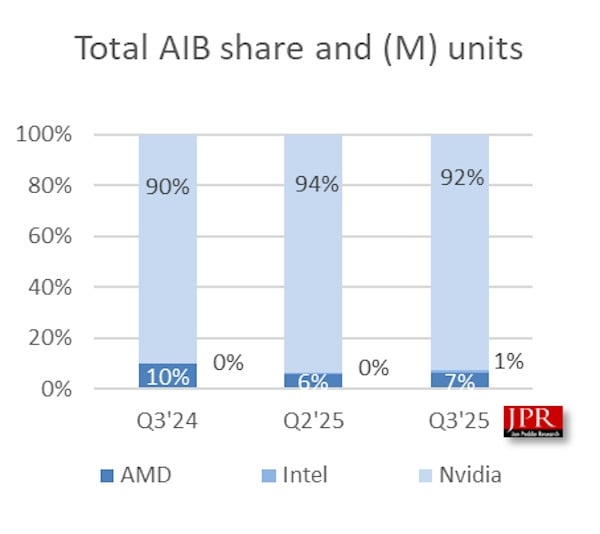
As Tech PowerUp reports (via VideoCardz) this is Jon Peddie Research (JPR) which keeps close tabs on GPU shipments - for the global discrete market (and I'll come back to that in a moment) - and while 1% might not sound like much of an achievement, it's a milestone of a move of the needle away from zero.
Previously, Intel has had a sub-1% market share according to JPR's statistics, and hovered around the half-a-percent mark, but with a 0.4% boost in Q3 2025, Arc discrete graphics cards now account for a full 1%.
That share was seemingly taken from NVIDIA, which dropped to 92% (shedding 1.2%) in this most recent quarter, but obviously Team Green remains massively dominant. AMD rose by 0.8% to reach 7%.
Now, what's important to note on these stats is that it's the overall discrete market, meaning not just gaming GPUs, but also workstation and data center boards (the latter were up 145% on the previous quarter, JPR tells us).
There are a lot of data center GPUs, and NVIDIA has a massive lead there, so that skews these figures somewhat. Remember, too, that Intel isn't much of a player with data center GPUs, so the gains here likely reflect more consumer graphics card shipments than anything else.
A rocky future - but hope for Intel?
JPR observes that the overall shipments for discrete GPUs hit 12.02 million units in the third quarter, which was a rise of 2.8% compared to the previous quarter, and a surge of 47.5% year-on-year.
The predicted future isn't so rosy, though, with JPR estimating that graphics card manufacturers will have a compound annual growth rate of -0.7% from 2024 to 2029.
There are a lot of unknowns with the GPU market right now, as JPR makes clear, not the least of which is the threat of tariffs in the global picture, along with potential inflationary pressures (or recessions).
On top of that, there have been a fair few rumors of late about GPU price increases which are in the pipeline for the near future, thanks to the situation around memory supply levels and scarcity of VRAM. The increased cost of video memory is surely going to impact prices, pushing them up - particularly for graphics cards with lots of VRAM.
Some consumer models will be disproportionately affected, namely more affordable 16GB gaming graphics cards, and there's even been talk that manufacturers might discontinue some of those particular models - all of that remains very airy speculation, though.
Intel may have a chance to capitalize here if AMD and NVIDIA do thin their respective wallet-friendly line-ups, leaving the Arc B580, its most popular graphics card - and a great 1080p offering - even more opportunity to snaffle market share away from rivals.
In short, we may see Team Blue rise in JPR's discrete GPU rankings even further, as long as Intel isn't too badly affected by VRAM supply issues itself (and with more modest needs than both AMD and NVIDIA, hopefully it won't be).